
With the sky on the roof
Classics of Russian literature admired the North Caucasus for its picturesque nature and the fiery temper of the local highlanders, but they hardly mentioned the man-made monuments of this region — and no wonder, because there was nothing much to tell. Suffice it to recall at least "A Hero of Our Time" from the school curriculum to understand what is meant.
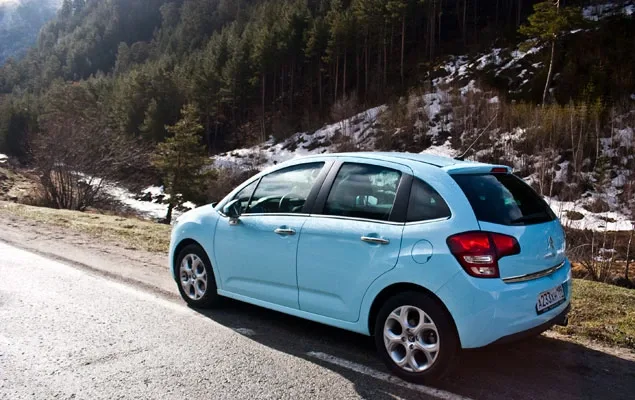
Since then, the situation with the material heritage in the North Caucasian republics has not changed much. At least in Kabardino-Balkaria, where we arrived to get acquainted with the new Citroen C3, only the mountain peaks please the eye. But the traces of human activity — shabby high-rises and garbage generously scattered along all more or less significant roads — only hinder enjoying the views.
that Citroen designers are capable of
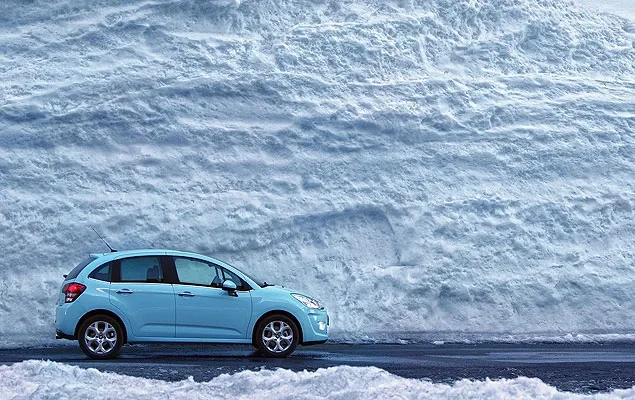
Even more unexpected and pleasant was the encounter with the French supermini in the parking lot near the airport on the outskirts of the republic's capital: a line of C3 subcompacts lined up before the press vividly demonstrated all the talents of Citroen designers, and even the dull post-Soviet landscape of Nalchik seemed fresher thanks to this abundance.
Connection of generations
At the press conference, we were shown an animated video where the first generation Citroen C3 transformed into the second, stretching horizontally. But such animation is deceptive: it presents the new model as a direct heir to the radical look of the first "bun-three" with its circular roofline that teased neighbors in traffic.
Unification
The second generation Citroen C3, like the first, is based on a platform shared with its PSA alliance "colleague" — Peugeot 207. The C3 Picasso compact MPV is also built on the same "cart". At the same time, the new "C-three" has become 118 millimeters longer than its predecessor (its length is 3941 millimeters), and the wheelbase has increased by only 15 millimeters (2466 millimeters). |
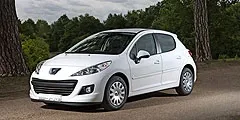
The "C-three" presented in Nalchik no longer shocks the public but pleases with a fashionable soap-bar body with an abundance of aggressive stamping. Moreover, while working on this model, Citroen clearly looked at Ford's kinetic design, especially the new Fiesta (note the trapezoidal faux radiator grille on the C3).
However, there is no talk of borrowing — Citroen has too rich a history of creating distinctive cars, and these genes cannot be hidden. For example, in profile, thanks to the sloping roof and rounded rear pillar, the new model resembles the five-door hatchback Citroen C4, and from the front, the sculpted hood and optics from some angles vaguely resemble the duck nose of the legendary "De-Esse".
In addition, the French came up with their own design trick for the "C-three" — a huge windshield with the proprietary name Zenith. It, like a bald spot, extends onto the roof almost to the middle pillars, visually turning the cabin of the subcompact almost into an airplane cockpit. It's a pity that this is an option available only for the top Exclusive trim. The car we got for the test with intermediate Tendance equipment and a regular windshield looked dull against the C3 with the "Zenith".
Don't look for a woman
If the exterior of the new C3 features quotes from other people's works, then the supermini's interior is French to the last stitch on the driver's seat upholstery: beautiful and witty. Moreover, already at first acquaintance — from outside, through the open front door — you notice the high quality of finishing materials, which owners of B-class cars are rarely spoiled with. There is a lot of soft plastic here (it is even in the trim of the front doors), and the part of the front panel turned to the passenger and the top of the center console are covered with a solid "metal-look" overlay.
Interior
|
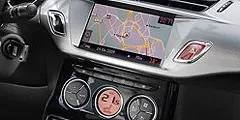
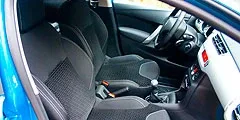
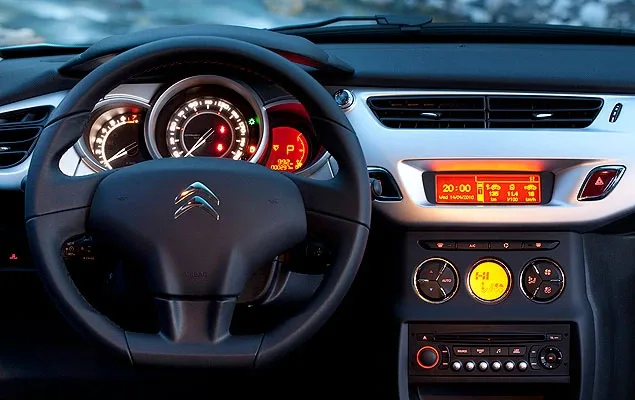
Once in the driver's seat, you want to place accents in the interior differently. Here, attention is drawn to the "instrument cluster", on which the dials of the speedometer and tachometer with lilac translucent needles are beautifully laid out, as well as a round LCD display for odometer data and fuel level. After examining the instruments, you notice the wide range of steering column adjustments and a large amount of legroom in the driver's seat, thanks to which even a tall man can easily fit behind the wheel.
But you don't notice the "Zenith" right away. Apparently, the point is that a person rarely looks up in everyday life – they have enough to do in the horizontal plane. But once you see that the windshield ends above the top of your head, you involuntarily start regularly glancing at the sky. By the way, there is no need to fear that in the heat under the "Zenith" you will have to languish from the scorching sun. For this case, the C3 provides a false roof that lowers almost to the interior mirror, to which sun visors are attached.
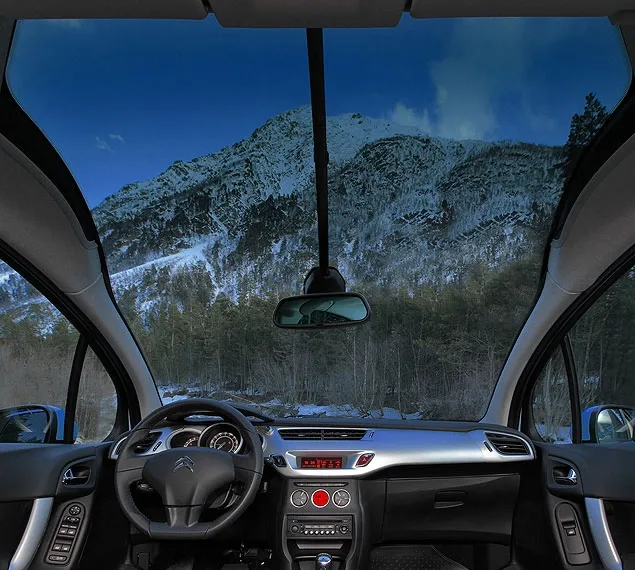
These visors have no mirrors – apparently, with them, the design would become too expensive and bulky. However, thanks to this feature, as well as the fact that even a large man can comfortably sit behind the wheel, the C3 no longer carries the label of an exclusively women's subcompact. Moreover, the "C-third" steers eagerly, which should appeal to "racers", among whom there are usually more men than women.
Brother of an acrobat
The mountains of the North Caucasus resemble the Alps, but although they are formally located on the geographical border separating the Western world from the East, this region is far from Europe. Especially considering the condition of the Caucasian serpentines. And the values that local motorists preach on the roads are directly opposite to the bourgeois way of life of modern Europe.
For example, buckling up here is considered a sign of cowardice and simply bad manners, and before blind turns, drivers use the entire width of the road, regardless of solid markings: because only this way can a hairpin be taken at the limit of the tires' grip capabilities.
The Citroen C3 is brought up on other values – two front airbags and ABS are included in the standard equipment already in the base version, and at the next equipment level, there are already six airbags. Therefore, sitting behind the wheel of the "Frenchman" and watching the selfless driving of Caucasian drivers, you involuntarily accuse yourself of cowardice.
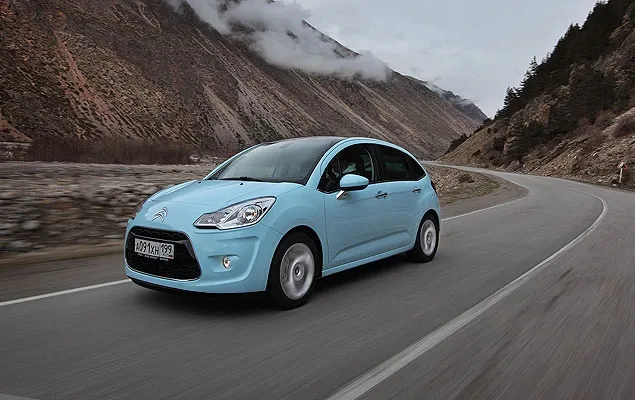
Having learned to drive around cows grazing on the roadway and brake sharply before deep potholes, the C3 can be let off the leash and allowed to frolic on a winding mountain road. Especially since there are plenty of sections here where even the 90 kilometers per hour allowed by traffic rules on suburban highways is more than enough, and the "C-three" itself is simply made for serpentines that twist like intestines.
The chassis settings and adaptive power steering of the Citroen C3 are clearly borrowed from its older sibling — the platform here is from the Peugeot 207, and that one, as is known, received many compliments from journalists for its handling. The new "C-three" fully deserves similar praise: it holds confidently in corners, body roll is minimal, and it responds to steering commands instantly and without delay.
True, the steering wheel itself turns so easily that on straight sections it seems slightly "empty." But on winding roads, for example on the serpentine along which we climbed into the Baksan Valley, the steering wheel of this French hatchback provides, if not ideal, then very clear feedback and allows you to accurately maintain the trajectory.
As is known, for minimal body roll and the absence of pitching, one often has to pay with ride smoothness. This is especially true for compact budget models. But at first it seems that the C3 rides over "speed bumps" and broken asphalt noticeably softer than the same 207. However, after a longer trip over broken mountain roads of Kabardino-Balkaria, understanding comes: it's not that the suspension has become more comfortable. It's just that the "C-three" turned out to be... very quiet. Therefore, the impacts that the dampers still transmit to the body are perceived in the "Citroen" not as sharply as in the "Peugeot."
The automatic — a C grade
The new sound insulation also dampens sounds from under the hood quite well, but only while driving calmly. If you press the gas pedal to the floor, a strained howl of the revved engine breaks into the cabin. Those who like to drive fast will have to come to terms with this: both engines we tested in the Elbrus region, with 16 valves and variable valve timing — the 1.4-liter with 95 horsepower and the 1.6-liter with 120 — begin to truly pull only near the red zone of the tachometer.
By the way, the car with the 95-horsepower unit paired with a five-speed manual seemed to us more spirited than the 120-horsepower version with the ancient four-speed automatic. According to official data, the younger engine even wins 0.3 seconds over the older one: acceleration to 100 km/h takes 10.6 seconds. In real conditions, the advantage of the manual is even more noticeable — the automatic transmission not only eats up part of the torque during acceleration but also often gets confused between second and third gears in the stop-and-go city rhythm.
As a result, during active driving you realize that even the 120-horsepower engine of the "C-three" is not enough. A manual gearbox could save the situation: with it, the 1.6-liter engine would accelerate the hatchback to 100 km/h in almost "sporty" 8.9 seconds, and the price would be lower.
But "Citroen" allows you to purchase a car with the 120-horsepower engine exclusively paired with an automatic. The same story with the 95-horsepower unit: it is offered only with a five-speed manual, although in terms of its characteristics it could well handle calm driving with an automatic transmission. Especially since similar modifications exist among competitors — take at least the Ford Fiesta.
Marriage for love or for convenience?
But the Citroen C3 is a car that should evoke emotions. If you fall in love — you will forgive it both the dictate in choosing powertrains, and the thoughtful automatic, and the engines suffocated by Euro-5 norms, and the lack of a stability control system (it is available only in the top Exclusive version and even then for an extra 15 thousand rubles). But a marriage of convenience is unlikely to work out here: you can't buy this small car cheaply. The new C3 starts from 498 thousand rubles (prices are given without taking into account discounts that were in effect at the launch of the model on the Russian market).
But if you look closely at classmates, it becomes clear: the apparent high cost of the "C-three" is explained primarily by the absence of poor trim levels and weak engines. After all, even the base version already has a 75-horsepower engine, two airbags, ABS, and front electric windows.
Against the background of the Skoda Fabia, which starts from 389 thousand rubles, this is indeed a lot. But do not forget: the base Czech car is equipped with a three-cylinder 1.2-liter engine with only 60 horsepower, manual windows all around, one airbag, and no ABS. At the same time, the "Fabia," comparable in equipment to the base 75-horsepower C3, will cost the same 499 thousand. True, such a "Skoda" will have an engine more powerful by 10 horsepower, and air conditioning will appear in the cabin.
Alternatives
|
However, Citroen marketers are not seeking to win over buyers of budget "B-class" cars. It is no coincidence that the version with the 60-horsepower 1.1-liter engine is not supplied to our market. The French are aiming higher: the main trump card of the C3 is the "Zenith" panoramic windshield, and cars with such an option usually cost from 580 to 650 thousand rubles.
Of course, this is a risky strategy — having such money, a buyer can also look at a golf-class car, or even a family sedan. But the C3 still has a chance: it's hard to forget meeting this car. I realized this back at Nalchik airport. Auto.Lenta
Technical specifications of Citroen C3
| Length, mm | 3941 |
| Width, mm | 1728 |
| Height, mm | 1524 |
| Wheelbase, mm | 2466 |
| Curb weight, kg | 1135 |
| Engine displacement, cm3 | 1598 |
| Power, hp/rpm | 120/6000 |
| Torque, Nm/rpm | 160/4250 |
| Acceleration time from 0 to 100 km/h, s | 10.9 |
| Maximum speed, km/h | 190 |
| Fuel consumption in combined cycle, l/100 km | 7.0 |
Artem Betyev