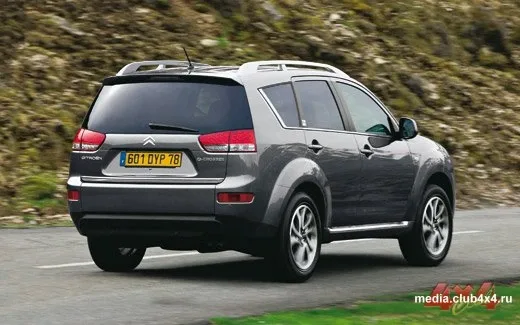
When you start getting to know this car better, you realize: its kinship with the "Japanese" is not just in its blood, but in almost every detail. Except that the "Frenchman's" appearance is slightly less daring, more calm.
The cloning principle
The key feature of the C-Crosser, in my opinion, is that it is assembled in Japan. On the very same production line where its "blood brother" Outlander XL is also produced. At the same time, the 2.2-liter HDi diesel engine with 160 horsepower arrives at the factory all the way from France. There it is installed under the hood, and the finished car is sent to Europe. This turbodiesel delights with a very decent torque for its displacement — as much as 380 Nm at 2000 rpm. And its fuel consumption is also impressive. At the presentation in France, we drove along mountain serpentines, stormed passes above two kilometers, and yet the engine's appetite did not exceed 10 liters per hundred. Although our driving style was, to put it mildly, far from economical. A considerable credit for this also goes to the six-speed "manual" from Mitsubishi, which perfectly matches such a torquey engine.
The crossover's suspension, both front and rear, is fully independent. But its travel is small: hitting a bump stop on serious potholes is a piece of cake. But what drive this car gives in corners — it's just a song! And the credit here goes not only to the suspension, but also to the power steering, which changes its characteristics.
Separately, the Michelin tires, created specifically for this model, pleased us. On mountain turns, you feel their capabilities immediately. You exit one closed turn, and there the road twists into a "hairpin," even steeper than 180 degrees. And the C-Crosser drives as if on rails, with only a slight squeal of the tires hinting that it would be better to slow down.
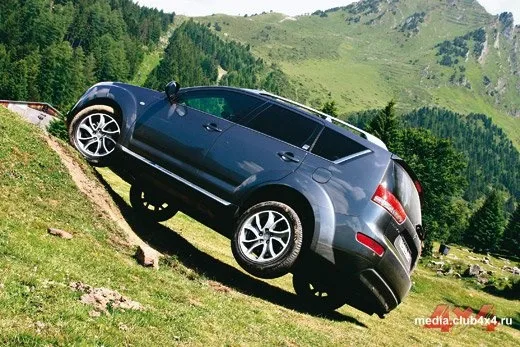
The all-wheel drive transmission has three modes that the driver selects manually. In the 2WD position, everything is simple — torque goes only to the front axle. In 4WD mode, only a small portion of torque is sent to the rear wheels. But in the Lock position, a bit more goes to the rear, but still it's not an honest 50/50. So if one of the wheels ends up in the air, Lock is unlikely to help here.
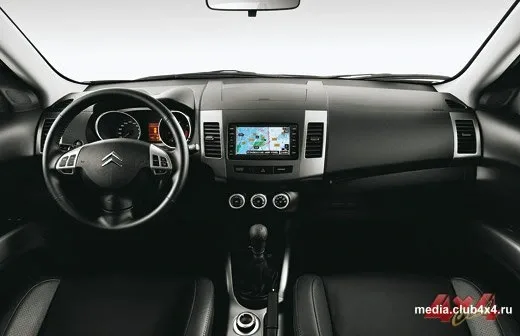
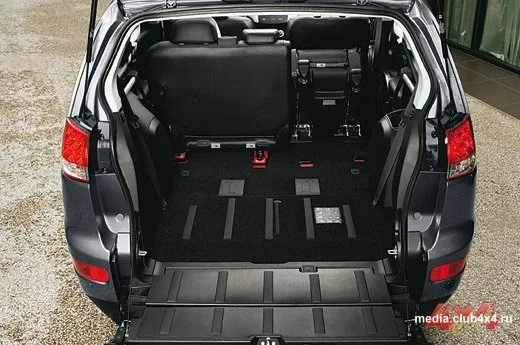
Inside, the C-Crosser pleases with space and comfort. The second-row seats can be slid forward and backward, and they can also fold automatically. The trunk turned out to be remarkably well-thought-out. Firstly, two additional seats are hidden in the floor, which the Outlander XL doesn't have at all. They are, of course, cramped and uncomfortable even for my not-so-large build. But when the choice is between "riding badly" and "walking well," they will come in handy. Secondly, the lower tailgate forms a shelf that easily holds 200 kg of weight. Also pleasant are the navigation, color touchscreen, and rear-view camera. But I'll put the "space-saver" spare tire in the cons. The Japanese brother has a full-size spare wheel under the floor, but here it's replaced by a flimsy temporary tire.
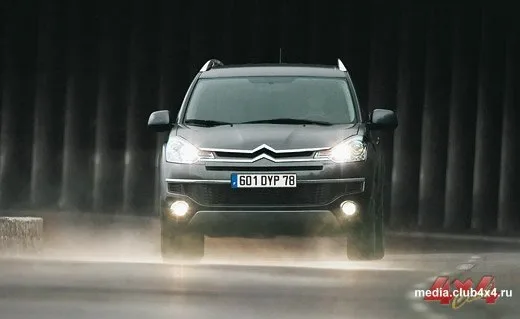
In Russia, sales of the C-Crosser will begin on January 1, 2008. Does it have a chance? In Europe, the base version is priced at a minimum of 34,250 euros — that's with the diesel, "manual," and, mind you, excluding customs duties. The lineup will also include a 2.4-liter gasoline engine. For comparison: here, the top Outlander with a 3.0-liter engine and "automatic" costs $44,900. But those for whom the brand and "European" status matter are unlikely to pay attention to the difference of a couple thousand "USD." And the seven-seat cabin is such a trump card that it definitely won't sit idle.
