
French with a Japanese accent
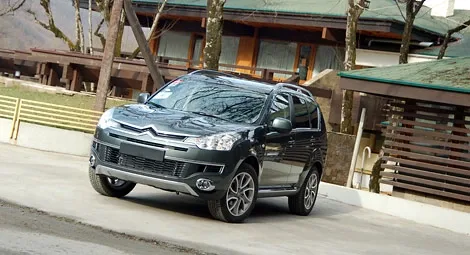
In April this year, Citroen is launching the seven-seat C-Crosser crossover on the Russian market. This is the first SUV in Citroen's history (and indeed an SUV, since the Mehari model, produced from 1968 to 1988, was an off-road vehicle) and the first Citroen with a diesel engine on the Russian market. We went to Sochi, where its Russian presentation took place, to get acquainted with the C-Crosser.
 |  |
Variations on a theme
The Citroen C-Crosser and Peugeot 4007 are essentially the Mitsubishi Outlander XL crossover with very minor changes. The difference between the three cars lies in details such as the front-end styling, trim materials, and the presence or absence of a third row of seats.
In that case, it's logical to ask: why choose the Citroen from this trio? Is it cheaper? Is the service better? In Sochi, at the press conference, Citroen representatives, citing sociologists' data, stated that "the Russian soul has always been touched by French design." And the car's appearance is much more important to compatriots than its price.
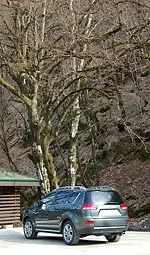
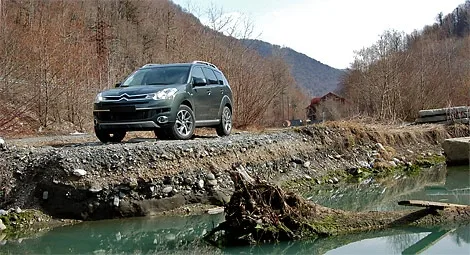
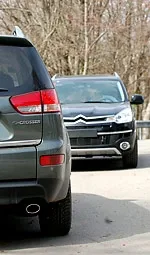
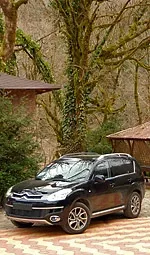
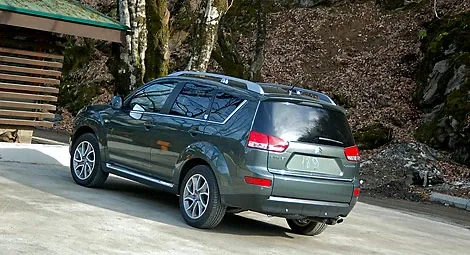
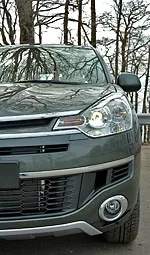
When it comes to design, from the side, the French crossover can be distinguished from the Japanese one only by the front-end styling, rounded rear lights, and a large number of chrome details. The chrome covers the signature chevrons, fog lamp housings, trim on both sides of the license plate and on the tailgate, as well as the model's logo – the "Compass Rose" – located on the rear pillars.
 |  |
Arguing about whether the Citroen turned out beautiful or not is pointless. Everyone has their own tastes, and everyone chooses what appeals to them.
Inside
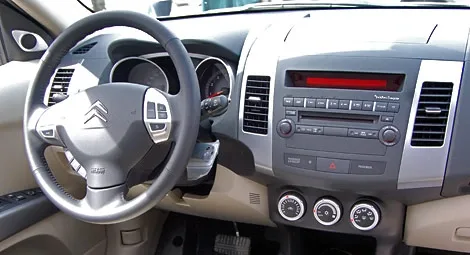
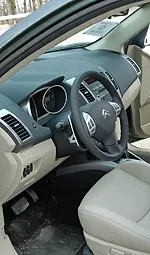
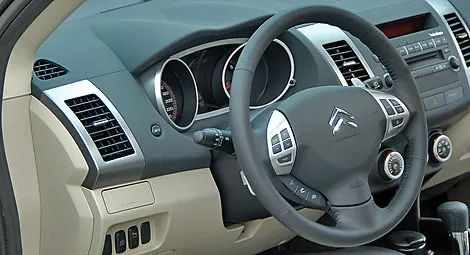
Inside the C-Crosser – it's still the same Outlander - if you cover the Citroen emblem on the steering wheel, it's impossible to identify French citizenship. Citroen claims that the C-Crosser uses softer plastic for the center console, but we somehow didn't notice it - it's hard and hollow-sounding.
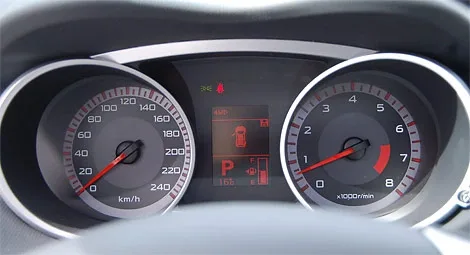
A driver of average height can get comfortable without issues, but for those who are taller, the "Japanese" range of adjustments may not be enough. The instrument cluster is perfectly readable, and all necessary switches, buttons, and knobs are exactly where you'd expect to find them. The only things that disappointed were the flat seats and the narrow display of the stereo "à la Mazda," which completely "goes blind" during the day.
 |  |
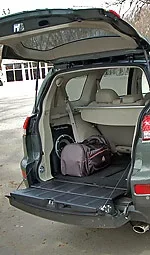
The second row of seats is split in a 60:40 ratio. The seats can be folded together or separately, slid forward and backward by 80 millimeters, and the backrest angle can be adjusted. The trunk volume with the second-row seats up is 510 liters, and it increases to 1691 liters when they are folded.
The third-row seats, which Citroen calls an advantage of the "C-Crosser" over the Mitsubishi, fold flush with the trunk floor and are intended only for children. An adult, as our experiment showed, can fit there. True, sitting in the "gallery," they'll have their knees pressed to their chin.
 |  |
Let's go
Almost the entire route prepared for the test drive, laid mainly along mountain serpentines in the Sochi area, we drove in the C-Crosser in the top Exclusive trim, equipped with a 170-horsepower Mitsubishi gasoline engine with a displacement of 2.4 liters and a continuously variable transmission that can simulate the operation of a regular six-speed "automatic" with a manual shift system.
Most of the trip – from Krasnaya Polyana to the Navalishchensky Canyon, located just six kilometers from the sea coast – took place on paved roads that were far from ideal condition in the highland areas.
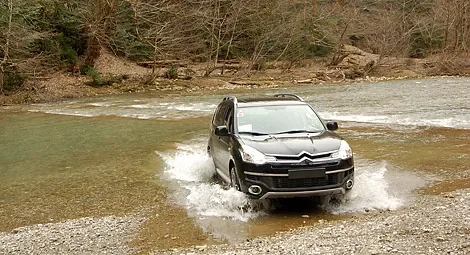 |  |
On a road with good surface, the C-Crosser rides very smoothly, holds the straight perfectly, barely rolls in corners, and the informative steering allows you to enjoy driving. The "highway" suspension, in favor of handling, is made with a fairly short travel, but it absorbs most potholes absolutely calmly, and hard impacts are felt only on large bumps and holes.
The gasoline engine paired with the CVT, unfortunately, is not at all designed for active driving. The car accelerates very measuredly, and the loud roar of the engine from two thousand rpm persistently breaks into the cabin, and soon this sound (which is, in general, of a rather pleasant timbre) gets annoying.
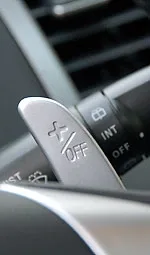
The character of the C-Crosser becomes a bit livelier if you switch the gear selector to manual mode and use the paddle shifters to select the desired "virtual" gear yourself. In this case, you even start to forget that the car has a CVT, and you get the full feeling that it's a regular "automatic." If you shift to a lower "gear," the car will effectively engine-brake, and during acceleration, it will rev up to the highest rpm. Of course, fuel consumption in this mode, especially with active driving, will increase significantly.
At the end of the test, according to the onboard computer, "our" C-Crosser consumed more than 18 liters of fuel per hundred kilometers. For comparison, colleagues who also drove the "Crosser" with the CVT had an average consumption of about 15 liters - but they didn't drive in manual mode.
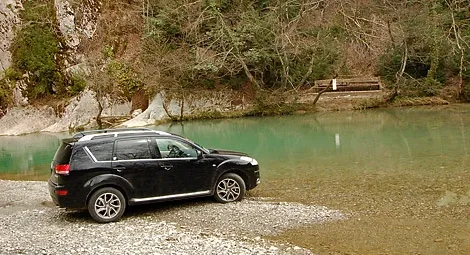 |  |
We also drove a bit in the "Crosser" with a manual transmission. We got the car at the observation deck on Mount Akhun (663 meters above sea level). Over the 18 kilometers that separated this place from the final point of our route – the Navalishchensky Canyon – it became clear that the potential of the 170-horsepower engine is revealed precisely in combination with the "manual." Which, in general, is not surprising...
Unfortunately, we didn't get to drive cars with the 2.2-liter turbodiesel producing 160 horsepower (380 Nm). Such cars will arrive in Russia only in June this year. The C-Crosser with the diesel will be offered exclusively in the top trim and with a six-speed manual transmission. Later, this engine will also be paired with an "automatic." When such versions will appear on our market, Citroen doesn't know yet.
We also, alas, didn't get to test the off-road qualities of the Citroen C-Crosser. There was simply nowhere to do it. The crossover is equipped with an all-wheel-drive transmission, whose operating modes can be selected using a small "washer" on the center tunnel. There are three such modes in total. The first – 2WD – is front-wheel drive only. The second – 4WD – automatically engages the rear drive. The third – 4WD Lock – is intended for off-road driving with a locked "differential."
 |  |
The "Crosser" doesn't have a center differential as such. Its role is played by an electronically controlled clutch located in front of the rear axle. In 4WD mode, part of the torque will be transferred to the rear wheels depending on road conditions, which are determined by the computer based on the vehicle's speed, the difference between the speeds of the front and rear axle wheels, and the force applied to the accelerator pedal.
Of course, with such an all-wheel-drive system, you won't be able to storm the sands of the "Dakar" (by the way, this can also be hindered by the ground clearance of 174 millimeters (slightly more for the gasoline version) and large overhangs), but for getting out into nature and reaching a picnic spot over reasonable "off-road," it will be quite sufficient.
Conclusion
As a result of the Japanese-French collaboration, a car with an original appearance was produced, which has excellent handling, given that it's a tall crossover, good ride smoothness, and a torquey gasoline engine.
There are only two trim levels for the C-Crosser: the base Comfort and the top Exclusive. Standard equipment for all cars includes all-wheel drive, cruise and climate control, full electric package, six airbags, anti-lock braking system, stability control, MP3 stereo with steering wheel controls, onboard computer, and 16-inch alloy wheels. The price of the Citroen C-Crosser in the Comfort trim with a petrol engine and manual transmission is 963,500 rubles (about 40.5 thousand US dollars). The surcharge for the CVT is 14 thousand rubles.
 |  |
As an option, you can order a phone headset with Bluetooth interface, steering wheel controls, and voice recognition function (though only in French, English, German, Italian, or Spanish), rear parking sensors, and a sunroof. The top version will feature a Rockford Fosgate stereo system with a 650-watt amplifier and subwoofer, electric driver's seat adjustment, tinted rear windows, xenon headlights, leather upholstery, and 18-inch wheels.
Later, the C-Crosser will also have a navigation system with a 7-inch touchscreen and a 30-gigabyte hard drive, as well as a rearview camera. However, it is not known exactly when.
The petrol "Crosser" in top trim with CVT will cost 1 million 104 thousand rubles (about 46.5 thousand dollars), and the diesel version, which will initially be available only in Exclusive trim with manual transmission, will cost 1 million 142 thousand 500 rubles (over 48 thousand dollars).