
The designers of the Chrysler PT Cruiser were given a seemingly impossible mission. And they handled it brilliantly. Notice how harmoniously retro motifs and modern technologies are intertwined in this car, how organically the past and the future coexist! You simply can't find a better realization of the "back to the future" concept.
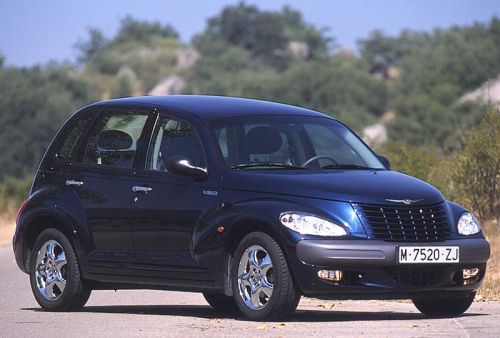
2001 Chrysler PT Cruiser
© Photo: Chrysler
The PT Cruiser, styled as a modern hot rod, delights the youth, and with its homage to the aesthetics of the forties, it touches the souls of the older generation. Look at this huge "crocodile" hood, crowned by a curved windshield, at the muscular fenders with "crystal" optics, at the door handle buttons, as if from old cars, but made of plastic, at the vertical stern with an integrated composite bumper, stylish sills, wide low-profile tires and alloy wheels... It looks stunning!
More than 300,000 people have already expressed a desire to purchase this car. To cope with such overwhelming demand, Chrysler plans to expand production: next summer, the Mexican plant, designed for 180,000 cars a year, will be joined by an assembly line in Austria, which will produce another 50,000 cars annually.
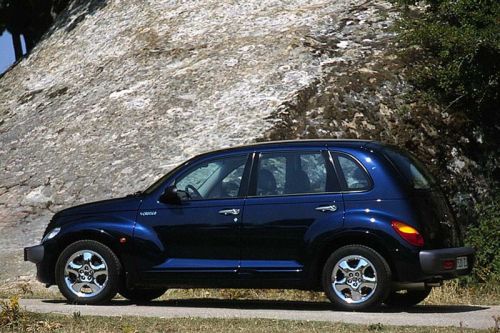
2001 Chrysler PT Cruiser
© Photo: Chrysler
The PT Cruiser can perhaps be characterized as an original minivan, or more precisely, as a high-capacity station wagon. Its appearance hints at the features of the famous "London taxi". The model's lineage begins with the Pronto Cruizer concept, shown two years ago at the Geneva Motor Show, which was built on the platform of the compact Chrysler Neon. A year later, a pre-production version was presented to the public in Detroit, already under its current name. Another year later, the final version was shown there, in three versions at once: the PT Cruiser, as well as the "charged" GT Cruiser and the Panel Cruiser van, differing in front and rear ends.
The family plans include a coupe, a convertible, and a pickup. For the European market, two modifications of the PT Cruiser are intended — with a two-liter gasoline engine and a turbodiesel, in three increasing trim levels: Classic Edition, Touring Edition, and Limited Edition. For North America, a version with a 2.4-liter gasoline engine producing 150 hp is also provided. Our test Cruiser is equipped with a gasoline engine (2 l, 140 hp) and a manual gearbox, in the top Limited Edition trim.
Thanks to the tall body, wide door openings, and internal sill steps, getting into the car is a real pleasure. You don't need to bend at all, let alone fold in three, as in some ordinary passenger cars.
2001 Chrysler PT Cruiser
© Photo: Chrysler
The front seats are high, full-size, with convenient manual adjustments — they guarantee comfort on a trip of any length. The driver's seat is equipped with electric height adjustment.
In the back, there is a lot of space for the legs of a tall passenger, and above the head — a huge air reserve to the ceiling. True, as is usually the case, seating a third passenger on the rear sofa is problematic. The seatback here is too horizontal — to avoid sliding off it during braking, you have to brace your feet on the floor. But the rear seat, divided in a 40:60 ratio, folds down with two light movements. Or, just as easily, it can be removed entirely. Moreover, both parts, turned into "briquettes", are equipped with wheels and handles for transportation.
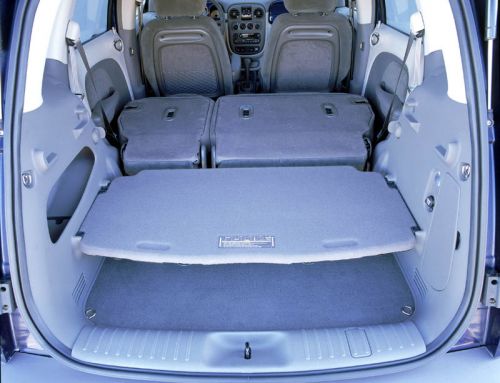
Without the rear seat, the trunk (with a volume of 1820 l) turns into a real hangar that can accommodate all country supplies, sports equipment, or a traveler's gear. Most oversized cargo (for example, a surfboard) won't have to go on the roof rails — long items can be placed along the entire cabin by also folding the backrest of the right front seat. It, by the way, can also serve as a table for the driver — a solution familiar (for example, from Mazda) and very practical.
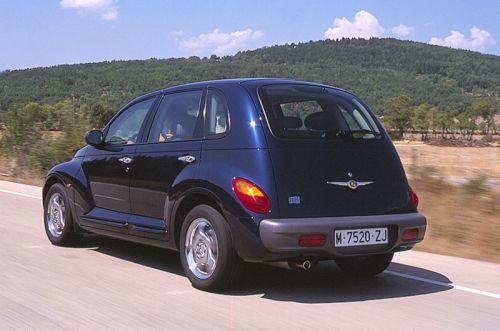
2001 Chrysler PT Cruiser
© Photo: Chrysler
The trunk shelf, which in its normal state holds more than half a thousand liters, is very durable (you can sit on it), can be placed at three levels, or, if not needed, stand vertically, close to the backrest of the rear seat. And if you pull it out, you get a table under the canopy of the raised tailgate.
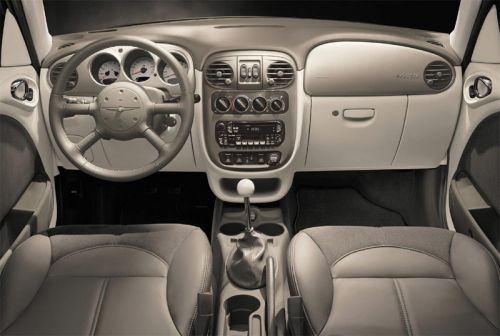
The front panel with plastic inserts in body color, three round instruments with white dials, a long gear lever with a large spherical knob, and a pseudo-archaic steering wheel skillfully recreate the atmosphere of the past. However, the boldly protruding center console somewhat stands out from this picture (although you can't deny its functionality).
The PT Cruiser is still not a rarity, but an "imitation", so it is equipped according to the most modern requirements. The Limited Edition package includes power accessories, cruise and traction control, ABS, air conditioning, CD player, information display on the ceiling, front and side airbags, immobilizer, and much more.
2001 Chrysler PT Cruiser
© Photo: Chrysler
Overall, the interior of the new Chrysler leaves a pleasant impression. The enthusiasm fades somewhat only when you knock on the "oak" plastic of the front panel...
A curious discovery awaited us later: when the plump wheels (205/55R16) start rolling the car along the road, it suddenly turns out that this "handsome guy" is in no hurry at all. In the literal sense, of course, it drives. It's just too phlegmatic.
Yes, from a car with a 2-liter 16-valve engine producing 140 hp, even with such a large curb weight (1383 kg), you expect more agility. After all, our Cruiser is equipped, in the European spirit, not with a thoughtful "automatic", but with a 5-speed "manual".
Acceleration to 100 km/h takes about 12-13 seconds. Sluggish acceleration comes alive only after the tachometer needle passes 3500 rpm. However, the PT Cruiser can easily wipe the nose of a VAZ "nine". Again, when driving calmly, aerodynamic noise (especially noticeable with the rear side window open) not only doesn't press on the ears, as at high speed, but is almost absent.
The gears are long, the lever is very precise and obedient, although the large amplitude of its travel — due to the long "arm" — may not appeal to fans of active driving.
2001 Chrysler PT Cruiser
© Photo: Chrysler
The gas pedal is specific: pressed all the way, it lies flat on the floor, forcing you to stretch your toe. The clutch and brake pedals are impeccable — both in travel and in applied effort. Disc brakes on all wheels slow the car without excessive zeal, but confidently. Therefore, it is very easy to control braking. On slippery surfaces, the delicacy of the anti-lock braking system is endearing.
The PT Cruiser meets road irregularities with dignity. Small potholes are easily damped by the elastic suspension elements. But in front of larger pits, which are quite "up to the teeth" of foreign cars of this class, the Cruiser begins to falter. The "Old World" suspension (whose characteristics differ for European and American cars) has short travel, so stiffness is the main trait of its character. But in corners, the tall car holds up magnificently. And in general, the PT obeys the steering wheel like a smart dog — its beloved owner.
From the high driver's seat, a full panorama of the road opens up. Visibility through the exterior mirrors is quite satisfactory. But visibility through the small rear window is limited by the central headrest.
The scope of application of the Chrysler PT Cruiser is not as wide as it might seem at first glance. The urban rhythm with frequent trips to shops and errands is closest to it. Here the PT Cruiser is in its element (as, indeed, on a rolled path in a forest park or beach area). Some see in the new Chrysler a tribute to the past, others — a maneuverable car for the metropolis, others — a universal mini-truck. But be that as it may, the PT Cruiser is, first of all, a work of art. And it is valued accordingly — at $35,000.
Technical characteristics of Chrysler PT Cruiser 2.0
Body – 5-door
Number of seats, persons – 5
Curb weight, kg – 1383
Gross weight, kg – 1773
Dimensions (length/width/height), mm – 4288/1705/1601
Wheelbase, mm – 2616
Maximum speed, km/h – 178
Control fuel consumption, l/100 km:
- city cycle – 11.5
- suburban cycle – 7
- mixed cycle – 9.5
Engine:
- type – gasoline, in-line, 4-cylinder, 16-valve
- displacement, cm3 – 1995
- power, hp at rpm – 140/5700
- torque, N·m at rpm – 188/4150
Here is how I rewrote this test drive, preserving all the technical details and the author's style.
The powertrain runs on gasoline with multipoint injection. The gearbox is manual, with five gears. Tires are sized 205/55R16. The front suspension is McPherson type, supplemented by an anti-roll bar. At the rear, there is a spring-loaded beam, also equipped with an anti-roll bar. The braking system includes ABS: ventilated disc mechanisms are at the front, and regular discs at the rear. Steering is implemented according to the rack-and-pinion scheme and is equipped with power steering.
As for practicality, the trunk in standard condition holds 538 liters, and if you fold down the rear row of seats, the volume grows to 1820 liters. The fuel tank is designed for 57 liters. In the Limited Edition trim, this car was priced at $35,000.
The entry is dated August 23, 2000, and the material was prepared by the publication «5 Koleso».