
The fourth gear accelerates as if second were engaged. In fifth, the pace barely drops... Is this really a Niva? Yes, damn it, yes! We're tearing along one of Tolyatti's highways, ignoring speed limit signs, traces of road workers' efforts, and small front-wheel-drive cars with their valves. Want to wipe the nose of your neighbor in a brand-new "2113" with your Chevy Niva? Save up for the FAM1. The phrase "Go to Tolyatti and ask..." should become a classic for every "Chevy" owner. I mutter this to myself, not slowing down from 140 km/h and carving into a turn with a fifty-meter radius. You can feel the mass shifted to the front – the rear sways a bit more. Rejoice, manufacturers of bright-red stabilizers for the "Niva" rear axle, tremble, chip tuners: the "Shniva" has gained power (though now it needs training, and the driver needs common sense).
PROVOCATION #1
First question: is the Chevrolet Niva FAM1 really mass-produced? Hard to answer definitively. I was on the assembly line; there are cars with an X at the end of the index, and there aren't that few – about four or five out of 240 assembled daily. The powertrain, connected as a single unit with the transfer case at the marriage station (where the body meets the chassis), I also saw. One such, next to five classic "Niva" ones, stood on a special platform. This means that the Niva with the Opel Z18XE engine is indeed assembled serially, but this assembly is almost piecework. Meanwhile, dealers are seeing a growing stack of orders for the "Niva" with the "Opel" engine. Because everyone has heard about it, some have seen it, and a few have even tried it. And the reviews are the most enthusiastic. Later, meticulous owners and experts will find some flaws in this cute lady ("Niva" seems to be feminine after all), but for now, I don't want to get out from behind the wheel; I want to go to the steppe, give it gas, into the Tver forest and along the ruts, to Karelia, to bounce over pebbles. And not to tremble over every scratched piece of metal, and not to have my back ache halfway. A provocateur, this FAM of yours!
THE MAIN THING – GEAR RATIOS
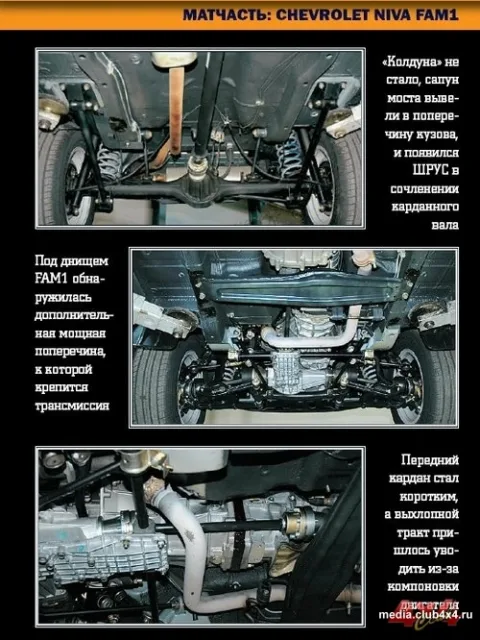
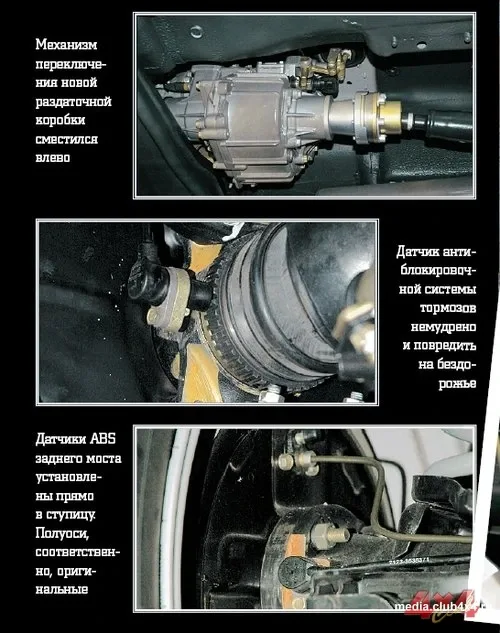
The Opel Z18XE engine is not the most powerful in the world, nor the most torquey, and it's not very new. Next to the "ex-Fiat" unit from 1900-something, it's a masterpiece of engineering, but otherwise, it's a decent middle-of-the-road, without kulak pretensions, but not poor either. Its forte is excellent balance of parameters, smooth torque across the entire rev range, starting from about 1,200 rpm, and sufficient power for the light Niva, peaking at 5,000. There's no need to rev it "to the redline," because 140 km/h is confidently achieved at 4,000 rpm. Not like before: 130 was already 4,500 and ringing in the ears for half a day. However, you need to be more careful with the lower sector of the speedometer. Starting uphill in second, be ready to hear the heart-rending clatter of detonation. The engine generally digests our 92-octane gasoline, but that doesn't mean it's as elastic as a proper diesel. Good torque is a bit relaxing, so don't forget about the low range in both gearboxes. The transfer case ratios, by the way, have changed; high is now 1:1.46, and low is 1:2.228, so both have become longer. The final drives remain the same – 3.9. They are structurally standard, so nothing prevents you from installing even tuning 5.28. But you can't swap the gears in the transfer case for old ones; they're different, as are the shafts and the shift mechanism.
DIFFICULTIES OF TRANSFER
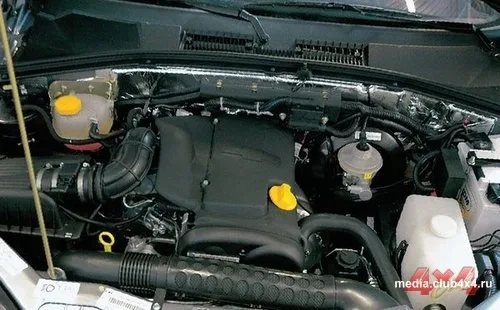
My favorite place in an article about a new model is the list of innovations. Well, let's begin! Engine 1.8-liter Opel, 5-speed manual gearbox Aisin, new transfer case in a single unit with the gearbox. "Electronic" gas pedal. ABS system, for which the rear axle and front wheel hubs had to be redesigned, a 10-inch vacuum brake booster installed, and a place found for the electronic-hydraulic control unit. Anticipating questions, I report that no, it's practically impossible to transfer all this to a regular Niva. The units are not sold, the axles too, and the brains of classic engines were not designed for ABS. I won't even get into debates about the necessity of this system, and for those who want to argue, I recommend visiting a cemetery to read epitaphs...
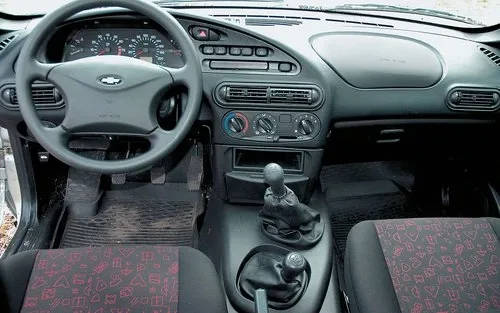
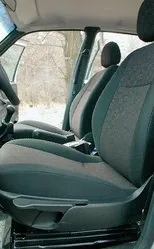
In principle, into a regular Chevy Niva, you can install only the new seats from the FAM1, but only with adapters and preferably with belt pretensioners. It'll be expensive... Generally, the new seats differ from the old ones, in my opinion, only in two points: height adjustment and slightly more rigidity. If you had an Opel or a VW, you'll appreciate it, but I prefer softness. Or maybe another place...
Less significant for the factory, but very important for the consumer, is the change in configuration: the use of Turkish-made driveshafts with CV joints in the articulations, which are an order of magnitude better than the best domestic or Belarusian ones. In addition, as a result of moving the transfer case forward, the rear shaft has become longer and less vibration-loaded, and the CV joint boot of the shaft doesn't tear during articulation. To improve passive safety, airbags (two frontal as standard), belt pretensioners, new seats are installed, and the configuration of the side members has been changed. They say the car is ready to pass the European NCAP crash test with four and a half stars. Half a star will be taken away by the tightness in the driver's footwell, which, alas, cannot be eliminated.

The air conditioning, necessary in the city in summer in every car, is present. It makes a bit of noise, but cools like crazy! It doesn't affect speed, tested. The air intake is routed to the very edge of the hood, about fifteen centimeters higher than the previous position. What else... The spare tire has a new bracket, which is harder to remove without permission and which turns the wheel to face people, i.e., the front side of the disc. The breathers of all transmission units and the front reduction gear are routed to the engine shield, and the rear reduction gear breather is raised to the floor crossmember. A chic bag for the car's minimum road kit – with a first-aid kit, a "triangle of fate," and a two-liter fire extinguisher – can be purchased from the dealer. It's better to throw out the tow rope from it immediately and buy a proper kinetic one from WARN instead – and good mood will accompany you for free!
SHORT ASPHALT
Asphalt, when you drive a Chevy Niva FAM1, ends 30 percent faster, that's a proven fact! However, Tolyatti, fortunately, is not Moscow, and the gorgeous Volga bank is a fifteen-minute drive from the office. Sorry, now ten... Driving around the city in a regular Chevy Niva is also not difficult, you just have to shift more often. In the Niva FAM1, the gear selection shifts up by one across almost the entire speed range: where third was needed before, fourth suffices here; instead of second, third; instead of... and so on. Outside the city, you can overtake dacha-goers in fifth. Owners of Grand Cherokee and Tahoe won't understand me, owners of "Nivas" and "Shnivas" might even puff up a bit. Don't be sad, fourth is also a good gear. And third is not bad. But it's not boring. And it's a pity about the money...
Okay, I'll admit it honestly: overtaking on the highway, when you accelerate from 100 to 140 without even shifting gears, is a real pleasure! The power reserve at high speeds is exactly what you need. Staying in the flow next to a brisk "hundred" (Lada 100), easily overtaking a cocky Patriot at the start and catching up with an already rumbling Cherokee — for this, money is truly not a pity. At the same time, the cabin is quiet and smooth. The engine responds with a metallic roar, and the light whistle of the transfer case gears pleasantly complements the picture, distracting from the wind noise that gets tangled in the mirrors. At a speed of 130 km/h, I can easily hear a passenger in the back seat quietly telling some story from the lives of remarkable people.
Do you think I'm praising this car too much? In reality, the perception of the Chevy Niva, especially the previous version, differs greatly among different drivers. Those who switched to it from a "UAZ" or "Lada Niva" will be pleasantly surprised by the excellent handling, lack of noise and vibrations, comfortable seating, and spacious cabin. True, they will later regret a scratched bumper, a torn-off rear license plate, or a dented rocker panel. But those who previously drove a passenger car, even a decent one, will notice some roll and sway on dirt roads, hear knocks from below and hissing from under the floor, be surprised that ten liters per "hundred" is not achievable, and acceleration to a hundred in ten seconds is not for it. The average speed will also be lower. But then they will be amazed that they can drive here, and here, and there, and over there... There, something will begin that will make everyone forget about scratched bumpers — both the first and the second.
The times when GM-Avtovaz called the Chevrolet Niva simply an all-wheel-drive passenger car are gone. Now the Niva is officially considered an SUV. It's time to celebrate this event by arranging a moderate mud adventure!
**WE REJOICE AND MAKE MISTAKES**
Off-road, the Niva FAM1 behaves almost the same as the classic Chevy Niva with the 1.7 engine. The only difference is that due to better traction, you can unexpectedly stall, losing vigilance. What a paradox... Once you get used to it, you immediately want to hooligan. "Go, go! – Vadim Klassen, the head of UFO and advanced developments at GM-Avtovaz, catches my questioning look – We're in a Niva!" Easy to say, go, there's a pit! Last time I "went" like that, I broke the transfer case cover in half... But this time we got through, and the cover was reinforced long ago. True, experienced "Shevy" enthusiasts wave their hands: they say it's only a matter of time.
The new shock absorbers and rebound limiters thud from critical articulation, but there are no bottoming-outs at all. And yet the suspension was only slightly recalibrated, just by installing new shock absorbers from Delfi, a long-time GM supplier. They are more energy-intensive, and everything works perfectly. The weight distribution shifted to the front made diagonal wheel hanging easier to overcome. The wheels grip better, the main thing is not to forget about the center differential lock. It engages and disengages the same as before, that is, not always immediately. But the increased traction across the entire rev range, especially at low RPMs, is useful in any case, especially on the Volga sand, which, although dense, is ready to happily accept the narrow-track Niva (by the way, FAM1 gets wider 215/65R16 tires) if you get distracted.
Gears shift easily, only from first to third you need to shift carefully — they are close, and I missed twice, but corrected in time. In general, at the factory now it is the FAM that is positioned as a passenger all-wheel-drive car, while the classic "Shniva" is already spoken of as a light SUV, the terror of the Patriot in standard trim... The reason for this division, I believe, is not only the improved behavior on asphalt, but also the fact that the vulnerable spots of the Chevy, such as CV joint boots and bumper plastic, are now joined by exposed ABS sensors, driveshaft joint boots, and engine compartment protection.
**ABOUT THE PAINFUL**
$21,000 for a new Niva — is that a lot or a little? Honestly, the very combination of the words "twenty-one thousand dollars" and "Niva" still seems to me like an excerpt from a science fiction book. At the same time, a regular Chevy Niva in the simplest trim has already jumped over $13,000, which is somehow explained by the large number of improvements, and in the most expensive trim it is close to $16,000, which is harder to comprehend... And now the sum of 550,000 rubles doesn't sound so fantastic... Especially since in rubles the amount has not grown so noticeably. The difference in exchange rates also matters. But still, it's a lot! However, what's worse is that given the trends of recent years, this "a lot" can quickly turn into "even more"... And the car is very good!
Should I reveal a secret to you? Do you know where the engine for it was calibrated? In Lotus laboratories. That's what I thought — where does this lady with a German heart get such an assertive, truly British character!
PROVOCATION #1
First question: is the Chevrolet Niva FAM1 really mass-produced? Hard to answer definitively. I was on the assembly line; there are cars with an X at the end of the index, and there aren't that few – about four or five out of 240 assembled daily. The powertrain, connected as a single unit with the transfer case at the marriage station (where the body meets the chassis), I also saw. One such, next to five classic "Niva" ones, stood on a special platform. This means that the Niva with the Opel Z18XE engine is indeed assembled serially, but this assembly is almost piecework. Meanwhile, dealers are seeing a growing stack of orders for the "Niva" with the "Opel" engine. Because everyone has heard about it, some have seen it, and a few have even tried it. And the reviews are the most enthusiastic. Later, meticulous owners and experts will find some flaws in this cute lady ("Niva" seems to be feminine after all), but for now, I don't want to get out from behind the wheel; I want to go to the steppe, give it gas, into the Tver forest and along the ruts, to Karelia, to bounce over pebbles. And not to tremble over every scratched piece of metal, and not to have my back ache halfway. A provocateur, this FAM of yours!
THE MAIN THING – GEAR RATIOS
The Opel Z18XE engine is not the most powerful in the world, nor the most torquey, and it's not very new. Next to the "ex-Fiat" unit from 1900-something, it's a masterpiece of engineering, but otherwise, it's a decent middle-of-the-road, without kulak pretensions, but not poor either. Its forte is excellent balance of parameters, smooth torque across the entire rev range, starting from about 1,200 rpm, and sufficient power for the light Niva, peaking at 5,000. There's no need to rev it "to the redline," because 140 km/h is confidently achieved at 4,000 rpm. Not like before: 130 was already 4,500 and ringing in the ears for half a day. However, you need to be more careful with the lower sector of the speedometer. Starting uphill in second, be ready to hear the heart-rending clatter of detonation. The engine generally digests our 92-octane gasoline, but that doesn't mean it's as elastic as a proper diesel. Good torque is a bit relaxing, so don't forget about the low range in both gearboxes. The transfer case ratios, by the way, have changed; high is now 1:1.46, and low is 1:2.228, so both have become longer. The final drives remain the same – 3.9. They are structurally standard, so nothing prevents you from installing even tuning 5.28. But you can't swap the gears in the transfer case for old ones; they're different, as are the shafts and the shift mechanism.
DIFFICULTIES OF TRANSFER
My favorite place in an article about a new model is the list of innovations. Well, let's begin! Engine 1.8-liter Opel, 5-speed manual gearbox Aisin, new transfer case in a single unit with the gearbox. "Electronic" gas pedal. ABS system, for which the rear axle and front wheel hubs had to be redesigned, a 10-inch vacuum brake booster installed, and a place found for the electronic-hydraulic control unit. Anticipating questions, I report that no, it's practically impossible to transfer all this to a regular Niva. The units are not sold, the axles too, and the brains of classic engines were not designed for ABS. I won't even get into debates about the necessity of this system, and for those who want to argue, I recommend visiting a cemetery to read epitaphs...
In principle, into a regular Chevy Niva, you can install only the new seats from the FAM1, but only with adapters and preferably with belt pretensioners. It'll be expensive... Generally, the new seats differ from the old ones, in my opinion, only in two points: height adjustment and slightly more rigidity. If you had an Opel or a VW, you'll appreciate it, but I prefer softness. Or maybe another place...
Less significant for the factory, but very important for the consumer, is the change in configuration: the use of Turkish-made driveshafts with CV joints in the articulations, which are an order of magnitude better than the best domestic or Belarusian ones. In addition, as a result of moving the transfer case forward, the rear shaft has become longer and less vibration-loaded, and the CV joint boot of the shaft doesn't tear during articulation. To improve passive safety, airbags (two frontal as standard), belt pretensioners, new seats are installed, and the configuration of the side members has been changed. They say the car is ready to pass the European NCAP crash test with four and a half stars. Half a star will be taken away by the tightness in the driver's footwell, which, alas, cannot be eliminated.
Airbags, new seats with height-adjustable cushion, tunnel of a different shape, "electronic" gas pedal
SHORT ASPHALT
Asphalt, when you drive a Chevy Niva FAM1, ends 30 percent faster, that's a proven fact! However, Tolyatti, fortunately, is not Moscow, and the gorgeous Volga bank is a fifteen-minute drive from the office. Sorry, now ten... Driving around the city in a regular Chevy Niva is also not difficult, you just have to shift more often. In the Niva FAM1, the gear selection shifts up by one across almost the entire speed range: where third was needed before, fourth suffices here; instead of second, third; instead of... and so on. Outside the city, you can overtake dacha-goers in fifth. Owners of Grand Cherokee and Tahoe won't understand me, owners of "Nivas" and "Shnivas" might even puff up a bit. Don't be sad, fourth is also a good gear. And third is not bad. But it's not boring. And it's a pity about the money...
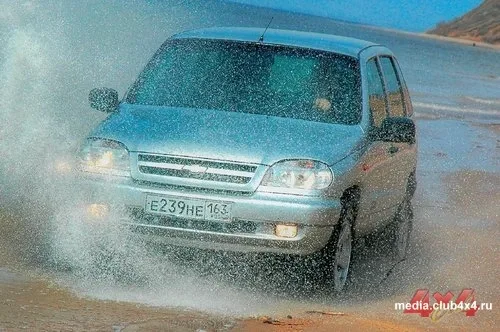
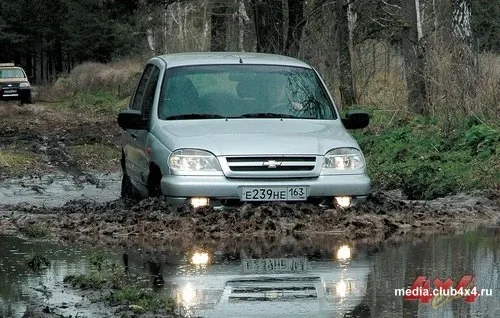
Fords are easier for the Chevrolet Niva FAM1 than for the Niva 1.7. The breathers of the units are routed to the engine shield, the air intake for the engine is raised to the hood edge