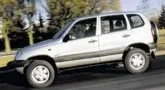
Russia and the States have much in common: vast expanses, extensive provinces with sparse populations and roads far from ideal, and a climate ranging from scorching deserts to frozen tundra. Therefore, the approach of American automakers should be closer to us than the European one, which has taken root here more due to geographical proximity. Our classic off-roaders — UAZ and Niva — have always been valued for their off-road capability and practicality. So the appearance of a joint venture between General Motors and AvtoVAZ, which was supposed to combine American comfort and pleasant looks with Russian unpretentiousness and a democratic price, seems quite logical. Both parents are easily recognizable in the car's appearance: the grille is a dead ringer for a Chevrolet, while the front optics with turn signals on top are a clear nod to the classic Niva. The car looks solid and well-thought-out, without any design blunders. The body is assembled properly: doors, including the massive rear one, close easily and pleasantly, and the gaps between panels are pleasing to the eye.
But when you look inside, you get a persistent feeling that the interior was made at a completely different factory. Inside, the usual domestic style prevails: cheap plastic everywhere, which is scary to touch — it might break off at any moment. The front seats with heating are a great thing, but why the wires to them are laid in a loop right under the feet of rear passengers and pinched by the central tunnel cover is beyond comprehension! When trying to fold the rear sofa, decorative trim pieces fell off, although the operation itself is easy. A small step still remains, but everything goes back without problems. And the heavy standard jack has no place of its own and is not secured — it just flies around the trunk on every bump.
However, the front seats are perhaps the best of all that are installed in our cars from the factory. The seats somewhat resemble French ones: the cushions are soft and noticeably compress. There seems to be no lateral support, but under load it somehow appears. The small-diameter steering wheel fits comfortably in your hands, although the plastic feels unpleasant, but the column is adjustable for tilt. On the central console are controls for the heater, auxiliary lights, and rear window defroster, as well as an ashtray and even a cup holder. True, we couldn't pull it out — the gearshift lever gets in the way. The gearbox itself, while not brilliant in precision, has good selectivity and is conveniently located. Next to it is the transfer case selector with neutral, high and low ranges, on which you can engage the forced locking of the center differential.
Visibility from the driver's seat is good: both forward (although the irregularities of the windshield slightly distort the picture) and backward — thanks to the traditionally large VAZ "burdock" mirrors. However, the driver's mirror vibrated like an aspen leaf while driving due to a faulty adjustment drive. The pedals are comfortable, no need to get used to them. Thanks to the ZF power steering, which is already standard, the car, unlike its predecessor, is easy to handle without strain. And here we move on to the main thing — to driving, where the car should be considered in two guises: on asphalt and off-road. The sensations are radically different.
On the highway, the engine clearly lacks power; you have to rev it to the limit. During the test, the engine stalled several times at idle. Something constantly rattles in the cabin. But handling is top-notch. The new SUV behaves much better in the city and on the highway than all other VAZs. The steering wheel is informative, and your hands don't get tired during parking and maneuvering. On the highway, there's a clear "zero" and confident movement up to the maximum of 140 km/h. In a corner on dry asphalt, there's almost no reaction to throttle — there's not enough torque for the all-wheel drive. The car behaves stably. On slippery surfaces, when adding throttle, the front wheels push outward in the turn — typical front-wheel-drive habits, but within reasonable limits. Body roll is minimal. Like the previous Niva, this car is more tiring in the city than most others. But comfort has noticeably increased: the reduction gears are noisy, but not too much, and thanks to the longer wheelbase, the "goat-like" bouncing is gone, and the suspension has become softer.
But as soon as you turn onto a dirt road, the car transforms like a seal diving into water. Driving on a country road becomes a pleasure. The suspension is endlessly energy-intensive — we never managed to break through it. Traction is more than enough. The slight increase in noise only masks the transmission sounds and is taken for granted. The car itself provokes more energetic driving. And on serious off-road, just engage low range — and there are almost no insurmountable obstacles left for the car. It takes any slopes playfully, without the slightest strain: it just crawls and crawls, without slips or surprises. Hanging it diagonally is very difficult, and if you don't deliberately try, it's practically impossible. We drove on frozen ground with snow on highway tires — and not a hint of wheel spin. And there are also lockouts... The clutch deserves special praise: soft and slightly stretched at engagement, it, paired with a convenient handbrake, allows you to start on a slope of any steepness without the slightest rollback. With the low range, the engine seems quite torquey, and I'm confident in it.
The Chevrolet Niva clearly has more advantages than disadvantages. And all the pluses are fundamental: successful layout, excellent suspension, handling with excellent weight distribution and balance of tire slip angles — many a passenger car would envy that. The finished design that requires no modifications is also important. But the car can be rid of its flaws: improve build quality, install a more powerful engine, and replace cheap interior parts. This is within the power of both the factory (we hope it won't stop at what has been achieved) and tuning studios. The main thing is that we didn't find a single problem that would require messing with the body geometry, component placement, or controls. Right now, the car feels more Niva than Chevrolet. But one thing is certain: this is the most progressive domestic car. It's a bit sad that all the qualitative leaps of our auto industry are somehow connected with foreigners: first Ford — GAZ, then Opel — AZLK and Fiat — VAZ, now GM. However, each such "injection" has brought us to a new level. I want to believe that the Chevrolet Niva of subsequent releases will get rid of its "childhood diseases" while retaining its solid baggage of advantages.
Technical specifications of Chevrolet Niva
Body – station wagon
Number of seats, persons – 5
Curb weight, kg – 1350
Dimensions (length/width/height), mm – 4048/1770/1652
Wheelbase, mm – 2450
Maximum speed, km/h – 140
Control fuel consumption, l/100 km:
- urban cycle – 10.8
- suburban – 8.6
Engine:
- type – petrol, inline, 4-cyl.;
- displacement, cm3 – 1690
- power, hp at rpm – 80/5000
- torque, N·m at rpm – 127.5/4000
- fuel system – multi-point injection
Transmission – manual, 5-speed, permanent all-wheel drive
Tire size – 205/75R15
Suspension – coil spring;
- front – independent, double wishbone
- rear – dependent, 5-link
Brakes (front/rear) – disc/drum
Steering – power-assisted
Price, $ – 9300
A few questions to John Milonas, General Director of the GM-AvtoVAZ joint venture.
— How do you assess the quality of Russian components?
— There is a stereotype that Russian enterprises cannot produce quality products in principle. This is not true. Often, components have to be rejected only due to external defects caused by poor packaging. Achieving high quality of manufactured products is not so difficult, and many of our partners have managed to do this without significant costs: small enterprises find it easier to adapt to our requirements than giants with ossified management and quality control structures.
— Will your compatriots manage the enterprise?
— GM's philosophy and standards have been implemented here from the very beginning, so people with extensive experience in the corporation were appointed to key positions. However, this does not mean that Russians are excluded from the management process: four of the eight directors of the joint venture are Russian citizens.
— You claim that you strive for GM quality standards; what does this mean in practice?
— The joint venture conducts full quality control of components. For example, at the VAZ section for assembling gearboxes for the Chevy Niva, the same quality control system has been introduced as at GM plants. The organization of the production process also fully meets GM requirements. Thus, any assembler can stop the conveyor if a defect is detected or if any other problem arises: work will resume only after they are eliminated. That is why we are increasing car production so slowly.
— What are the priority goals of the joint venture?
— We set ourselves an ambitious task — to become one of the leaders of the Russian car market by offering customers a product of European level at a price that will be affordable for the domestic consumer.
December 2, 2002
© 5 Koleso