
 Comments (1)
The automotive world has changed significantly over the past 10 years – a huge number of SUVs of all types and classes have appeared on the roads, eating away market share primarily from family sedans and station wagons. Most of those who used to buy an Opel Omega or Ford Scorpio now prefer a crossover. For conservatives, however, a narrow niche of affordable business sedans remains, entirely occupied by Japanese and Korean cars. And recently, a very ambitious newcomer from Korea, if not a prodigy, entered this class. With a very moderate price and a rich set of options, it threatens to quickly become a class favorite.
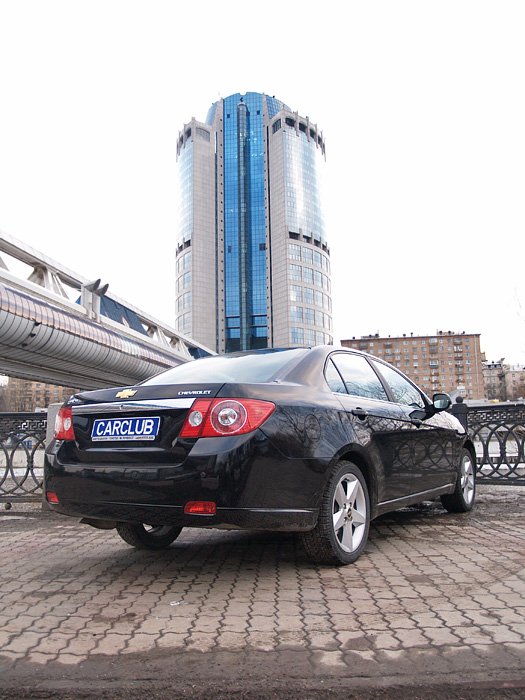 We hastened to take the Chevrolet Epica for a test drive, choosing the top trim. With a 2.5-liter 6-cylinder inline engine, automatic transmission, and leather interior, the sedan costs $30,430 – isn't that a tempting offer?
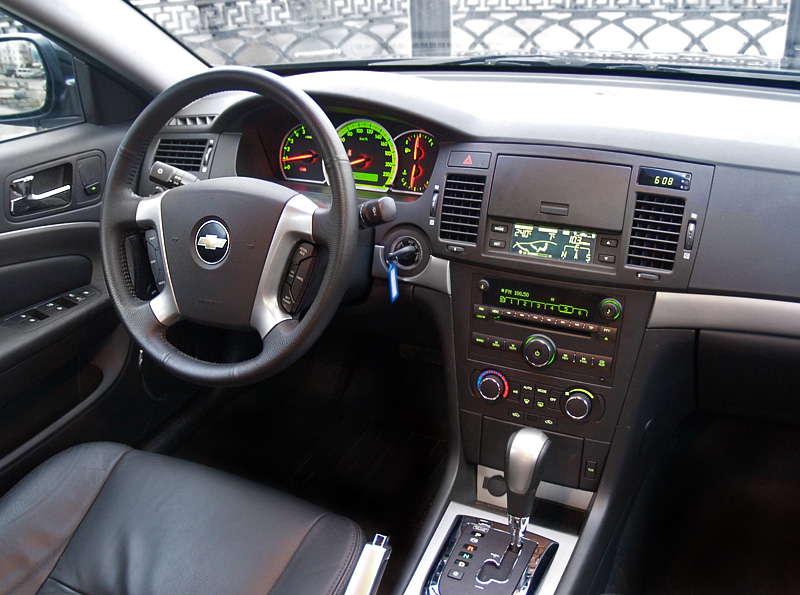
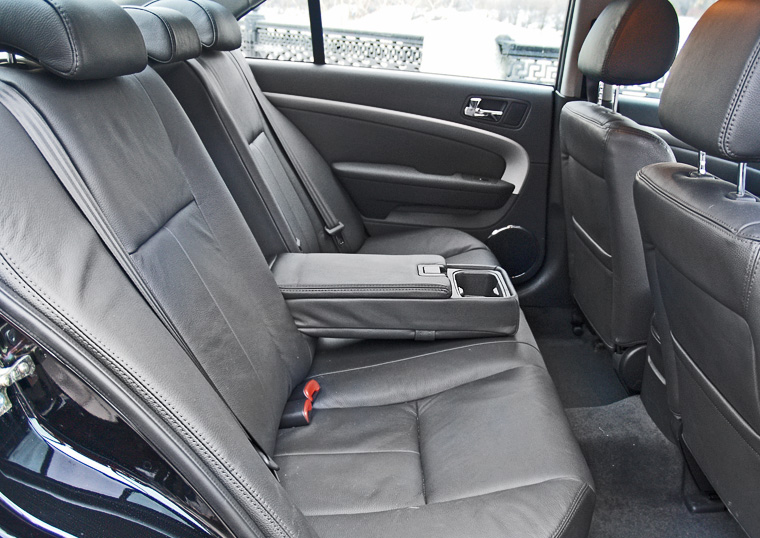
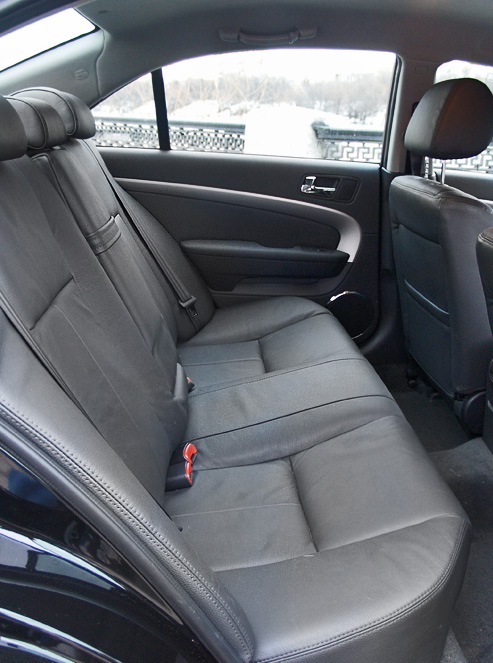
The interior design is quite modern and lacks the flashy details that Koreans indulged in 5-10 years ago. Everything is decent, though without a zest. At first glance, soft plastic and significant body width give a feeling of solidity and belonging to a true business class. However, upon closer acquaintance, minor flaws emerge that spoil the taste of an appetizing barrel of honey. The center console is adorned with an impressive display showing climate control, compass, and onboard computer. Just below is a separate audio system display, but for some reason it is noticeably paler than the upper display when headlights are on, and brighter when they are off. Even adjusting the backlight doesn't help – the contrast remains. The sound from the stereo is a solid four, which is an excellent result for a $30,000 car. Audio controls are duplicated on the steering wheel. Against this splendor, the absolutely "blind" digital clock on the right side of the console looks like another teaspoon of tar. Also annoying is the closing compartment in the center of the dashboard: its black lid is in the most visible place, and it's inconvenient to open. It would be better if it were open – you could put a mobile phone in it. There are closing compartments between the seats and in the armrest. Even better would be to raise the stereo and climate control higher, as using the latter requires taking your eyes off the road for a long time. The climate display and its control buttons are separated by the stereo. The glove box is another example of extreme economy: it's too small, and its lighting is weak – such is forgivable for a Chevrolet Aveo, but not for an Epica.
Also, in pursuit of reducing costs, the Epica is deprived of a number of options customary for the business class, although the necessity of some of them is highly questionable. For example, the Chevrolet has single-zone climate control, no headlight washers, and no stability control system. The absence of the latter is completely unnoticeable and does not affect safety – the traction control system, which works quite correctly and unobtrusively, is quite sufficient.
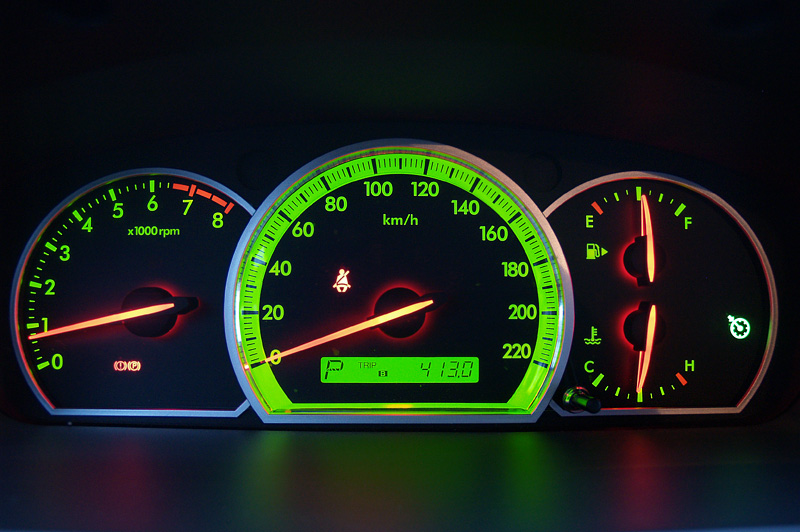
The first thing you notice in the cabin when trying to get the right seating position is the lack of steering wheel reach adjustment: the huge steering wheel only moves vertically, and you want to pull it a bit closer. The instrument panel is simple and concise, although during the day the speedometer and tachometer scales slightly lack contrast.
But enough examining the car from the inside; it's time to hit the road. Especially since under the hood hides an inline 6-cylinder engine mounted transversely. Besides Chevrolet, only Volvo currently uses this scheme. This engine configuration promises ideal balance and smoothness. Indeed, at idle, the engine is inaudible and produces absolutely no vibrations.
So, selector to Drive – and off we go. The gas pedal turned out to be incredibly long-travel, which is not very convenient. Of course, a large car should have smooth responses to any driver actions, but when you have to reach for the pedal – that's not quite what you need. Most likely, the designers wanted to protect customers from accidental disappointment in the car. When driving with the "accelerator pedal to the floor," the Epica pleases with brisk responses and diligently, but without excessive jerkiness, leaps forward with each press of the gas. It seems that if you press the gas a little harder, the Epica would compete with more powerful cars. However, the expected sharp acceleration does not follow. First, the "automatic" thinks for a couple of seconds, and then... the cabin fills with a piercing engine roar. Although the engine revs up to the claimed 6500 rpm, it does so without much pleasure. It moans and begs for mercy, asking to release the gas pedal and let the "automatic" shift gears up to 4500 rpm. Strange, from a modern inline 6-cylinder engine of 2.5 liters, you expect significantly more agility and ease at high revs. However, you can't accuse Chevrolet of deception: the claimed power of the 2.5-liter engine is only 156 "horses," which is not much for a sedan aiming at the business class. For example, on a BMW 3 Series, a similar engine in volume and cylinder count develops 218 hp.
The "automatic" flatly refuses to engine brake in standard mode, and even with manual gear shifting, it does so reluctantly. The torque converter lockup, when engine revs are rigidly linked to vehicle speed, only works on the last 5th gear, and this has any practical effect at speeds above 100 km/h. In the city, you have to forget about engine braking. Overall, the brakes have enough power to stop the large car in time. However, the soft brake pedal creates a slight feeling of distrust in the Epica, although it's clear that the developers deliberately tried to increase the travel to make it easier for the driver to modulate deceleration. There is no certainty that these brakes can repeatedly stop the car from high speed without overheating, but the Epica doesn't claim sports car laurels either. The ABS also caused some problems – it activates too early, which once nearly led to an accident. The issue lies in significant unsprung masses caused by large wheels and, probably, a sturdy suspension. On numerous small irregularities, the shock absorbers fail to cope, and the wheels lose stable contact with the road. As a result, during braking, the ABS activates, and the car barely slows down.
However, if you don't nitpick and ignore traffic light races, the Epica's acceleration and braking dynamics are quite sufficient for confident city driving. On the highway, the Chevrolet easily accelerates to 180 km/h, although in reality, you don't want to go faster than 150 km/h. It's not about lack of power or suspension, but about sound insulation – the cabin fills with such a strong hum that you have to significantly increase the stereo volume and raise your voice. Whether it's the weak acoustic protection or the noisy studded Toyo tires, it's hard to say. But the fact that Koreans have never paid much attention to quality sound insulation is a fact.
Apart from the quirk when braking on uneven surfaces, the suspension of the Epica deserves praise. Independent on all wheels, it is well suited for the business class. Significant ground clearance and high energy intensity allow you to boldly jump over speed bumps and not slow down on a broken suburban highway. As for large rolls and the lack of reactive effort on the steering wheel, in this case, it is a moderate price for passenger comfort, which is characteristic of cars of a higher class.
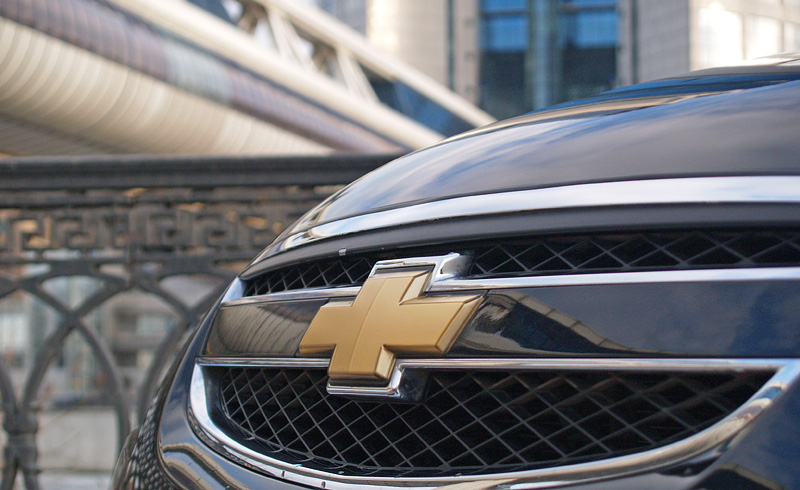
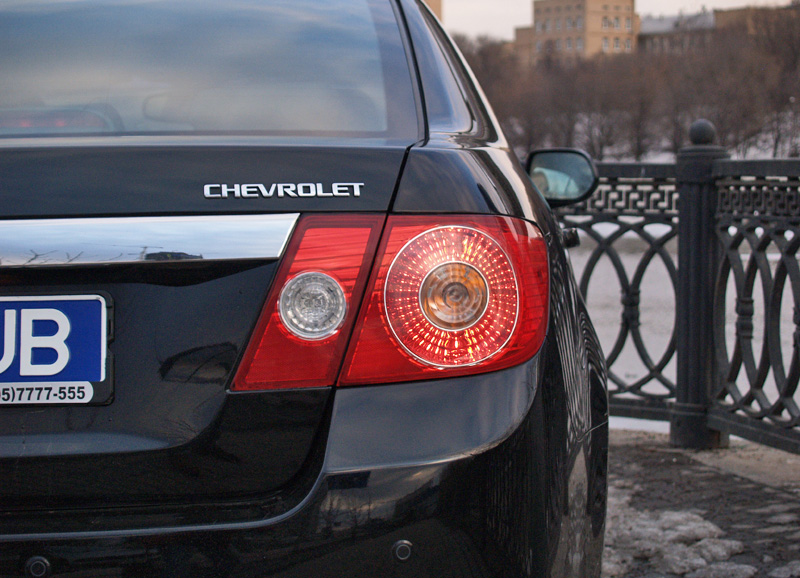
One of my colleagues, after a ride in the Chevrolet Epica , even thought about buying it, although his previous favorite was the sedan Toyota Avensis. But the Japanese car formally stands a step lower in classification, and for 30 thousand dollars it is offered only with a 2.0-liter engine and an automatic transmission, but without leather interior and other attributes of the business class. The only thing that caused serious complaints was the too large cross emblems at the front and rear.
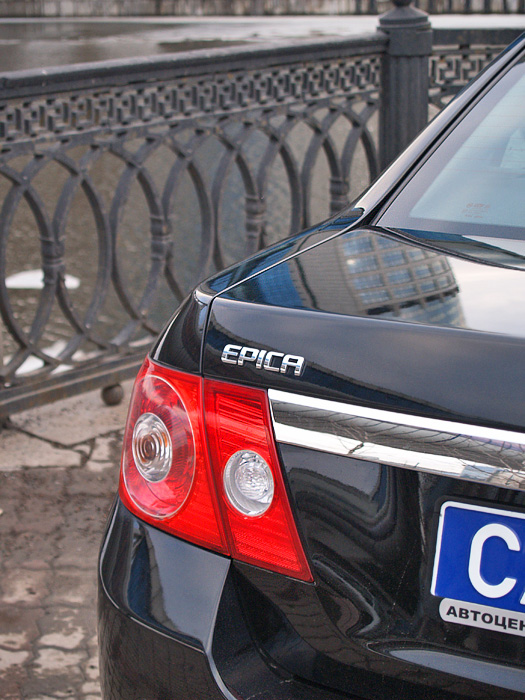
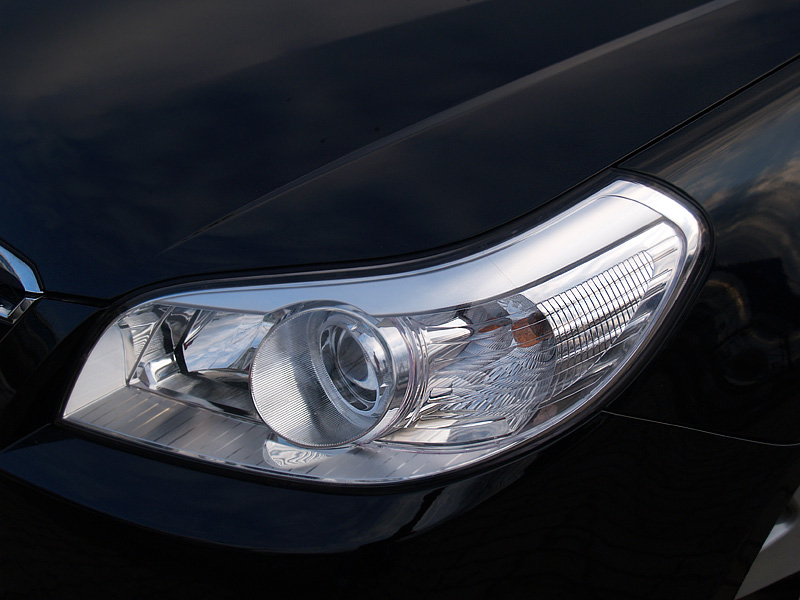
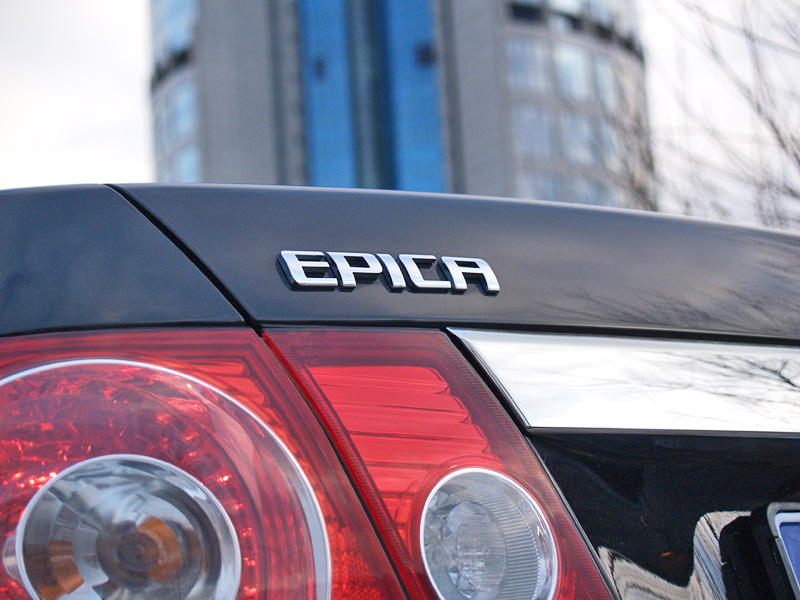
"If they are removed, the Epica will only benefit," my friend decided and, it seems, has already gone to the dealership to order the car. And indeed, if you remove the emblem from the radiator grille of the Epica, replacing it with something more interesting, then by the shape of the headlights it can be mistaken for a BMW "five". Surely in a few months, dealers will have tuning packages that allow making the Epica more similar to European models – Koreans love to imitate. The fashionable rear round lights resemble the same Toyota Avensis or Ford Mondeo. In profile, the Epica is completely unrecognizable – a classic business-class sedan. Either the Toyota Camry of the previous generation, or the Mercedes E-class. In any case, the dimensions of the Epica significantly exceed its price. If you do not make a cult out of the car, but choose a spacious and solid car for business and family, then Chevrolet still makes a very tempting offer.
Text: Leonid Pavlov. Photo by the author.