
Golf-class sedans have always been in demand in Russia. It would seem, add to this the popularity of the predecessor model — and success is guaranteed. That's exactly what we thought when we set off for a test drive of the Chevrolet Cruze. The car replaces the well-known Lacetti, which our drivers loved for its reasonable combination of price and quality. Now they've added fresh design, slightly increased dimensions, and established assembly in Russia. Ideally, it should turn out to be a very solid middle-of-the-road car capable of winning many hearts. Well, let's check it in practice? Let's set sail!
Weigh anchor!
The first thing that catches the eye is the novelty and unusualness of the appearance. You can't even immediately tell whose successor this is. Cruze has clearly outgrown the Lacetti externally, but doesn't seem to reach the Epica, although there's no hint of the comfort of the older model, but there's plenty of solidity. "Wow, do they have a new business class?" asked a friend I was giving a ride to after a meeting. "No," I replied, but noted to myself that the question wasn't that stupid. The car really looks a class more expensive, somewhere in the company of Honda Accord or Ford Mondeo. Modern styling does its job: the body lines are smooth, but at the same time you feel some faceting, even a certain choppedness of forms. This "little ship" is not an Eastern junk maneuvering in traffic, but a real battleship, like from Missouri, cutting through road "waves" among small vessels. And it must be said, such an image suits an American car very well. After endless streamlined and sleek cars, you want to see something more brutal, but at the same time modern. We got a bright red example — just the shade that evokes associations with a sports car, not a lady's handbag. However, in dark blue or black, the car also looks good.
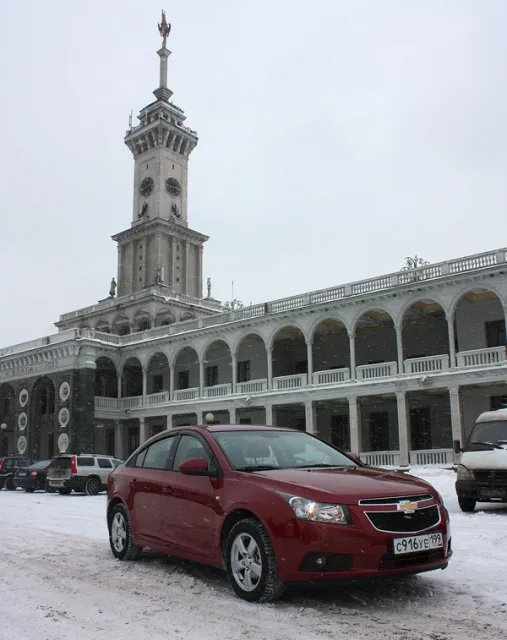
Chevrolet Cruze:"cruiser" of the golf class Photo: Timofey Isaev. Auto.Ytro©
The name matches the appearance — Cruze, derived from the English cruise, clearly hints at the target audience: young, ambitious, and those who have already managed to save up for a "slightly bigger" car. And what awaits them inside?
Set sail!
You open the driver's door and enter a world of beautiful modern lines. Your gaze glides from bottom to top and inward: from the glowing sill plate, past the air vents to the very successful instrument binnacles that tempt you to press the gas, and to the comfortable steering wheel. The composition is completed by a stylish center console and glove box. Add to this a two-tone (and if you look closely at the shades, even three-tone!) interior trim — and the impression is quite pleasant.
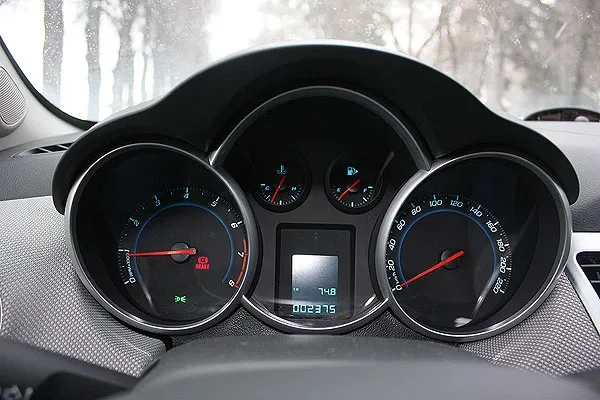
The instrument binnacles are one of the most successful places in the interior. Photo: Timofey Isaev. Auto.Ytro©
To make the impression even rosier, let's try turning on the music. "No, not this... What else do we have? — I mutter, switching stations. — Not that button, this one... So, where did everything go? What did I press? Stop, let's go back and try again. Not that again?!" The stereo, despite its external beauty, is completely illogical to control. This is not like audio systems in German cars, where everything is intuitively clear even to a child. Here you can't figure it out without the instructions. And it's also unclear: why make such a large cutout for the head unit if the screen itself is tiny, and you have to read information from a narrow line? In general, you'll have to tinker with the "music."
You also don't immediately figure out the climate control. The temperature adjustment knobs have no markings, so you turn them by feel. And in parking mode, it's also inconvenient to switch airflow modes — the gear lever gets in the way. But there's an excellent seat heating with three modes, allowing you to adjust the seat temperature as the cabin warms up. Pleasant. True, like the stereo buttons, the heating keys require a firmer press than competitors'. The same story with the doors, although the trunk lid opens surprisingly easily. Maybe this is a calculation that a real man will be behind the wheel? Quite possible: there's not even a mirror on the driver's visor — the car is clearly not for ladies. But if that man turns out to be a brutal macho, he'll have a place to put his sunglasses — there's a special box on the dashboard for that. You can also put other small items there, and if there's not enough space, the glove box will help: it's not huge, but quite roomy.
By the way, no matter what height our hero is, he'll be quite comfortable behind the wheel — thanks to seats with decent lateral support. The seat is positioned a bit low relative to the floor, but that's more a matter of taste than a drawback. The main thing is that the steering wheel is comfortable to hold in this position, and the posture itself encourages active driving.
But rear passengers will have a hard time. It's all about the flat and low-positioned seats. Surprisingly, in the back you feel like in a subcompact, although there seems to be enough space. It's just that the rear seats are clearly secondary here, like in sports coupes. For those who mostly drive alone or for a young family with one child — it's quite suitable.
To sum up briefly, the interior deserves a five for design and a solid three for comfort and practicality. The last straw was the broken blinds in one of the air ducts. Considering that our test car's odometer showed only 2,500 kilometers, the conclusion is that they don't last long. It's a shame if this isn't our nitpicking but harsh reality. However, let's see how our "little ship" behaves on the road.
Course — North! Full speed ahead!
You turn the key — and the car responds with a pleasant vibration and engine sound. An intriguing start. Let's see what this cruiser is capable of. Turning the slightly stiff steering wheel, we head to where waves splash against Moscow's shores in summer, and even far from the sea, the cry of seagulls doesn't seem strange — to the Northern River Terminal. Moscow is, after all, a port of five seas!
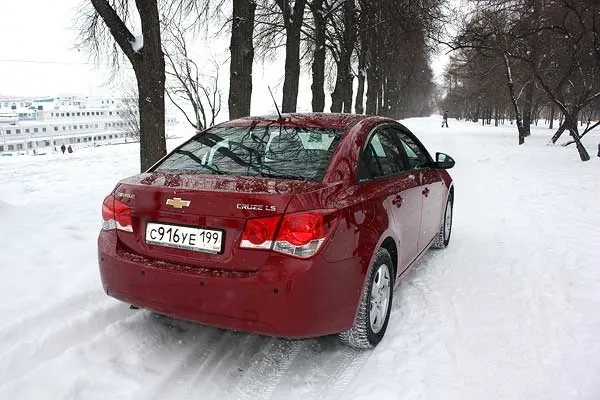
The stylish red color suits the Cruze very well. Photo: Timofey Isaev. Auto.Ytro©
And don't let the heaviness of the steering wheel bother you. In parking, it might surprise you at first, but at speed you understand that this is not a minus but a plus. And don't forget that Cruze is a men's car. Besides, everything is learned in comparison: switch to a car without power steering — and the Cruze's steering wheel will seem like a feather.
The journey to the Northern Port turned out to be eventful. It so happened that on my way there were old Moscow streets with intersections and traffic lights, broken courtyards, and, of course, the straight Leningradka highway where I could really press the gas. And on all these sections, the suspension caused no complaints — the Cruze swallows small bumps perfectly, and behaves decently on serious potholes. In corners, of course, I'd like a bit more stability, but let's not forget that creators always have to find a balance between comfort and stiffness. And in our opinion, they did it well, especially considering that our "little ship" claims to be a car for everyone. Those who want to cut waves dashingly or do police turns will choose a fast "speedboat," not a "cruiser," right?
But the engine is really good. The new 1.8-liter engine with 141 hp and 176 Nm of torque paired with an automatic transmission is exactly what the Lacetti lacked. According to the specs, with the "automatic," the car accelerates to 100 km/h in 11.5 seconds. In reality, of course, it's a bit slower, but the dynamics are still quite decent. Honestly, behind the wheel, I wanted to press the gas harder: it seems the car itself provokes active driving.
However, having accelerated to 70 km/h, this desire slightly fades. It's all about insufficient sound insulation. Perhaps against the background of the Lacetti, the results don't seem bad, but for the money they ask for the Cruze (more on that later), I'd like more.
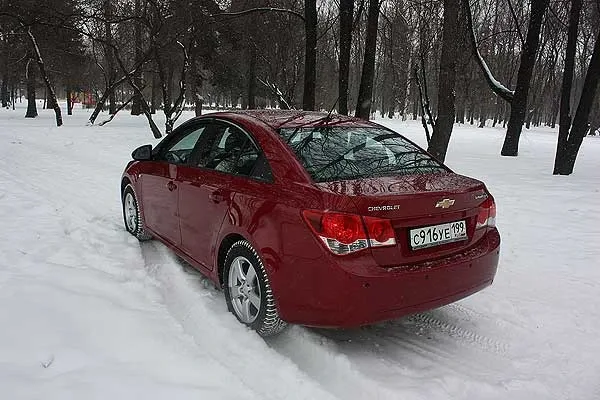
Chevrolet Cruze:"cruiser" of the golf class Photo: Timofey Isaev. Auto.Ytro©
Calling the automatic transmission's operation on our example ideal would be a stretch — small jerks are still noticeable during shifts. But calling it "bad" would also be unfair: it's certainly not experiments with a "robot" like some Japanese brands, nor slow units that think for half an hour. The best way to describe this automatic's work is "normal." Plus, there's a manual mode — it seems like it's almost everywhere now, but for some reason, it's pleasant to use here.
In the urban cycle, the car consumes about 9 liters per hundred — an excellent indicator for such dimensions. The engine itself meets the Euro-IV environmental class. Let's look under the hood? We pull the handle in the cabin, go out to open the hood... And then it turns out that it's not so easy. Another drawback surfaces: the inner lever needs to be pulled not upward, as in most cars, but sideways. Moreover, the gap between the hood and the body is quite small — you can get dirty, and it's inconvenient. Also, the hood rests on a prop, not gas struts, which looks strange for a car costing more than half a million rubles.
Now about the price. The base Cruze starts at 540,000 rubles. This price includes ABS, four airbags, CD/MP3 audio system, front electric windows, steering wheel height adjustment, and a 1.6 engine with manual transmission. If you pay an additional almost 70 thousand rubles for the LS trim, you get rear electric windows, fog lights, side curtain airbags, and heated front seats. In the top LT version, the list expands with climate control, 17-inch alloy wheels, cruise control, rain sensor, and a six-speaker audio system. Such a Chevrolet Cruze will cost at least 708,150 rubles.
How ships are seen off...
Time to say goodbye. My cruise in the Chevrolet Cruze has ended. I was heading to a meeting and caught myself thinking that I didn't want to part with this car, although at first it seemed rather ordinary to me. Yes, there are ergonomic miscalculations, there are functional flaws, but in the main thing it is good — it is pleasant to drive, and its appearance is quite fresh. If only the price tag were a bit softer. But, as we know, nothing is perfect.
Pros: stylish design, good dynamics, comfortable suspension
Cons: ergonomic miscalculations, slightly inflated price
Author's subjective rating on a five-point scale:
Engine: 5
Exterior: 5
Interior: 4
Capacity: 4
Handling: 5
Fuel consumption: 5
Suspension: 5
Automatic transmission operation: 4
Multimedia: 3
Price: 4
Average score: 4.4
We thank General Motors and personally Roman Skolsky for providing the car.
Timofey Isaev