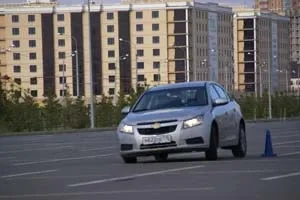
Chevrolet Cruze

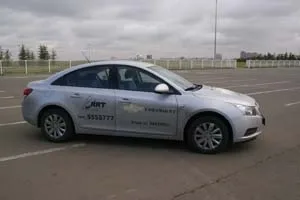
Engine — 1.6 L
Peak output — 114 hp
Maximum torque — 153 Nm at 4200 rpm
Top speed — 179 km/h
Sprint from standstill to 100 km/h — 12.9 seconds
Fuel consumption:
combined cycle — 7.8 L
city — 11.2 L
highway — 5.8 L
Six-speed automatic transmission
Curb weight — 1285 kg
Body — 4597 mm in length
Width — 1788 mm
Wheels — R16
Equipment
Climate control, electric power steering, screen, four power windows, fog lights, heated mirrors, multifunction steering wheel, audio system with CD, central locking, immobilizer, ABS, ESP.
Warranty — 2 years without mileage limit.
Price 666,000
Base version $18,226 (145,800 UAH)
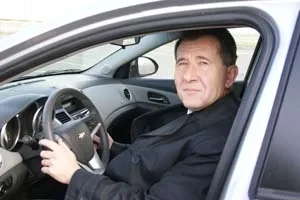
Marat Makhmutov
Chevrolet, which became the best-selling brand in Russia last year, rolled out its fresh C-class creation, the Cruze, onto the world stage in the summer of 2009. At the same time, the Lacetti, which has long been on the GM assembly line and belongs to the same segment, has no intention of giving up in our latitudes, so both cars will peacefully share the Russian market for some time. The first thing that catches your eye about the Cruze is its dimensions: at 4597 mm in length, it comes close to D-class representatives, although compared to the related Lacetti it has grown by only 48 mm. It would seem the increase is tiny — less than five centimeters — but the perception of the car as a more serious and solid purchase is guaranteed one hundred percent. The newcomer's appearance also turned out to be intriguing: due to the sloping roofline, the Cruze looks like a four-door coupe in profile, hinting at a sporty character. But, to jump ahead, I'll say: with the engine and automatic transmission on the test car, those promises remained unfulfilled. The front end is styled interestingly — curved headlights sweeping upward toward the windshield, with fenders forming a kind of bridge, a sculpted hood, and a two-tier grille divided by a horizontal strip into two unequal parts. Bulging wheel arches complete the picture. The rear, however, evokes associations with the new Honda Civic — at least, the shape of the taillights personally brought such thoughts to mind. Overall, the exterior left a more than pleasant impression.
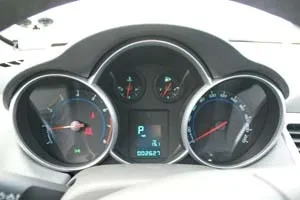
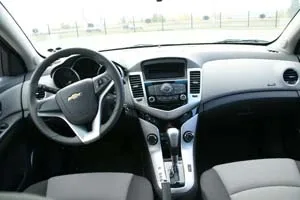
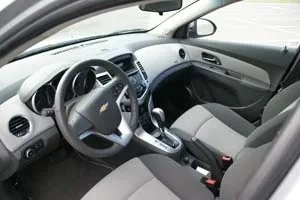
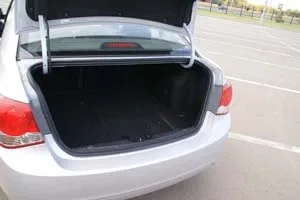
The interior fully matches the exterior sporty mood. The front area is organized so that the driver and passenger feel as if they are in a racing car cockpit — their seats are so tightly and envelopingly arranged. No, it's not that large-built people will be cramped there; it's just that with such impressive external dimensions, you expect more space up front. But in the back, the Cruze fully rehabilitates itself: passengers of average height sit with genuine comfort and freedom. Not every car of a higher, "family" class can boast such an amount of space per occupant. The comfortable seating in the rear is also aided by a neat armrest built into the seatback, with a couple of cup holders. However, we did not find a hatch for long items from the trunk into the cabin, but the trunk itself pleased with its proper rectangular shape and a solid volume of 450 liters. As for the front panel, there are both pros and cons. On one hand, I liked the architecture, build quality, and materials. The fabric inserts seemed particularly successful — they look stylish and also work for sound insulation: less plastic means fewer potential squeaks. But there is a flip side: cloth upholstery, especially light-colored, will get dirty faster and be harder to clean in real life. The shape of the instruments, steering wheel (including its buttons), and even the steering column light switch with a chrome rim is clearly borrowed from the Opel Insignia. The borrowing, I must say, is successful — from the older sibling in the concern. The "beard" and front part of the tunnel are beautifully designed: silver trim combined with black glossy plastic looks winning. But here too there is a fly in the ointment: this gloss easily gets scratched, and over time all this beauty may dull.
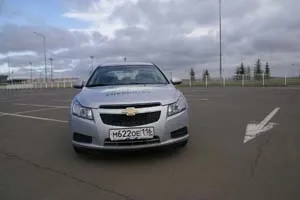
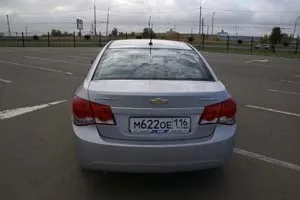
Fresh, swift design, sporty appearance, and equally drive-oriented seating for the driver and front passenger would seem to be backed by appropriate engines and transmission settings. But our test subject is equipped with a typical 1.6-liter engine producing 114 hp and a six-speed automatic with manual shifting capability, still unusual for "small cars." More gears are intended to improve torque delivery and promote fuel economy. However, the first encounter with the car brought disappointment: the engine is insufficient for such a vehicle, and the gearbox cannot compensate for this shortcoming. The problem is especially acute during active acceleration — power is frankly lacking, and acceleration comes out sluggish and not matching the throttle input. The situation is partially saved by manual mode, where you can rev the engine "to the limiter," but then its voice becomes unpleasantly loud and oppressive, although the overall cabin sound insulation is decent. There are also complaints about the steering: the wheel is rather "empty" and uninformative. If at the "zero" position feedback is still balanced, then as the steering angle increases, information about the wheels' position becomes less. On the high-speed "slalom," we managed to complete the exercise at a maximum of 75 km/h — for such a car, this is not a brilliant result.
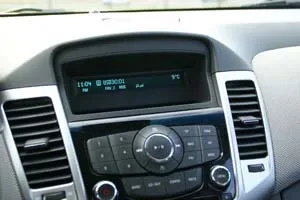
Interestingly, we got the same maximum speed in this exercise on the Citroen C3 microvan — a car of a completely different purpose. The reason is insufficient suspension stiffness, causing the car to noticeably roll and be prone to skids. Moreover, disabling ESP with the button to the right of the automatic selector on the tunnel makes cornering sequences more willing, but does not increase the limit speed — the car just dives into corners more easily, and that's it. I note that we drove the "slalom" in manual mode, in second-third gears; in automatic, the speed would be even lower, because the car simply does not have time to accelerate. On regular roads, another nuance emerged: at moderate speeds, the suspension seemed stiff and not very smooth. Here's the paradox: at a calm pace, the car is not too friendly to bumps, but during active steering — on the contrary, it is overly comfortable. It seems the engineers have something to think about. Another matter is smooth suburban highways and freeways. Here the Cruze fully matches the creators' intent: it is comfortable, quiet at legal speeds, and does not tire the driver at all. Such a car will surely appeal overseas, in America, where roads are long and endless. In our conditions, this Chevrolet can count on success only thanks to the established stereotype of "a lot of car for little money," which the big Cruze, with a starting price of 540 thousand rubles for a well-equipped base version, matches like no other in the golf class. It's just that the engines' efficiency could be refined...

Albert Dirzizov
I knew about the new Chevrolet in advance — I have long followed GM products, as I have driven Opel cars for many years myself. Back in September, the dealer invited me to the Cruze presentation, but I couldn't make it then. So I accepted the offer to participate in the test drive with great interest.
Unlike my colleagues Marat and Alfred, who approach studying new models with all the meticulousness of professionals, I decided to look at this car through the eyes of an ordinary buyer who primarily trusts emotions.
First, about the appearance. I definitely liked the design: in profile, with its sculpted forms, the car resembles a BMW 5 Series, the rear echoes the new Corolla, and the front is associated with the Grand Vitara. This is not surprising — such is global automotive fashion. I was especially pleased with the wheels: the manufacturer did not skimp on size. Even the base comes with 16-inch rims, with 17-inch available for an extra charge. True, owners will have to shell out for winter tires — that will be a significant expense. The five-spoke wheels look very organic. The fog lights not only adorn the car but, I think, also illuminate the road well.
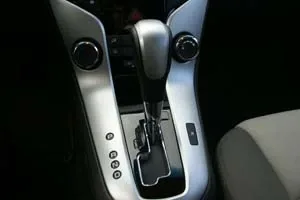
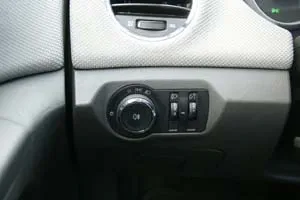
The interior, with its sporty touches, evokes Italian cars. The instruments are recessed into deep pods with chrome trim, the air vents are round, the three-spoke steering wheel is both elegant and comfortable, there are chrome inserts on the dashboard, and the seats are moderately firm with good lateral support. Overall, the impression is pleasant. But there are also obvious flaws, and I'm not the only one who noticed them. I'm talking about the fabric inserts on the dashboard and door cards: if a child drops ice cream or chocolate, you'll need professional auto detailing, which is a hit to the budget. The upper glovebox is also poorly placed — it immediately reminded me of the Gazelle, where the lid of a similar box would warp in the heat and stop closing. Moreover, small items will rattle in it forever over bumps, and you can't put anything large in there anyway. The thin plastic trim above the instruments also raised concerns — I suspect it will start to squeak on uneven roads over time. Among the ergonomic miscalculations, I'd note the light control unit, which is hidden behind the steering column, and the small buttons scattered across the console without much logic. It's especially annoying that the air conditioning and recirculation buttons are located behind the gear lever — reaching for them requires taking your eyes off the road, which is a safety issue. It's a pity we're not in Europe: an old KAMAZ puffing diesel exhaust nearby ruins all the pleasure of the drive.
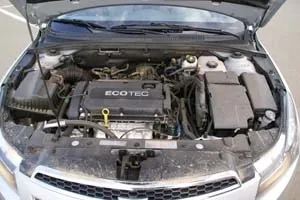
Thanks to the micro-lift and wide adjustment ranges of the seats, it's easy to get comfortable behind the wheel, which also adjusts in two planes. There's enough space: both front and rear passengers won't feel cramped, and knees don't hit anything. And there's ample headroom, even for driving with a hat on.
As the manufacturer claims, the Cruze is built on the platform of the new Opel Astra and is equipped with engines from the same range — 1.6 and 1.8 liters. These engines are decent: torquey and moderately thirsty. My Vectra and other cars of the brand confirm this. But the Chevrolet Cruze behaved strangely. During the test, it accelerated sluggishly, with a howl at high RPMs, the six-speed automatic shifted without haste, and fuel consumption was considerable. When overtaking, I really had to strain to complete the maneuver. It seems the issue lies in the combination with the automatic transmission: 114 horsepower is clearly insufficient for energetic driving. I'm sure that with a manual transmission, the car would be completely different. Especially if there were a more serious engine under the hood. As far as I know, the manufacturer plans to expand the engine lineup, up to a turbodiesel. I think we'll still have a chance to try the Cruze with a more powerful unit. And the version with the automatic is clearly designed for calm, measured driving — and, in my opinion, would suit women perfectly.
The car handles well. The steering wheel is informative, with pleasant effort. The brakes also pleased: the car stops exactly where you plan. In corners, body roll is moderate. The suspension handles road imperfections decently. However, on bumps, impacts were felt from the rear. This might be a design feature, or it could be due to overinflated tires. In my opinion, an independent rear suspension would be more appropriate here. But that would be a completely different price point.
On the highway, the Cruze showed its best side: both dynamics and handling are up to par, and fuel consumption noticeably dropped. It was genuinely pleasant behind the wheel. Acoustic comfort is also top-notch — at high speeds, you can talk calmly without raising your voice. Interestingly, it was on the highway that the automatic revealed its advantages, although cars with automatic transmissions are usually chosen primarily for the city.
To sum up, the Chevrolet Cruze left a mixed impression. On one hand, it's a modern, attractive, comfortable, and quite competitively priced car for a wide range of buyers. On the other, the manufacturer has clear shortcomings that, hopefully, will be fixed over time. Then it would be safe to recommend the new Chevrolet to friends and acquaintances.
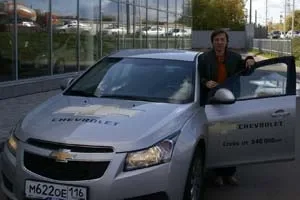
Alfred Mardanov,
"Autoclub-Kazan"
The global auto industry, despite financial troubles, continues to delight with new products. Here, Chevrolet has introduced a model that is completely uncharacteristic for it. Why? Because previously, the brand's cars were essentially variations on the Daewoo theme. This left its mark, although their design was always in order. And the new Cruze, you'll agree, is a completely different matter: more interesting, fresher, it can well claim the status of a fashionable car. True, the manufacturer itself, for some reason, addresses it to an adult audience. That's what we'll figure out during the test. So, the car sits on a new platform that will soon underpin the new Astra as well. Externally, the Cruze is very attractive; its lines create a dynamic image: the hood paired with the headlights, the sloping roof, and the short trunk lid. There's something of the Mazda 3, something of the BMW, and something else vaguely familiar in it.
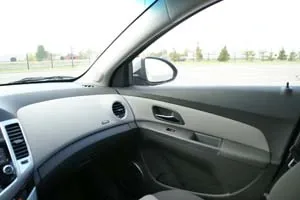
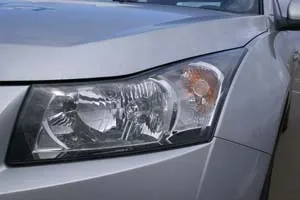
Judging by the promotional brochures, the car was conceived as inexpensive but generously equipped. The list of available options is indeed wide, and many of them are rarely found in this class. By European classification, this is C-class, but the manufacturer insists it's more like C+. And not without reason: the car is very spacious, especially in the back. Even with the front seat pushed all the way back, you can sit behind it without issues — at my height of 176 cm, my knees don't touch the backrest. Two rear passengers will be very comfortable, especially with the armrest and a pair of cupholders. The only thing that caught my eye immediately is that the seats are flat and hard. This applies to both the leather and fabric interiors. However, the driver's seat is beyond reproach, although adjusting it requires twisting your left wrist — otherwise, you can't reach the handle. The designers did a great job with the workspace: both the instrument panel and the dashboard turned out interesting. I like everything, although the greenish digital display looks a bit old-fashioned. But it's perfectly readable. The small display in the center could be larger and more informative, but that's already more expensive options. The steering wheel with a trendy triangular insert perfectly matches the unusual panel, and the recessed pods of the speedometer and tachometer add sportiness to the interior. Overall, the cabin looks fresh and unusual, which, you'll agree, is rare nowadays. The quality of materials matches the class, parts are fitted tightly, and there's nothing to complain about in assembly. The fabric inserts are a nod to the famous Corvette, where such a solution was used back in the mid-last century. And although they look easily soiled, the manufacturer has treated the fabric with a special compound that will prevent it from "aging" and help resist dirt. By the way, an interesting point: the first about a thousand cars of Korean assembly imported to Russia have an engine power of 114 hp, while versions to be assembled near St. Petersburg will have 109 hp. Even though the engine seems to be the same — the time-tested Ecotec.
A six-speed automatic is already commendable. Even a five-speed gearbox is not available to everyone in more expensive segments, and here there are six gears at once. True, for such a large car, a 1.6-liter engine might be a bit weak — but we'll check that. We proceed as usual: pick up the car and head to the site where we'll perform the "slalom." I get behind the wheel first. The drive to the track is considerable, so I'll also assess the Cruze's behavior in city traffic.
The car starts off briskly, but then the enthusiasm fades. There's clearly not enough thrust. You need to handle the gas pedal carefully with this car: if you press it "to the floor," you won't get results. But pressing about halfway down gives a noticeably livelier response. The six-speed gearbox calmly handles the engine's power, and with smooth acceleration, the responses are quite adequate. Gradually, the car's concept emerges: the advertisers didn't lie — the car will indeed appeal to older drivers.
The Cruze doesn't encourage aggressive driving. It behaves like a representative of the higher D-class — sedately and solidly, although its appearance, as I noted, is quite dynamic. Marat confirmed: at the site, we both achieved the same result in the "slalom" — 75 km/h. In the first runs, I even forgot to turn off the ESP. With the system off, the car dives into corners more eagerly, but it doesn't change things radically: exceed 75 km/h slightly — and you miss the final gate. Strangely enough, the steering responds well, the car tries to hold the line tenaciously, but the final turn still remains behind. And here's the surprise: the ESP here turns off for real. Previously, I'd only encountered this on one very expensive car. Usually, "disabling" stability control is just shifting the activation threshold, and in a critical situation, the electronics still intervene. But on the Cruze, it's an honest shutdown: the system no longer reminds you of itself, fully trusting the driver. Surprising but true. Thinking about the car's behavior in the "slalom," I concluded that the problem lies in understeer due to the body's size, not in the chassis or steering settings.
In corners, the car rolls reluctantly, which means it will hold the road quite confidently. My assumptions were confirmed on the highway: the Cruze runs stably, and if you take into account the modest engine power and start overtaking in advance, it won't cause any problems. On a fairly gentle curve at a speed well over a hundred (sorry, traffic police), the car grips the asphalt tenaciously. I expected it to hint at the rear axle sliding outward, but that didn't happen. On the next bend, the same picture, and that's good. This is what the stiff suspension is for: on the highway, the car behaves excellently and doesn't need to be "caught." Add ESP as insurance. Sound insulation for this class is more than decent — only the engine roar disturbs the silence in the cabin.
Aerodynamics are also top-notch, and side mirrors don't spoil it: they don't "hum" even at serious speeds, although they are quite large. Many manufacturers sacrifice visibility in pursuit of a low drag coefficient, but that's not the case here. (By the way, the Cruze's drag coefficient is 0.31.)
To sum up, we can say: the Cruze can offer serious competition thanks to its fresh design, reasonable pricing policy, and a rich set of options.