

 Comments (7)
 The class of crossover SUVs originated more than 10 years ago and has since been known as the most dynamic segment of the automotive market. Demand for crossovers is stable in all major world markets, be it cramped Japan or spacious America. Even in economical Europe, in recent years many customers prefer more practical SUVs over family station wagons. Therefore, only the laziest, or those who missed the SUV train and are now trying to jump on the bandwagon to grab their piece of the tasty pie, deny themselves the pleasure of selling all-wheel-drive vehicles.
For European Opel and Korean GM-DAT, building a crossover SUV is a bold experiment in many directions. How will Asian and European engineers coordinate with each other, what technologies to use, more affordable Korean or advanced German ones, etc. There are many questions, but so far there is only one answer – the Chevrolet Captiva SUV, which recently appeared in the showrooms of official dealers.
 This is actually the first experience of building crossovers for Europe and Asia within the General Motors concern. At the same time, the technologies of American Hummers and Escalades, alas, are of little use for creating crossovers. Previously, Opel produced SUVs under license from Japanese Isuzu, and Daewoo, later transformed into GM-DAT, for some time owned the Korean brand SsangYong, which collaborated with the DaimlerChrysler concern in the field of building all-wheel-drive vehicles. However, crossovers are a very young class of cars, and standards in it change so quickly that the experience of 5-10 years ago is no longer suitable for use in building a car that would sell well for at least 5-7 years.
Therefore, having joined forces, the Europeans and Koreans took into account all the world experience in building SUVs and produced the twins Chevrolet Captiva and Opel Antara. While the latter is still preparing for its Russian debut, production of the Captiva has already begun – and not just anywhere, but in St. Petersburg. Here, at the facilities of the Arsenal plant, commercial vehicles are assembled from Korean car kits using the screwdriver technology. This scheme allows significant savings on duties and, accordingly, provides a price advantage over competitors. It remains to find out whether this polyglot of Korean-German-Russian origin has any other positive qualities besides an attractive price.
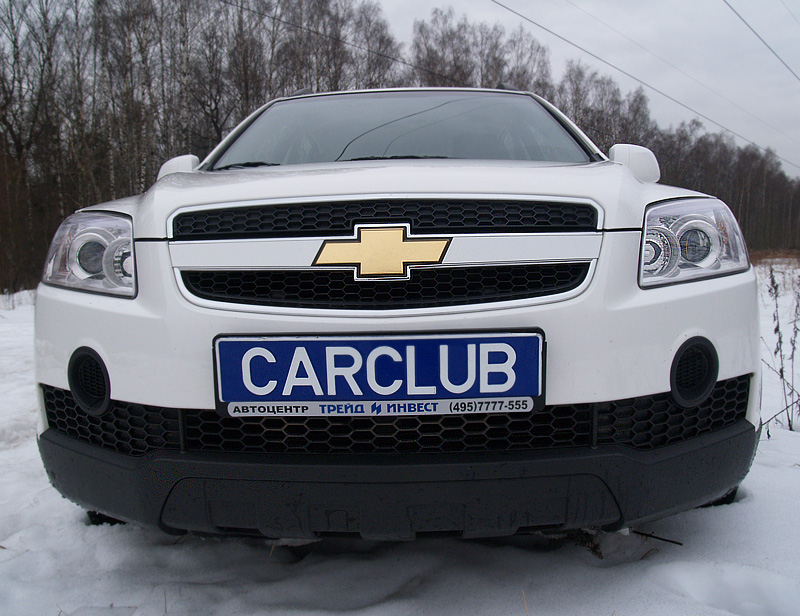
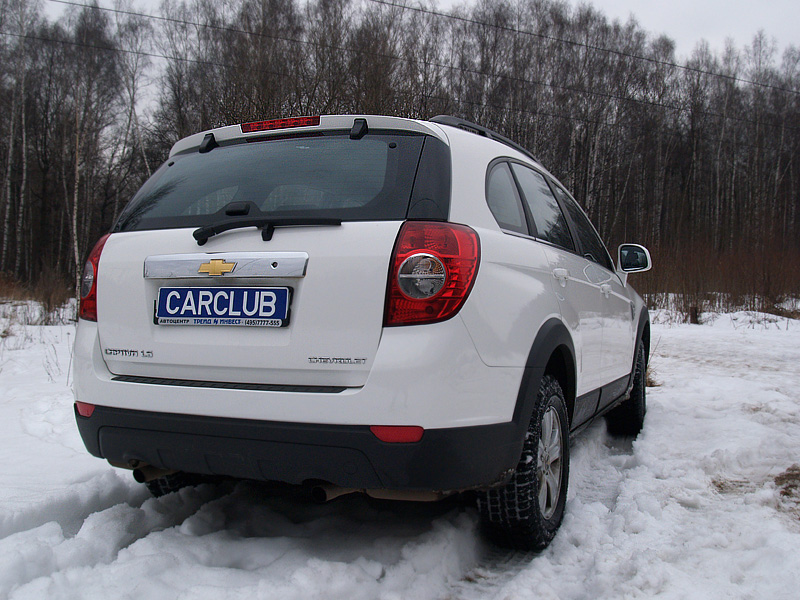
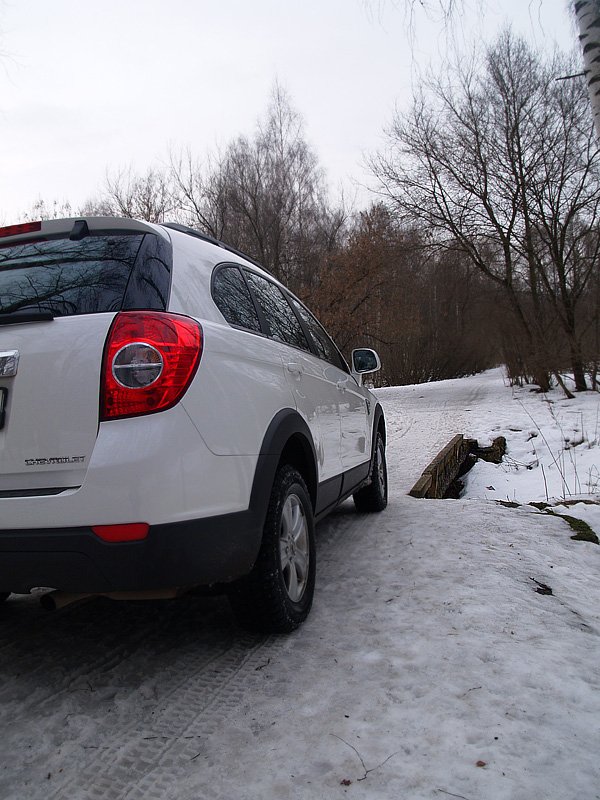
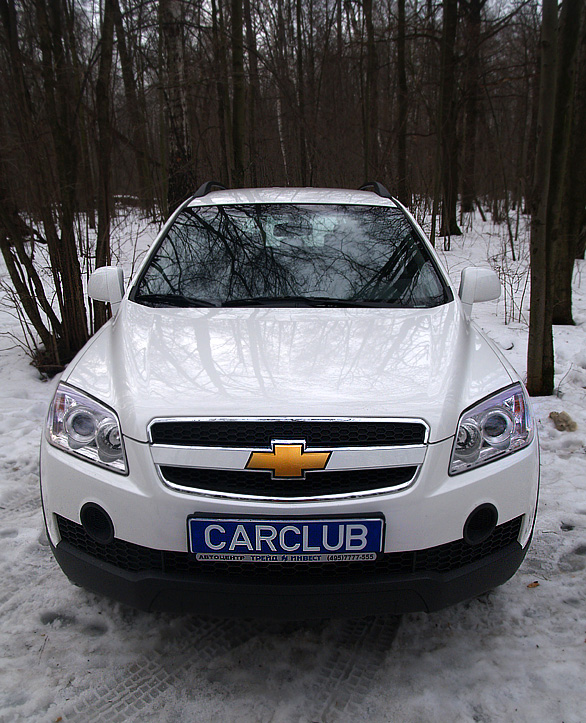
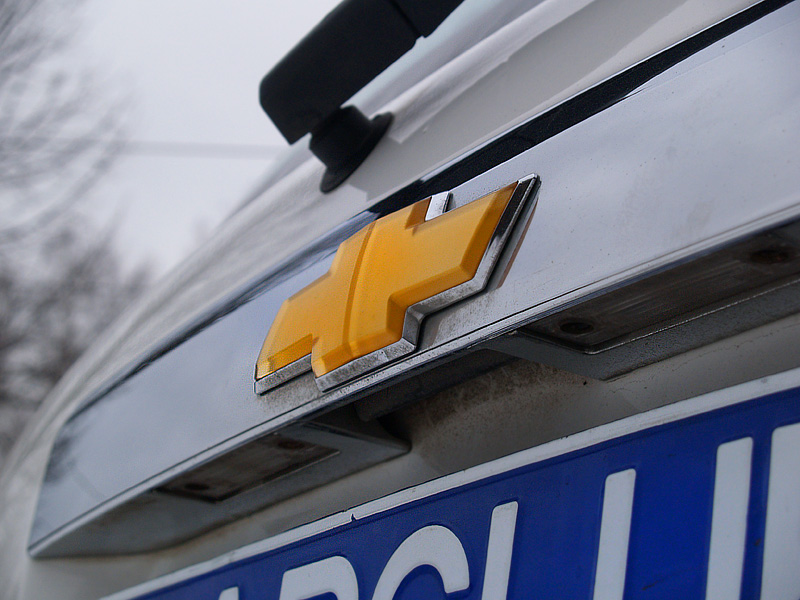
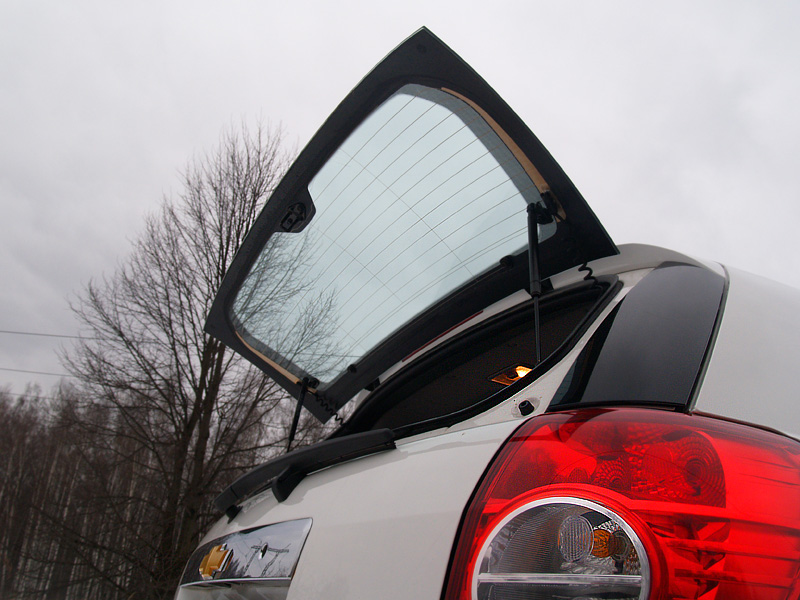
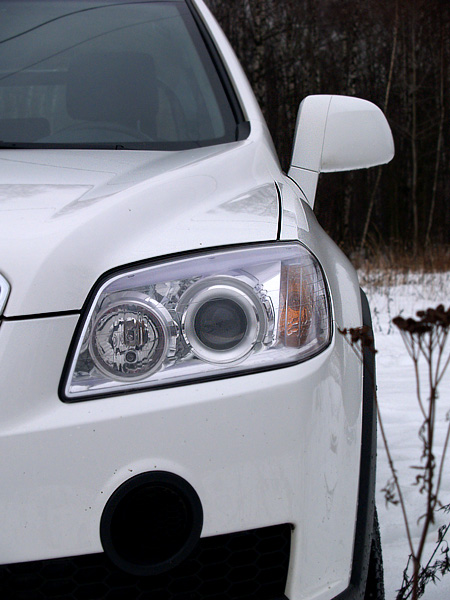
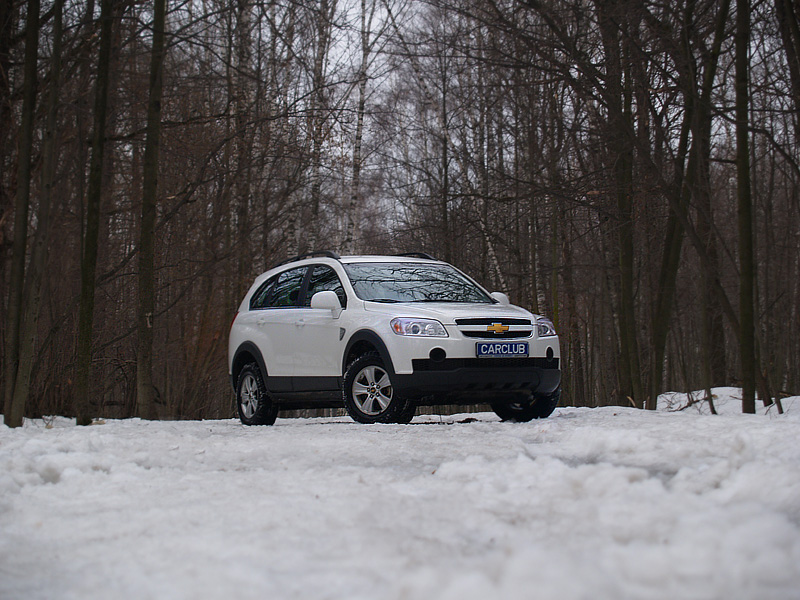
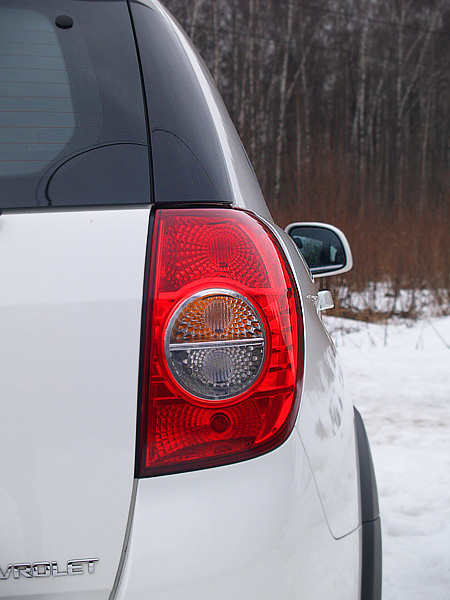
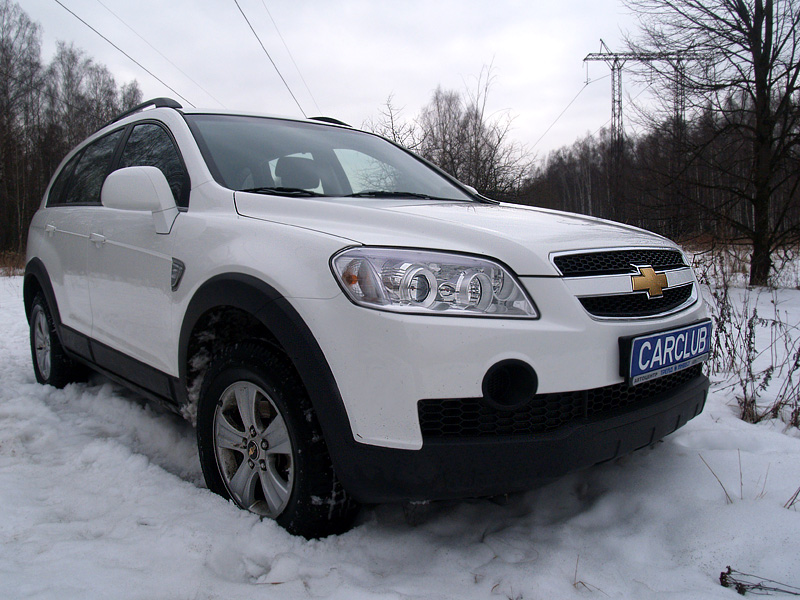 For the test drive, we chose the base version of the Captiva with a 2.4-liter engine producing only 133 hp and a manual transmission. The highlight of our car is the 7-seat interior. If more compact models like the Toyota RAV4 are mostly driven by women, then the Captiva, which is comparable in length to the Hyundai SantaFe and Mitsubishi Outlander XL, is already a purely masculine car, regardless of engine power and gearbox type. This is confirmed not so much by dimensions as by appearance. The large golden cross emblem, powerful wheel arches with black trim, especially noticeable on the white body, and long overhangs with a vengeance reveal the utility of the car: for a woman, this is the same as wearing rubber boots and a poncho. And parking such a car is not very convenient. Rear visibility through the interior mirror leaves much to be desired – behind the small glass and massive body pillars, when reversing, you can easily miss a low car or a child. This forces you to rely mainly on the side mirrors, almost like on a truck. But in these large "burdocks" you can see almost everything that happens on the sides of the car.
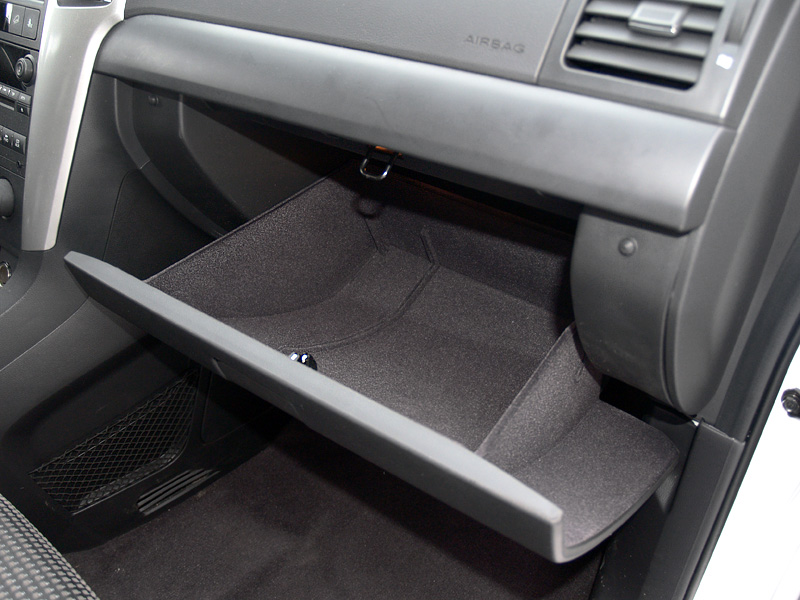
The driver's seat only confirms the impression of the car's patriarchal nature. Solid efforts on all pedals, long gearbox throws, a large steering wheel – a woman, of course, can handle all this, but she will feel uncomfortable here. And the interior trim is not very friendly – a box in the center of the front panel, covered with a visor for some unknown reason. In more expensive versions, a color monitor is installed here, but in its absence, the plug box looks very depressing. It would be better if there was an open niche for a phone. The glove box is somewhat larger than on other Chevrolet models, but it is still folding and is not cooled by air from the air conditioner, which can be needed on trips out of town, for which, in fact, the SUV is designed. In an attempt to add a twist, the developers for some reason came up with a handbrake of a non-traditional shape: with a button located on top, rather than at the end, as on all normal cars. Of course, you can get used to this, but such a scheme does not add any convenience, so its purpose is unclear.
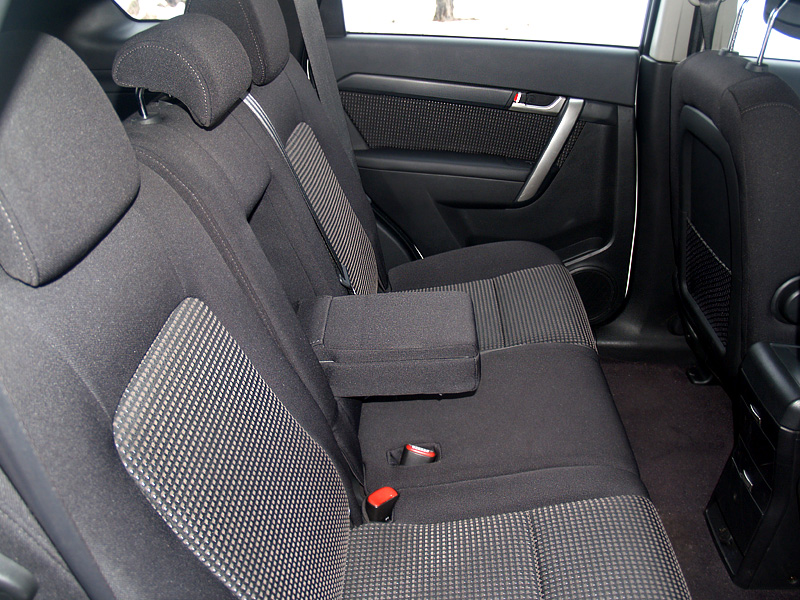
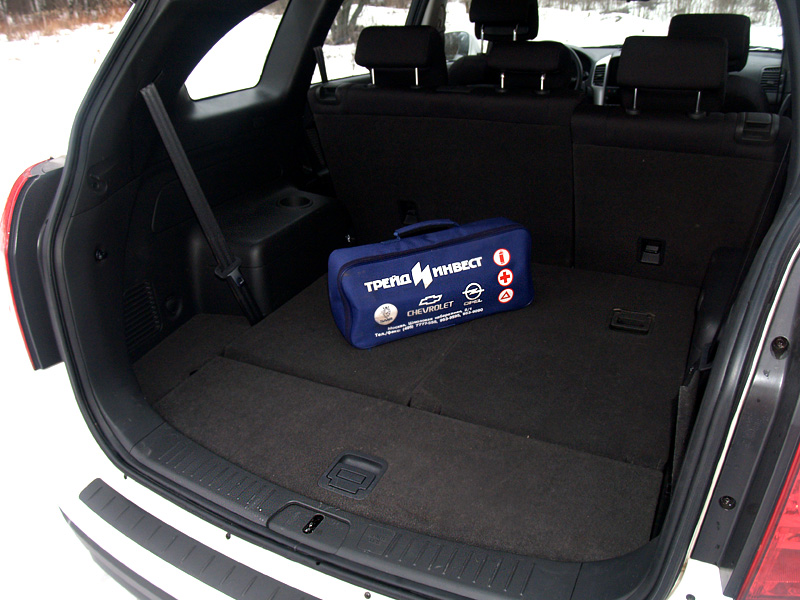
 It is better to place the wife and children in the back. There is a large amount of space in length, a completely flat floor, the seat back is divided into two parts and adjustable for angle, and between the front seats there is a pull-out 2-seat cup holder and a small box for trifles. However, the width of the body is not very large – three adults press against each other with their shoulders. By the way, for children there is also a third row of seats that folds out in the trunk. Adults are not expected here – their knees will be at chest level, so it is simply impossible to go far like that. But schoolchildren will be comfortable – their own little corner in a big dad's car. And parents should like this arrangement – children physically cannot reach the doors and accidentally open them.
On the road, the Captiva behaves as befits a large SUV – imposingly and unhurriedly. The high body does not react to ruts at all, but is afraid of side winds. Quickly go through turns? Why? If you need to avoid a suddenly appeared obstacle – the Captiva will cope. The modern design with independent suspensions and a unibody body ennobles the SUV's habits, but without need, you don't want to drive recklessly on the Captiva, and it's not really possible. Despite the quite decent 2.4-liter displacement and 16-valve cylinder head, the engine produces only 133 hp, which is clearly not enough for active driving. Even the flat torque characteristic, which reaches its peak of 220 Nm already at 2000 rpm, does not save the situation. The Captiva starts off without much agility – the large wheels and heavy transmission take their toll. To keep up with the flow, the engine has to be revved up considerably, fortunately the limiter only kicks in at 6500 rpm, although the engine delivers maximum power already at 5000 rpm. But when shifting, it is better not to rush – the long-throw mechanism may not engage if the lever is moved too quickly.
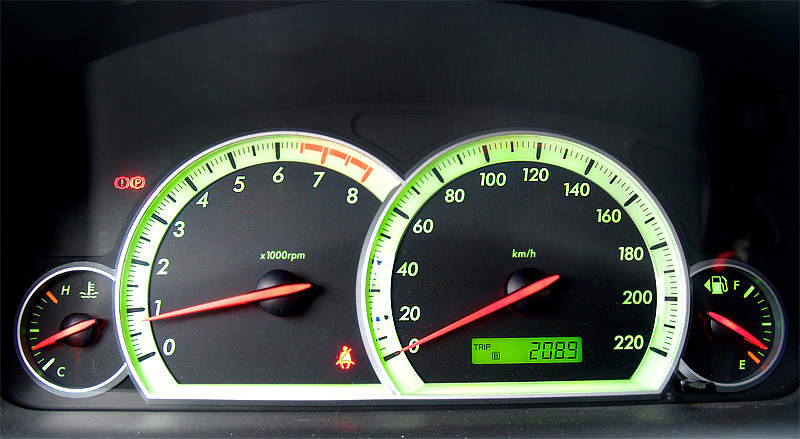
 Getting on the highway, I was mentally prepared for the fact that today I was assigned the role of a "heavenly slowpoke", but the Captiva presented a pleasant surprise, perhaps the first since our acquaintance. On the last fifth gear, the SUV easily pushed the speedometer needle past 140 km/h, then, albeit unhurriedly, but just as confidently, the figure of 160 and even 175 km/h (according to the speedometer) was reached. And this despite the fact that the declared maximum speed of the SUV is 183 km/h. It seems that the Captiva can easily reach its "max speed", but the free section, alas, ended and it was time to test the brakes. Although they are disc brakes on all wheels and formally stop the car quickly enough, the sensations behind the wheel are not pleasant. The car strongly dives with its nose, raises its rear, and wanders considerably, especially if you have to "slow down" in a rut. It is interesting how the more powerful version with a 3.2-liter engine producing 211 hp will behave? After all, its maximum speed exceeds 200 km/h, while the brakes are exactly the same...
If you avoid extreme situations, the Captiva is moderately comfortable – it is quite difficult to break through the long-travel, energy-intensive suspension on asphalt, but soft shock absorbers allow significant body rolls in corners, and sometimes body sway, which is especially unpleasant in tense turns.
Off paved roads, the Captiva performed well – significant ground clearance and toothed Cooper tires allowed it to climb quite far. However, any obstacles, be it thawed snow or soggy soil, have to be overcome only on the move, not sparing the suspension and passengers. Moving in tension is not allowed by the weak clutch and the lack of a forced locking function for the electronically controlled hydraulic coupling that connects the rear wheels. Even during calm driving, the cabin was filled with the smell of burning from time to time – either the clutch is slipping, or the degree of coupling locking is insufficient, causing it to spin. Although, to the credit of the Captiva, we did not have to run after a tractor, and we did not stop anywhere, although the car is clearly not designed for constant off-road use.
 As a result, the attempt to harness a horse and a tender doe to one cart, and at a minimal price, as expected, turned out to be... if not a failure, then a means of transportation. To be called a car, the Captiva would do well to add integrity, but as it is – neither fish nor fowl. Even the name – Captiva – is artificially synthesized and expresses nothing at all – just four wheels with an engine and a large body.
For serious off-road assaults, the Captiva lacks a more advanced transmission with differential locks, and a low-range gear would not hurt either. On the highway, the Chevrolet may appeal only to calm, undemanding drivers who switch to the Captiva from a small body-on-frame SUV, such as the first-generation Kia Sportage or the previous Suzuki Grand Vitara. The Captiva will be even more liked by those who switch to it from another Chevrolet – the Niva.
I admit that the Captiva can also be chosen by calculation: a large 7-seat SUV for 30 thousand dollars is an excellent offer, all closest competitors are at least a third more expensive. But such unions, although they can be long and strong, rarely bring true happiness, at least driver's happiness...
Text and photos: Leonid Pavlov