
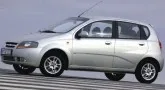
The Korean compact car Hyundai Getz has already won the sympathy of those who approach car selection rationally. But now a newcomer steps onto the stage — the Chevrolet Aveo. Can it compete with the recognized leader?
It certainly can, and we have seen this firsthand. Both cars look quite attractive: their exterior is expressive but without excessive pretentiousness. They blend harmoniously into city streets and have no clear gender or age affiliation — a true unisex on wheels.
The Getz buyer will have to rack their brains over the choice of trim level, engine power, and even the number of doors — there is a three-door version. But the future Aveo owner faces a different dilemma: which of the two completely different front-end designs to prefer. One is already familiar to the eye, while the other is completely new, with different headlights, radiator grille, bumper, and fog lights. It is in this guise that the Chevrolet Aveo appeared before the public, although it was originally known as the Daewoo Kalos. This front-end styling is much more reminiscent of the work of masters from the Giugiaro studio than what we are used to, even though the "parallel" Aveo also bears their hallmark.
In terms of dimensions, the cars are practically indistinguishable. Without checking the technical data, hardly anyone could say which car is larger. To be completely precise, the Aveo is slightly longer than the Getz, but the difference is measured in millimeters. Inside, the situation is similar: there is roughly equal space, so claiming that the Aveo is noticeably more spacious would be an exaggeration. However, sitting is still more comfortable in the Getz. This is primarily due to the better-designed seats from an ergonomic standpoint. Additionally, unlike its competitor, the Getz has an adjustable rear seat backrest angle, which is a pleasant bonus.
As for the interior design, the cars are also on par. But if one is picky, the Getz looks more "European" in terms of finish quality and material selection, while the Aveo leans toward Korean traditions diluted with a slight Italian influence. Just look at the instrument binnacles and central air vents.
However, the situation with the trunk is different. In the Aveo, it is 34 liters smaller, and with the rear seats folded, it is a full 150 liters less. The secret lies in the different folding mechanisms. In the Aveo, everything is elementary: the backrest simply falls onto the cushion. In the Getz, you first have to fold the backrest onto the seat, then tilt this assembly toward the front seats. It takes a bit more effort, but what a gain in volume!
Under the hoods of our test cars were engines of almost equal displacement — 1.4 liters, but their output differed. The sixteen-valve Aveo engine produced 94 hp, while the Getz made do with 82 hp. However, in practice, the difference in dynamics is almost imperceptible. Technically, it is those 0.4 seconds to 100 km/h that you would not notice without a stopwatch. But the fact that the Getz's top speed is 10 km/h lower can be seen. Yet what sensible driver would push such a car to 176 km/h? First, it is frightening, and second, after 140 km/h in both cars, you forget about comfort: sound insulation is weak, and the body makes itself known.
There is another difference related to the engine. The Getz easily handles 92-octane gasoline, while the Aveo requires only 95-octane. Given that both have 45-liter tanks, refueling the Aveo will consistently be more expensive. And this is with almost identical fuel consumption.
The suspensions and brakes of the cars are similar, so their road behavior is roughly the same, except that the Aveo feels slightly stiffer. But the gearboxes are a separate story. The Getz's manual transmission delights with precise and crisp shifts. The Aveo, on the other hand, has obvious problems here: gears engage sluggishly, finding the right one on the move is difficult, and reverse can easily be confused with first — they are too close.
Despite such shortcomings, the Aveo is still capable of slightly displacing the king of compact cars. Especially since their prices are comparable — around $13,000 in decent trim.
Technical specifications Chevrolet Aveo // Hyundai Getz
Body – 5-door hatchback
Curb weight, kg – 1085 // 1045
Gross weight, kg – 1525 // 1530
Dimensions, mm:
- length 3880 // 3810
- width – 1670 // 1665
- height – 1495 // 1490
Wheelbase, mm – 2480 // 2455
Trunk volume, l – 220/980 // 254/1130
Maximum speed, km/h – 176 // 166
Acceleration time to 100 km/h, s – 11.1 // 11.5
Reference fuel consumption, l/100 km:
- urban cycle – 8.6 // 8.8
- suburban – 6.1 // 5.3
- combined – 7.0 // 6.4
Fuel tank volume, l – 45
Fuel grade – A-95 // A-92
Engine:
- type – petrol, inline, 4-cylinder
- displacement, cm3 – 1399 // 1341
- power, hp at rpm – 94/6200 // 82/5500
- torque, Nm at rpm – 130/3400 // 119/3200
Transmission – manual, 5-speed, front-wheel drive
Tire size – 185/60R14 // 175/65R14
Wheel suspension:
- front – independent: McPherson
- rear – semi-independent, coil spring
Brakes (front/rear) – disc, ventilated/drum
Steering – rack and pinion, with power steering
Price, $ – 12,850 // 12,790