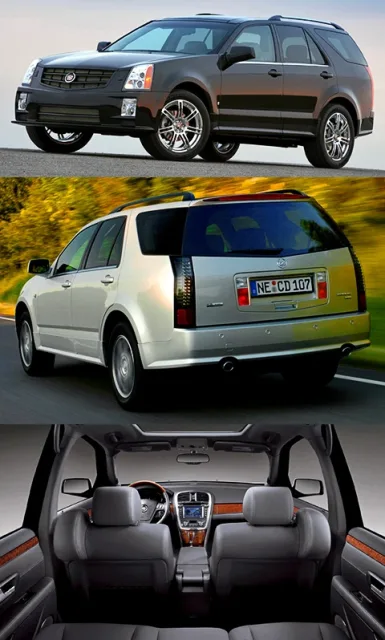
In person, the SRX looks no worse than in the first official photos. It's taut, with sharp edges on the taillights and a deliberately rugged front end in the spirit of the flagship Escalade. There's no trace of the previous model's angular hunch, and the most memorable exterior detail is the sharp stamping that cuts across the side of the body from fender to fender. A real macho!
Cadillac seems more compact than its predecessor. And that's not surprising: the switch to the front-wheel-drive Theta Premium platform reduced the length to 4833 mm (-117 mm), and the wheelbase shrank by 153 mm to 2807 mm. But personally, I didn't think this affected passenger comfort. There's about as much room in the back as in the old SRX. Up front is also spacious, although the wide center console with a V-shaped insert visually creates a sense of tightness.
The front panel with separate "trumpets" for the instruments looks nice, but the leather that's pleasant to the touch only covers the top. And where your hand touches it most often, there's hard plastic of not the highest quality. Another debatable point is the abundance of buttons to the right of the driver. There are about forty of them, and the climate control unit and its display are too far apart. The seating position is more car-like, and the steering wheel adjusts for reach as well, over a wide range. It's just a pity that it's done manually. The pedal assembly was supposed to have a power drive, but that function didn't work... Flat and slippery seats are uncomfortable for slim drivers, like pants a couple sizes too big. But tall and stout riders will likely be satisfied.
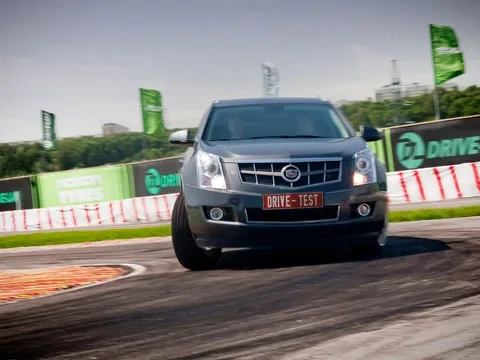
The test track turned out to be twisty. Sorry, buddy Caddy, you'll clearly be cramped here! First, a couple of laps at a calm pace — no surprises. The steering wheel with a dead zone around zero fills with quite informative effort as the steering angle increases, body roll is small, and the brakes work flawlessly. Perhaps only the six-speed Hydra-Matic, even in relaxed mode, can't keep up with the three-liter "six": the SRX either hesitates for a moment when you press the gas, then sharply lunges to catch up.
As speed increases, the "automatic" completely fails to match the rhythm of the winding track. And Sport mode doesn't help here. Using manual shifting is just a toy: the delays in gear changes are too long. However, even with fast steering wheel rotation, it doesn't bite, and the SRX responds to the driver's commands almost without delay. Well, the fact that steering feel is lost during sharp course changes is not a problem. It's not like we're on a kart track. After all, it's a Cadillac. And a very important one. If not by image, then by status for sure. Big hopes are placed on this car in Russia, as it will be assembled at the Kaliningrad "Avtotor" plant, where commissioning work is currently in full swing.
On the smooth asphalt of the autodrome, we're unable to assess ride smoothness. Ideally, the suspension here has adaptive electronically controlled shock absorbers. Their control unit processes data from vertical movement sensors every two milliseconds. But such systems have a habit of surprising in real conditions. I can't even judge acoustic comfort. It seems quiet in the car, but the speed barely exceeds 50 km/h. (In such tightness, that's more than enough.) And on the highway, wind and 18-inch tires could change the picture beyond recognition — look at the Cadillac's front end! More elegant than before, but it still doesn't look very streamlined...
But we can talk about prices with confidence. The Cadillac SRX with a naturally aspirated engine producing 269 hp will cost from 1,760,200 rubles (for the Base version). This price includes xenon headlights, power tailgate, and leather interior with power-adjustable front seats... Competitors are more expensive: the Japanese, for example, ask from 2,226,000 rubles for the smaller Lexus RX. And the Germans offer BMW X3 xDrive20d (177 hp, 1,803,000 rubles), Audi Q5 2.0 TFSI (211 hp, 1,799,500 rubles), and Mercedes-Benz GLK 220 CDI (170 hp, 1,680,000 rubles) for comparable money. And the Swedes are no better: for a 185-hp diesel Volvo XC90 2.4 they ask from 1,726,900 rubles. The Cadillac has a price advantage. It will likely remain in the case of the 300-hp supercharged SRX 2.8 modification, which will also be available to Russians. Note that the small 333-hp Infiniti EX37 costs at least 2,043,500 rubles...
At first acquaintance, the SRX made a mixed impression. It's no longer an "American," but not yet a "European" — like all current Cadillacs. For example, in terms of the quality of finishing materials and ergonomic refinement, the SRX doesn't measure up to rivals from adjacent classes, but it's also cheaper. Is the compensation adequate? Having peeked at the Cadillac with one eye, I'm not yet ready to answer that question definitively. Much remains to be figured out. I hope we'll have the opportunity to bring the SRX to light.
Two-zone climate controlSteering wheel with many functionsHeated steering wheelAdjustable steering column (tilt and reach)Mirrors with electrochromic coating, heating, and power drivePower-adjustable front seatsDriver's seat memory functionSeparate seats for the second rowHeated front seatsRear sunshadeRadio with CD and MP3Built-in Bluetooth hands-freePower tailgateImmobilizerAnti-theft alarmLeather interior trimWooden inserts in the interiorAlloy wheels
Starting price — 1,760,200 rubles
Technical part
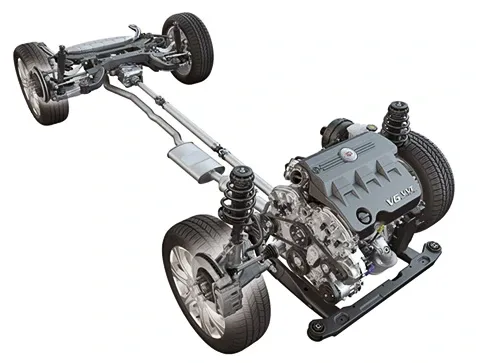
GM engineers combined two platforms — Theta and Epsilon 2, and based on them, a new Theta Premium design emerged. Up front, there are McPherson struts, and at the rear, a multi-link suspension. The same base was used for the Swedish crossover Saab 9-4X. The transmission installed on the SRX is called by Cadillac almost the most advanced in the world. Instead of the usual differential all-wheel drive, there are two multi-disc clutches — Haldex and eLSD, which are combined with the rear differential. As on the Saab XWD, the fourth-generation Haldex clutch is responsible for transmitting torque to the rear axle, and eLSD distributes it between the wheels, acting as a differential lock.
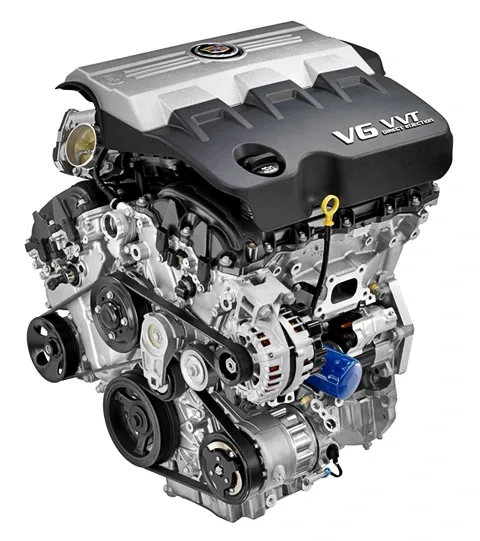
As the base engine for the crossover, a V6 with a volume of 3.0 liters (index LF1) is offered with direct fuel injection and variable valve timing. This unit is already familiar from other GM cars — for example, the Chevrolet Equinox or the Cadillac CTS sedan.
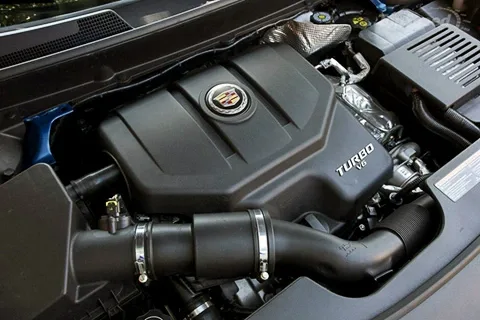
The senior version is a turbocharged "six" LP9 Turbo with an intercooler. Despite the smaller displacement (200 cubic centimeters less), it produces 305 horsepower and 400 N·m of torque.
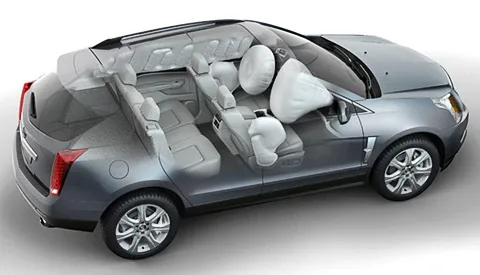
The key body areas of the SRX responsible for passive safety are reinforced with parts made of hardened steel — this helps maintain the integrity of the structure upon impact. Even in the base version, six airbags and pretensioner seat belts are provided.
Model history
The mid-size Cadillac SRX appeared in 2004 and was built on the Sigma platform, shared with the CTS and STS sedans. Buyers were offered V6 and V8 engines, as well as rear-wheel drive or permanent all-wheel drive. The interior, finished in a cheap American way, didn't match the European driving characteristics. The exterior, unusual for that time, also lived its own life. After the update in 2006, the model began to look more harmonious. Until recently, the car sold steadily, albeit without hype, in America, China, and the Middle East. In Russia, the SRX was assembled at the Avtotor plant in Kaliningrad: last year, only 333 units were sold there. The total global production didn't even reach 150,000 units.
Behind the scenes

They say that a KamAZ could easily drive onto the decks of Soviet nuclear submarines — and not just stand there, but work: unload, turn around, and leave. I'd like to see that and learn. But my back is wet with sweat, and under the gaze of the painted Schulmeister, I'm trying to fit the newest Cadillac crossover into a tight turn. Navigating such a corner without error is difficult even for an experienced kart racer. What can I say — even a toy car couldn't pass without hitting the edge of the road.