
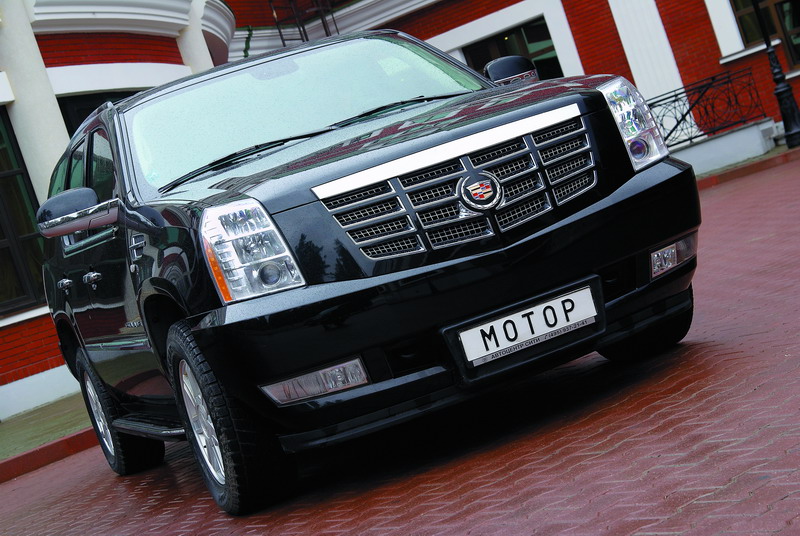
 With cars, everything is simple. One model, passing from generation to generation, can eventually transform beyond recognition. But such metamorphoses usually take years. The Cadillac Escalade clearly didn't have that time. With cars, everything is simple. One model, passing from generation to generation, can eventually transform beyond recognition. But such metamorphoses usually take years. The Cadillac Escalade clearly didn't have that time. But did the creators themselves want such changes? Looking soberly, this black monster is a real tangle of contradictions. The Escalade is bulkiness, monstrous appetite (good thing it's not picky about food), blurred handling, and, as a result, complete unsuitability for the urban hustle and bustle for which it was actually conceived. Didn't the engineers understand this? They did, even better than we do. They just have their own logic. And with this model, they are trying to prove that their approach has a right to exist. |
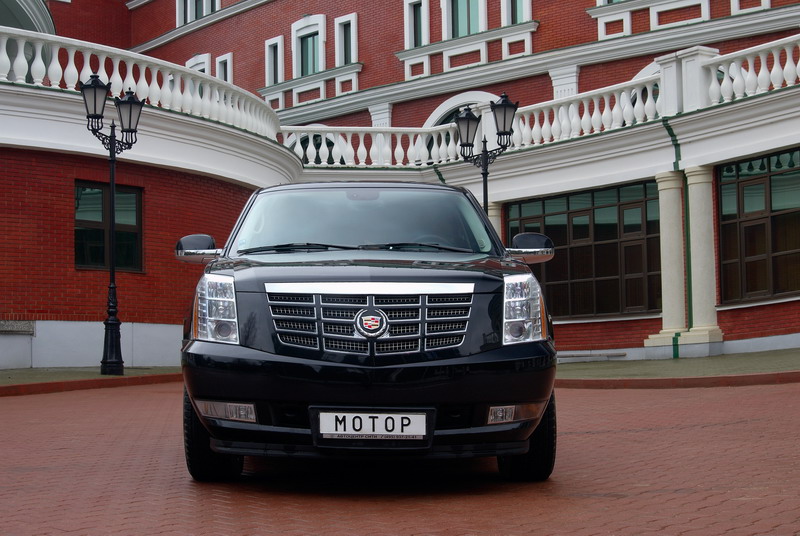
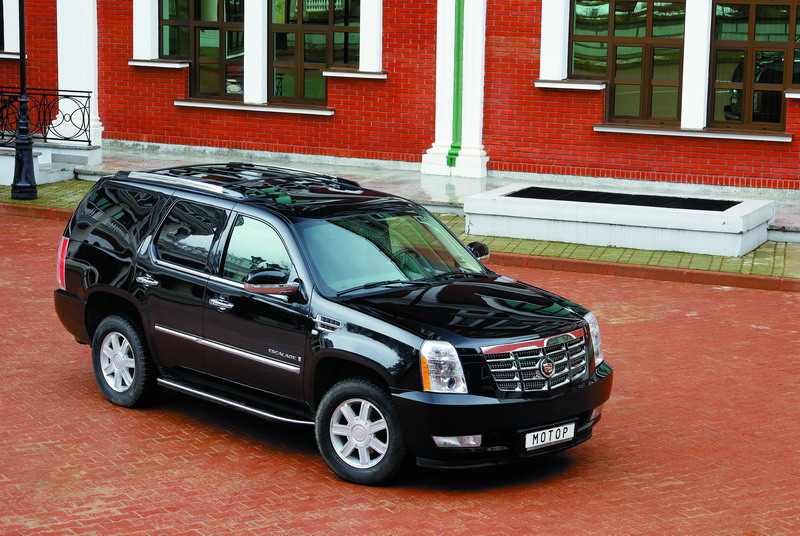
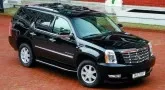
 In the American view, an expensive urban SUV should look exactly like this. If it's dimensions, then they must be gigantic — primarily in width. When I first stood next to the Escalade, my memory brought up the encounter with the Hummer H2. The same giant. Large dimensions cause inconvenience when parking and at high speed, but they also provide obvious advantages. The main one is that people around you are afraid. To change lanes, you don't even need to turn on the turn signal: everyone has long noticed this behemoth and yields the road in advance. In the American view, an expensive urban SUV should look exactly like this. If it's dimensions, then they must be gigantic — primarily in width. When I first stood next to the Escalade, my memory brought up the encounter with the Hummer H2. The same giant. Large dimensions cause inconvenience when parking and at high speed, but they also provide obvious advantages. The main one is that people around you are afraid. To change lanes, you don't even need to turn on the turn signal: everyone has long noticed this behemoth and yields the road in advance. |
 In their opinion, an expensive and large SUV should also be flashy, adorned with chrome trinkets. I understand them perfectly. If our country had as many African Americans and other lovers of extravagant style, we would have to reckon with their tastes. Although Russians generally accept the new Escalade. Power and strength are respected here — the sight of the huge front end with the wide rectangle of the signature grille works flawlessly. And the three-section vertical headlights add sharpness to the image. In their opinion, an expensive and large SUV should also be flashy, adorned with chrome trinkets. I understand them perfectly. If our country had as many African Americans and other lovers of extravagant style, we would have to reckon with their tastes. Although Russians generally accept the new Escalade. Power and strength are respected here — the sight of the huge front end with the wide rectangle of the signature grille works flawlessly. And the three-section vertical headlights add sharpness to the image. |
 The lowered bumper adds expression to the "face." It looks impressive, but I was unpleasantly surprised when, while reversing off a medium-height curb, I caught its spoiler. Geometric off-road capability is clearly sacrificed for beauty. However, who needs it? In America, they don't go off-road in a Cadillac! The lowered bumper adds expression to the "face." It looks impressive, but I was unpleasantly surprised when, while reversing off a medium-height curb, I caught its spoiler. Geometric off-road capability is clearly sacrificed for beauty. However, who needs it? In America, they don't go off-road in a Cadillac! |
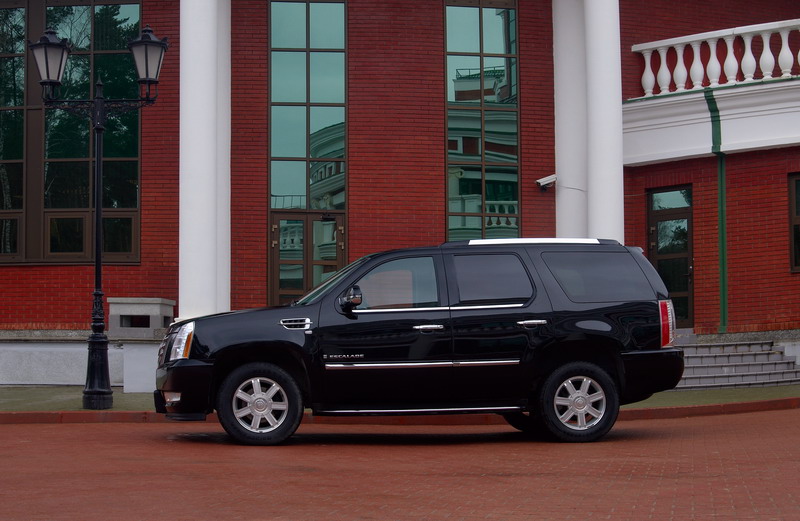
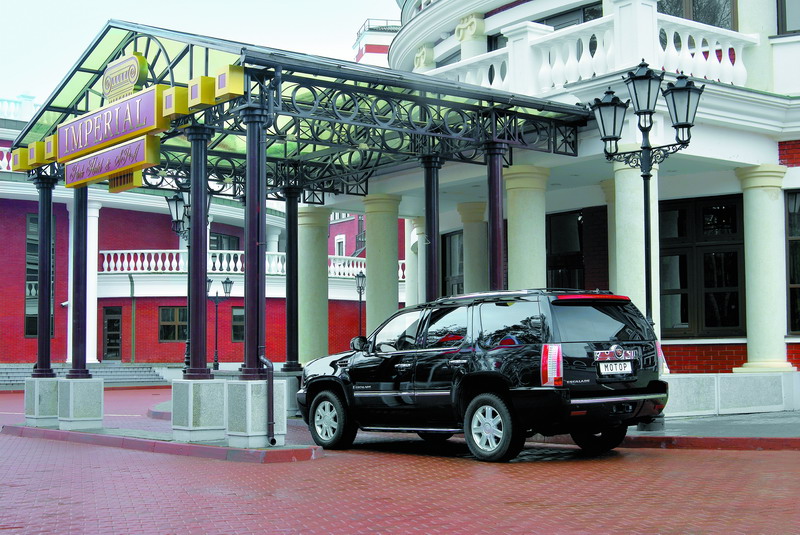
 After such a front end, the sides are a bit disappointing — they seem borrowed from the old Chevrolet Tahoe. The flat surfaces with rectangular wheel arches lack plasticity. And the 18-inch wheels get lost against this body. Wheels of 23 inches are called for here. And certainly chrome ones. Only the slits in the front fenders try to liven up the picture. After such a front end, the sides are a bit disappointing — they seem borrowed from the old Chevrolet Tahoe. The flat surfaces with rectangular wheel arches lack plasticity. And the 18-inch wheels get lost against this body. Wheels of 23 inches are called for here. And certainly chrome ones. Only the slits in the front fenders try to liven up the picture. The rear also looks rather dull. The situation is partially saved by the unusual vertical taillights and the huge Cadillac emblem on the tailgate. And, of course, the abundance of chrome. Where would we be without it? The chrome is real, coated in seven layers. It shines beautifully! |
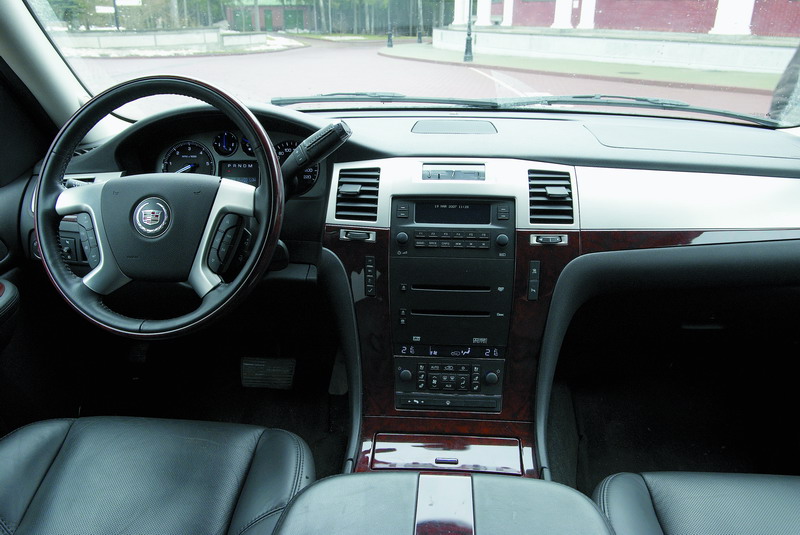 The Americans have finally realized that their ideas of a luxurious interior have long been outdated even for their own citizens. And they took measures. In my opinion, the Cadillac Escalade is the first overseas luxury car whose cabin almost without reservation meets strict European standards. The STS that visited us recently couldn't boast of that. The Americans have finally realized that their ideas of a luxurious interior have long been outdated even for their own citizens. And they took measures. In my opinion, the Cadillac Escalade is the first overseas luxury car whose cabin almost without reservation meets strict European standards. The STS that visited us recently couldn't boast of that. |
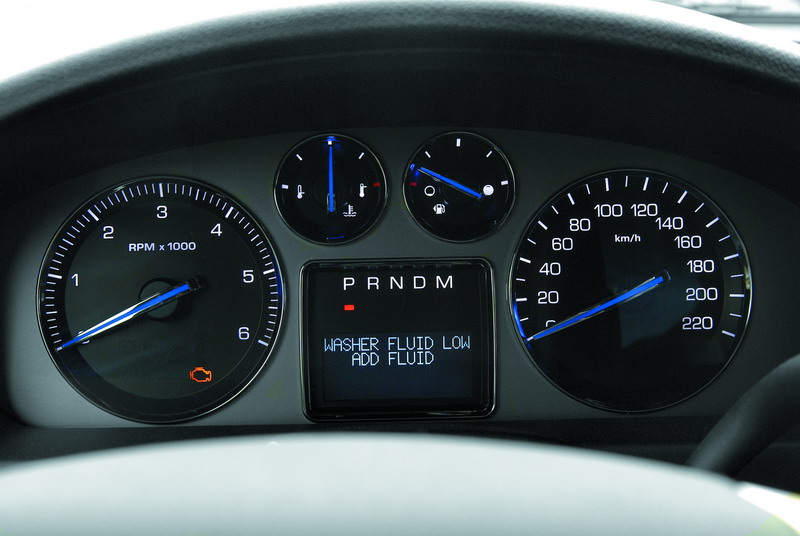
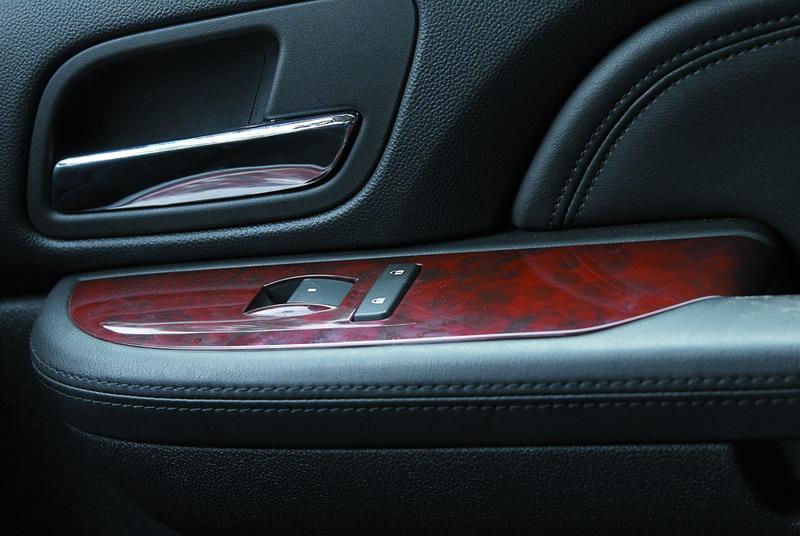
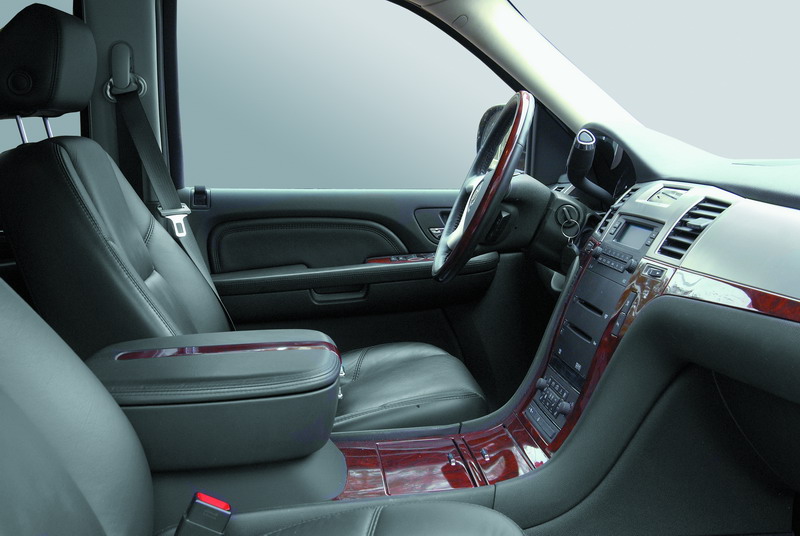
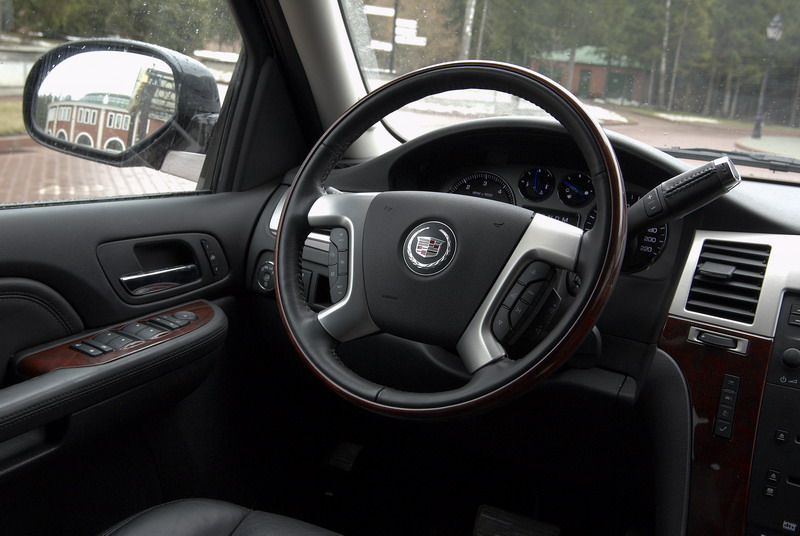 The front panel has calm, American-style smooth contours. But it no longer looks primitive — style is felt here. The plastic is pleasant to the touch and resilient. Not only on top, but also below, and on the door cards. The large wood inserts don't irritate — the texture is nice, and the wood looks appropriate in the cabin. The steering wheel with combined trim (leather and wood) is comfortable, the seats are well profiled, and the instruments are beautiful, with blue needles. The range of seat adjustments is sufficient, but the steering column adjusts only by height — that's a minus. You have to adjust the pedal assembly. The front panel has calm, American-style smooth contours. But it no longer looks primitive — style is felt here. The plastic is pleasant to the touch and resilient. Not only on top, but also below, and on the door cards. The large wood inserts don't irritate — the texture is nice, and the wood looks appropriate in the cabin. The steering wheel with combined trim (leather and wood) is comfortable, the seats are well profiled, and the instruments are beautiful, with blue needles. The range of seat adjustments is sufficient, but the steering column adjusts only by height — that's a minus. You have to adjust the pedal assembly. |
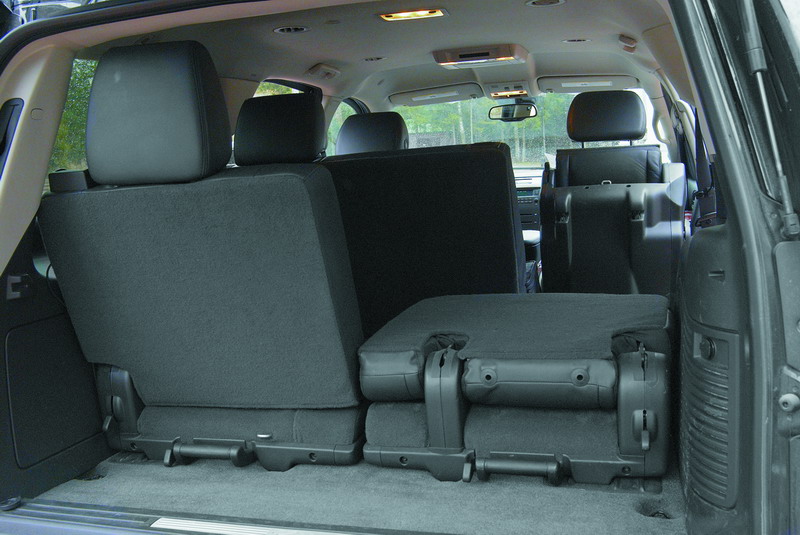 The seats are separated by a wide armrest. Perhaps the only detail that reminds of the car's Gulliver-like dimensions. Inside, there's no feeling of huge space. But objectively, five adults on two rows fit quite comfortably. True, the front passenger might complain about tight legroom — the low glove box presses on the knees. The car is long, so two additional comfortable seats were placed in the trunk. Though, it's better for people of short stature there. The seats are separated by a wide armrest. Perhaps the only detail that reminds of the car's Gulliver-like dimensions. Inside, there's no feeling of huge space. But objectively, five adults on two rows fit quite comfortably. True, the front passenger might complain about tight legroom — the low glove box presses on the knees. The car is long, so two additional comfortable seats were placed in the trunk. Though, it's better for people of short stature there. |
 The front seats are equipped with electric drive, ventilation, and separate heating for the cushion and backrest (interesting, why?). Climate control is separate for front passengers and common for the second row. In the center console, there are two slots: one for DVD and one for a 6-disc CD changer. Rear passengers have access to audio system control and seat heating. On the ceiling, there's a 7-inch multimedia system monitor, and in the front area, there are buttons for folding the second-row seats. Press once — the backrest falls with a crash, press twice — the backrest together with the cushion presses against the front seats. Alas, you can only return everything to its place manually. The front seats are equipped with electric drive, ventilation, and separate heating for the cushion and backrest (interesting, why?). Climate control is separate for front passengers and common for the second row. In the center console, there are two slots: one for DVD and one for a 6-disc CD changer. Rear passengers have access to audio system control and seat heating. On the ceiling, there's a 7-inch multimedia system monitor, and in the front area, there are buttons for folding the second-row seats. Press once — the backrest falls with a crash, press twice — the backrest together with the cushion presses against the front seats. Alas, you can only return everything to its place manually. |
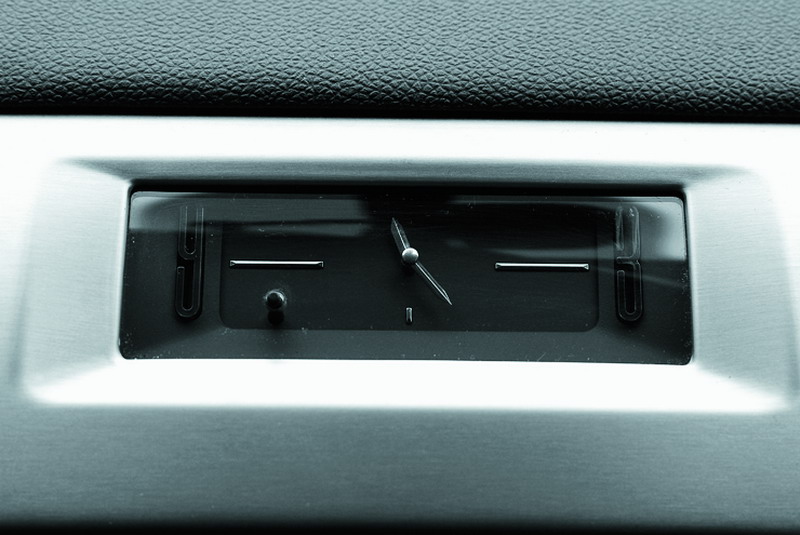
 The laconic console is made of solid black plastic. But there's a minus — the small climate control buttons at the bottom are inconvenient to operate. However, at the top, stylish rectangular clock (with numbers 9 and 3) are displayed. The laconic console is made of solid black plastic. But there's a minus — the small climate control buttons at the bottom are inconvenient to operate. However, at the top, stylish rectangular clock (with numbers 9 and 3) are displayed. The updated V8 gained 200 "cubes" (now — 6.2 L) compared to the previous engine and received a variable valve timing system VVT. The cast-iron cylinder block gave way to aluminum alloy. All this allowed extracting 403 horsepower and 565 Nm from the engine. It works in tandem with a new six-speed automatic transmission. It seemed to me that it hesitates a bit when shifting down. In any case, progress is evident — the predecessor had only four gears. The automatic is controlled by a column-mounted "lever," at the end of which there's a funny two-armed button with +/- symbols. I'll assume it will be useful only off-road. In the city and on the highway, it's inconvenient to use. |
 Some sports car would envy the Escalade's dynamics. 6.5 seconds to 100 km/h is no joke. Especially for such a giant! And what a fierce roar spreads around when the car rushes forward! The Cadillac confidently and easily reaches the maximum 180 km/h (electronically limited). I accelerated to this mark and realized it's critical. Faster — it's simply dangerous. Some sports car would envy the Escalade's dynamics. 6.5 seconds to 100 km/h is no joke. Especially for such a giant! And what a fierce roar spreads around when the car rushes forward! The Cadillac confidently and easily reaches the maximum 180 km/h (electronically limited). I accelerated to this mark and realized it's critical. Faster — it's simply dangerous. |
 To turn the wheels from one extreme position to another, you need 3.4 turns of the steering wheel. You have to turn it often to fit this behemoth into corners. Sometimes, with particularly fast rotation, the power steering performance drops, and the steering wheel becomes stiff. Unpleasant. The feedback is purely symbolic; in a turn, you have to feel for it. Things are also bad on the highway — the "feedback" disappears completely. When the speedometer needle passed 140, driving the Escalade requires more attention — constant steering corrections are needed. And the "center" is empty, empty... To turn the wheels from one extreme position to another, you need 3.4 turns of the steering wheel. You have to turn it often to fit this behemoth into corners. Sometimes, with particularly fast rotation, the power steering performance drops, and the steering wheel becomes stiff. Unpleasant. The feedback is purely symbolic; in a turn, you have to feel for it. Things are also bad on the highway — the "feedback" disappears completely. When the speedometer needle passed 140, driving the Escalade requires more attention — constant steering corrections are needed. And the "center" is empty, empty...Nevertheless, across the ocean they claim that the chassis has been noticeably refined. The frame has become 49% more torsionally rigid compared to the previous version. In the front suspension, the shock absorbers are now placed inside the springs, and the rear five-link setup has also been improved. The track has been widened: by 76.2 mm at the front and 25.4 mm at the rear. Even in the base version, the Road Sensing system is installed — these are fully automatic shock absorbers that adjust stiffness in real time and keep the body level. But, honestly, in practice you only feel a slight assistance: in corners the car still leans, and during hard acceleration it noticeably raises its nose. The system only partially suppresses these shortcomings. However, in fairness, the suspension handles longitudinal pitching quite decently. But in a calm rhythm, the Escalade shows its best side. Just ease off the pace a bit — and where bumps used to send vibrations through the body, now it simply glides, without disturbing passengers. Add to that an excellent audio system and exemplary sound insulation. On the highway, the car confidently holds a cruising 120 km/h without straining the driver, and passengers are left utterly delighted. Perhaps in twenty or thirty years, I'll get behind the wheel of a new-generation Escalade again. I doubt I'll have changed much myself — there simply won't be enough time for that. But Cadillac, who knows, might become something completely different: for example, a hybrid crossover with sharp handling. And I wouldn't be at all surprised by such a turn. Just as I wasn't surprised today to find that the new Caddy has retained all its family traits. Heredity is a force. Prices and trims of Cadillac Escalade The Cadillac Escalade is available only with a gasoline V8 producing 403 hp and a 6-speed automatic. There are three trim levels: Base — from $97,250, Mid — from $103,200, and Top — from $107,300. The most affordable version includes StabiliTrak stability control, automatic ride-height adjustment, traction control, front airbags for driver and passenger, three-zone climate control, cruise control, leather interior, front seats with power adjustment, memory and heating, a Bose audio system with DVD receiver and ten speakers, an onboard computer, rear parking sensors, a rain sensor, and 18-inch wheels. The test car was in the Mid trim, which adds a heated steering wheel, second-row seats with power-folding, leather upholstery and heating, as well as a more advanced audio system. Such an Escalade costs $103,200. |
Giant of contradictions
Heredity is a powerful thing. You try to overcome yourself, to change, to become better. At first it works, you already think you've finally made it, and then... bam! Genes make themselves known.
Test drive photos
Comments
No comments yet. Say the first word.