
The original test drive was not provided. Please paste the text that needs to be rewritten.
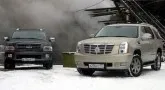
```Driving through the city center is far from the toughest challenge for a Cadillac Escalade. Many drivers themselves avoid approaching this golden giant, more than two meters wide, which majestically glides over the flow of compact cars like an iceberg. However, I would strongly advise against trying to enter a parking lot via a narrow circular ramp in such a vehicle — you could spectacularly get stuck in full view of everyone, which would deal an irreparable blow to your image. And for a Cadillac owner, that is absolutely unacceptable. After all, the Escalade only pretends to be an SUV. Its body and all-wheel drive are simply an inheritance from the Chevrolet Tahoe. In essence, it is a true limousine, a luxurious and comfortable home on wheels. It is a symbol of status, pomp, and defiance. With its size, chrome, and the crest on the grille, this colossus makes it clear to everyone who is in charge. And the low rumble of the 6.2-liter V8 Vortec completes the picture — the Escalade invariably ends up in the spotlight.
The Infiniti makes less of an impression, although it aims for the same niche. It is also huge and towers over most cars. But its appearance has less refinement and polish. This is not surprising, since the Nissan Armada did not possess these qualities, and the QX56 has not strayed far from it. The changes only affected the front — new headlights and a huge grille, and at the rear — a different bumper and LED taillights. Plus massive 20-inch chrome wheels. The Infiniti's style is emphatically aggressive: bulging wheel arches, tinted windows, and a protruding hood create the image of a heavyweight boxer. If the Cadillac is an iceberg, then the QX56 is an icebreaker, ready to plow its way through dense traffic.
This "icebreaker" is quite fast. And that is not surprising: under the hood there is almost 6 liters of displacement. Such an engine is not afraid of either the 2.5-ton curb weight or imperfect aerodynamics. When you press the gas, 325 "Japanese horses" swiftly carry the giant forward, and even the unhurried 5-speed automatic does not interfere. Torque is high across the entire rev range, allowing the Infiniti to accelerate to 100 km/h in 7.5 seconds and calmly reach speeds up to 180 km/h, where the electronic limiter intervenes. Acceleration is accompanied by the sound of the engine with a metallic tint, which is audible up to speeds of 120–140 km/h. Then aerodynamic noises prevail. But overall, the cabin is quiet, and good sound insulation masks the sensation of dynamics, which is more than sufficient for such a vehicle.
But everything would be fine if we did not have the Cadillac. Its engine with variable valve timing is half a liter larger and almost 80 horsepower more powerful, although it has half as many valves. The Escalade itself is a couple of hundred kilograms heavier, and its 6-speed automatic is even slower than the QX56's. It would seem that this should equalize the chances in acceleration. But it did not. When you press the gas, the Cadillac lunges forward like a wounded bison, with terrifying speed, accompanied by the roar of the exhaust system. And the automatic has a manual mode, where you need to shift gears with a strange button on the steering column lever — a real mockery.
For a luxury SUV, this function seems unnecessary, but it was impossible not to try it. And here is what happens: you engage first gear, floor the gas pedal, a second's pause — and this mastodon squats on its rear, raises its nose, and begins its hellish acceleration! It remains in that position until you release the pedal. The main thing is to shift up in time, twisting your arm in an unnatural way. But it is worth it! From the outside, it is a real spectacle: the sight of an almost six-meter, three-ton behemoth rearing up and surging forward is mesmerizing. At the same time, the Escalade beats the Infiniti by a second in the sprint to 100 km/h, generously bestowing unique sensations. This is real American power!
But, as they say, not by power alone. Both vehicles have complex suspensions. The Escalade has electronically controlled Magnetic Ride shock absorbers of the latest generation with a rear axle, while the Infiniti has an independent suspension with air elements. I would like the Cadillac to handle as well as it accelerates. But here, the QX56 is the winner. It responds more adequately to steering input, clearly following the intended trajectory. The driver receives a lot of information, perhaps even too much for a vehicle of this class. Whether a large SUV needs to "play sports" is a serious question. Excessive suspension stiffness and vibrations of unsprung masses do not benefit a huge liner. In corners, this does not help: the impressive weight and high center of gravity negate all efforts. Any small car turns better. And comfort suffers. But the fact that the QX56 is a much more driver-oriented vehicle is indisputable.
The Caddy, as befits a huge "American," is the complete opposite. Here, everything is aimed at not spilling the Coca-Cola or dropping the hamburger. There is a constant feeling that you are not behind the wheel but in a cozy living room. The Escalade tries not to disturb the owner and passengers. It smoothly glides over the road like a hydroplane over waves. If you do not overdo the gas, acceleration will be smooth and unobtrusive. Nevertheless, even at "half throttle," you go faster than everyone else. The work of the adaptive shock absorbers is felt almost on the skin: on high-speed straights, the Cadillac gathers itself and rolls elastically over gentle bumps, and on broken roads it becomes noticeably softer.
The goal is achieved — the Coca-Cola did not even stir. Inside, there is silence and peace. We glide on. You have to feel out the turn — the steering wheel is empty, and body roll is noticeably greater than in the Infiniti. But if you "hit" it, the Escalade enters the corner as if on rails. And on the exit, you press the accelerator again, and under the blinking light of the StabiliTrak stability control system, the huge block speeds away. Not bad for an "American."
Cars from the New World have always been famous for comfort. But the interior finish was lacking. The same previous-generation Escalade was far from handsome inside. Now it is a different matter — a huge leap forward. Everywhere there is excellent beige leather, wood and aluminum panels, and soft carpets matching the interior color. The front seats with ventilation and 14 power adjustments allow you to sprawl out like at home, leaning on the huge "chest" of the armrest. You sit high but comfortably. You can adjust both the steering column and the pedal assembly. You touch the touchscreen multimedia display with your finger and enjoy the sound of Bose. You enjoy it until you switch to the Infiniti. There, the same Bose "plays" much better and juicier. There is a sense of "stage," and the sound — very high quality — seems to come from under the hood. But the materials and layout of the center console are worse.
The QX56's interior looks like a poor relative after the pomp and shine of the Cadillac. There is leather and "wood," but it does not reach the Escalade's level. Maybe the gloomy gray color is to blame? It is surprising that the interior of Infiniti's most expensive model is no better than that of the younger FX or even the G. But we would still recommend future owners to choose a more cheerful color scheme. The seating position in the Japanese car is noticeably lower, which contributes to a greater sense of unity with the machine. But the feeling of sitting on a throne and royally looking down on everyone, as in the Cadillac, is lost.
The gigantic interior space is used somewhat differently. The length of over 5.5 meters allowed both vehicles to accommodate a third row of seats, for which a separate climate control system is provided. Getting there is inconvenient, but if you manage it, a person up to 1 m 75 cm tall will feel quite comfortable. The main difference is in the second row: the Cadillac has a solid bench seat that folds in a 2:3 ratio, while the Infiniti has two separate comfortable chairs. We have repeatedly noted the irrational use of useful volume in "Americans." And here is the same picture. With smaller external dimensions, the QX56 has noticeably more space. But that does not mean the Escalade lacks it — there is plenty. If you fold down the second and third rows, it feels like a Micra, for example, could drive into the belly of these giants. But it is unlikely that future owners will seriously be interested in transporting cargo. But towing trailers, quite possibly. Everything is fine with that: the Cadillac can tow 3.5 tons, and the Infiniti — as much as 4. You can easily haul a fairly large boat, not to mention small things like snowmobiles and scooters.
…Again, someone parked their car across the road. I feel like a tram driver: a little more, and I will have to stop and wait for the careless owner of the parked car. Yes, this is not the USA with its spacious and straight highways, where gasoline costs less than 10 rubles per liter, and the car itself is twice as cheap… So why all this suffering, you ask? Well, you can console yourself with the fact that if you are not in a particular hurry, even such a wait behind the wheel of an Escalade or QX56 is a pleasure — like being in a cozy and well-equipped living room. If such consolation is not enough, then in addition to possessing all the above-mentioned advantages, such a car allows you to feel a head above everyone else — both literally and figuratively. But it is better to be careful with that: when a dominant car becomes a tool of social self-affirmation, as often happens on our streets and roads, alas, there is little good in that, believe me. And do not forget that a certain convenience of moving in tight urban conditions in such a behemoth is a considerable inconvenience for the surrounding "little brothers." Do not offend the "little ones," remembering that behind the wheel, everyone is equal.