
Chasing the Germans
A couple of years ago, when we tested the Cadillac STS, passersby at traffic lights wondered what kind of beast was in front of them. And the answer "Cadillac" usually didn't convince them. Some had never heard the name, while others thought it wasn't a brand but a body style — something between a sedan and a limousine. That's why they'd ask: "Cadillac, that's clear. But what kind of car is this?"
Today, with massive Escalades and angular yet elegant SRXs increasingly common on city streets, the Cadillac brand is already recognized. Many know that Cadillac is a pricey American car. But not everyone knows that it was Cadillac that first introduced the electric starter. That these cars debuted V8 engines, hydraulic lifters in the valvetrain, and other advanced technical solutions. Cadillac, along with its eternal rival Lincoln, set the tone not only in the US but across the global auto industry. American presidents, rock stars, Hollywood celebrities rode in Cadillacs...
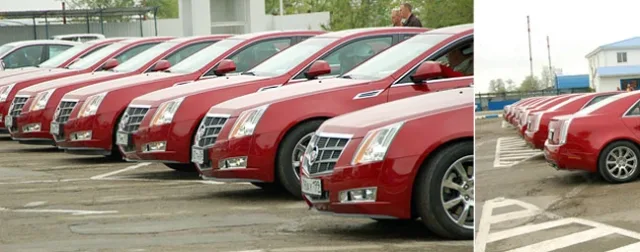 |
The world has changed a lot. Elvis is gone, rock 'n' roll sounds rarer and quieter, and huge sedans — the very cars Cadillac produced for decades — have faded into oblivion along with the King of Rock 'n' Roll. After automotive trends shifted in the States, Cadillac has been trying hard to catch up and get back to the forefront. In the 80s, Americans fought for a younger audience with the compact Cimarron. In the 90s, they stormed Europe with the front-wheel-drive Seville, and in the early 2000s, they bet on expensive SUVs and crossovers. It can't be said they failed — they succeeded, but they couldn't regain their former glory. Outside the US, Cadillac sales leave much to be desired. But now the Americans claim they've built a car that's in no way inferior to the renowned German competitors — Mercedes and BMW. That car is the new Cadillac CTS sedan, presented to Russian journalists near Anapa.
If you put the new and old CTS side by side, you immediately see they're completely different cars. But if the old CTS isn't around, it's not so easy to tell it's a new model. Vertical headlights, chiseled body lines, lots of chrome. Beautiful, distinctive, but no revolution — just another Cadillac.
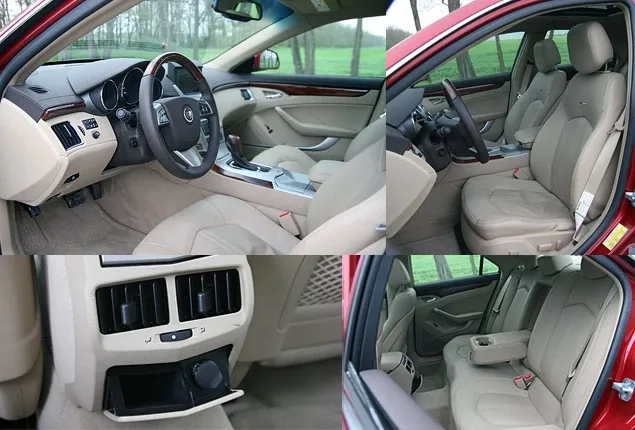
The interior, however, has changed radically. Such trim materials and attention to detail in an American car I've probably seen for the first time. True, the new Caddy falls a bit short of Mercedes — some panels are "too glossy," there are ergonomic flaws here and there, and some plastic creaks. But still, it's fair to say the Americans have reached the level of Japanese premium brands — Lexus and Infiniti. And in terms of design, they may have even surpassed them.
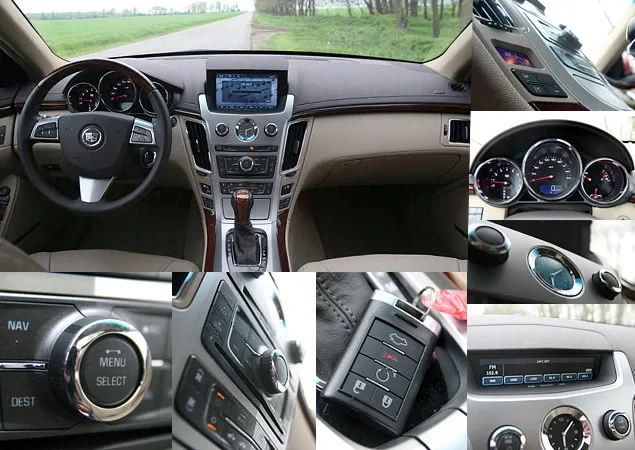 |
The new Caddy comes across not only as a high-quality car but also as one packed with technology. Just consider the LED interior lighting, the large retractable VGA display in the center of the dashboard, and the multimedia system with a built-in 40-gigabyte hard drive, 10 speakers, and a Bose amplifier. But perhaps the most intriguing option is the factory alarm with remote engine start. At the presentation, we were thoroughly briefed on how this system works, how easy it is to use, and how hard it is to bypass. We never quite figured out the tricky alarm, but we did manage to "hack" it once. Details are in the video.
In the CTS's cabin, the only thing I didn't like was the rear seat. It's mounted too low and is categorically unsuitable for long-legged passengers — knees will hit your chin. Yet the Americans claim the new Cadillac is one of the roomiest in its class in the back, especially in headroom. Maybe so, but extra centimeters don't always make a car more comfortable.
The main rival for the new Cadillac CTS is said to be the BMW 3 Series. Apparently, it was the benchmark for tuning the new CTS's driving dynamics on the Nürburgring Nordschleife. And it's the 3 Series the Americans targeted when choosing powertrains for the Cadillac: the new V6 with direct injection delivers 307 horsepower. That's exactly one "horse" more than the BMW 335i's engine. Finally, the CTS's all-wheel-drive system is very similar in layout to BMW's xDrive: torque constantly goes to the rear axle, and the front axle is engaged via an electronically controlled multi-plate clutch.
 |
So, let's see what it can do in practice? The winding roads in the north of Krasnodar Krai are, of course, not the Nürburgring, but a suitable place to test a truly driver-oriented car. Yet from the first minutes, you realize the Cadillac isn't that. It has a powerful engine, sharp steering, firm suspension — it could have been a great "energy cocktail." But the cocktail has been "diluted." Diluted by a too "thoughtful" gearbox. You approach a sharp turn, brake slightly to load the front wheels, turn, press the gas, and the 307 "horses"... are asleep, because the six-speed Hydra-matic automatic can't decide which gear to engage. The same issue arises when overtaking — after pressing the pedal, you don't know when acceleration will actually begin... The automatic does have sport and manual modes. But even they don't make the gearbox think faster.
It's much more pleasant to drive the new Cadillac fast but leisurely — handling the gas pedal without unnecessary fuss. In such modes, the gearbox behaves adequately, shifting smoothly and on time. Meanwhile, you can appreciate the excellent sound insulation (they really worked hard on it, even taming the "clatter" of fuel injectors typical of all direct-injection engines), the superb ride smoothness, and the car's stability on the highway...
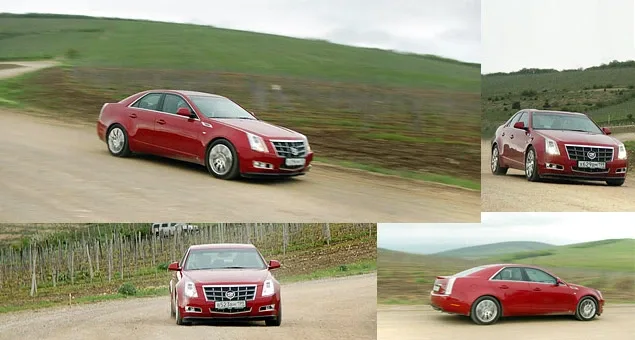 |
We descend another hill, and the asphalt ends. A smooth but winding dirt road runs to the sea along the vineyards — almost a rally special stage. After driving it, I was ready to sing praises to the BorgWarner all-wheel-drive system fitted to the new CTS. It's very hard to knock the American sedan off its line in a corner. It clings to the surface fanatically with all four wheels, allowing slight understeer only with outright hooliganism. The stability control instantly curbs that understeer. If you turn it off, you can steer the car with the throttle — the Caddy responds to the accelerator with a smooth, easily controlled drift. In short, it behaves like a thoroughbred rear-wheel-drive car. But only if you manage to switch the automatic's selector to manual mode. If you don't, the gearbox will start fumbling with gears at the worst moment. That's not just unpleasant but also quite dangerous.
While I unconditionally liked the tuning of the all-wheel-drive transmission, the suspension, on the contrary, showed its weaknesses on dirt — on rough roads it works noisily and shakes passengers unpleasantly. Of course, dirt roads aren't a typical habitat for a premium sedan. But on the other hand, our country's asphalt leaves much to be desired, and the Caddy doesn't like bad roads.
However, it's possible that the automatic's thoughtfulness and the suspension's insufficient energy capacity are characteristic only of all-wheel-drive versions. Rear-wheel-drive CTS models are lighter, have a stiffer chassis, and different transmission settings.
Prices for the new CTS (with the 210-hp 2.8 engine and rear-wheel drive) start at 1.2 million rubles. The version with the 3.6-liter V6 will cost 1 million 323 thousand, and for all-wheel drive, you'll have to pay an extra 100 thousand rubles.