
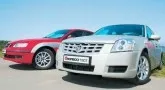
Cadillac BLS. Price: $36,100. On sale: since 2007
Saab 9-3. Price: $34,500. On sale: since 2006
2006 Cadillac BLS vs 2007 Saab 9-3
© Photo: 5 Koleso
Usually, comparing cars built on the same platform is not a very exciting task, because the differences between them are typically minimal. But it was impossible to resist comparing the Cadillac BLS and Saab 9-3. The "American" and the "Swede," born on the same assembly line, are a great reason to reflect.
At first glance, these cars seem to have nothing in common. The Cadillac looks monumental and emphatically strict, as if it had just been carved from a block of stone, and the dust hasn't had time to settle. The Saab, on the other hand, resembles a boulder that has long lain on the shore and been polished by sea waves to perfect streamlined contours. But that's only the first impression.
Upon closer inspection, you begin to notice curious details. First of all, the cars have absolutely identical roofs, and the front and rear windshields are installed at the same angle. If it weren't for the difference in door panel design, they could easily be swapped. Further, it gets even more interesting.
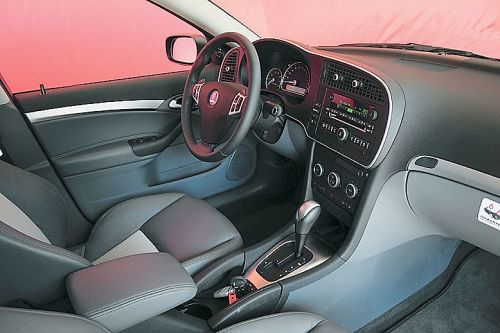
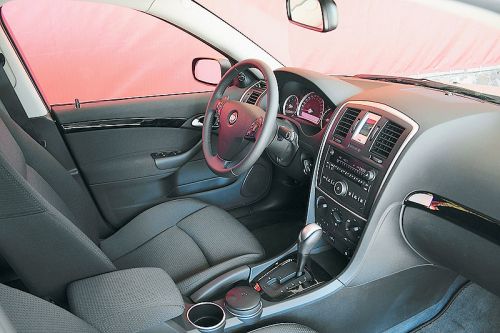
We place the cars side by side and open all the doors. If you ignore the color and materials, the interior trim is almost identical. Everything is in its place, everything is the same as in its "brother."
We shift our gaze inside and... We realize that the interiors differ only in the shape of the center console and a couple of small details.
In the Saab, the console, as expected, is stylistically merged with the dashboard. In the Cadillac, it also, by tradition, stands separately.
2006 Cadillac BLS vs 2007 Saab 9-3
© Photo: 5 Koleso
2006 Cadillac BLS vs 2007 Saab 9-3
© Photo: 5 Koleso
In the Saab, the ignition lock, by long tradition, is located on the "chin" of the center console. In the Cadillac, it is in the usual place. The cup holder in the "nine-three" is only one, and it slides out of the console. In the BLS, there are two, and they sit right behind the automatic transmission selector. By the way, this solution seemed more practical to us: the Saab's cup holder, due to its flimsy, lacy construction, did not inspire delight. As for the controls and instruments, here again there is complete unity. The only difference is that the backlighting of the instrument cluster and CD receiver is white in one and green in the other. But honestly, despite all the similarity of the interiors, we liked the Cadillac's cabin more: it is stylistically better executed and does not leave a feeling of detachment. Moreover, it is equally good from the driver's seat and from the passenger's.
The Saab, however, leans more toward egoism: everything for flight, everything for the pilot. But, as it turned out later, this is only an external pose.
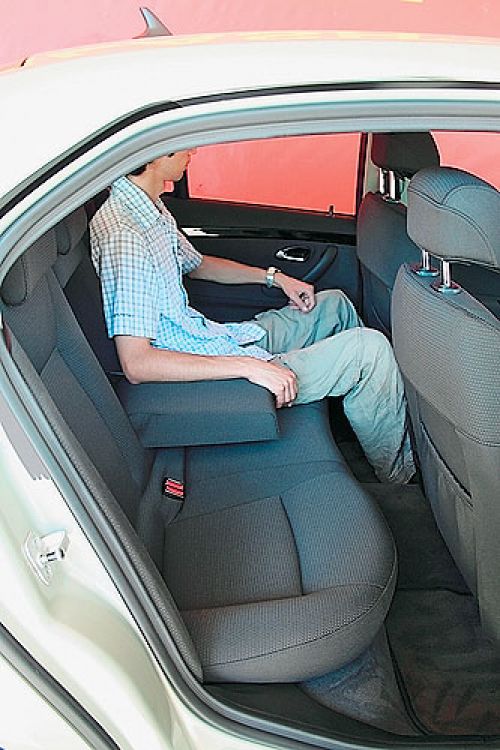
The fact is that in terms of driving qualities, the brutal BLS is in no way inferior to the "nine-three," and in some ways even surpasses it. In particular, in comfort.
2006 Cadillac BLS vs 2007 Saab 9-3
© Photo: 5 Koleso
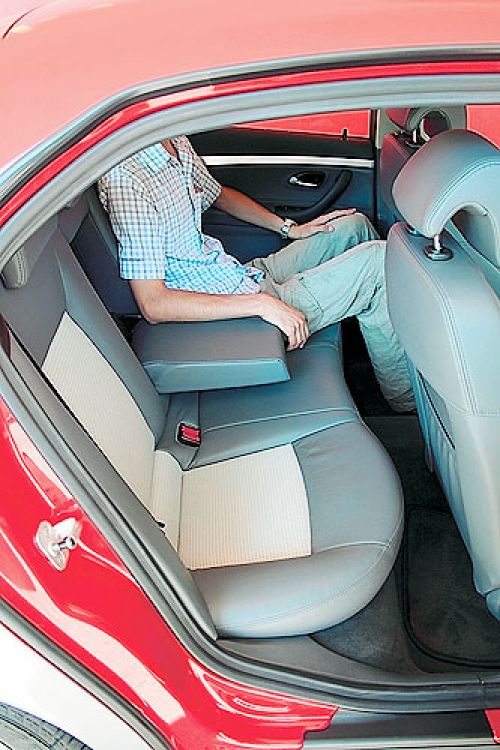
2006 Cadillac BLS vs 2007 Saab 9-3
© Photo: 5 Koleso
Firstly, the Cadillac has noticeably better sound insulation. The Saab is also fine in this regard, but when you switch from one car to another and drive the same route, it's impossible not to notice the difference: the BLS is indeed quieter. Moreover, there is less noise from both the engine and the wheels. True, up to a certain limit. Alas, no matter how good the Cadillac's sound insulation is, at speeds above 160 km/h it can no longer cope with aerodynamic noise. The oncoming airflow crashes against the almost flat body elements with a roar, like a wave against a granite embankment.
Therefore, the Saab, which has more modest sound insulation but more streamlined shapes, makes about the same noise at this speed. However, on our roads, such a pace is not only prosecuted by law but is often technically impossible. There's no need to explain what our roads are like. So, all other things being equal, the Cadillac is still preferable to the Saab in terms of noise comfort.
The second point is the suspension settings. They are the same in both cars, but they feel different. In the Saab, the suspension is tuned for fast and even daring driving, so it is taut. Stiffer shock absorbers, springs, and anti-roll bars are installed here, and the car, by the way, is slightly lower.
The Cadillac can't be called languid either, but dynamic driving in it is enjoyable not only for the driver but also for passengers. The BLS is less sensitive to bumps, which, you'll agree, is important in our conditions. And the suspension's service life should be higher because of this: it's easier to break a glass ball than a rubber ball.
As for engines, in our case, the Cadillac had a two-liter turbocharged unit with 175 horsepower, while the Saab had the same two-liter engine, but with a much lower boost pressure, so its power was 150 horsepower.
But the most curious thing is something else. According to the badge, such a "nine-three" was designated as "1.8t." That's how the Swedes decided to mark the least boosted of the three turbocharged two-liter engines.
However, even with less power, the Saab drives only slightly worse than the more powerful Cadillac. And if you consider that the cars can also be equipped with completely identical engines, up to the 250-horsepower 2.8T, then further comparison of dynamics loses its meaning. There are differences, but they are insignificant — just a few tenths of a second.
2006 Cadillac BLS vs 2007 Saab 9-3
© Photo: 5 Koleso
Cadillac BLS
The Cadillac BLS not only shared the platform with the Saab 9-3 but is also assembled at the same factory. Furthermore, the BLS is the first model in the brand's history aimed exclusively at the European market, and also the first with a turbocharged engine. The base trim is very generous: the only optional equipment offered is an electric sunroof.
Driving
Dynamics and brakes deserve a good rating. The suspension also raises no complaints.
Interior
Good quality is combined with stylish simplicity. There are also some interesting touches.
Comfort
Meets the high standards of the class.
Safety
Even the base version includes anti-lock braking and traction control systems, as well as a brake force distribution system. An electronic stability control system is available for an extra charge.
Price
Adequate.
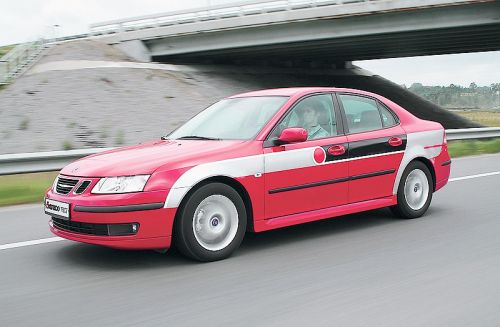
2006 Cadillac BLS vs 2007 Saab 9-3
© Photo: 5 Koleso
Saab 9-3
Although the Saab 9-3 is built on the same platform as the Cadillac BLS, it still differs in character from its relative. This applies not only to appearance and image but also to behavior on the road. In particular, the "nine-three" has a stiffer suspension, is a bit noisier, and handles differently in sharp turns.
Driving
The car will please a spirited driver.
Interior
The interior is done in a characteristic Scandinavian style, which doesn't prevent it from being comfortable.
Comfort
At a fairly high level, although sound insulation is somewhat worse than in the Cadillac.
Safety
The basic safety package is reasonable and sufficient. Its main components are ABS, TCS, 6 airbags, and a system to prevent slipping under the seat belt.
Price
Adequate.
2006 Cadillac BLS vs 2007 Saab 9-3
© Photo: 5 Koleso
Our Verdict
It's been a long time since we've come across such similar cars. The shared platform in this case not only brought them closer in characteristics but also created a déjà vu effect. And yet they are different. And it's not even about the body design or minor differences in the cabin. It's about mentality.
Put a Cadillac and a Saab side by side?! Who would even think of that?!
The Cadillac is the image of a prestigious car, while the Saab is more of an original one. In terms of driving characteristics, the BLS is not inferior to the "nine-three," and in terms of comfort, it surpasses it.
© 5 Koleso