

The Chinese company BYD Auto began its vigorous automotive activity back in 1980. Today, it has not only cloned well-known models but also its own developments. One of them is the Flyer.
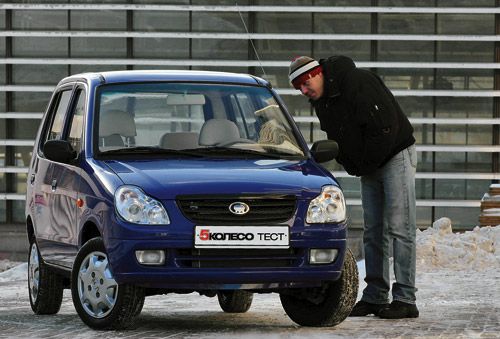
2004 Byd Flyer
© Photo: 5 Koleso
At one time, an acquaintance recommended that my child study Chinese rather than English. I smirked skeptically then, but today I understand he was right. Another year or two will pass, and Chinese speech on our streets will be heard more often than English. And there is nothing surprising about that. At least, the pace of commodity expansion from that country is simply cosmic. Everything is offered, from licensed receivers to cars of our own design. Moreover, it happens that the product is not so bad. At least, it corresponds to the price.
It is precisely to such a product that the Flyer car belongs. Why a car? Because calling this box on wheels the proud word "automobile" just doesn't roll off the tongue. It looks too toy-like. And yet, it is still a vehicle. Moreover, it must be admitted, it is quite cute. This applies not only to the design but also to the build quality. If not for the "Made in China" badge here, the Flyer could easily be mistaken for a car made in a country whose auto industry has a rich history. At least, our "Oka" looks much worse, both in external perception and in the joining of body elements. And although the Flyer's design cannot be called ultra-modern, in the modern city traffic the car looks quite adequate.
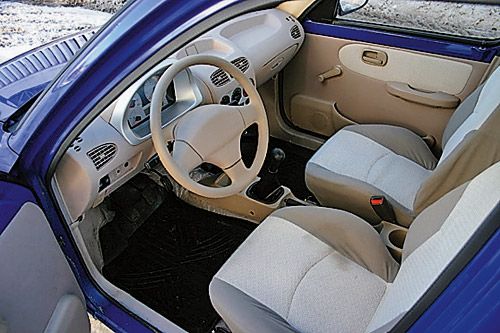
2004 Byd Flyer
© Photo: 5 Koleso
It is also not bad inside, though with one caveat. The quality of the plastic from which the interior elements are made leaves much to be desired. Today, few people can be surprised by shapes. What matters is what material these shapes are made of. However, if you turn a blind eye to this, then, by and large, there is nothing to find fault with here. Of course, one can complain that the car is not as spacious as one would like. One can ponder that a good half of drivers will be forced to give up shoes with a wide welt due to the cramped pedals. Many will probably immediately throw out the archaic radio, whose sound is very similar to that of a crystal radio. However... We should not forget that this car was created with one goal: to quickly and inexpensively deliver you from home to work.
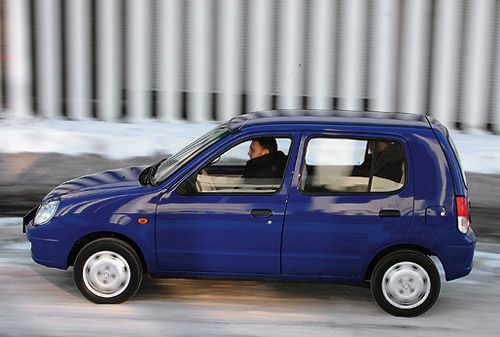
2004 Byd Flyer
© Photo: 5 Koleso
Surprisingly, the manufacturer officially states that this car can accelerate from standstill to 100 km/h in 35 seconds. By feel, this figure should be about half that. At least, in traffic we kept pace with others, and that was with three of us in the car. In the city, the Flyer consumes only 4.5 liters of 92-octane gasoline. Multiply that by the fuel tank volume of thirty liters, and the range turns out... In general, you can refuel once every two weeks, no more often.
Despite the lack of power steering, parking this car is not difficult. The effort on the steering wheel is insignificant; even a child can handle it. And in general, the car is quite light and easy to drive — there are no serious flaws. It was also pleasing that, despite its small dimensions, the car has a fairly large ground clearance: during the test, the car never scraped its belly anywhere. And we had to drive both on public roads and on our uncleaned courtyards. However, why be surprised! The Flyer was made not in Japan or even Korea, but in China, where roads for the most part also leave much to be desired. And what is good for a Chinese person will also suit a Russian.
It remains to add that we had the car in base trim. This option will cost the buyer 6200 dollars. Expensive? Sales rates say otherwise.
Technical specifications of BYD Flyer
• Number of seats — 5;
• curb weight, kg — 720;
• dimensions (length/width/height), mm — 3605/1468/1470;
• max speed, km/h — 118;
• fuel consumption (city cycle), l/100 km — 4.4;
• engine — 3-cylinder; displacement, cm3 — 796; power, hp at rpm — 40/5000;
• price, $ — from 6200.
© 5 Koleso