No, it's not about a sporty character at all — nowadays even station wagons can satisfy the thirst for speed. The true essence of a coupe, its message to the world, is demonstrative impracticality. Much like the attire of aristocrats before the era of historical materialism: a jabot on the neck, sleeves down to the knees. You look at such an outfit and it's immediately clear — its wearer is physically incapable of doing manual labor. And his sword is not a battle one, but a dueling one, rather ceremonial.
True, the BMW X6 has quite a battle-ready weapon: three liters of displacement, a pair of turbos, and a rapid-fire automatic transmission. But otherwise — it's all jabot. No seedlings in spring, no turnips in autumn. And in general — to hell with work in all its forms, and morality along with it. If the BMW X5, on whose platform the hero of our story is built, exudes status and implies conformity to social norms, then the BMW X6 reeks solely of the good life.
The interior of the new Bavarian crossover is designed for four — although it would easily accommodate five. At first glance, the interior has entirely migrated from the X5 — except that the front panel is finished in two colors to visually lighten the space. However, there is always room for choice in trim.
But the ergonomics differ — and at first it even seemed to us that the seats in the coupe were more comfortable than those in the X5 with sport seats that we had recently. That crossover instantly bonded with the driver, becoming an extension of the body. But in the X6, these intricate thrones require fine-tuning beforehand. For example, the lumbar support is complex, with the ability to move. The backrest is split, with its upper half adjusting separately. In short, you spend about ten minutes figuring out what's what, then another five adjusting everything to yourself — and you can go. True, such complexities are an option, as is the leather upholstery.
But the ergonomics differ — and at first it even seemed to us that the seats in the coupe were more comfortable than those in the X5 with sport seats that we had recently. That crossover instantly bonded with the driver, becoming an extension of the body. But in the X6, these intricate thrones require fine-tuning beforehand. For example, the lumbar support is complex, with the ability to move. The backrest is split, with its upper half adjusting separately. In short, you spend about ten minutes figuring out what's what, then another five adjusting everything to yourself — and you can go. True, such complexities are an option, as is the leather upholstery.
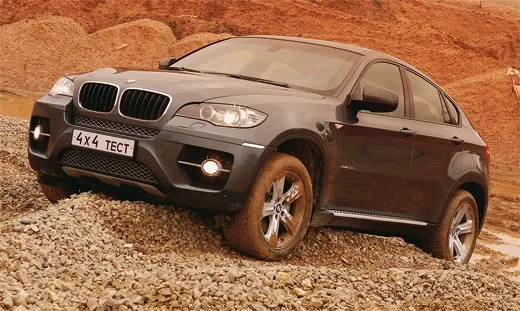
The flat floor, hot heart, and advanced all-wheel drive system allow the BMW X6 to misbehave not only on paved roads
DOME FOR THE HEAD
Sitting in the back "behind myself" at a height of 186 cm is possible in principle, but I wouldn't want to ride like that for long — knees are cramped... The head, due to the sloping roof, would hit the ceiling if not for the special round recesses in it — there are two of them, one for each passenger. A funny detail — a tall person would hardly even get into the back seat. But it looks cute, like, "we thought about that too."
The trunk is not that modest, but part of the volume is definitely eaten up by the sloping roof. Still, there's enough space.
Sitting in the back "behind myself" at a height of 186 cm is possible in principle, but I wouldn't want to ride like that for long — knees are cramped... The head, due to the sloping roof, would hit the ceiling if not for the special round recesses in it — there are two of them, one for each passenger. A funny detail — a tall person would hardly even get into the back seat. But it looks cute, like, "we thought about that too."
The trunk is not that modest, but part of the volume is definitely eaten up by the sloping roof. Still, there's enough space.
SIX BY SIX
As I already said, our test car came with a three-liter engine — an inline six with two turbos — and a six-speed automatic. Not the most powerful version, only 306 hp. Which, however, is enough to feel hatred towards humanity that gets under your wheels. As soon as the left lane clears and you manage to press the gas properly, some guy will inevitably pull out in front of you, thinking you're still far away. Yeah, I was far away — but a second ago. And now I'm here, roasting the potato harvest in your "barn" with my xenon... In short, we never managed to reach a criminal speed of 200 km/h on public roads. As one BMW 750 owner later told us, you need to constantly flash your high beams. "But that's rude," we objected. "Oh, rude?" he took offense. "Then drive your pathetic 170." Honestly, I would generally drive at the speed allowed by the rules, I usually like it that way, but it's impossible in the X6. You just relax your right foot, and the speedometer already shows 150. With a superhuman effort, you force yourself to slow down to 110, and a tail forms behind you. The logic of those around is clear — if a person in such a car is driving so slowly, it means he knows something. Probably there's an ambush ahead... No one wants to jump ahead of the father into the fire, and traffic on the highway becomes paralyzed.
As I already said, our test car came with a three-liter engine — an inline six with two turbos — and a six-speed automatic. Not the most powerful version, only 306 hp. Which, however, is enough to feel hatred towards humanity that gets under your wheels. As soon as the left lane clears and you manage to press the gas properly, some guy will inevitably pull out in front of you, thinking you're still far away. Yeah, I was far away — but a second ago. And now I'm here, roasting the potato harvest in your "barn" with my xenon... In short, we never managed to reach a criminal speed of 200 km/h on public roads. As one BMW 750 owner later told us, you need to constantly flash your high beams. "But that's rude," we objected. "Oh, rude?" he took offense. "Then drive your pathetic 170." Honestly, I would generally drive at the speed allowed by the rules, I usually like it that way, but it's impossible in the X6. You just relax your right foot, and the speedometer already shows 150. With a superhuman effort, you force yourself to slow down to 110, and a tail forms behind you. The logic of those around is clear — if a person in such a car is driving so slowly, it means he knows something. Probably there's an ambush ahead... No one wants to jump ahead of the father into the fire, and traffic on the highway becomes paralyzed.
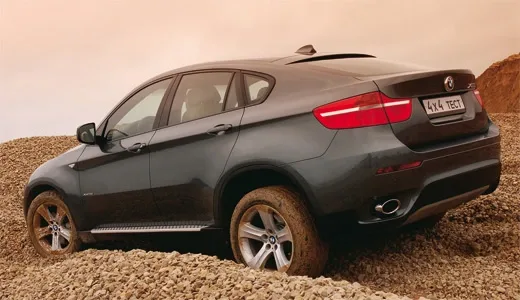
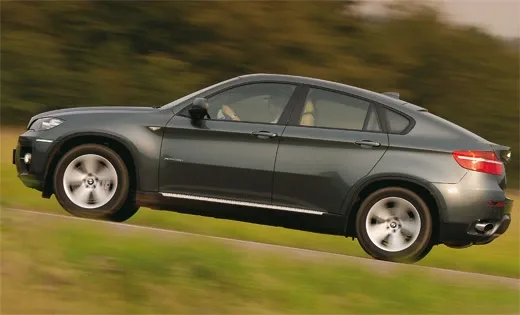
A distinctive feature of the coupe is the heavily raked roofline. Licking the smooth contours, the air flow presses the body to the road
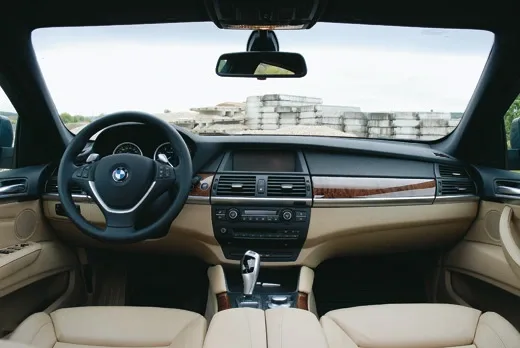
The front panel, controls – everything is borrowed unchanged from the BMW X5. Except that the two-tone trim looks unusual, but it's an option
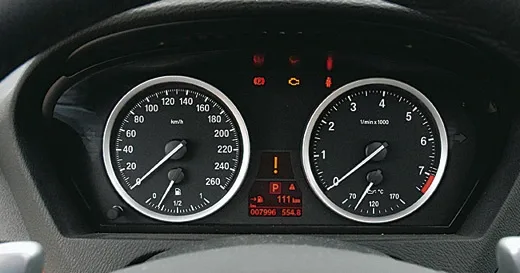
So there's no way out: if you call yourself a mushroom, press the gas. Then sharply brake. And again gas. And to avoid overheating the discs and pads, use the paddle shifters more often for slowing down: the pseudo-manual mode of the automatic allows you to drop down several gears. True, if you don't shift every two seconds, the automatic takes control. And it doesn't care whether you've revved the engine to the redline or not. I don't rule out that the transmission settings could have been changed via the iDrive onboard computer, but our car was forgotten to be equipped with a system administrator. Also, when shifting up, pulling the paddles towards you is inconvenient, and using the selector when you have paddles is somehow absurd. But the main thing is that the automatic works perfectly anyway — no need to interfere.
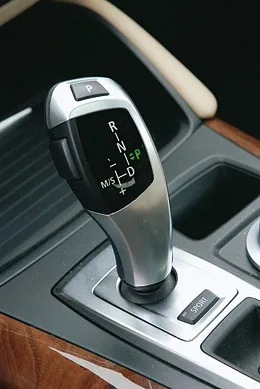
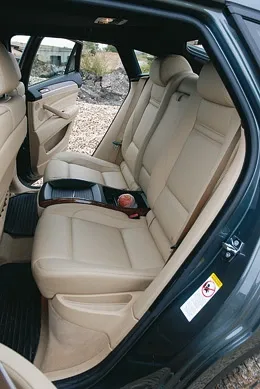
| The automatic transmission joystick is much more convenient than a regular selector: to control it, you just need to rock your wrist and press buttons | In the back – two seats. Maybe it's showing off, but in cars with a cardan tunnel, the middle seat is indeed usually compromised |
NIGHTMARE ON TVERSKAYA STREET
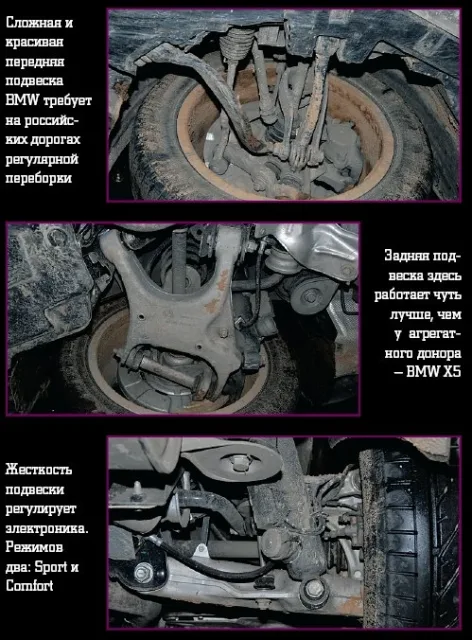
Credit must be given to the BMW X6's suspension tuning: the ride comfort is decent. Speed bumps and broken asphalt are handled correctly: softly but elastically. In Sport mode — sharper, in Comfort mode — with a barely noticeable hint of rocking. But the problems with directional stability inherent in the current generation X5 have not bypassed the coupe either. True, the rear suspension works more effectively here, but the steering has been re-tuned. Rutting doesn't just make itself known; it tries to gain control over the car. At speeds above 150 km/h, this starts to get annoying. And sometimes even at slow speeds. For example, I'm standing in a traffic jam on Tverskaya, studying the traffic situation in the city via a communicator. The car in front of me moves and travels three meters. I, without taking my hands off the electronic device, take my foot off the brake — and the BMW X6, on its own accord, veers to the left.
Credit must be given to the BMW X6's suspension tuning: the ride comfort is decent. Speed bumps and broken asphalt are handled correctly: softly but elastically. In Sport mode — sharper, in Comfort mode — with a barely noticeable hint of rocking. But the problems with directional stability inherent in the current generation X5 have not bypassed the coupe either. True, the rear suspension works more effectively here, but the steering has been re-tuned. Rutting doesn't just make itself known; it tries to gain control over the car. At speeds above 150 km/h, this starts to get annoying. And sometimes even at slow speeds. For example, I'm standing in a traffic jam on Tverskaya, studying the traffic situation in the city via a communicator. The car in front of me moves and travels three meters. I, without taking my hands off the electronic device, take my foot off the brake — and the BMW X6, on its own accord, veers to the left.
SPECS: BMW X6
OFF-ROAD WITHIN ALLOWED LIMITS
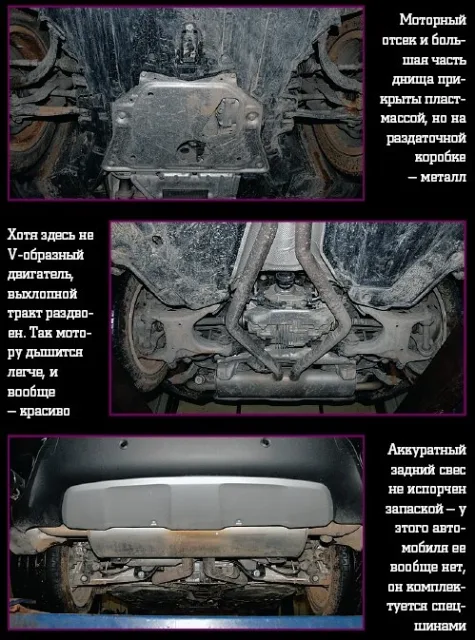
This may sound unexpected, but the BMW X6 frankly delighted us on rain-soaked field roads. It has an absolutely flat floor, like the X5, short overhangs (though there are some plastic eyelashes hanging in front of the wheels, but they can surely be ignored) and an excellent traction control system.
By the way, if you don't want to delve into technical details or already know what xDrive is, feel free to skip to the final part. But if you're interested in why it works so well, you're welcome.
Instead of a center differential, xDrive has a multi-plate clutch in the transfer case, controlled by a computer. When driving straight on dry road, 40% of the power flow goes to the front wheels and 60% to the rear, but in principle, torque can be distributed between the axles in any way. More precisely, as needed for stable movement. Well, the role of the axle differentials is played by the traction control system (DSC), which brakes the wheels or, if really necessary, strangles the engine. In principle, a common scheme for a modern crossover. There are only two important nuances. First, the computer receives signals not only from sensors measuring wheel speed, but also from sensors monitoring lateral acceleration, steering angle, engine parameters, and even the degree of yaw. This allows the electronic brain to act proactively, making a decision before wheelspin occurs. Second, the version of xDrive installed on crossovers is equipped with the DTC traction control system and allows slight wheelspin and even controlled drifting without disabling the stability systems. This is invigorating and at the same time promotes self-cleaning of the tread, noticeably improving off-road capability.
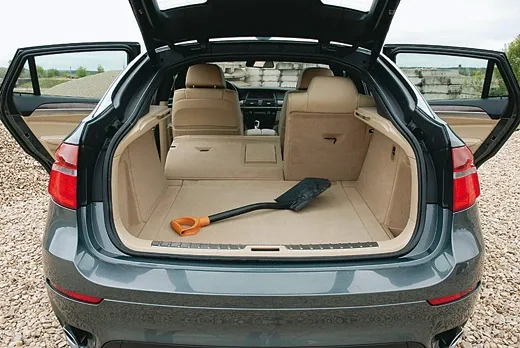
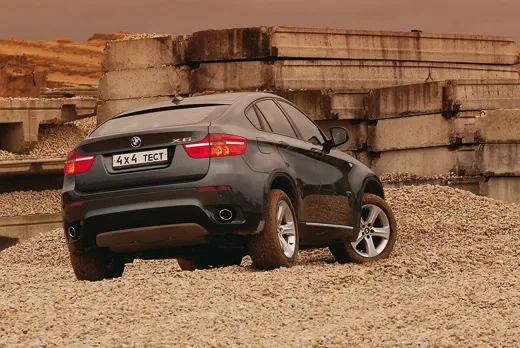
The fifth door has to be opened in two stages: first it rises only halfway, and only then completely. We never managed to figure out why this scheme was devised
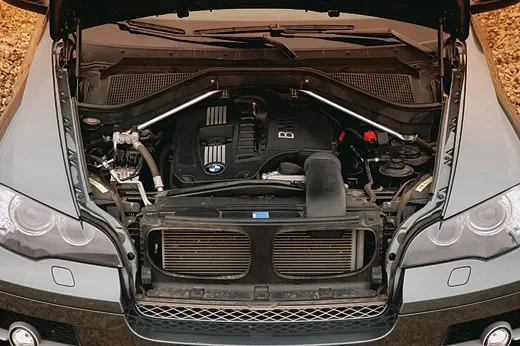
The turbines of this inline six-cylinder engine are made using heat-resistant alloys typically used in the aerospace industry
The result is by no means "crossover" figures. For example, we managed to get out of a very unpleasant situation even on a wet clay incline — where no one believed in success anymore. But the clever Bavarian "horses" pulled through, and that despite the fact that the wheels were fitted with regular asphalt tires.
DON'T KEEP IT ALL TO YOURSELF
Honestly, I can forgive the BMW X6 its retuned steering and the rather strange pseudo-manual mode of the "automatic". I'll even keep quiet about iDrive — enough has been said about it already. What disappoints me is something completely different — behind the wheel of the X3 I get no less pleasure, and off-road the sensations are very similar, while the Bavarian crossover costs half as much and doesn't veer from side to side in ruts. So, if I suddenly come into extra money, I won't be able to bring myself to buy the X6 — I'm too pragmatic for that. And one more thing: a coupe, in my opinion, should roar like a wild tiger. But the exhaust of the "Bavarian" sounds too polite. Although, I'm sure tuning studios have already figured out how to give it a real voice.
DON'T KEEP IT ALL TO YOURSELF
Honestly, I can forgive the BMW X6 its retuned steering and the rather strange pseudo-manual mode of the "automatic". I'll even keep quiet about iDrive — enough has been said about it already. What disappoints me is something completely different — behind the wheel of the X3 I get no less pleasure, and off-road the sensations are very similar, while the Bavarian crossover costs half as much and doesn't veer from side to side in ruts. So, if I suddenly come into extra money, I won't be able to bring myself to buy the X6 — I'm too pragmatic for that. And one more thing: a coupe, in my opinion, should roar like a wild tiger. But the exhaust of the "Bavarian" sounds too polite. Although, I'm sure tuning studios have already figured out how to give it a real voice.