
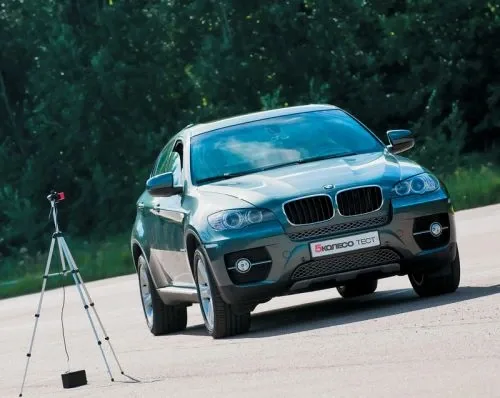
BMW continues to surprise. Every component, from the transmission to the powertrain, is refined to perfection. Despite its impressive dimensions, the X6 is a true coupe. Although it cannot be called a pioneer in this class: before it were the Infiniti FX and SsangYong Actyon. However, unlike them, the X6 has a truly sporty character, so calling the "Japanese" and "Korean" direct competitors of the new model is hard to do.
The donor for the X6 was the popular X5. This applies to the interior, exterior, and technical content. Specifically, the new model is 4 cm lower and 5 cm wider. It seems like a trifle, but thanks to different bumpers and body lines, the X6 looks much more dynamic. Having opened the massive door and sat behind the wheel, you will find no differences from the X5 — everything is identical. But it is worth turning around... and you immediately understand: the car is designed for only four people. Instead of a three-seat sofa, there is a two-seat one, divided by a tunnel with a pair of cup holders and boxes for small items. Due to the sloping roof, headroom has decreased by 35 mm, but without measurements, you are unlikely to notice it. The trunk volume is 570 liters. If you fold the rear seats, you get 1450 liters. The X5 has 300 liters more.
The X6 is equipped with active chassis, exactly the same as on the X5. The steering is supplemented with an Active Steering gearbox and Adaptive Drive suspension — this is needed for better handling. The equipment is included in the base configuration. The new model differs from the X5 in the gearbox and the active rear differential Dynamic Performance Control (DPC). The improved ZF automatic shifts gears even faster. For example, in "sport" mode with kickdown, it immediately drops two gears down. But without the rear DPC differential, the new X6 would hardly show such excellent handling. DPC distributes torque between the rear wheels. Transferring a larger portion of torque to the loaded wheel ensures "turning in" of the car during maneuvers, allowing corners to be taken at higher speeds.
The weight of the BMW X6 is more than two tons, but the weight distribution is almost ideal: 50.8% on the front axle, 49.2% on the rear. The 3.5i badge means that under the hood is an inline "six" with a volume of 2979 cm³. It could not do without a turbo — otherwise, the power would be much more modest.
The engine produces 306 hp at speeds from 5800 to 6250 rpm. The maximum torque of 400 Nm is available from 1300 rpm and holds up to 5000 rpm. Such characteristics are enough to reach 100 km/h in 6.7 seconds. Polygon measurements confirmed these figures. If you continue accelerating, then 140 km/h will be reached in 12.7 seconds, and 180 km/h in 23.2 seconds. At such speeds, you inevitably think about the brakes of a two-ton coupe. The X6 shows stable and good results: stopping from 100 km/h takes 44 m, and from 190 km/h — 144 m.
As befits a sports car, the steering wheel of the X6 is noticeably heavy. The information content is appropriate, although there is a slight "emptiness" in the near-zero zone, which disappears in "sport" mode. The difference in passing figures in normal and sport modes is noticeable. Reactions — both in control and in the operation of all systems — become sharper. This is indicated by the figures for passing the high-speed lane change: the difference is about 3 km/h — 135.2 km/h (sport) versus 132.9 (normal). With increasing speed, the X6 does not try to "push" the front axle, but smoothly slides with all four wheels, engaging the ESP and DPC systems. But there is a danger here: the X6 allows a lot, but with increasing speed, the cost of a mistake also grows.
The car surprises with the consistency of results in loaded and unloaded states — the figures differ by no more than 1 km/h. Plus, the X6 can boast a turning diameter of 12.2 m. Not bad for a car 4877 mm long.
The BMW X6 can safely be called another miracle of the Bavarian concern, proving that the impossible is sometimes possible. And it seems that it could not be better. But the X6 3.5i is the weakest version of the new model. A little later, a car with a 5-liter V-shaped "eight" will appear. That will be fun!
Race of Technologies
The appearance of any new product from BMW is always accompanied by a technological breakthrough. It has long been no secret that BMW engineers are among the best in creating engines and transmissions. The appearance of a completely new and unusual car, the X6, could not go unnoticed. The car is equipped with new engines, some of which have already managed to "shine" in the global automotive industry. The 35i engine, which is the base for the X6, has already received two awards from the Engine of the Year competition. They were awarded for combining direct injection and two turbines. The 35i engine is an inline "six", where each turbine works with a trio of cylinders. As a result, 306 hp and 400 Nm of torque, available in a very wide range from 1300 to 5000 rpm, are extracted from a three-liter volume! The next engine, which will first appear on the X6 and then on other BMW models, will be a V-shaped "eight" with a volume of 4.4 liters. The construction principle is similar to the 35i — direct injection and two turbines for each cylinder bank. But to make the engine as compact as possible, the turbochargers are placed in the V of the cylinders. The 50i engine will develop 407 hp, and the torque will be 600 Nm.
Expert
Eduard Shivorshinov, 36 years old, test engineer, 18 years of driving experience, drives an MB G300 TD
Tests at the polygon give an unambiguous answer about the dynamic capabilities of the X6. This BMW destroys all laws of physics. Having large dimensions and mass, it handles predictably and comparably to some lightweight sports cars.
Our Assessment
BMW has managed to create a unique car that, with a futuristic appearance, is a treasure trove of technologies. The X6 is a car that combines the dimensions of an SUV and the handling of a sports car.
Body
+ unusual design
- imperfect rear visibility
Ride comfort
+ spacious interior and trunk
- only two seats in the back
Powertrain
+ torquey engine
+ acceptable fuel consumption
Handling
+ energy-intensive and resilient suspension
+ high steering information content
Safety
+ abundance of airbags and active and passive safety systems
Environmental friendliness
+ compliance with all toxicity standards
© 5 Koleso