First contact: where is this X1 hiding?
Pulling up to the BMW dealership, I caught myself thinking that I had no idea where this very X1 was waiting for me. The evening before, Alfred had invited me for a test drive, but I hadn't had time to prepare — I hadn't even looked online to find out what kind of beast it was.
Based on the name, I expected to see something like a Nissan Qashqai, Volvo X60, or Audi Q5. I'll admit honestly: I'd never gotten behind the wheel of a car with a propeller on the hood, despite nearly a quarter-century of driving experience. And here the circumstances were also interesting — I had just switched from a crossover to a regular front-wheel-drive car. The weather, with its slush and melting snow, clearly hinted at the opposite. So why not enjoy all-wheel drive?
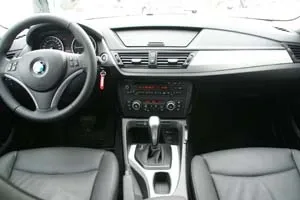
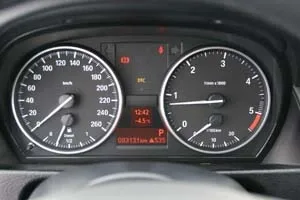
Scanning the parking lot in front of the showroom, I was looking for something resembling a scaled-down X5. But when the X1 appeared in all its glory, it became clear: this is not a compact crossover at all, but a full-fledged all-wheel-drive station wagon. In spirit, it's closer not to the Qashqai, but rather to the Audi Allroad or Volvo XC70. True, those are still larger, so I'll call them not classmates, but like-minded souls. By design, the X1 is a classic station wagon mounted on an all-wheel-drive chassis. It lacks that deliberate brutality that designers usually bestow on crossovers to make them look tougher, but at the cost of harmony. A kind of macho with a scar on his right cheek — and a scar exactly where women like it most. But the X1 has no such scars — it's simply beautiful. And this, in my opinion, might scare off the male audience. My suspicions were confirmed by the color of the test car — ruby, which ladies adore. The dealer, apparently, is also betting that the main owners will be members of the fair sex.


As they say, you meet people by their clothes…
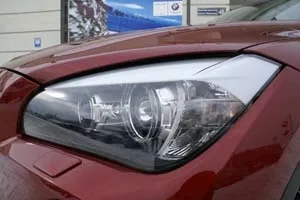
The headlights are gorgeous, the hood is huge, the side lines are beautiful. A handsome man or a beauty — to each their own. But why exactly the X1, and not, say, a BMW 320 Touring xDrive? That would be more honest. The X1 is not a crossover, but a beautiful sports wagon, and no one will convince me otherwise. Approaching the car, I noticed sills that slightly widen toward the bottom. This not only adds external sportiness but, as it turned out, brings practical benefits. The day was sunny, snow was melting everywhere, and there was plenty of slush on the roads. But when we drove the first ten kilometers and decided to switch places, we found that the car remained clean — even around the front wheel arches, not a speck of dirt. I really liked that: on my car, it's enough to drive a couple of meters for the front door to be covered in splashes, let alone the fenders.
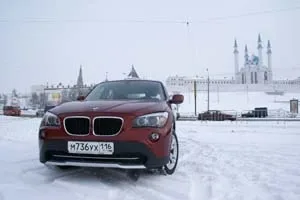

Later I noticed that the rear window also gets dirty less actively than on my previous SUV. It seems the BMW engineers spent a lot of time with the prototype in the wind tunnel. The result is not only a low drag coefficient (for the sDrive20d, xDrive18d, and sDrive18d versions it is 0.32), but also keeping this beauty looking neat.
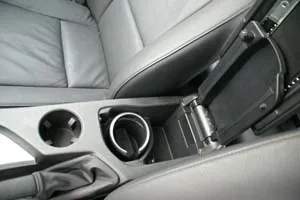
I won't describe the exterior in detail — to each their own, as they say. But what about the inside? Beautiful! The instruments and controls are arranged clearly and concisely. Compared to other manufacturers, it's a bit empty, but that creates a sense of spaciousness, although the cabin itself isn't exactly wide. The seating position is high, visibility is excellent, the seat is comfortable, though, in my opinion, not at all sporty — the lateral support didn't impress me. At the same time, the lack of electric seat adjustments on a car worth one and a half million is frankly annoying, especially since finding a comfortable position isn't easy. The dashboard plastic is a bit plain, but the carbon-fiber inserts add dynamism and excitement. The glovebox is small — it doesn't qualify as a full-fledged compartment: besides gloves, nothing else will fit. There are fewer pockets and cupholders than I'd like. In terms of practicality, the X1 will yield to any car a class lower. The climate and audio controls are slightly turned toward the driver.

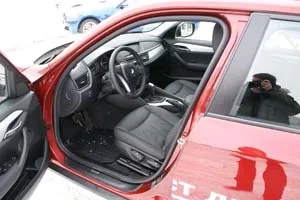
And this detail lets you feel a bit like a racer.
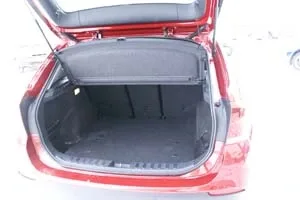
The trunk is ordinary, under the floor there's a compartment for small items, and even lower — the battery. There's no spare tire. And that involuntarily makes you think about long trips. But honestly, who will be driving between cities in this all-wheel-drive toy? No, let it be an X1 with all-wheel drive, but its element is the city: home, office, store, hairdresser, kindergarten, school. And, of course, as in any wagon, if you fold down the rear seatback (it's split into three sections and adjustable for angle), the trunk volume grows from 420 to 1350 liters. In short, nothing outstanding.
In the back, three will be cramped. And, as the further trip showed, it's quite bumpy in the back. So it's better to put kids in child seats and buckle them up well — otherwise, after hitting a deep pothole, you'll have to look for them in the trunk.
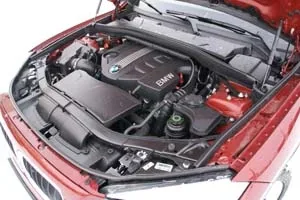
Insert the key (or rather, the fob), start it — and silence… That there's a diesel under the hood can only be guessed. Sound insulation is top-notch. At speed, aerodynamic noises are audible, but at a standstill — everything is very decent.
And here I am, pressing the gas pedal of a BMW for the first time. I expected a bit more, but still, a BMW is a BMW. It makes you want to overtake, cut in, and generally behave not quite adequately. Now I understand BMW owners who, out of the blue, start changing lanes, launching from intersections, and doing other strange things from the perspective of the uninitiated. It's not their fault — it's the spirit of BMW that starts to control them. On the bypass road, I gave free rein to my emotions, but I couldn't reach the desired 200 km/h: the large number of cameras on the highway didn't allow me to risk someone else's license. But even so, it's clear — the car drives well. In the city, it's easy to handle. The seating position is surprisingly high, and you can look down on owners of regular cars. The power of the two-liter diesel is quite enough for me. Fuel consumption is about 9 liters. But people don't buy a BMW to save money. This car is a pleasure. I'd like to try the top engine, but even in this configuration, the car doesn't feel sluggish. I liked it.
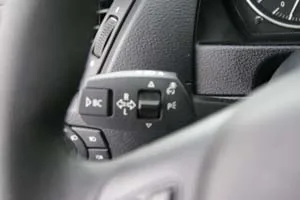
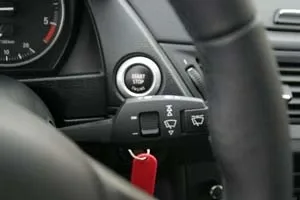
When we reached the ice area near the hippodrome, I managed to complete the cone course on the first try, although I don't consider myself an ace of extreme driving at all. The car made decisions on its own: at the right moment it throttled the engine, where necessary — applied the brakes. So you can trust this car with your wife and kids without any doubt, especially since the arsenal of safety systems here is simply huge. But when we found a way to disable the stability control system, I'm ready to admit my own helplessness. The X1 behaves like a classic rear-wheel-drive car with all the ensuing consequences. It spun me around so much that it was a sight to behold.
Overall, I had my fill of fun. The car is wonderful, but not mine. Out of curiosity, the next day I tried the BMW X5 with a four-liter engine. Now that's real power. And after that, I fell even more in love with the Bavarian brand. Stylish, powerful, sometimes capricious, but wildly desirable. Before, I looked at them differently.
So why do people buy BMWs? To figure it out, I found an article online that cited data from a US survey: 70% of Americans dream of having sex in a car this summer, and BMW owners have the best chances — 30% of US residents seriously believe that a car of this brand helps find a sexual partner.
So that's what it's about.
Hence the conclusion. Want to find a partner? Nothing could be easier. You pull out about one and a half to two million from your stash, head to the showroom — and the problem is practically solved. It's a matter of time. The BMW image will do the rest. This is, of course, a joke, but there's a grain of truth in it. People who drive BMWs are successful and passionate. I wish them luck, and to the readers — to someday feel what the spirit of BMW is. Good luck!
Vadim Sadykov, "Autoclub-Kazan"
BMW is a clean freak. Perhaps, in spring mud and slush, this is almost the main quality of any car. Thanks to well-thought-out aerodynamics, the car's sides almost always stay clean. Even the rear — which is where dirt usually sticks on hatches, crossovers, and wagons — defiantly shines in the sun. What a miracle? The secret is unknown to us, but the X1 allows you to save noticeably on car washes.
Another modern feature of efficiency is the 2.0 turbodiesel. They say diesels are too noisy. I agree. While Alfred was filming the X1 near the showroom, a “fifteenth” model stood nearby with its engine running. The noise level and timbre of both cars turned out to be identical. If you like, you could call it “excessive noise.” However, inside the cabin, it's impossible to tell whether it's a diesel or petrol under the hood. Sound insulation, though. As always with BMW, the engine settings are simply ideal. You can start with wheelspin, drive calmly and steadily, or accelerate sharply from low revs. And the turbodiesel adds efficiency too. True, the 6-speed automatic slightly spoils the picture: there are noticeable delays when you sharply press the accelerator. But there's no desire to switch to manual mode: shifts happen on time and quickly.

Now more about comfort in the cabin. Honestly, getting comfortable behind the wheel wasn't immediate. The seat adjusts fine, and the steering wheel adjusts for reach and tilt, but... you always want to tweak something else. As usual, the most comfortable place is the front passenger seat; no complaints about comfort there. But a ride in the back seat, given our broken roads, won't be pleasant. The suspension is quite stiff, so all irregularities are thoroughly transmitted into the cabin. On the other hand, stiffness has its pluses: for example, I accidentally hit a decent pothole with the right wheel, and the suspension managed to absorb the impact without transferring it to the body.
The suspension's composure allows for good maneuvering, which we tested on an icy pad. As usual, the stability control systems ensure maximum safety. No fooling around here! Disabling the traction control system gives more freedom. Just remember that the car behaves like a rear-wheel-drive vehicle, and you need to turn the steering wheel earlier than with front-wheel drive. And when all electronic aids are off, the car becomes interesting and unsafe. Each of us three “lost” the car during maneuvers.
Honestly, the X1 is an ordinary BMW. So ordinary that it doesn't evoke much enthusiasm. Or maybe that's the manufacturer's intention? To show that a small BMW, whether it's the 1 Series or the X1, still remains a BMW?
Alfred Mardanov, “Autoclub-Kazan”
The presentation of this model took place quite recently, and even then I was glad for the concern—a new trend is emerging again, just like with the BMW X3, which got worthy competitors only the year before last. And this X1, being a subcompact crossover, has no competitors yet. There are players in this segment—the all-wheel-drive Qashqai and, perhaps, the Yeti—but calling them serious rivals to the BMW X1 doesn't feel right. Most likely, they'll have to sort things out among themselves, but not with BMW. But soon a crossover from Mini will appear, which, however, is now under the patronage of the same BMW. So, what do we have this time? The X1 is a worthy member of the BMW family, at least by external signs. It has absorbed family traits, and not from just anyone, but from the new “seven.” This is the radiator grille, which has become almost vertical, with huge gills. Most likely, they have the same secret as the “seven”: the air ducts change direction depending on speed and regulate air flows. I thought about this later when we were on the highway. It also has some resemblance to the X6, especially from the front and slightly from the side—apparently, family continuity in design was paramount. Whatever BMW it is, it's first and foremost a BMW, both externally and in its idea and characteristics—undoubtedly, that's the main principle of creating new cars. It remains to see how much the X1 lives up to these principles. The exterior is a solid “five.” My question arose about the plastic trim of the lower part of the front bumper. It's beautiful, but there's a risk of scraping it on rocky and other hard surfaces, despite the claimed solid ground clearance of 195 mm. From the look of it, you wouldn't say it's a crossover—it's a high-riding station wagon, and quite a handsome one. That's something you can't take away from BMW: they know how to “draw” cars, and not just draw them.


This time, I give up the driver's seat to Vadim—he'll start the test drive. Probably, we'll skip the off-road discipline, despite the proprietary all-wheel-drive system, but honestly, it's not serious to treat it as an off-roader. But the ice rink will come in handy. The characteristic diesel sound of the engine is clearly audible outside, but inside the cabin it's completely indistinguishable. I sit in the back, noting to myself how comfortable the seats are and how much space there is to the front seatback, but three of us will be a bit cramped in the shoulders. The city road section couldn't hide, especially for the rear passenger, the stiff nature of the suspension. It's not that it transmits a detailed description of the tiniest cracks and potholes, but a more serious irregularity leaves a blot in the essay on comfort. Sitting in the back, I have no idea that there's such a thing as handling, and more on that. I fully felt it when I got behind the wheel. The chunky “donut” fits comfortably in your hand, and you feel with every fiber of your skin what car you're driving. The sensitive, sharp steering wheel never lets you lose contact with the car and the road—a rare quality these days. Thanks to a lower center of gravity than the X3, it behaves noticeably more actively in lane changes and corners. The feeling of confidence on the road is intoxicating. Light, barely noticeable delays in automatic transmission shifts are only noticeable to the driver—as a passenger, I didn't feel them. The confident torque of the diesel is beyond praise. Legends can be told about the spiritedness and liveliness of BMW engines; here, the X1 also has nothing special—an “ordinary” engine from BMW. What surprised us on the highway was how it remarkably stays clean: dirt from under the wheels doesn't get on the sides, let alone the roof. The hood also stays clean. It's a matter of aerodynamics. Everything is so refined and calculated that air flows neatly flow around the car. The model spent dozens of hours in the wind tunnel. This is also noticeable in the noise from air flows, which only just begins to appear at speeds from 120 km/h. The highway is definitely the element for the driver of this car, as is the city. Ahead is another discipline, possible thanks to the Kazan School of Higher Driving Excellence—the ice pad, which will be interesting for seasoned drivers. What is BMW famous for? The ability to completely disable the stability control system, which happens in two stages.

First, the restrictions are half removed, then completely. Today, only one or two brands among civilian models can afford such luxury. The logic is simple: an experienced driver should be able to truly feel the car, without intermediaries. And then the slogan “with pleasure behind the wheel” ceases to be an empty phrase and turns into a real, hard-earned concept.
When the stability control is on, the car monitors every movement and doesn't let you relax. But as soon as you turn it off, the car seems to come alive, raises its head, and becomes noticeably more spirited. However, even in this mode, the electronics continue to subtly back you up, and you can feel it. It certainly helps to take corners more carefully, catching the car at the moment it's about to break into a slide, but that's not it.
But if you cut the electronics entirely, a completely different story begins. Controlling only the throttle and steering wheel, with due skill, you can make the car obediently slide sideways, tracing smooth arcs. It becomes yours—you just need to understand it, show character, adapt, and let it understand you. Like a rider who must demonstrate strength so the horse obeys. It's an amazing feeling, so typical of BMW.
Timur, the instructor from that school, whom we let take a spin, put it briefly: an “ordinary” BMW. And in that phrase there was meaning—before us is a well-balanced rear-wheel-drive car. Despite the all-wheel drive, most of the torque goes to the rear axle, so the car's habits are closer to classic rear-wheel drive. And that's great.
Where else to test the brakes and ABS operation than on bare ice, where I couldn't even stand—which greatly amused everyone present. Acceleration to 60 km/h and the brake pedal to the floor. It's unnecessary to say that the pressing force is easy to dose, as is the fact that ABS engages predictably. The car stopped with a large margin before the spot I had mentally marked. Of course, the tires played their role, but the X1's merit shouldn't be downplayed either.
Again the road back to the dealership. Rarely do you not want to part with a car so much—you want to behave in traffic like a crazy driver, darting between lanes, accelerating and braking, doing whatever. But we decorously, barely restraining ourselves, roll back. An “ordinary”—invigorating and lively BMW.