It's a pity that our acquaintance lasted only three days. They flashed by like a single moment. But even in such a short time, I managed to... fall in love! Or perhaps it was some other, no less strong feeling? I can't say for sure. But one thing I know for certain: all these days I was truly happy. I put aside all my affairs, didn't get distracted by anything. I just drove. I delved in, tried to understand the details, and constantly wondered: "How does she do it?"
Every person dreams of their wishes being fulfilled. They want to be understood, felt, and finally, obeyed. But when it comes to human relationships, you constantly have to seek compromise, sacrificing those very wishes. That's why it's so hard to find a pair where the relationship would be truly mutually beneficial, and the balance — ideal.
A car, by its very nature, is a wonderful outlet, a magnificent executor. It doesn't act up, doesn't try to impose its opinion, doesn't butt in with advice, but asks only one thing — to press the gas and turn the wheel. And, by and large, it's precisely by how accurately and quickly it executes our commands that we conclude whether it's a driver's car or not. Although, of course, cars also have character. But the stiffer it is, the faster the car usually is, and the more pleasant it is to realize your superiority, feeling how unquestioningly it obeys you. Someone might say my words reek of typical male chauvinism. But the BMW M3 is also a truly masculine car. You just don't need to "break" it; it feels everything, understands everything. After three days behind the wheel, a connection arose between us almost on a subconscious level. I'm sure over time it would only have strengthened.
This M3 is the epitome of advanced technology. And most of it is in the heart of the car. Electronically controlled throttles for each of the eight cylinders, spark plugs with built-in knock sensors, a recuperation system that saves much-needed energy during acceleration, Double VANOS, which turns the camshafts and optimizes valve timing. It's thanks to all these tricks that such an incredible engine became possible — powerful, reacting lightning-fast to accelerator input, where 85% of the torque is available across a wide range of revs — from 1900 to the maximum 8750 rpm. And our "three" is also equipped with the new M DKG gearbox with dual clutches, which allowed increasing the engine's maximum revs by 500.
The engine sounds like all its technology! At low revs it's quite calm, and only the low-frequency grumble of the mufflers seems to say: "Come on, don't be shy, add some gas, and you'll hear a real aria!" No need to ask twice. I pull the left paddle shifter, floor the pedal, and after a short, filigree rev-match, I enjoy the rich, juicy roar of the "V8," which after 8000 turns into almost a shriek! Kolossal, unerhört!
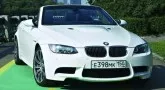
Perhaps someone, looking at the photos and seeing a convertible, will think we won't talk about the handling of the BMW M3 Cabrio, saying an open car can't compare to a real coupe. Of course, the difference is noticeable. Besides the direct presence of a hard roof, in the coupe it's also made of carbon fiber, significantly lowering the center of mass. Yes, the M3 Cabrio yields to the coupe in this regard. The raised roof (in this generation already metal) — extra kilograms on top; folded — a heavier rear end. Also, body rigidity is worse, noticeable on bad roads when you have to catch the trajectory with a steering wheel that goes light. But these nuances, as expected, couldn't spoil the overall impression of the car. M3 is M3.
Telling how the M3 handles is difficult. Just as it's difficult, for example, to describe your sensations from touching something. What can you say? Cold? Rough? But that won't convey the fullness of sensation. Same with the "M." You can say — precise, correct, thrilling, but still, you need to feel it. Feel how it responds with maximum accuracy and minimal delay to every your... no, not movement, but even desire. It's so correct, so perfectly matches the "pilot's alphabet," that if you have an idea of how a powerful rear-wheel-drive car should behave, you'll easily think one step, or even two, ahead.
For example, on corner exit, when you press the gas, you need to simultaneously make a short steering movement in the opposite direction. The "three" will immediately appreciate your foresight and, instead of the expected drift at such power, will briefly wag its tail and send you into one of the best straight-line accelerations in the world, on to the next bend. In fact, the beauty of the M3 is also that it's ready to take that corner in different ways, depending on your desires, courage, and skill. Physics is physics. Flying into the next "hairpin" at insane speed, instead of ideal neutral handling, you'll of course get understeer. And here options are possible.
The first — calmer. Slightly unwinding the wheel and briefly stomping the left pedal, manage to be amazed by the incredible grip of the brakes and return the car to a neutral position. The second requires composure, and I wouldn't advise testing it on public roads. You need to not be afraid to open the throttle with even more steering input, and then in an instant understeer will turn into oversteer, and in a dashing power slide at wild speed, the M3 will fly through that corner. But note — the speed must be really high, and the driver must be ready to accurately and instantly correct the trajectory, otherwise a spin with all the consequences is inevitable.
The M3 constantly assesses the driver's capabilities. If, conditionally speaking, a "newbie" is at the wheel, then the "M" will behave calmly and even friendly. But if you dare to experiment like the one described in the previous paragraph, don't expect mercy; it will show its character. But when your temperaments match, when you learn to anticipate each other's desires, when you feel complete unity, then that very happiness I experienced becomes possible. And getting out of the M3, you'll also feel that slight tremor in your limbs, an idiotic smile will wander across your face, and in your soul — a thirst for the next meeting.
**Engine**
For the first time, the BMW M3 offers a V8 engine configuration (not counting the racing version GTR V8 4.0 of the previous generation). It's commonly believed that this engine was created by "cutting off" a pair of cylinders from the V10 installed in the M5 and M6. There's some truth to this, but of course, it's not all so simple. Let's start with the common. These engines have the same connecting rods, pistons, and parts of the valve mechanism. Both use individual electronically controlled throttle valves, the Double VANOS system, and a lubrication system with two powerful oil pumps that cope with their task even under lateral loads of 1.4 g. Now about the differences. Naturally, these engines have different blocks and camshafts.
In addition, the V8 lacks a MAF (mass air flow sensor) on the intake; this job is done by clever spark plugs with special sensors. But it has a system that disconnects the alternator during acceleration. As a result, the engine, packed with all these things and having received two additional cylinders (compared to the BMW M3 E46), still turned out to be almost 15 kg lighter than the previous "six." Progress doesn't stand still!
**Gearbox**
(To be continued)
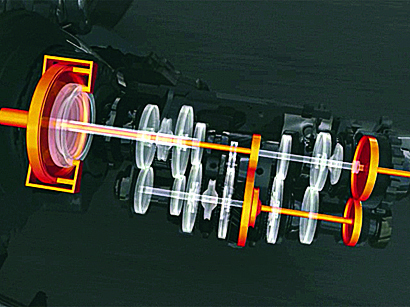
M DKG — in German, it's Doppelkupplungsgetriebe. That's what BMW calls the seven-speed transmission with dual clutches. The principle is the same as DSG from Volkswagen or PDK from Porsche: even gears sit on one shaft, odd ones on the other. At any moment, only two gears are engaged: on one hand, this allows shifting to the adjacent gear without loss of traction; on the other, when jumping over several gears, a slight pause occurs, although in reality it's almost imperceptible — it still happens quickly.
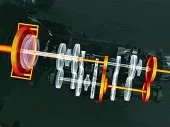
The Drivelogic electronics can select one of eleven programs that change the firmness and pace of shifts. Five modes work in automatic mode, another six are configured manually. A separate cooling system is provided for the oil so that M DKG works without failures even in extreme situations.
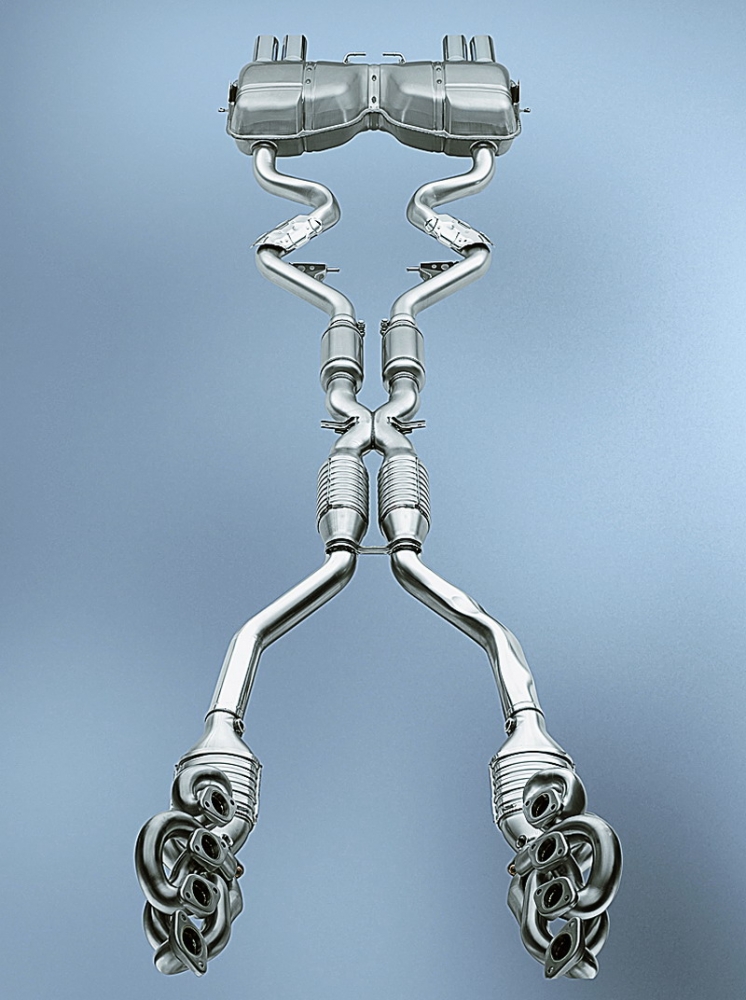
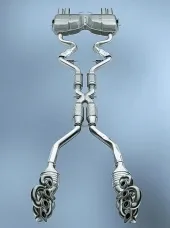 Exhaust system
Just look — this isn't just an exhaust, but a real work of engineering art! No wonder the M3 has such a luxurious "voice."
 Three M Three
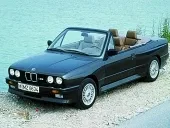
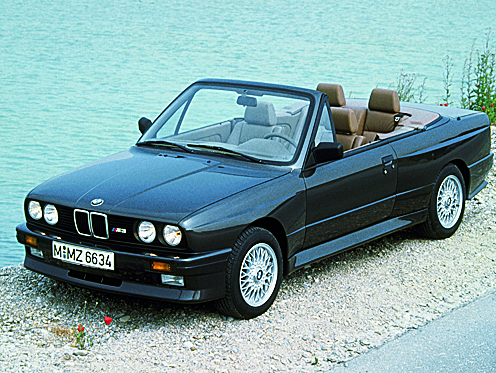
BMW M3 E30 (1986–1990)
The first generation of the BMW M3 appeared thanks to motorsport and... Mercedes: when the Germans brought the 190E model to European circuits, BMW had to respond. Hence the engine — racing rules didn't allow a displacement larger than 2.3 liters. But even then, the four-cylinder S14 in civilian versions produced from 195 to 220 hp. The convertible debuted in 1987. This is a true rarity — only 785 cars were produced, which is extremely few even against the background of the total run of the first-generation M3 of 17,889 units. The value of these cars only grows — demand from connoisseurs is constantly increasing.
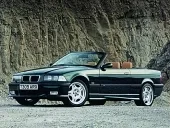
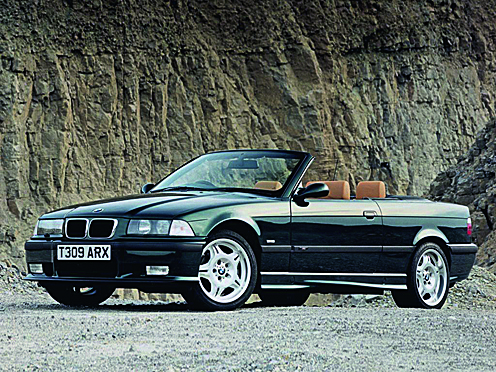
BMW M3 E36 (1991–1999)
The second "three" received the famous inline six-cylinder engines with a displacement of 3.0 liters (286 hp) or 3.2 liters (321 hp). Plus, for the first time, the M3 became available as a sedan. This time, many more convertibles were made — 12,114 units. That's almost as many as sedans (12,603), but still fewer than coupes — 46,169 of them were sold. Add to this 356 extremely rare M3 GT with 289 hp — and you get a total of 71,242 cars.
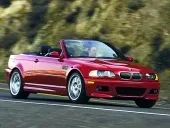
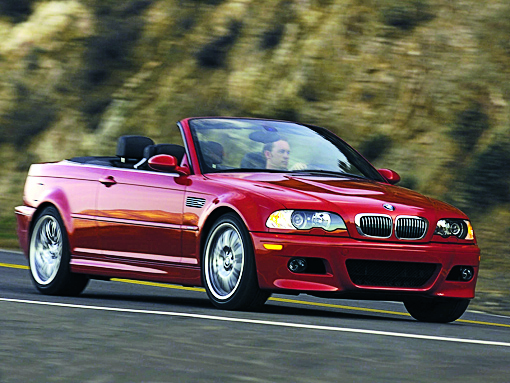
BMW M3 E46 (2000–2006)
The closest relative of the current model is the M3 E46. The 3.2 engine already produces 343 hp. The sedan disappeared from the lineup again. 29,633 convertibles and 54,750 coupes were sold. But the most coveted are the 1,383 lightweight CSL coupes. In total, that comes to 85,766 cars. As you can see, the third generation only slightly surpassed the previous one in sales.

 The Drivelogic electronics can select one of eleven programs that change the firmness and pace of shifts. Five modes work in automatic mode, another six are configured manually. A separate cooling system is provided for the oil so that M DKG works without failures even in extreme situations.
 Exhaust system
 Three M Three
 BMW M3 E36 (1991–1999)
 BMW M3 E46 (2000–2006)