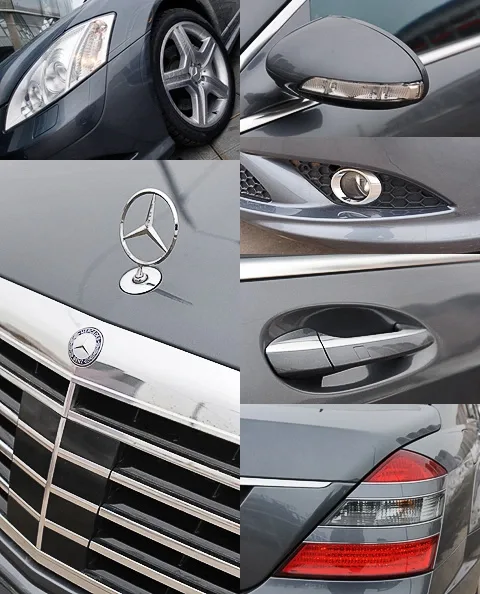

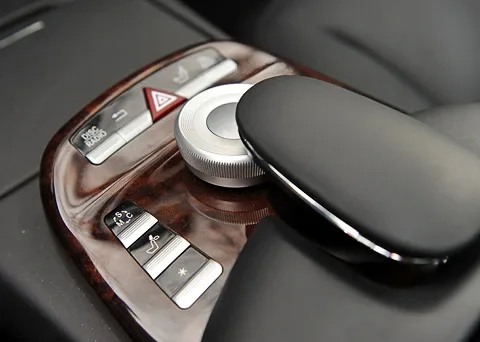
Yes, even after the arrival of the new generation of the BMW 'Seven', Mercedes still holds the lead in the class when assessing the sum of qualities. The interior of the S-Class is one of the most refined in the world, creating an atmosphere that is both strict and serene. And the smoothness of the ride fully matches this mood. After the 'Seven', where vibrations from the wheels are felt even by rear-seat passengers, the time-tested Mercedes chassis with the ABC (Active Body Control) hydropneumatic suspension makes you forget about bumps — the road seems freshly paved with warm asphalt.
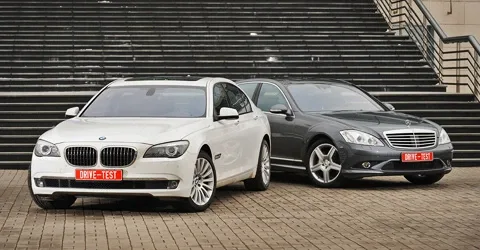
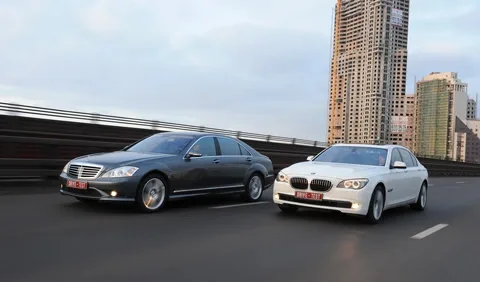
The face of the new BMW 'Seven' is devoid of any human emotion — it resembles a gas mask. The Mercedes' appearance is no less artificial.
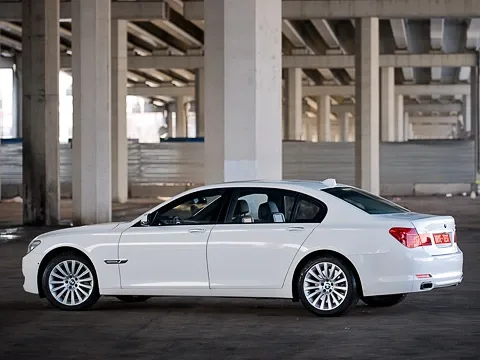
On one hand, the new 'Seven' looks more dynamic than its predecessor; on the other, it seems designed for taller people. The revolutionary Bangle-era 'Seven' E65/E66, which recently seemed huge, looks almost compact next to the asymmetric interior by Nader Faghihzadeh!
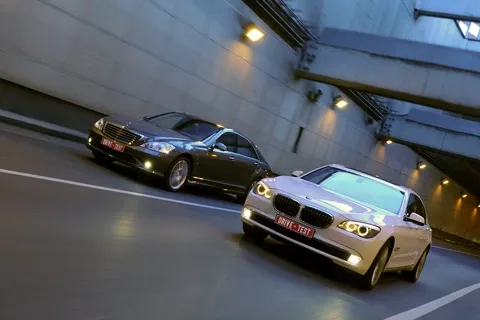
Meanwhile, Mercedes, without claiming sportiness or trying to flirt with the driver, literally dances through Moscow mud on the exact same tires as the BMW, while the 'Seven' simply drives. At the limit of its capabilities, the S-Class reveals itself as the secret dream of Stuttgart engineers, while the artificial steering resistance of the 'Seven' would probably appear in a Bavarian handling specialist's nightmare.
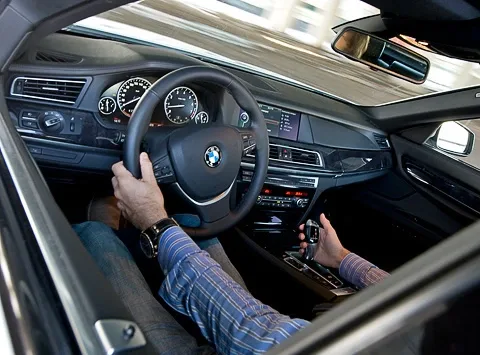
Ah, those seven and a half degrees by which the central console in the BMW is turned toward the driver! In them lies the whole difference in approach. You sit lower here than in the Mercedes, and the organization of space flatters your ego.
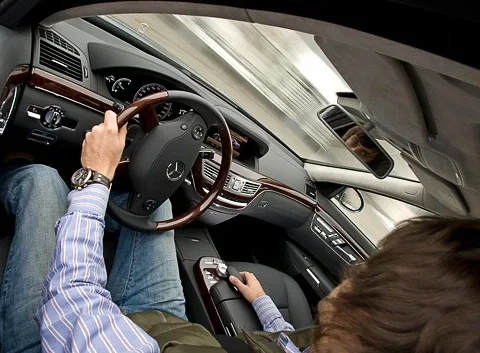
The symmetric interior of the S-Class gives the driver no visible privileges — here he is a chauffeur. But being a chauffeur in a Mercedes, enjoying the driving, is far better than driving your own 'Seven' and suffering from its aloofness. The higher seating position in the Mercedes provides a better view forward, though the side mirrors could be larger.
It seems that during final refinement, BMW testers did everything to spite the Mercedes engineers. You have a large suspension rebound travel — we'll make ours small. You have a clean and informative steering wheel — we'll load it with vibrations and useless background effort. In reality, all this stems from a lack of real-world experience. The new 'Seven' is the first with an active steering mechanism. Plus, all its wheels are steerable. The car enters an arc as if sideways — especially noticeable in the first minutes of acquaintance. Hence the synthetic taste. Additionally, the Bavarians are new to the front double-wishbone on a sedan instead of the usual McPherson struts. Having played on the contrast with Mercedes, the Bavarians will now await reactions from real customers and the press. Then everything will fall into place. Or not?
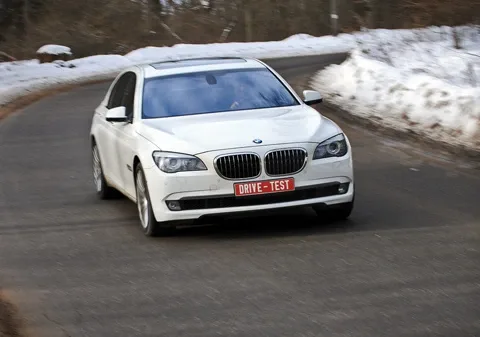
It would seem the steering wheel transmits detailed information about the road's micro-profile. But where is the reactive action? What happens to the steerable wheels? How many are there at all? I guide the 'Seven' into a corner by feel, even steering on straights to find contact with the car. Due to the lack of clear feedback, the BMW feels its full five-plus meters and nearly two tons. Yet the previous 'Seven', even in long-wheelbase form, could shrink to the size of a subcompact in the hands of a skilled driver. But now the Mercedes is the smallest.
Remember when the 'two hundred twenty-first' Mercedes first appeared on the market, it was also somewhat strange. True, that strangeness was of a different nature: it was noticeable how the S-Class was being dragged by the ears after the BMW 7 Series. The Mercedes had an inappropriate sportiness. It was stiff and in the first comparative test on fatter tires lost to the BMW in ride smoothness! But then everything returned to normal: after receiving enough feedback, in Stuttgart they made the Mercedes a Mercedes again.
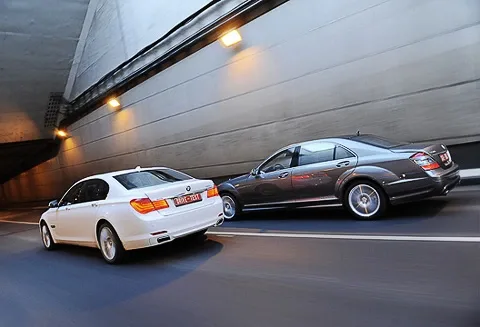
The duelists on identical 19-inch Pirelli Sottozero M+S tires. The BMW's size is less demanding — 245/45 R19 versus 255/40 R19 for the Mercedes. But even on more 'strict' tires, the Mercedes is more comfortable.
Such is common industrial practice. It is naive to think that any new car debuts in optimal form. It is prepared according to plan: according to deadlines and budget. The rest is compromise. The manufacturer's task is to extract maximum from circumstances. So after the premiere, work on the car does not end. Minor changes are made directly on the assembly line. Significant ones await a facelift.
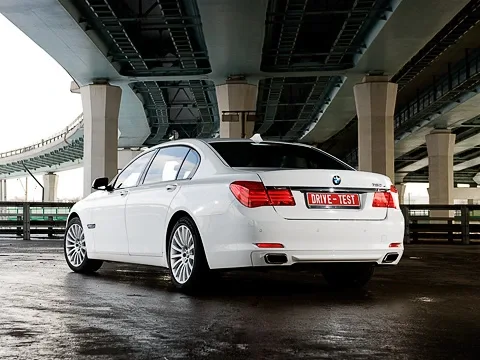
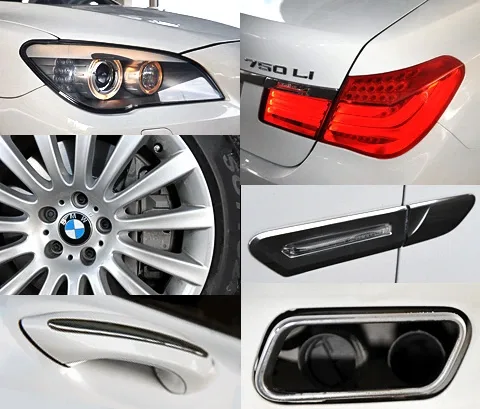
The strength of the 'Seven's' appearance lies in details. What doesn't play well in an ensemble solos beautifully, for example the rear lights. On their own, they are a sight to behold. The problem is that they are not hanging on someone's wall but are mounted at the corners of the BMW 'Seven', giving it a Japanese flair.
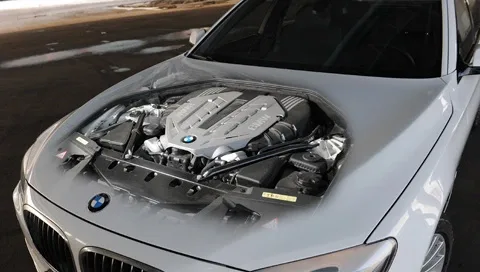
The 'Seven' also has to find itself. At least, we hope so. It's not for nothing that the chassis, united by a ten-megabit FlexRay bus, is the most computerized in the world. Ideally, it should provide unprecedented freedom for fine-tuning. And the 'hardware' here is impeccable. Take the turbocharged engine — the first in 13 years on a 'Seven'. This V-shaped 'eight' with a pair of turbochargers in the V of the cylinder block is an engineering masterpiece!
The insane thrust of the biturbo engine is so far the only backing for the driver-oriented promissory note issued by the Bavarians. There is so much of it that the non-studded tires break into wheelspin at every careless movement of the accelerator. On any gear! The six-speed 'automatic', trained to work with naturally aspirated engines, does its job as always honestly and firmly. Therefore, the turbo engine dumps torque onto the drive axle like dropping a weight on a foot. The 'Seven' lets out a metallic roar (not exactly musical) and squats on its rear. Traction control instantly bites the brakes and tightens the reins of 407 'horses'. Only this saves the occupants from a hammer blow to the chest. Acceleration builds smoothly but inexorably.
The Mercedes growls more nobly during acceleration. In the voice of the 388-horsepower naturally aspirated V8, there is no metallic technogenic strain — just as there is no metallized plastic in the Mercedes interior. The torque converter of the seven-speed gearbox, like in the BMW, provides a fairly firm connection, but responses to the accelerator are softer, and the rear wheels do not choke on torque. And the traction control system is not afraid of initial wheelspin.
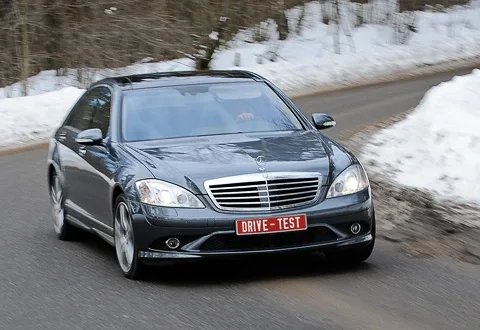
The Mercedes rewards the discerning driver with excellent feedback and unexpectedly lively reactions in extreme modes. But unlike the 'Seven', its stability control cannot be switched off.
And so it turns out that due to the strict electronic collar, the BMW loses outright in a drag race to the less powerful Mercedes. On a cold road, the BMW driver is warmed only by the flickering of the traction control warning light while the gap to the S-Class grows body by body. Oh, now it's clear why the 'Seven' needed all-wheel drive. It's not a matter of prestige, as we thought, but a big plus in dynamics. Only this way can the engine's crazy temperament be fully realized. However, I bet the rear-wheel-drive 'Seven' will get its revenge on the Mercedes on dry roads.
The braking dynamics of both cars are a mirror image of their acceleration. The Mercedes, with its smoothly increasing pedal effort, allows braking as gently as you like. The 'Seven' excellently handles high speeds but annoys with the sensitivity of the drive in traffic jams. And the BMW's 'automatic', ideal under full throttle, makes you regret the lack of paddle shifters at partial loads: the turbocharged engine is not rich in engine braking within a single gear.
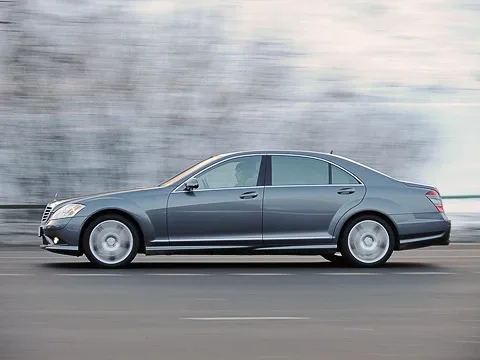
A massive body in the traditions of the W140, one of the most elegant interiors in the world, and a well-rehearsed duo of the 388-horsepower naturally aspirated V8 with a seven-speed 'automatic'.
If we were unanimous in our assessment of ride smoothness with my traditional passenger comfort expert, Mr. Klenov, our perception of noise differs slightly. The driver thinks the Mercedes is a bit quieter thanks to a narrower noise spectrum. And the one to whom the driver entrusted his pension savings concluded that the BMW is less annoying with tire hum.
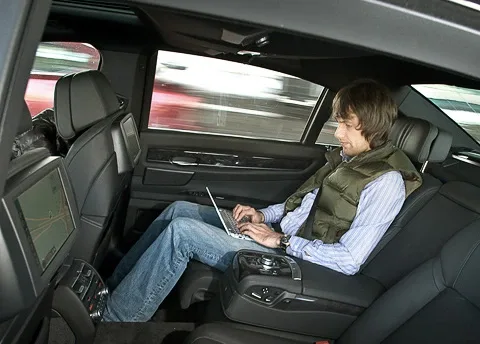
Important Klenov doesn't like to be in front of the camera — I'll be the visual example. In a properly adjusted BMW seat, it's like being in a racing bucket. On the backrest and cushion — detailed information about the road quality. Paradox: the driver is annoyed by the steering wheel, but the rear passenger lacks a steering wheel in their hands for balance of sensations. The seating position is lower than before, but, as before, it can be called commanding: you look at the road over the shoulder of the front occupant. However, the designers benefited more from the layout change: the ceiling still looms overhead.
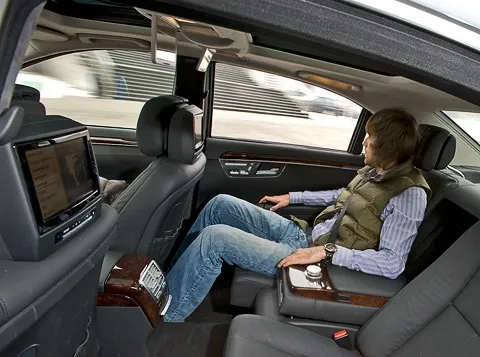
The rear seating in the Mercedes is noticeably lower than in the BMW: at the same level as the front passengers. There is less lateral support here, including on the cushion. But, taking the same route, the Mercedes transforms the road beyond recognition. On bumps, the S-Class is solid. No rattling. If we had an oscilloscope showing peaks of vertical accelerations, we would see how they turn from sharp stalagmites into gentle dunes. Even with a quartet of singing tires, it's very quiet here.
Music should be listened to in the BMW: after the Mercedes, it seems like cotton has been removed from your ears. But watching TV from the back is more pleasant in the Mercedes. The front seat backrest in the "Seven" shakes too much on bumps, and with it the large LCD monitor for passengers. If not for that, you could fiddle with the BMW multimedia system for hours. Rear passengers have access to all corners of iDrive, except those responsible for the chassis. There's navigation, onboard computer, and even an interactive owner's manual. With videos!

In working with the new iDrive, auxiliary direct-access keys to the main menu sections are a big help. Of the former compass rose, along which the main controller moved, only four directions remain. The menu is fully Russified, though not without spelling errors.
The iDrive interface has been simplified just enough so that the owner doesn't stop feeling like an advanced user. Navigating the system still requires a certain mental agility and known persistence. Overall, the "Seven" gives the impression of being aimed at a younger buyer than the S-Class.
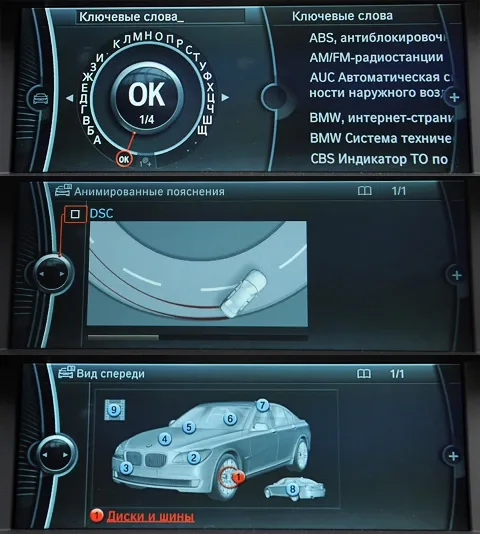
A great way to kill time in the "Seven" is to read the interactive user manual. Here there's not only a clear guide to the car, but even an animated primer on the basics of active and passive safety. The owner of the new "Seven" will know much more about the car than the Mercedes owner.
It's important for it not just to be, but also to seem a little. Take, for example, the front panel styled after the E38 "Seven". Oh, this demonstrative functionality! Everything that used to be hidden in the depths of iDrive is now in plain sight: audio system knobs and a full climate control unit. Below — a switch for suspension and transmission modes, a button to activate side-view cameras and call the parking assistant... Everything is under control, everything is one press away — there's always something to keep your hands busy.
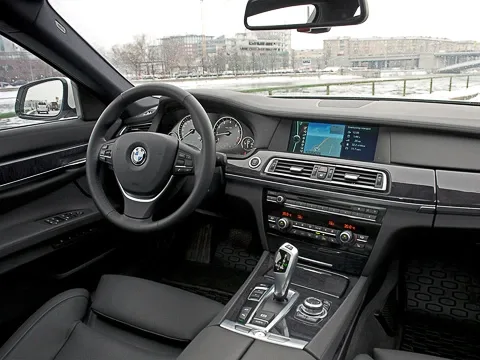
The BMW interior has too much plastic and an abundance of metallic trims. For that kind of money, there could be more natural materials. The shock that the symmetrical interior of the previous Bangle-era "Seven" E65/E66 caused doesn't occur. The huge cockpit conveys: BMW Group has returned to its roots. In the interior of a car bearing a propeller on the hood, the iDrive controller is no longer the main thing. Even if it were made of aluminum or pure gold.
In the previous "Seven", the driver was nominally not the main one. His place was on the periphery, and iDrive was considered the centerpiece: it was the aluminum washer that was the fundamental element of the interior — so proud were the Bavarians of their revolutionary controller. Here, everything is for the driver, and the infamous controller is planted in a flowerbed of auxiliary keys on the passenger side of the motorized "automatic" selector.
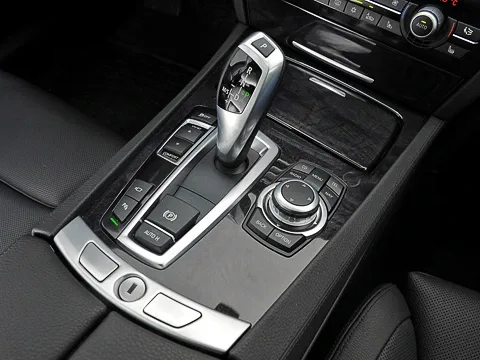
Don Quixote and Sancho Panza. The iDrive "bump" modestly huddles to the right of the "automatic" selector, surrounded by auxiliary quick-access keys. Both controllers are electronic: the lever has the same contact with the gearbox as iDrive — via wires. Both simulate feedback. It's amusing to watch how the servo drive with a click returns the selector to "zero" when putting the car into parking from M/S mode.
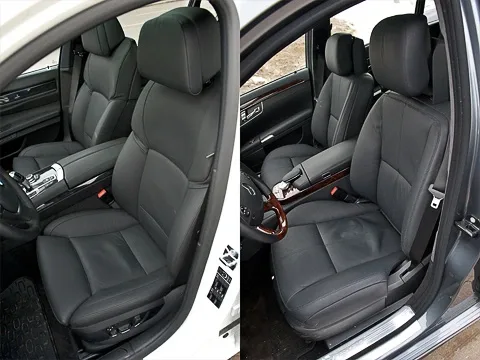
Both seats are good. In the Mercedes (right), there's adjustment of the cushion's lateral support and a more "inventive" massager. And the BMW seat is valuable for the ability to separately recline the upper part of the backrest. In the S-Class, the inflatable bolster pointlessly presses under the shoulder blades. But our Mercedes is equipped with a function to inflate the seat side bolsters in corners. An expensive but very pleasant option.
However, while driving, the driver previously didn't feel detached. Forgetting the design subordination, the "Seven" involved you in the driving process no worse than a selfish two-door. Now it's the opposite. The designers did everything to make the person behind the wheel feel like the main one. But on the move, it seems: let go of the steering wheel, and the "Seven" won't even notice. It will just keep rolling, obeying the navigator's instructions: "You'll need to turn right...", "You'll need to change lanes to the left..." You'll need to learn to be a BMW!
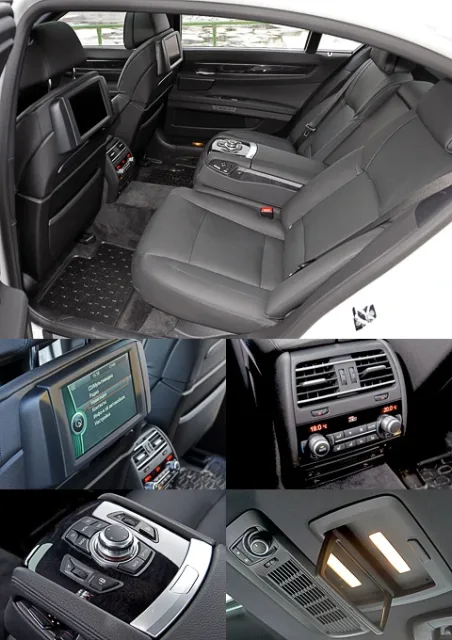
- Finally, the "Seven" has a full-fledged climate control on the center tunnel in the back. Although you have to reach for the control unit, just like in the Mercedes. Modernized autonomous air conditioners are still on the ceiling. But their appearance no longer evokes an unambiguous association with the products of the Baku factory.
- You'll also have to bend down to turn on the multimedia system screen. How it vibrates on the move! You could lose your eyes. All adjustments are through the iDrive menu.
I'm pleased to see how much more harmonious the interior of the new "Seven" has become. Previously, it resembled a haberdashery stall. Now — long live the unity of textures and colors! But why, in this restrained interior, are there ubiquitous accents of silver plastic? For the illusion of technological superiority? Why was it necessary to build a liquid-crystal garden on the instrument panel, if its tasks are to remain conservative, imitate analog scales, and change the backlight from white to orange at dusk? To be cool.
The Bavarians use any opportunity to surprise. You can't even close the door right away — there's no inner handle in its usual place! You have to grab the upper edge of the wooden trim, raising your hand high. You can compare this to slamming a carriage door, or recall the pre-restyling Logan. The main thing is that it creates a certain psychological discomfort. First, it's hard to believe that the thin trim won't tear off (there is indeed some play). Second, Klenov noted that it's not very pleasant to stick your fingers somewhere unknown — what if there's something there that could hurt you? Moreover, the handle inside is finished with rubberized plastic, and we're used to grabbing leather, wood, or metal — another nuance of artificial contact with the car.
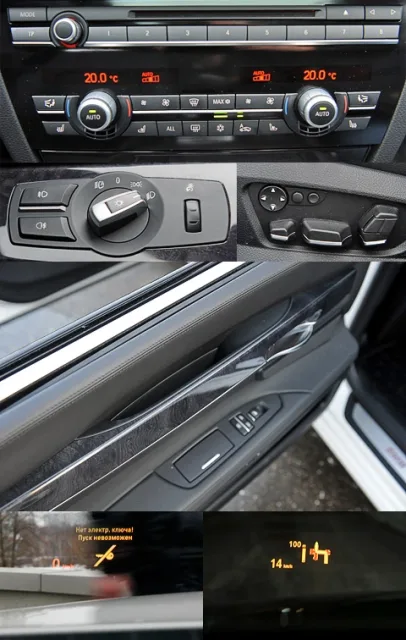
- Unusual door handles are the most memorable element of the BMW interior. Everything else is, in principle, familiar. The control unit for the front seats has moved from the armrest to the side of the seat base and no longer needs design treatment. This is an excellent example of the reorganization of the "Seven's" interior.
- The audio system keys don't even need to be pressed — they are touch-sensitive.
- Navigation prompts on the windshield practically eliminate the need for voice guidance.
Does the Mercedes driver have two displays at once? No problem. But the central one in the BMW has a diagonal of 10.5 inches. There hasn't been a bigger one yet! In addition, the S-Class has only two video cameras: rear view and infrared. And the "Seven" has another pair of cameras in the front fenders: these help when pulling out of an area with limited visibility — just stick the car's nose out onto the road a bit. Not a car, but a mobile studio for filming a 24/7 reality show.
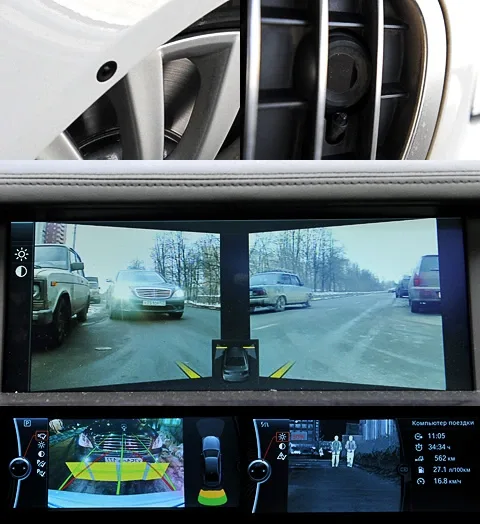
The side-view camera (top left) is the central attraction in the BMW 7 Series cabin. The dual image will be shown to friends and used to pass the time in traffic jams. Who would have thought that peeking under the "skirts" of neighboring cars could be so fascinating. In the infrared camera image, the computer is ready to highlight potentially dangerous pedestrians in yellow. In the rear camera image, dangerous obstacles are highlighted. The main thing is to keep the optics clean.
The 7 Series is much more playful in character than the button-restrained S-Class. Fans of technical innovations will appreciate the servo drive of the automatic transmission selector, the four suspension adjustment modes (of which only a couple are really needed), the pair of air conditioners, like from an office, hanging over the heads of rear passengers, and the countless manipulations of the controller wheel (even more than the Mercedes requires). But if you need entertainment of a different kind, peace of mind — here the Mercedes wins unconditionally.
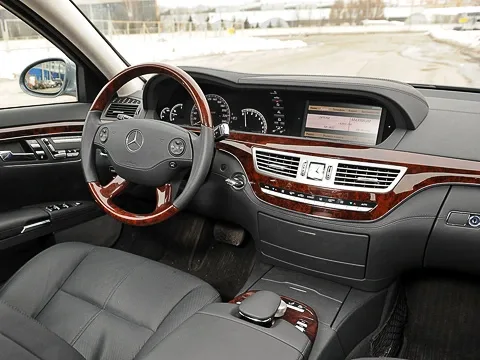
Inside, the Mercedes is upholstered in leather literally everywhere, right down to the ashtray lid. Everything that looks like aluminum is aluminum. The origin of the wooden inserts remains a mystery. From the rear seat, the interior seems more cohesive, as there are fewer intersecting lines.
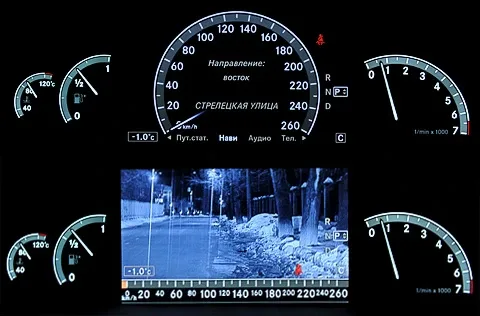
In the Mercedes, the night vision camera image is projected onto the LCD screen in the instrument cluster, replacing the virtual speedometer. In principle, you can drive at low speed with such an image. But the camera is mounted in the center, which makes orientation difficult. In the BMW, it's the opposite: the camera is shifted toward the driver, and the image is displayed on the central screen. However, the Bavarian system also works during the day, while the S-Class only works in low-light conditions.
Tap your fingernail on the Comand controller wheel in the Mercedes, and you'll hear a delicate metallic response. Ding! No part in the 7 Series can do that. The Mercedes sets such a high quality bar that the 7 Series can only respond with the quantity of parts.
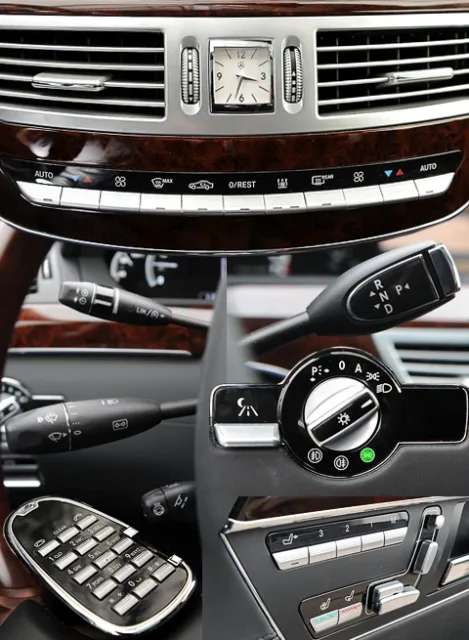
- We won't count the overloaded left steering column stalk of the Mercedes as an ergonomic drawback — it's still more logical than the non-latching analogs in the BMW. The automatic transmission selector on the steering column is also convenient. But we noticed an interesting feature: the steering wheel heating is activated by turning the "head" of a small lever that controls the servo drive of the steering column. This switch is in the blind spot, and after turning, the "head" returns to its original position — you can't tell by touch whether the heating is on. However, the reflection of the control LED is visible on the polished door panel. What an unusual solution!
- In both sedans, rear passengers can adjust the front seat.
The Mercedes multimedia system, like the seat control unit on the door, is a model of simplicity and clarity. Even Zyuganov would have figured out the intricacies of the few settings... if he knew a foreign language. In the Mercedes, the menu for rear passengers is not localized into Russian! It seems like two independent systems work in the cabin: everything in the front is in Russian, while for Klyonov, there are about fifteen other languages, including Turkish.
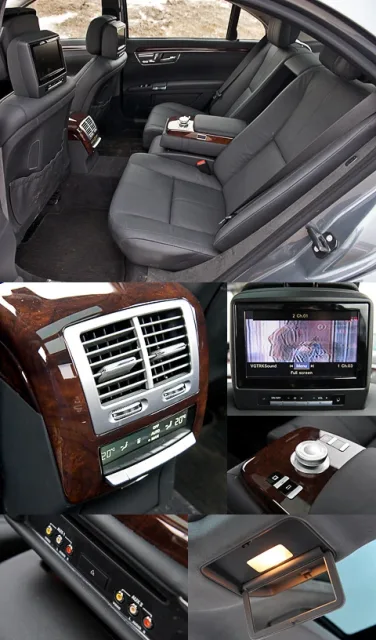
The atmosphere in the Mercedes is conservative. There's more wood here. The monitors are more modest. The multimedia controller has fewer functions. Volume and image are adjusted with "live" buttons near the screen. Above the passengers' heads is a glass section in the roof. The ceiling is higher, no air conditioners or handles. The vanity mirrors are lit brighter. It's cozier here.
And this is perhaps the only drawback of the S-Class. Not counting, of course, the exterior. Actually, neither car inspires literary flourishes. But the 7 Series at least catches the eye at first glance. It has impressively executed details, while the Mercedes is saved only by the AMG body kit... And don't forget: the author of the 7 Series, Karim Antoine Habib, is already working on the new S-Class...
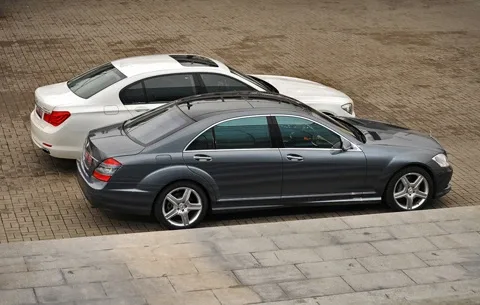
The difference in size is barely noticeable. Despite the redesigned interior, the 7 Series remains slightly taller than the Mercedes — by five millimeters. And longer — by three.
Although there is no winner in this comparison, the new 7 Series deserves praise. Its main achievement is originality. Being completely unlike the Mercedes, it has again made the tight world of executive sedans clearly bipolar. The Bavarians should be thanked by the Mercedes folks themselves: now no one will look for BMW traits in the S-Class. The new 7 Series has allowed Mercedes to be original again.
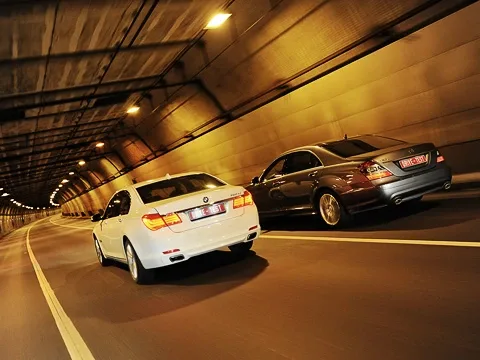
After driving the S-Class on broken streets, you begin to think that the wrong car was chosen as the basis for the small Rolls-Royce. The era of digital technology in this class has not yet arrived. And will it ever?
Until the new S-Class arrives in a few years, we can expect a fascinating confrontation between ideologically different cars. If, of course, the 7 Series finds itself. And until it learns to evoke in the rear passenger a sincere desire to move to the driver's seat, it will remain an image product. For those who gave up the S-Class because they don't ski but snowboard.
Technical specifications
| Model | Mercedes S500 L | BMW 750Li |
| Body |
| Number of doors/seats | 4/5 | 4/5 |
| Length, mm | 5209 | 5212 |
| Width, mm | 1872 | 1902 |
| Height, mm | 1473 | 1478 |
| Wheelbase, mm | 3165 | 3210 |
| Track front/rear, mm | 1604/1606 | 1611/1650 |
| Curb weight, kg | 1985 | 1980 |
| Gross weight, kg | 2565 | 2610 |
| Trunk volume, l | 560 | 500 |
| Engine |
| Type | gasoline | gasoline, with direct injection and turbocharging |
| Location | front, longitudinal | front, longitudinal |
| Number and arrangement of cylinders | 8, V-shaped | 8, V-shaped |
| Number of valves | 32 | 32 |
| Displacement, cm³ | 5461 | 4395 |
| Max. power, hp/rpm | 388/6000 | 407/5500–6400 |
| Max. torque, N•m/rpm | 530/2800–4800 | 600/1750–4500 |
| Transmission |
| Gearbox | automatic, seven-speed | automatic, six-speed |
| Drive | rear | rear |
| Chassis |
| Front suspension | independent, hydropneumatic, on transverse arms | independent, spring, on double wishbones |
| Rear suspension | independent, hydropneumatic, multi-link | independent, pneumatic, multi-link |
| Front brakes | disc, ventilated | disc, ventilated |
| Rear brakes | disc, ventilated | disc, ventilated |
| Ground clearance, mm | 140 | 141 |
| Performance characteristics |
| Maximum speed, km/h | 250 | 250 |
| Acceleration time 0–100 km/h, s | 5.4 | 5.3 |
| Fuel consumption, l/100 km |
| urban cycle | 17.5 | 16.4 |
| extra-urban cycle | 8.6 | 8.5 |
| combined cycle | 11.8 | 11.4 |
| Toxicity standard | Euro-4 | Euro-4 |
| Fuel tank capacity, l | 90 | 82 |
| Fuel | AI-95–98 | AI-92–98 |
In this test, we compare two flagship sedans — the BMW 750Li and the Mercedes S 500 L. Both cars are the pinnacles of engineering for their brands, and each offers its own view of luxury and comfort.
Technical content of the BMW 7 Series
The new 7 Series received a chassis that combines the evolutionary Integral-V rear suspension with four links and the front double-wishbone setup familiar from the X5 and X6 crossovers. Engineers had to develop a new front suspension to increase the wheel turning angles and maintain maneuverability despite the wheelbase extended by 80 mm. The increased wheelbase allowed rear passengers to be seated lower and, accordingly, made the roofline more sloping — this is the key feature of the new design.
The main engineering find is the Dynamic Driving Control system, which connects all chassis components via a fast FlexRay bus that operates 20 times faster than traditional CAN buses. In addition to active stabilizers, which were also present in the previous model, there is now steering with variable ratio and additional actuators in the rear suspension capable of turning the rear wheels up to three degrees. The shock absorbers of the 'Seven' have separate compression and rebound adjustment that works in real time.
The DDC system also controls the electronic accelerator, engine control unit, and ABS. Imagine the tuning possibilities this opens up.
The difference between the adaptive damper modes is truly noticeable only when switching from 'Comfort' to Sport. Moreover, the sport mode can be activated separately for the suspension or the powertrain, or for both at once. Comfort mode does not provide such an improvement in ride smoothness, as the body roll on waves noticeably increases. In the most radical Sport+ mode, traction control is additionally disabled.
Technical features of the Mercedes S-Class
The Mercedes S-Class W221 is built on a modernized platform of the previous generation W220. The rear multi-link and front double-wishbone suspension here are fully aluminum, and the steering rack has a variable ratio. A feature of the test car is the Active Body Control hydropneumatic suspension with active mounts, which effectively suppresses body roll.
The S-Class body is half made of high-strength steels. The hood, trunk lid, and some elements of the load-bearing structure are aluminum, while the doors are assembled from a combination of steel and aluminum parts.
Unlike BMW, in the Mercedes you cannot select a sport mode only for the seven-speed automatic: when switching the button on the center tunnel, the suspension settings also become stiffer. However, the difference between comfort and sport modes here is not as noticeable as in the BMW. But there are paddle shifters for manual gear changes.
The BMW's trunk holds half a cubic meter, but that is 60 liters less than the S-Class's cargo area. There are also fewer loading options: part of the space is taken up by a compartment with service electronics. Under the BMW's floor is a repair kit, while the Mercedes has a space-saver spare wheel. Power trunk lid is available as an option.
Multimedia systems
Each rear passenger of the 'Seven' has their own volume control wheel and a priority key for working with the controller. Together, they will have to use it in turns. Passengers have access to all iDrive functions except driver settings for chassis and powertrain.
The Comand system in the Mercedes is intuitive, even a child can figure it out. The menu is not too branched, and vehicle settings are accompanied by clear pictures. Although Comand owes its current form to iDrive.
History of the rivalry
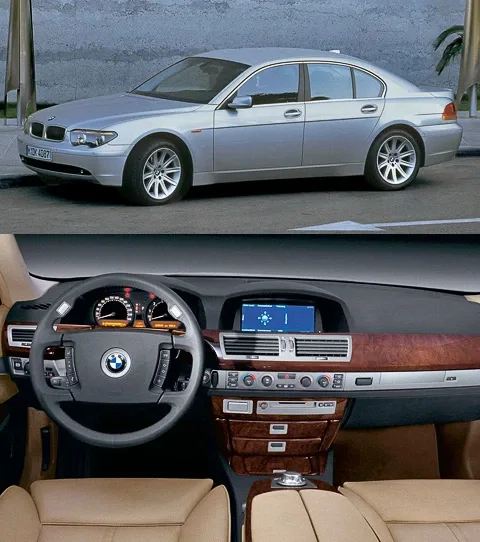
The BMW 7 Series appeared in 1977 with the factory index E23. The flagship with a predatory face and the signature Hofmeister kink looked elegant. The body length was 4860 mm, wheelbase - 2795 mm. The 'Seven' was equipped only with six-cylinder inline engines ranging from 2.5 to 3.4 liters with power from 150 to 286 hp. From 1977 to 1986, more than 285 thousand cars of the first generation were produced.
The 'Seven' E32, which appeared in 1987, grew to 4910 mm in length, and the wheelbase increased to 2833 mm. A long-wheelbase version also appeared - 5024 mm from nose to tail and 2947 mm between axles. It was one of the first to receive a 12-cylinder engine - a five-liter one with 300 hp and a torque of 450 N•m. The engine lineup changed: initially there were two 'sixes' (3.0, 188 hp and 3.5, 211 hp), then two 'eights' were added (a three-liter with 218 hp and a 286-hp 4.0). Transmissions - five-speed manual and four-speed automatic. Until 1994, more than 310 thousand 'Sevens' were produced.
Many brand fans consider the third-generation sedan to be the most elegant in the model's history. With a length of 4983 mm, the body looks squat, and restrained lines create a strict and representative image - this design approach is worthy of emulation. It was with this 'Seven' that the confident march of diesel engines began: buyers were offered three diesels with outputs from 140 to 245 horsepower. The gasoline range was represented by one 'six' with a volume of 2.8 liters (193 hp), and the flagship engine was a V12 with a volume of 5.4 liters, developing 326 hp and 490 N•m of torque. From 1994 to 2001, over 340 thousand such cars were produced.
In 2002, BMW fans experienced a real shock. Bold design decisions hit the pride of many adherents of the Bavarian brand. However, this same revolution attracted new admirers: over time, it turned out that the 'Seven' with the index E65/66 turned out to be the most commercially successful - at least, the best-selling. During production, the flagship sedan was equipped with five gasoline engines ranging from 231 to 445 hp and three turbodiesels with outputs from 231 to 330 'horses'. In 2006, the model underwent a planned restyling, and two years later it was replaced by the current sedan with the index F01/02.
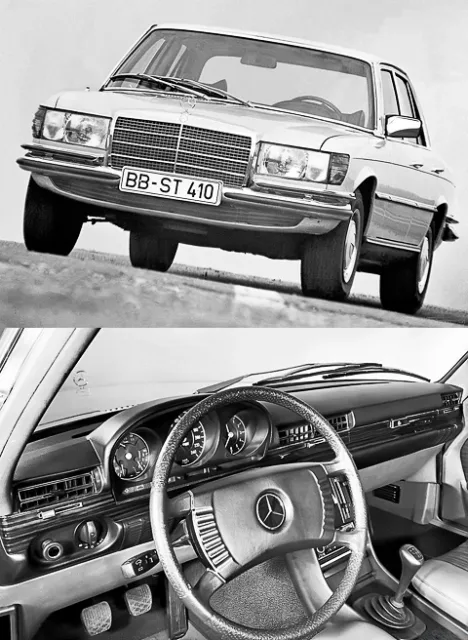
The predecessors of the current S-Class can be considered the W180 sedan of 1955 or the first eight-cylinder Mercedes - the W108 model, which appeared in 1965. And the Mercedes 600 of 1963–1981 with the 6.3 'eight' producing 250 hp and 500 N•m is, in essence, the prototype of long-wheelbase S-Class models. But let's start with the first official S-Class - the W116 model. The car was offered with five engines: four gasoline ('six' 2.8 and 'eights' 3.5, 4.5, 6.9) and one three-liter diesel. Even then, the equipment included a driver's airbag, anti-lock braking system, and air suspension. Until 1980, more than 423 thousand cars were assembled at the Sindelfingen plant.
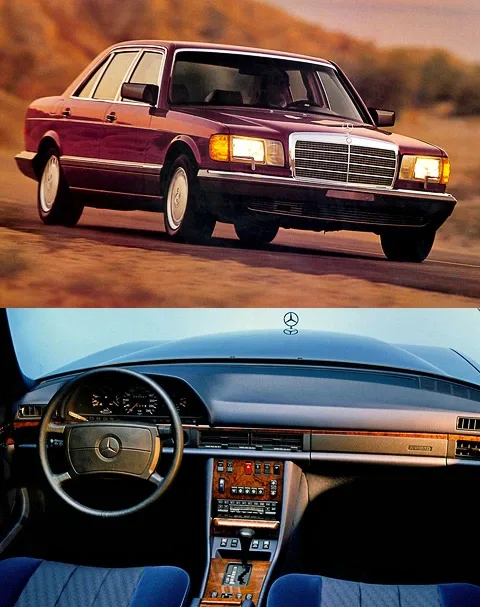
From 1980 to 1991, the S-Class W126 was produced there. This favorite of the elite was distinguished by strictness both in the exterior and in the interior design. The minimum body length was 4995 mm, wheelbase - 2935 mm. At various times, nine engines with power from 134 to 295 hp were under the hood of the flagship. The 560 SE sedan with the top 'eight' 5.6 (455 N•m) accelerated to 100 km/h in 6.9 seconds, and the top speed reached 250 km/h. In total, 818 thousand such cars were sold - compare with BMW's figures of that time!
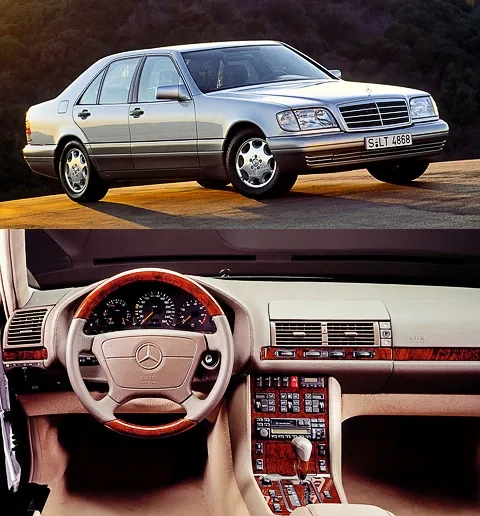
In March 1991, the Germans presented the S-Class W140. After the elegant 'one hundred twenty-sixth', the new flagship seemed a real heavyweight. It was the first to receive a V12 engine: the six-liter unit initially produced 400 hp and 580 N•m, then the output was reduced to 394 hp and 570 newton-meters. In addition, there were six more gasoline and diesel engines in the range with power from 148 to 320 hp. With the 1994 restyling, Mercedes introduced a new designation system: the letter S began to be placed before the engine index - for example, S 600L instead of 600 SEL. Over seven years, more than 406 thousand sedans were produced.
By the mid-90s, Mercedes wanted to attract younger buyers: the brand was preparing to launch new C- and A-Class models. BMW customers came into the marketers' field of vision. In 1998, the swift S-Class W220 debuted - a real trendsetter. Elegance itself: smooth body lines echoed the cozy interior. Associations with cabinet furniture disappeared. During production, 14 engines were installed on the car, including a 500-hp biturbo V12 (S 600) and its 612-hp version from AMG (S 65 AMG). The 'two hundred twentieth' became the first all-wheel-drive S-Class and a pioneer in the Pre-Safe preventive safety system. In addition to air springs, the suspension received electronically controlled shock absorbers and active hydraulic mounts of the ABC system. Until 2006, 485 thousand W220s were produced.
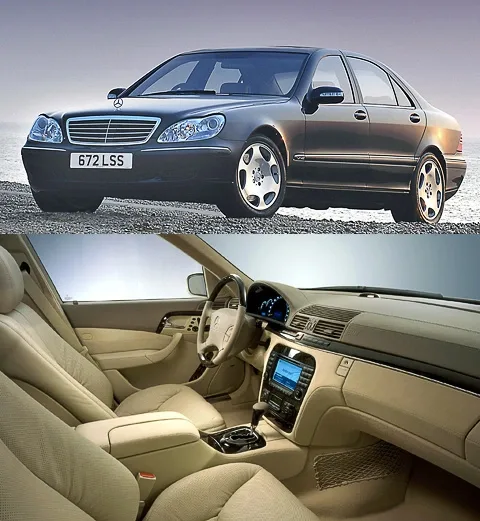
We took the Mercedes for a test, but soon returned it: the vibration was too strong. As it turned out, colleagues who took the car before us managed to kill all the wheels. And no one warned us! As a result, we lost a whole day. But the S-Class returned on brand new AMG wheels. It was all the more offensive to fly into a pothole in a Moscow region parking lot. Fortunately, everything worked out. And thanks to a random savior: he had both a tow rope and a Toyota Land Cruiser Prado! By the way, having gotten stuck, we completely forgot about the Mercedes' ability to raise itself on hydraulic mounts. So we sat on our belly waiting for a tow truck.
Interestingly, the economy test ended in a draw. With the same mileage and in the same modes, the fuel consumption of both cars was 26.9 liters per hundred. Although, in essence, this is a victory for the more powerful 'Seven'. The question remains: why did this masterpiece of Bavarian engineering consume a liter of oil during the tests with a mileage of 3500 km?