
Haul and Dash
In the world of automotive press, there is a term called "rendering" — this is how computer images of future models are referred to, published while the manufacturer still keeps their appearance under wraps. Usually, such pictures appear based on leaked drawings or data provided by insiders, but in most cases, they are merely the fruit of a particular artist's imagination. Using fragmentary information as a basis, they try to guess what the new model will look like.
Often, such works look as if they were hastily thrown together in a simple graphics editor. But those images published by reputable outlets are usually made with soul. Their authors do not simply copy other people's cars or distort the proportions of existing models. They spend months searching for any clue to predict the design of a future car as accurately as possible.
debuted a year ago on the X6 SUV
In Search of "Gran Turismos"
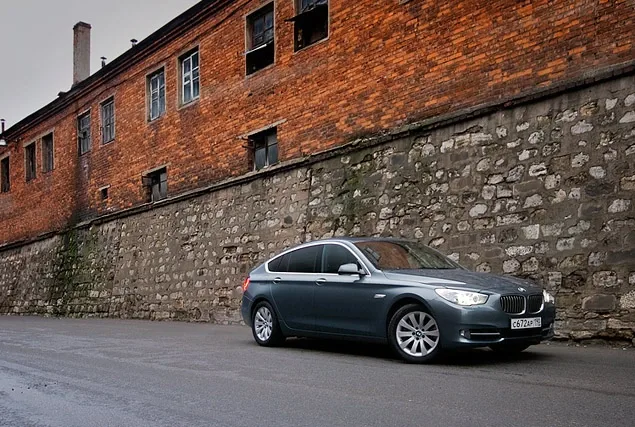
When you first look at photos of the "Five" Gran Turismo, the thought comes to mind that these are those very "renderings". Especially if you look at the car from the side — from this angle, it resembles a flattened X6, whose rear end has been slightly extended for solidity. But, as with the real works of professional designers, this impression is deceptive. If you look closely, the SUV and the new "Five" GT share only one common element — the recognizable "coupe" roofline, which we first saw on the X6 a year ago.
Otherwise, these are completely different cars. The "X-Six" is built on the basis of the X5 SUV, while the five-door coupe got its platform from the new, sixth-generation "Five". It is this kinship that gives it the right to be called Gran Turismo. The chassis of the new "Five" is unified with the current "Seven", so the inheritance here is rich: a new double-wishbone front suspension, a rear multi-link that can steer the wheels (though only with the Active Steering option), and a whole arsenal of electronic assistants identical to those on the flagship of the Bavarian brand.
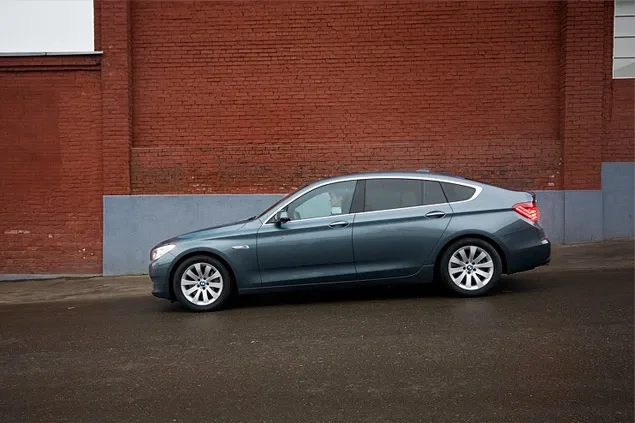
Now add to this list the wheelbase from the regular "Seven" without extension, the high roof from the X6, a driver's seat raised by seven centimeters relative to the standard "Five", a trunk of 440 liters (and with the rear seats folded — all 1700), and a complex fifth-door design reminiscent of the Skoda Superb solution (nothing to be done here — the Czechs thought of it first). As a result, we get a car that can please the most discerning traveler.
But where to find such travelers ready to spend several thousand, or at least several hundred, kilometers behind the wheel? The answer is simple: in North America. It is there that the Bavarians plan to sell the lion's share of the "Gran Turismo". The main target audience of this coupe-hatchback is "soccer moms", that is, affluent mothers of many children. Those very ones who once ignored the previous-generation "Five" wagon — in the entire last year, only 400 such cars were sold in the USA!
In Europe, station wagons are treated with more sympathy than overseas, but expensive premium cars here are more often taken for business trips with a chauffeur. In such a case, the exotic appearance of the "Gran Turismo" would be more of a minus. Although there are also aristocrats — those who once invented the fashion for three-door shooting-brake wagons based on luxury limousines, to comfortably go hunting. But how many of them are left?
Or take Russians who have the means for a "Five" GT (our test car in maximum configuration with a 407-horsepower gasoline V8 of 4.4 liters costs 3.3 million rubles). They travel a lot on business trips, but due to our vast expanses, they are unlikely to trade the faceless airplane cabin for a comfortable multi-contour leather seat of the Bavarian Gran Turismo.
Sport with a Plus
|
"Eye" like an eagle
|
At BMW's Munich office, they probably perfectly understand that there are few true "gran turismos" left in the world, and it is unlikely that they should bet on them when launching such a model. Most likely, marketers calculated that this five-door coupe, despite the nice chrome "GT" badge on the trunk lid, will be bought primarily as a stylish alternative to the practical but too familiar 5 Series "Touring" wagon.
If so, then the answer to another logical question becomes clear: where should the owner of the "Gran Turismo" be — in the back or behind the wheel? It would seem, with a wheelbase of 3070 millimeters, it is logical to settle on the rear sofa, giving the front seat to the driver. But the rear seats here slide forward, turning extra millimeters of legroom into additional liters of trunk space — its volume grows from 440 to 590 liters. Why would a representative sedan with a chauffeur need such an option? Moreover, in a car with a sloping roof, as in any coupe, it is easier to breathe in the front.
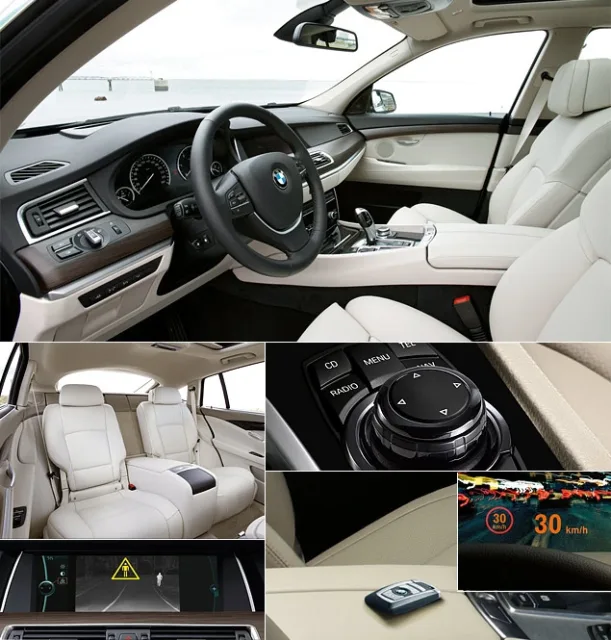
But the main argument in favor of the driver's seat is the sensations you experience when you sit in it. Firstly, admiring the elegant handle of the eight-speed automatic and the front panel from the "Seven", which could easily pass for a slice of expensive geological rock — plastic, wood, leather — is best done from the driver's seat. Here, all this can not only be examined but also touched. Overall, ergonomics and tactile sensations from contact with the car in the "Gran Turismo" receive no less attention than in the 7 Series. The differences that maintain model hierarchy lie in the details. For example, the GT does not have paddle shifters behind the steering wheel, separate climate control cannot be ordered for rear passengers, and rear seats with electric adjustments, ventilation, and heating can be "added", but they will not have a massage function.
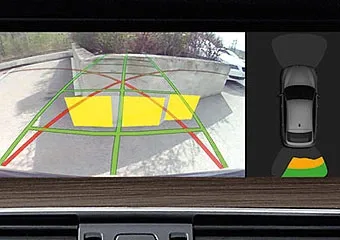
However, the driver's seat, as in the "Seven", can be had with active support and ventilation. In addition, at the driver's hand, on the transmission tunnel next to the futuristic automatic lever, is the iDrive joystick, and on the front panel — a neat minimalist row of buttons in a single strip. They provide access not only to the usual audio system, navigation, and Bluetooth but also to the active safety systems of the ConnectedDrive mobile platform. Translating from marketer language to human, this means a set of the most advanced electronic "toys" to date (the same ones installed on the "Seven") that noticeably ease the driver's life.
Take, for example, the "optronic" instrument panel, complemented by a head-up display projecting data onto the windshield. Since the sound insulation here is so good that it does not even let in the rumble of the gasoline "eight", speed in the GT is felt weakly, and the electronic speedometer constantly hanging before your eyes on the "windshield" greatly helps in controlling the speed limit. The Night Vision system, through an infrared camera, displays a "lit" picture of the road on the ten-inch LCD screen on the center console (or seven-inch — depending on the trim). It also tirelessly scans the 300-meter zone ahead, warning the driver about pedestrians appearing on the path.
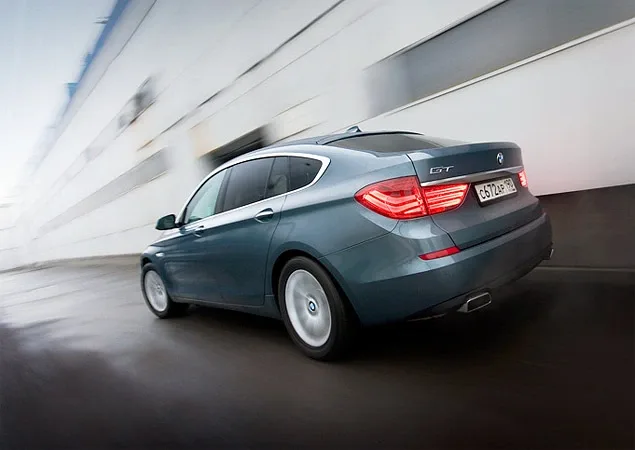
Thirdly, the "five" GT, with its curb weight of over two tons and a higher center of gravity than the standard 5 Series, handles and drives like a one-and-a-half-ton passenger car. This is especially noticeable when switching the adaptive rear suspension, accelerator, and steering control system to Sport mode. The steering wheel fills with a pleasant heaviness, giving full control over the trajectory, and the suspension clearly, without unnecessary body oscillations, "digests" any irregularities of Moscow asphalt according to the football scheme: received, processed — and immediately passed on.
The "civilian" Normal and Comfort modes, aimed at maximum smoothness, encounter obstacles differently — much softer, but as if a slight convulsion runs through the body. Both modes are similar as twins: on smooth asphalt, differences in suspension settings can only be recorded with special measuring equipment, although BMW assures that in "Comfort" the car rolls less in corners so as not to disturb passengers. In any case, behind the wheel of the "Gran Turismo," neither one nor the other is tempting to engage — in the "non-sport" mode, the car seems to gain its real kilograms, and the steering wheel loses the precision sharpness of response.
the "five" GT handles and drives like a one-and-a-half-ton passenger car
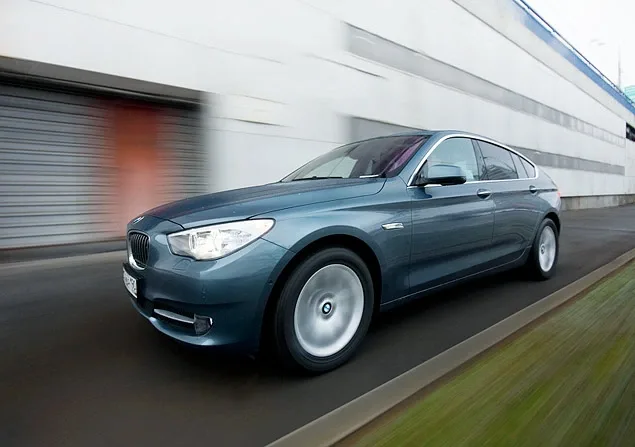
But in Sport+ mode, which has a reduced sensitivity threshold of the stability control system, you immediately remember that under the hood is a top-end eight-cylinder engine with twin turbocharging, accelerating the "Gran Turismo" to 100 km/h in 5.5 seconds. The maximum torque of 600 Newton-meters is available from 1750 rpm and holds until 4500. With such power, an unprepared driver without a properly tuned ESP will find it difficult to cope — in "combat" mode, the "five" GT willingly drifts its tail on both wet and dry asphalt.
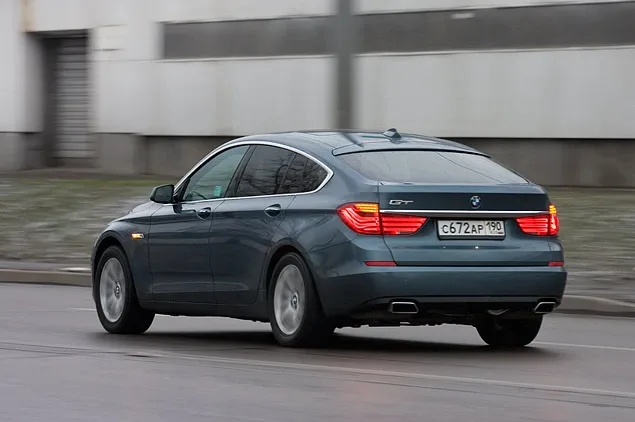
By the way, given the "rambunctious" nature of the eight-cylinder engine, when buying a Gran Turismo for the city, it is worth looking at two other, less powerful engines — a three-liter gasoline inline "six" with 306 horsepower (with a single turbocharger) or a diesel of the same volume with 246 "horses." And the excellent eight-speed ZF automatic transmission, shifting gears in just 200 milliseconds, is installed on all "Gran Turismo" modifications already in the "base." And it's not shameful to think about fuel economy — in our test, the coupe with V8 consumed no less than 26 liters of gasoline per 100 km.
Prospects
In general, there are more than enough reasons to get behind the wheel of the Gran Turismo. For wealthy buyers, this is also a chance to drive a big and powerful BMW without looking like a "personal driver." Since the "five" GT is cheaper than the 7 Series with a similar level of equipment, this car has excellent prospects on the Russian market. Even despite the fact that domestic motorists do not favor five-door cars.
However, the real life of the "Gran Turismo" coupe-hatchback will most likely begin a little later. Not when sales of the all-wheel-drive version start (this segment of the Bavarian manufacturer is well covered by a full range of crossovers and SUVs), but after the appearance on the roads of... the "three" GT. Given the popularity of the 3 Series, the new BMW body layout has every chance to win over the mass buyer of premium cars. Who would refuse a fast, stylish, and at the same time convenient car?
True, such luxury attributes as "seven-series" electronic gadgets, LED door handle lighting, and a servo drive that prevents the door from slamming, itself choosing the last six millimeters of gap with a delicious smack, are unlikely to go to the "three" Grand Turismo. Nothing can be done — subordination.
Technical characteristics of the BMW 5 Series Gran Turismo
| Length, mm | 4998 |
| Width, mm | 1901 |
| Height, mm | 1559 |
| Wheelbase, mm | 3070 |
| Curb weight, kg | 2060 |
| Engine displacement, cm3 | 4395 |
| Power, hp/rpm | 407/5500-6400 |
| Torque, Nm/rpm | 600/1750-4500 |
| Acceleration time from 0 to 100 km/h, s | 5.5 |
| Maximum speed, km/h | 250 |
| Fuel consumption in combined cycle, l/100 km | 11.2 |
| DISCUSS | [ comments: NONE ] |