
For BMW, the third series model has meant much more than just a successful car for three decades now. Until the "one series" appeared, the "three" remained the only compact car in the premium segment. For most fans of the brand, it was with this car that their acquaintance with the brand began. We won't claim that no other car can boast the same impeccable conceptual harmony as the new BMW 3 Series, however...
The designers faced a difficult task: to maintain the perfect balance between sportiness, dynamics, and elegance, while also bringing something new and forward-looking to the design. The same impulse that was set by the Z4, the "five", and the "seven" is also reflected in the appearance of the new "three". At the same time, it differs noticeably from its predecessor: the body length, hood, and wheelbase have increased, and many details have changed. Compared to the older sedans, the "three" looks lighter and more maneuverable — its relatively compact dimensions have an effect. Externally, it is sportier than the "five" and more elegant than the Z4 or the "one".
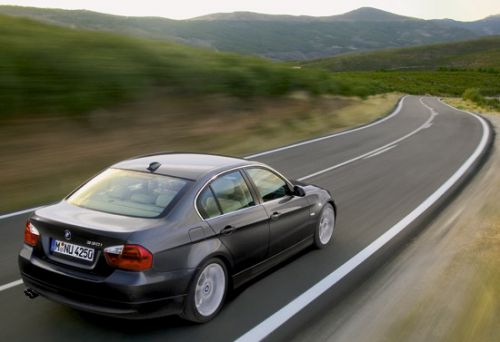
2006 BMW 3-series (E90)
© Photo: BMW
The car's dimensions have grown: length increased by 49 mm, width by 78 mm, and height by 10 mm. The reason is simple: humanity is gradually getting taller, and BMW decided that cars should grow along with people.
Inside, it has also become more spacious. Rear passenger knee room has increased by almost 50%. But the most interesting thing is that the body has become larger but not heavier. The secret lies in new grades of steel that, with a smaller cross-section, possess exceptional strength. Multi-phase steels can withstand much greater loads than traditional ones, so they were used in areas responsible for safety. Additional rigidity is provided by special braces between the most loaded components: at the front, this is the engine mount bracket and its connection to the side member, as well as the attachments of the B-pillar and the rear section. As a result, torsional rigidity of the body has increased by 25% compared to the previous model. In a collision, energy is distributed along special load redistribution paths, which reduces deformation and enhances the safety of the driver and passengers.
The "cockpit" of the new "three" is classic BMW: an instrument panel with two round dials for the speedometer and tachometer. The automatic diagnostic system has become broader in functionality and is now comparable to the one installed in the "five".
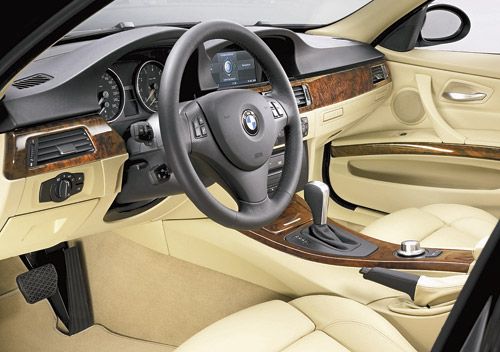
2006 BMW 3-series (E90)
© Photo: BMW
Behind the wheel, the seating position is sportily low — there is plenty of headroom, and the lateral support of the new seats is excellent. In the base version, the seats are upholstered in fabric; for an additional cost, you can order combined upholstery or fully leather.
In the list of options for the driver's seat — electric longitudinal adjustment, as well as adjustment of the cushion height, its tilt, and backrest tilt. Seat heating (also for an additional cost) covers the entire surface of the cushion and backrest, including the side bolsters.
Despite the coupe-like roofline, there is as much space in the rear as in the previous model. The seating has become freer, and there is more legroom. It's a pity that the rear seat backrest in the base version is rigidly fixed — you can't fold it down, so the trunk volume cannot be increased. However, it has already grown by 20 liters — to 460 liters.
But future owners are usually interested not in the trunk, but in the engine. The new model will hit the market in four versions: three gasoline and one diesel. All engines have noticeably increased power, smoothness, and efficiency. And each modification is interesting in its own way.
The cylinder block of the inline "six" is cast from ultra-light magnesium. The top version BMW 330i produces 258 hp — 27 hp more than its predecessor (an increase of 20 kW). Torque of 300 Nm is available in a wide range from 2500 to 4000 rpm. This is the most efficient and lightest engine in its class.
In spring 2005, production of the BMW 325i will start: 218 hp at 6500 rpm and 250 Nm in the range of 2750–4250 rpm. Displacement is 2.5 liters.
The most powerful four-cylinder version will be the BMW 320i. It is based on the inline 2-liter engine from the 318i, equipped with the Valvetronic system and "double VANOS". It develops 150 hp at 6200 rpm, maximum torque — 200 Nm at 3600 rpm. Acceleration to 100 km/h takes 9.0 seconds, top speed is 220 km/h, and fuel consumption according to the EU cycle is 7.4 l/100 km.
The diesel version BMW 320d received a new turbodiesel with 163 hp and torque of 340 Nm already at 2000 rpm. The sporty character is confirmed by the numbers: acceleration to 100 km/h — 8.3 seconds, top speed — 225 km/h, and fuel consumption — only 5.7 l/100 km.
All new "threes" in the base configuration are equipped with a 6-speed manual transmission. For an additional cost, a 6-speed automatic will be offered. The extra gear allows for more efficient use of the power of the new engines.
The suspension was developed from scratch. The front is fully aluminum, which provides an optimal balance of dynamics and comfort. The car features high lateral stability and low rolling noise. At the same time, despite its low weight, the front suspension is very rigid. The rear — 5-link, steel, but lightweight — provides excellent maneuverability and a sporty character.
Special attention deserves the steering. For the first time in the middle class, for 6-cylinder versions, you can order BMW's Active Steering system. At low speeds, it makes the response sharper; at high speeds, on the contrary, calmer. Plus, the system helps when braking on surfaces with different grip — for example, when there are patches of ice or snow on the asphalt. Active intervention in the steering stabilizes the car faster and more accurately than even an experienced driver could.
Safety is also enhanced by the new latest-generation Dynamic Stability Control (DSC) system. On versions with 6-cylinder engines, it can keep the brake discs dry in wet weather and bring the pads closer to the discs for increased braking readiness. In addition, DSC prevents the car from rolling back on an incline and eliminates nose dives before a complete stop.
Assembly of the new "three" will be organized at four BMW plants — in Munich, Regensburg, Leipzig, and Rosslyn, and later the Chinese Shenyang will join. In Kaliningrad, production is planned to begin in the second quarter of 2005. The price of the new model in Ukraine starts from 29,900 euros for the base version with a 2.0 engine, while, for example, a car with a 3.0 engine in the Dynamic trim will cost 52,900 euros. A bit expensive, but the brand has never been cheap.