
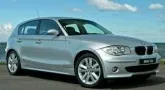
A long hood and a cabin shifted toward the rear axle. A look that promises a lot! Another BMW model with similar proportions immediately comes to mind. But can the younger "one-sixteen" live up to such expectations?
Open any advertising brochure of the Bavarian brand. Next to the corporate emblem is the slogan "Sheer Driving Pleasure." The meaning is simple: BMWs are made for those who know how and want to enjoy driving. Of course, at a corresponding price.
We won't argue: the brand has plenty of reasons to be proud, even if we don't take into account coupes, roadsters, and forget about the existence of "M" models. Although current sedans no longer look as sleek as their predecessors, and some seem heavy... But it's not about the looks at all!
Nevertheless, among the "mass-market" BMWs, the 1 Series stands apart. A knowledgeable person will immediately understand what's what by looking at its proportions. Yes, formally it's a hatchback, but you don't shift the cabin back just for fun. Look under the hood—and you'll see that the engine sits almost above the front axle, as if wedged into the cabin, leaving passengers and luggage not much of the wheelbase that is huge for this class. This is a classic sports layout aimed at ideal weight distribution. And, if you think about it, a Bavarian inline-six with a displacement of three liters would fit under this hood without any problems. In short, the car looks promising. Associations with the Z3 Coupe and other racing fantasies involuntarily come to mind.
And, of course, there is no doubt that this is a BMW. No, it's not about the badges or even the famous "kidneys." You can have different attitudes toward Chris Bangle's work, but you can't deny that he achieved his goals. Now you can't say that BMW models look like one sausage cut into pieces of different lengths. Rather, it's a construction set of characteristic details used in various combinations. In this regard, the "one" is closer to the Z4 and X3: the kinship is visible both in the exterior and interior. Although owners of pre-Bangle BMWs will find familiar features in the shape of the ventilation deflectors.
By the way, about the panel and the X3. Here, the soft plastic has a different "shagreen" texture, and the panel looks much more noble—no associations with rough leather. The trim panel textures are also better chosen, although the "one-sixteen" is almost half the price. Climate control is also more convenient. And it's dual-zone, by the way! It's clear that the steering wheel is simpler, but it's nice, pleasant to the touch, non-slip, and very comfortable. And the 12-volt socket on the tunnel begs to charge your mobile phone.
The low seating position continues the sports theme. The engine start button is just a detail, but it also sets the mood. The seats are excellently contoured, with a huge range of adjustments. Everything here is for the driver, and this sporting spirit is well felt in the rear seat: there's nowhere for even teenagers to put their legs, and adults will have to settle in only if someone short is sitting in front. And it's better to ride in the back with two: there's not much width, and a tunnel rises in the center of the floor.
The trunk is also "sporty": the size seems acceptable, but the opening is narrow, and the high rear wall doesn't make loading easier. However, the tailgate closes with an inner handle with minimal effort—this is a sign of the brand's refinement, as is the quality of materials, perfect panel fit, and the solid sound of door closing.
The clutch pedal is a real exercise machine: the travel is long, and the effort is as if there were not 1.6 liters under the hood, but twice as much. And you can only work the clutch by lifting your heel off the floor. So get into a sporting mood and hone your skills, because it's impossible to understand by feel what's happening and when.
Over time, you get used to it and begin to understand the dynamics. If BMW is synonymous with a powerful surge for you, you'd better look at the 120i model. No, the 1.6-liter engine is undoubtedly good. It has a smooth, without pronounced dips, characteristic, it pulls confidently in a wide range of revs, starting from the very bottom. But if you need to accelerate sharply or want to surprise someone, you'll have to rev the engine to the very top on every gear and shift at a frantic pace. And if you've already gotten used to the clutch quirks, the process itself will be a pleasure: shifts are precise and crisp, the engine revs up to 6500 rpm, and its thoroughbred voice at high revs is music for a true fan.
But for a true connoisseur, the thrill of driving is not in hurricane acceleration, but in refined handling, which the brand's motto hints at. A sharp steering wheel, excellent feedback, minimal body roll, perfect precision in corners, excellent stability—a traditional set of noble manners for the Bavarian brand, which the 1 Series is ready to demonstrate. On smooth asphalt. But it reacts noticeably to ruts cut by studs, and on uneven surfaces, alternating loads begin to arrive at the steering wheel. Whether they mean nervousness or possible yawing, we couldn't fully determine: the fallen snow hid the unevenness, and the slippery slush worsened feedback and didn't allow high speeds.
But the conditions for slides were ideal, and the car, devoid of overhangs, handles almost intuitively. Moreover, the stability control system is an excellent tool in experienced hands. When enabled, it allows a playful "tail wag" in a corner, but then quickly "catches" the car, not letting the slide develop. In DTC (Dynamic Traction Control) mode, stability control weakens, and the traction control almost stops "choking" the engine, working in a differential lock simulation mode. The driver is given the opportunity to accelerate intensely, but with the appropriate skills: the car can "drift" quite a bit. And, of course, following BMW tradition, the system can be completely turned off. Then you get a "primitive" but perfectly controllable rear-wheel-drive car—if only you had the skill not to "lose" it.
Ideally, the next passage should be about how sporty handling implies a stiff, short-travel suspension, especially since on uneven asphalt the "one" can give your stomach quite a few unpleasant sensations.
But there will be no such passage. Indeed, the car meticulously copies the road profile, transmitting detailed information about irregularities to the driver and passengers, down to thin ice patches and bare spots. And, of course, broken asphalt is not its element. But bumps are overcome easily, without heavy jolts on individual potholes. The stiffness of the suspension in this case is not the stiffness of a wooden stool, but rather of a heavily inflated ball. And it is perceived as part of the image, not as a forced property. After all, modern suspensions allow combining excellent handling with decent ride comfort, and many BMW models are an example. If only the creators had the desire. Especially since the "one's" wheelbase is not small at all, and there are no particular contraindications for good ride comfort.
Alas, in winter on our roads, this wheelbase is not always a blessing. Especially in combination with a ground clearance of 145 mm, as in the 1 Series with the "European" suspension. The scenario is standard: snowfall, road workers plow snow to the edge of the roadway, "forgetting" about exits from courtyards and entrances to gas stations. Nothing terrible while the snow is fresh and the formed ridges are soft. But, hearing the rustling under the bottom, you understand: if a thaw comes, then frost, the "sh-sh-sh" will turn into "gr-r-r." With unknown consequences. Involuntarily, you think about the "Russian package"!
Well, in terms of acoustic comfort, this car is a true BMW, perhaps with a minimal adjustment for the size class. The engine's voice dominates only during acceleration, but it's quiet and hard to call unpleasant. The audio system is not the most expensive for the brand, but with traditionally pleasant sound. Only one sound noticeably stands out from the overall picture—a whistle that appears at the front doors at a speed of about 120 km/h. It seems to come from the mirrors.
Like any BMW, the 1 Series is not cheap. Even considering that special "Russian" configurations cost noticeably less than similar cars ordered from the official price list and then cleared through customs. The one we tested, essentially the base BMW 116i with a manual transmission, will cost a Russian buyer 22,900 euros. In principle, given the brand's image, the presence of stability control, 8 airbags, climate control, and a decent audio system, the price doesn't seem exorbitant. Even with a minimum of other interior equipment and stamped steel wheels. Still, given the current euro exchange rate, the amount is significant. But, as you know, when buying Bavarian brand cars, financial considerations rarely prevail. After all, it's about pleasure, which is worth paying for. If you have the opportunity not to save.
Technical specifications of BMW 116i
Body—5-door hatchback
Number of seats—5
Curb weight, kg—1205
Gross weight, kg—1705
Dimensions (length/width/height), mm—4227/1751/1430
Wheelbase, mm—2660
Trunk volume, l—330/1150
Maximum speed, km/h—200
Acceleration time to 100 km/h, s—10.8
Fuel consumption, l/100 km:
- city cycle—10.5
- highway—5.9
- combined—7.5
Fuel tank capacity, l—50
Engine:
- type—gasoline, inline, 4-cyl., 16-valve, with variable valve timing.
After getting acquainted with this car, I realized that catalog compilers sometimes make mistakes — and that's a pleasant surprise. The technical data lists 115 horsepower from a 1.6-liter engine, but in reality, the car feels much livelier than one might expect. Peak torque of 150 Nm is reached at 4300 rpm, and up to that mark, the engine responds to the throttle with enviable eagerness. The five-speed manual and rear-wheel drive add to the driving excitement, and the 205/55 R16 tires on the test vehicle provide excellent grip on the asphalt.
The suspension here is classic for this class: MacPherson struts up front, a multi-link setup in the rear, all complemented by anti-roll bars. The tuning is quite firm, which is immediately felt on uneven surfaces, but in corners, body roll is minimal, and the steering fills with pleasant weight. Brakes are disc all around, ventilated up front, which inspires confidence during spirited driving. I deliberately tested them several times at speed — deceleration is stable, with no hint of fade even after a series of hard stops. This car is clearly made for those who derive pleasure not from the numbers on paper, but from the very act of driving.