
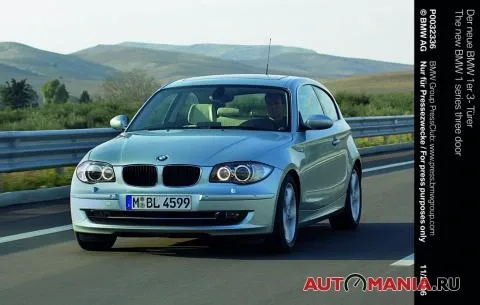
BMW 1 Series. The Golden "One"
 <\/p>
<\/p>
The first version of the 1 Series hatchback was received by true "connoisseurs" mildly speaking, ambiguously. Why would BMW need such a car? - they asked. Why venture into the already overcrowded C-class? From the standpoint of the brand's traditional orientation, indeed there was no need, but there is a nuance: this car was aimed not so much at loyal fans of the brand, but at those buying a car for the first time. By releasing the "one" on the market, the Bavarians simply increased their already numerous army of admirers. As a result, all brand clients received the 1 Series warmly and with interest. I think the new "one" will arouse no less interest. And there is nothing wrong with the fact that it is only a formal restyling - firstly, the model hasn't become worse looking, and secondly, its market position has significantly strengthened after the release of the 3-door modification, which the Germans initially seemed to consider superfluous. <\/strong>
<\/p>
And if we take into account the fact that a sports coupe has also appeared in the "first family", it becomes clear: the Germans have resolutely and diligently set about updating the entire 1 Series. However, we will talk about the coupe some other time, and now let's focus on the classic "one", or rather, its three-door version. The release of this car on the market is associated with another surprising, in my opinion, fact: although the car's style and mood have changed (albeit not radically), BMW's marketing service preferred not to make a kind of sports icon out of the new modification and placed the car on the lowest step of the price ladder. Thus, the three-door "one" is currently the cheapest new car with a white-and-blue "propeller" on the hood. A little over 20,000 euros - and it will be yours. True, for that amount you can only purchase the base version of the BMW 116. But even with such a price tag, hardly anyone would dare to claim that this car has become as democratic as the Opel Astra or VW Golf, which are equal to it in dimensions. The definition "cheap" is not applicable to the "three-door", as, indeed, to any of its other "relatives". Firstly, it's a BMW, which means its price compared to nominal competitors should still be on average 20-30% higher. Secondly, it's a BMW, which by definition cannot be "mass-market". Of course, cars that are considered mass-produced come from under the Bavarian pen, but they are addressed to buyers who can afford not to skimp. And thirdly, it's again a BMW, that is, not an ordinary family hatchback, but a decently "packed" premium-class car, something like an elite mobile phone: it makes calls the same way, but otherwise, as they say, feel the difference. However, this consideration was fair before, but today the situation is no longer so clear-cut. Many automakers show no less ambition, actively break into the luxury segment and make money by classifying their creations as "business" and "premium" classes. And we, the buyers, agree with this and patiently stand in months-long queues, for example, for the 5-door Honda Civic, whose price in most cases, if not exceeding, comes very close to the cherished mark of 20,000 euros. Comments, as they say, are unnecessary.
<\/p>
<\/p>
But let's return to the new "one". Its exterior has remained practically unchanged: the simple-minded "face" borrowed from the "three", a long hood, a profile "flowing" into the stern, a tailgate styled like the X3... It seems all the same, but compared to the five-door car, the appearance of the "three-door" much better corresponds to the dynamic, sporty styling of the Bavarian concern, which over the years has become a hallmark of the brand. It would seem such a trifle - the absence of a second opening. However, it is this feature of the car that changes its proportions as a whole, reduces the profile in horizontal and vertical sections, and thereby adds swiftness and aggression to familiar shapes. The same nuances can be traced in the interior design. Yes, the "one" lacks French refinement or Japanese abstractionism, but here we have German solidity multiplied by truly Bavarian respectability. The stylists calculated everything so precisely that not a single detail spoils the picture. Even the monitor that pops up when you press the starter button - and it becomes a harmonious continuation of the center console. During the trip, you get so used to the presence of this device that the moment it hides back, you begin to perceive literally as a personal insult. It's even awkward to talk about fruitless attempts to find any flaws in the quality of materials, trim, and ergonomics of this car: problems of this kind do not arise here a priori. One can only dream of such an interior architecture, and the driver surrounded by such an interior is envied - maybe unconsciously, but regularly.
<\/p>
Few would dare to criticize BMW from the standpoint of comfort either, but in this case, that is precisely the only thing that cannot be presented as a dogma. At least if the cabin is equipped with optional sports seats. The lack of electric adjustment in them is more than compensated by full-size mechanical adjustment: longitudinal displacement, backrest tilt, cushion, extender length... Everything is perfect, but these seats are still cramped. I admit that the assessment is subjective: the physique of a particular correspondent's body played a significant role. But, on the other hand, from a car costing more than a million rubles, you expect perfect comfort. It gets to the point of absurdity: the driver has the ability to adjust even the position of the side bolsters of the backrest (a single electric drive is responsible for this function), but for a full-fledged Russian size 58, the provided space is clearly insufficient. And what if it's size 60 or 62?
<\/p>
The same thoughts come to mind when you sit on the rear sofa. It's clear that this car is not intended to carry three people daily in the second row of seats, but no one pulled the tongue of the Bavarians who stated that their car has five seats. In practice, there can be no question of three rear passengers - at most two, and even then not of too strong a build. There is plenty of space in the shoulder and elbow areas, but free space above the head and in the legs is, as always, in short supply. However, these are details. In general, the design of the rear sofa can provide both passengers with a quite decent level of comfort, while the shortcomings are a banal consequence of the small size of the hatchback, which shows a certain adherence to tradition: after all, compact BMW models have never suffered from an excess of space in the second row.
<\/p>
The most "delicious" thing in this car is hidden from prying eyes by a split "sandwich" of metal and plastic. The presence of such protection excludes any possibility of close acquaintance with the technical "filling" of the Bavarian product. However, most current BMW consumers do not strive for such an acquaintance. In essence, they are not so interested in the volume of a particular engine or its power; the main thing for them is that this 2-liter unit allows accelerating the "three-door" to 215 km\/h, gaining the first "hundred" in 8.5 seconds. And there is no doubt that it will be exactly so. BMW's reputation is so good that the very presence of the "propeller" on the hood and four shiny branded "angel" rings under it guarantees the attention of motorists. Polishing the already ideal facets of the German "diamond" is all that the company's specialists will have to work on in the future. They developed and implemented the optimal chassis, brakes, and steering wheel for cars of this level back in the mid-1990s, and now they only have to modify individual elements to the required level as needed.
<\/p>
So you won't see the desired criticism in this article, and there's nothing to criticize here. And here the old proverb fits perfectly - better to see once than hear a hundred times. And even better - to try. And if you think that the "one" handles poorly or is unstable on the road, then get into it, turn off the electronics, do a "moose test" - and then repeat all this, say, on a Renault Megane. And after - on some offspring of Southeast Asia. Everything is known in comparison: this car also has a limit, but it is much higher than that of dozens of competitors of the 1 Series hatchback. And that is why today they speak of it in superlatives, and that is why BMW can afford to make a compact car for seven hundred thousand in the base version, and adding a couple of package options, ask a million for it.
<\/p>
Technical characteristics:
<\/p>
Source – AUTOMANIA.RU