
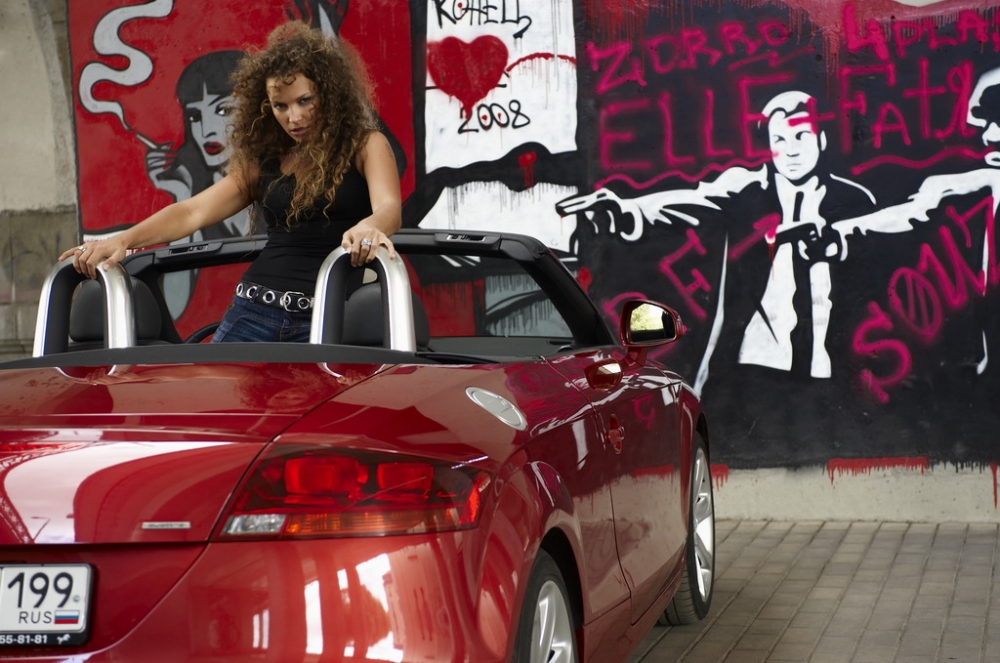
 Audi TT Roadster Audi TT Roadster In my daily routine, I drive a convertible. True, it's a modest Citroen C3 Pluriel, but that doesn't change the essence. When it's a sunny summer day outside, an open car is a real source of positivity. Moreover, I am convinced that a convertible is a very practical thing. And all because you can manage to get a tan right on the way to the beach! |
 However, my Citroen is not so convenient in terms of folding the roof: it has to be removed manually and left at home, there is no automation here. Once my husband urgently needed to leave on business, and he took the C3 without the top. On the road, he was caught in a heavy downpour, and he had to drive under the sidelong glances of passersby. So an automatically retracting roof is great, but it's a pity that it folds into the place where the rear seats are in a regular TT. Of course, they are tiny, an adult is cramped there, but for my little child it would be ideal. But as it is, there's nowhere to put the baby. Not in the front seat! But giving a friend a ride is just the thing. She would be absolutely delighted! However, my Citroen is not so convenient in terms of folding the roof: it has to be removed manually and left at home, there is no automation here. Once my husband urgently needed to leave on business, and he took the C3 without the top. On the road, he was caught in a heavy downpour, and he had to drive under the sidelong glances of passersby. So an automatically retracting roof is great, but it's a pity that it folds into the place where the rear seats are in a regular TT. Of course, they are tiny, an adult is cramped there, but for my little child it would be ideal. But as it is, there's nowhere to put the baby. Not in the front seat! But giving a friend a ride is just the thing. She would be absolutely delighted! |
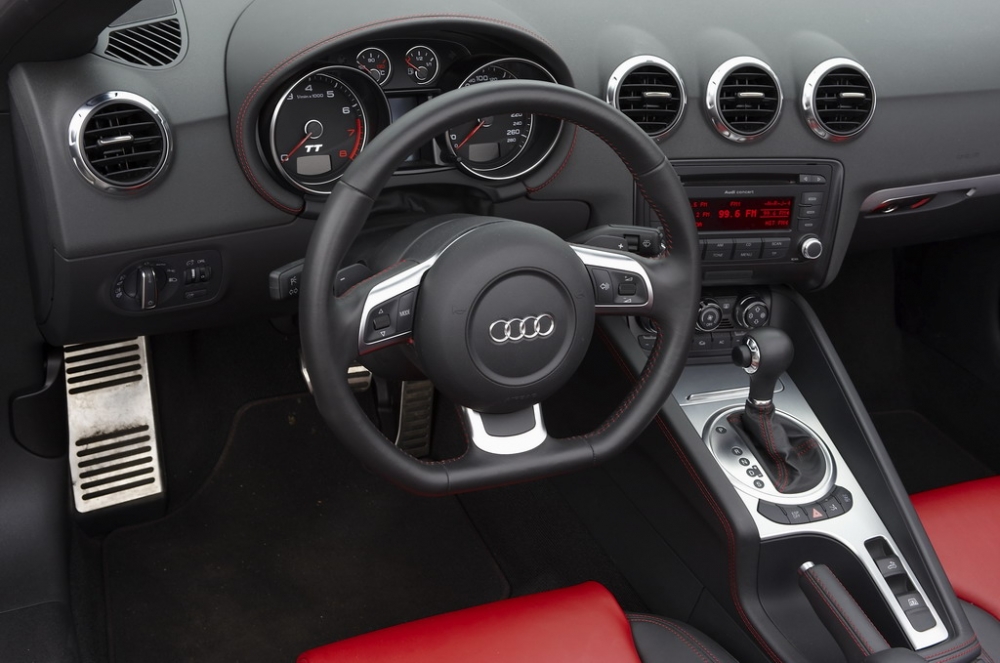
 The interior of the TT is also beyond praise. What impeccable quality of finishing, what a comfortable seat. Red accents on the seats, neat stitching, instrument lighting — as luck would have it — matching the body color. I was especially pleased with the steering wheel with a flattened bottom: it's easier to get in and out, and you feel the steering wheel better. The control of the audio system and climate is clear without unnecessary thought. And how cleverly the rotating chrome rings on the deflectors are designed, with which the air flow is regulated. The interior of the TT is also beyond praise. What impeccable quality of finishing, what a comfortable seat. Red accents on the seats, neat stitching, instrument lighting — as luck would have it — matching the body color. I was especially pleased with the steering wheel with a flattened bottom: it's easier to get in and out, and you feel the steering wheel better. The control of the audio system and climate is clear without unnecessary thought. And how cleverly the rotating chrome rings on the deflectors are designed, with which the air flow is regulated. |
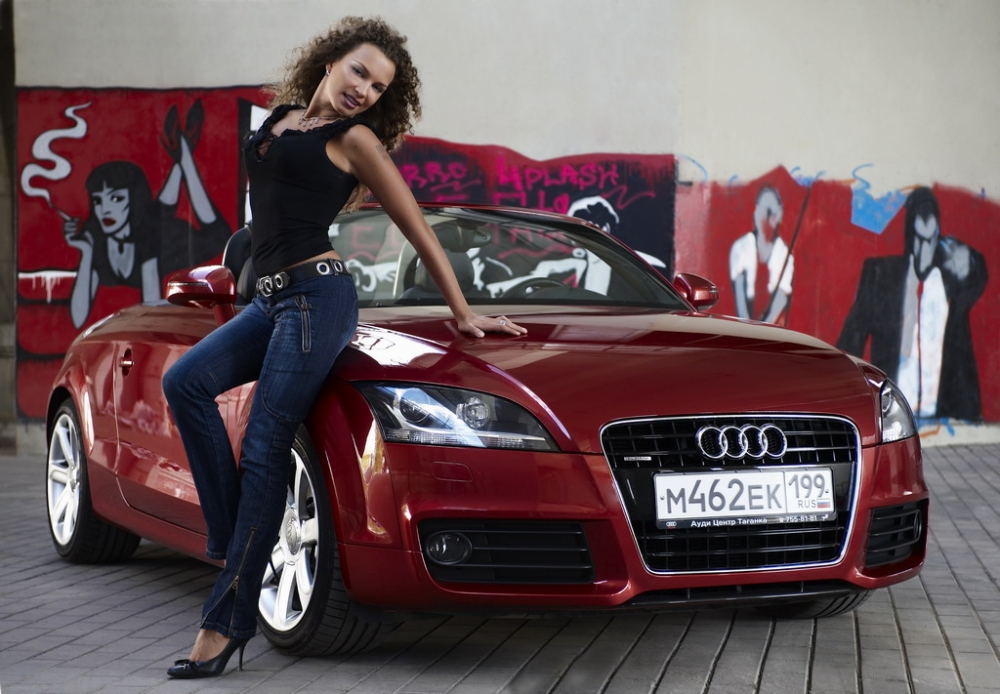
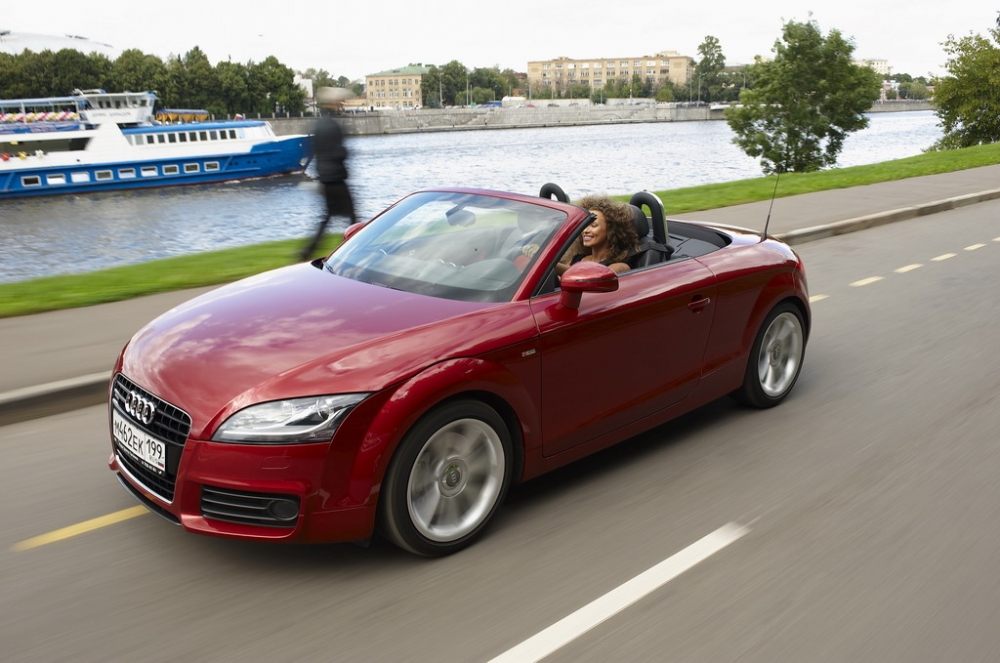
 But the fact that the Germans completely forgot about places for storing small items is a big minus. There's nowhere to put a cosmetics bag. It doesn't fit in the glove box, nor in the narrow pockets in the doors. You have to put it on the adjacent seat. And if someone is sitting there? Although, wait. You can stuff it behind the seat back. It's not ideal, of course, but what can you do? And there's nowhere to put outerwear either. And the phone? Either in the ashtray, or it will dangle in the cup holders. But I am ready to forgive the TT all these shortcomings. Forgive it for its beauty. It is incredibly good, especially in this cherry shade and without a roof. Although with the fabric top raised it also looks great. This is a car for a lady. It seems to me that a man behind the wheel of such a car would look somehow strange. But the fact that the Germans completely forgot about places for storing small items is a big minus. There's nowhere to put a cosmetics bag. It doesn't fit in the glove box, nor in the narrow pockets in the doors. You have to put it on the adjacent seat. And if someone is sitting there? Although, wait. You can stuff it behind the seat back. It's not ideal, of course, but what can you do? And there's nowhere to put outerwear either. And the phone? Either in the ashtray, or it will dangle in the cup holders. But I am ready to forgive the TT all these shortcomings. Forgive it for its beauty. It is incredibly good, especially in this cherry shade and without a roof. Although with the fabric top raised it also looks great. This is a car for a lady. It seems to me that a man behind the wheel of such a car would look somehow strange. |
 Naturally, the question arises: why does a girl need 250 horsepower under the hood? The answer is obvious: women need to feel self-confidence no less than men. Confidence in themselves and in their car. And the 3.2-liter engine confidently pulls out of any trouble. The car is always ready for sharp acceleration. The gearbox also plays a significant role. I'm not a fan of fast driving, but I can appreciate the smoothness of the automatic's shifts. In the TT, the gearbox works flawlessly; my jerky "robot" on the C3 could never dream of such a thing! You say the suspension is stiff? I didn't notice, it didn't seem so to me. And the steering is top-notch. Look how clearly the Roadster holds the given trajectory. Easily and effortlessly. I've heard that convertibles usually have a less rigid body, which suffers handling. I wouldn't say that about the TT. Even without a roof, it understands at a glance, instantly and accurately responds to my commands. Very obedient. Naturally, the question arises: why does a girl need 250 horsepower under the hood? The answer is obvious: women need to feel self-confidence no less than men. Confidence in themselves and in their car. And the 3.2-liter engine confidently pulls out of any trouble. The car is always ready for sharp acceleration. The gearbox also plays a significant role. I'm not a fan of fast driving, but I can appreciate the smoothness of the automatic's shifts. In the TT, the gearbox works flawlessly; my jerky "robot" on the C3 could never dream of such a thing! You say the suspension is stiff? I didn't notice, it didn't seem so to me. And the steering is top-notch. Look how clearly the Roadster holds the given trajectory. Easily and effortlessly. I've heard that convertibles usually have a less rigid body, which suffers handling. I wouldn't say that about the TT. Even without a roof, it understands at a glance, instantly and accurately responds to my commands. Very obedient. |
 Would I like to switch to an Audi TT Roadster? Absolutely, yes! But on one condition: it should not be the only car in the family. And if you have a child, then unfortunately you can't ride in the Roadster. And it would be even better to enjoy it not in the stuffy and dusty Moscow, but somewhere on the shore of a southern sea! Would I like to switch to an Audi TT Roadster? Absolutely, yes! But on one condition: it should not be the only car in the family. And if you have a child, then unfortunately you can't ride in the Roadster. And it would be even better to enjoy it not in the stuffy and dusty Moscow, but somewhere on the shore of a southern sea! |
 |
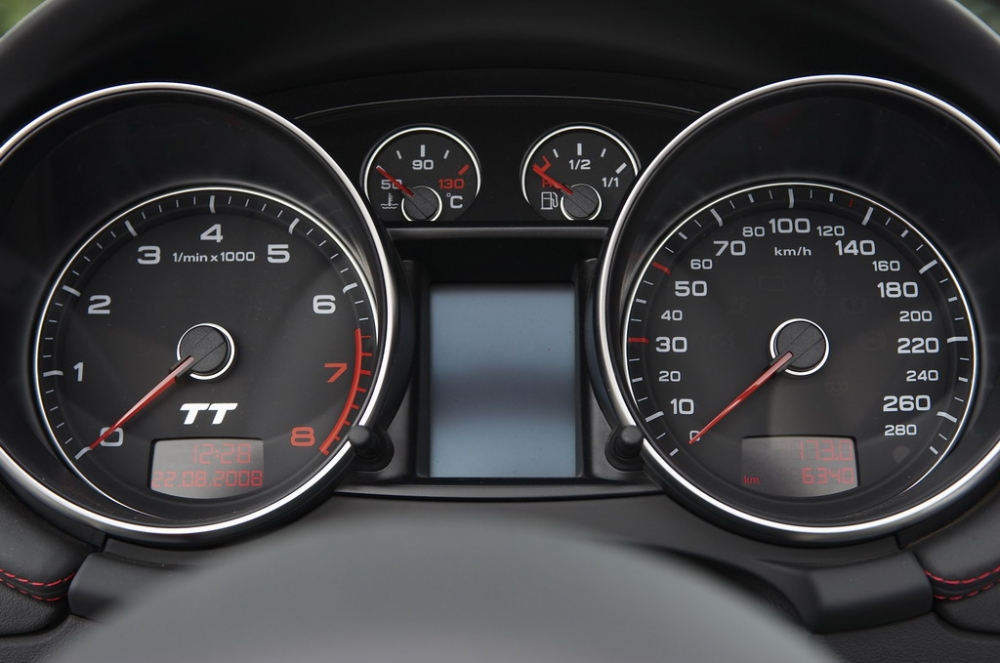
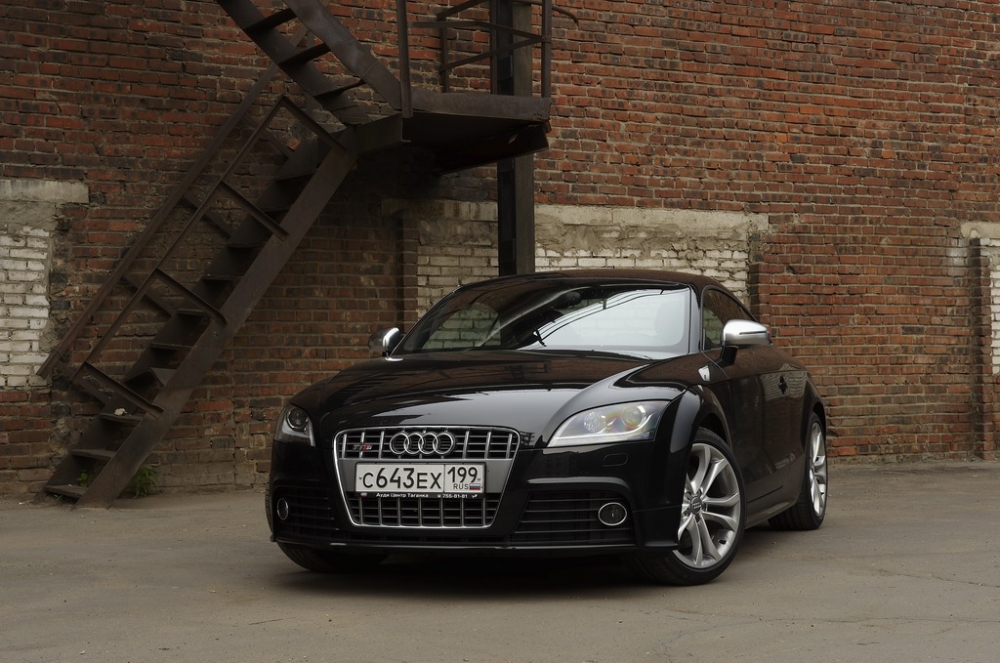 Audi TTS Audi TTSAudi TTS is a classic example of German pragmatism, precision, and a rational approach. As is customary in the Audi lineup, versions with the letter S sit exactly halfway between regular production models and the truly radical RS. It's just a step on the path to the extreme "RS" models. However, for the TTS, the step isn't exactly intermediate—it stands right between the most powerful TT version with the 3.2-liter engine and the future 350-horsepower TT RS, whose premiere we expect next year. But the "middle" position of the TTS doesn't imply any understatement or rawness. The "S" is a car that is complete, refined, and... very fast. So much so that it can easily challenge its older sibling—the R8. And in city traffic, the nimble TTS is perhaps even more convenient than the R8. A kind of "checker" that a skilled player can easily move to the king row on the board of urban traffic. The chefs at Audi clearly know their craft. The recipe for an S-dish has long been familiar to them: less fat (the TTS is nearly a hundredweight lighter than the TT Roadster 3.2), more meat (the 2.0 TFSI engine from the S3 is boosted to 272 hp, making the TTS the most powerful TT in history), add pepper (a suspension lowered by 10 mm and special brake pads), and season generously with hot spices—reprogrammed engine and transmission control units. By the way, a similar recipe was once used for the previous-generation TT quattro sport—a powerful turbo engine, stiff suspension, a strut brace instead of rear seats, black roof and mirrors, S-line body kit, and signature wheels. The TTS has no strut brace in the cabin—it's simply not needed. The body, welded using ASF (Audi Space Frame) technology, previously used only on the A2 and A8, has become 50% stiffer. There are also plenty of exterior differences. The easiest way to identify a TTS from the front is the chrome single-frame grille with vertical slats over horizontal ones (on other TTs it's the opposite), LED strips in the headlights, and a bumper with large air intakes. The mirrors are matte chrome, there are elegant side skirts, and four exhaust pipes protrude from the rear. Inside, there are almost no changes compared to the Roadster—only TTS badges on the automatic gear lever, door sills, and the tachometer scale. The speedometer is marked up to 300 km/h versus 280 in the open version. Pure fetishism, of course—everyone knows that production Audis are electronically limited to 250 km/h. But there should be a step up, even if formal. After all, it's an "S"! I got behind the wheel of the TTS right after the Roadster, and I felt the difference instantly—as soon as the engine came to life. Instead of the muted rumble of the inline six, there's the characteristic dry crackle of the TFSI with a bassy exhaust note. Sporty! I reverse out of the parking spot. At idle and with the high gear ratio of reverse, the car jerks—the two-liter turbo engine, which in the TTS version delivers a whopping 272 hp, clearly lacks low-end torque. This engine came from the S3, but with a revised ECU and a different exhaust system, which allowed it to produce 7 hp more than the S3. But people usually don't drive in reverse or stand still. So, shift to Drive—and off we go! Although I'd call this mode not Drive, but Economy or Women. What does a girl most often need from a car? For it to be cute! And she doesn't need the extra fuss of the turbo engine and the jerky gearbox. So, smooth S-Tronic shifts, gentle acceleration, and dampened throttle response are just what's needed. Up to 2500–3000 rpm, it feels like there's a 120-horsepower naturally aspirated 1.6 under the hood—the tachometer needle crawls so lazily. Above 3000, there's a noticeable surge. But that's not what I expected from an S-version with 272 horses! Where's the masculine character? The mufflers grumble discontentedly when I sharply press the gas. And I'm displeased—in response to kick-down, the gearbox leisurely shifts down through the gears (DSG can't skip more than one gear—there are only two clutches). I expect all 272 "horses" to surge forward. But no—the acceleration didn't impress: quick, but not for a 270-horsepower car. What's going on? An "S" that drives slower than the Roadster? And what's the point of this bumpy suspension then? Enough tormenting—both myself and the car. I switch to Sport. It seems the engineers deliberately emphasized the S mode of the "automatic"—in honor of the TTS name. There's logic in that: if you bought an Audi S, you should drive in "sport." The TTS seems transformed. Everything fell into place. Press the pedal—instant rapid acceleration. The S-Tronic is tuned so that it now needs to "drop" down several gears less often—the revs always stay above 3000, in the zone of maximum torque. The gearbox quickly adapts to active driving, with noticeable thuds as it downshifts under braking, and when you lift off the throttle, it holds the gear as long as needed. At times, it felt like a microchip was secretly implanted in the brain at birth, silent for years, but now awakened and transmitting signals to the TTS's transmission. Complete mutual understanding! If you don't have such a chip in your head, you can give commands not to the DSG but to your hands—pull the paddles and get lightning-fast shifts. I see a small "gap" between cars in traffic. Left paddle—pull, almost simultaneously—floor the gas. A quick blip, steering left, steering right, and... while you were reading this, the Audi is already "in the king row." And what sounds does the TTS engine make during intense acceleration! Usually, people say: "The engine's voice is a song!" Here, it's not a song but a whole symphony. The turbo whistles dashingly, the intake howls, each upshift produces a loud exhaust crackle, and when you lift off the gas, the blow-off valve sobs as if alive. I don't know how an RS engine should sound to outdo such an orchestra. All of this is absolutely fitting and never gets tiresome—it only excites and heats the blood. These are natural attributes of a true sports car, which also rest on a solid foundation of excellently tuned suspension and steering. The foundation is usually concrete, but you can't call the suspension with Magnetic Ride dampers stone-like. Yes, it's stiff, but what grip it provides! No discomfort is felt even when switching the toggle on the center tunnel to Sport. The Audi holds enormous speeds through corners without understeer. But the TTS is just a car, and sooner or later, the speed may be too high. First, slight understeer, then a four-wheel drift that's easily controlled with the throttle and the informative, transparent steering. If the corner is very tight, you can also help with the handbrake—yes, despite all-wheel drive, the TTS easily allows its use. The stabilization after a slide is quite firm; you need to be ready for a sharply increasing force on the wheel. The TTS turned out to be a unique car. It feels great on the highway—it flies like an arrow, ignoring road imperfections even at 200 km/h. And on winding narrow roads, it's also good—it threads corners of varying sharpness onto its chrome grille, like D'Artagnan stringing the Cardinal's guards on his sword. In the city? No problem. Any small gap between cars can be used for overtaking, and if you're tired of "racing," just put the S-Tronic lever in Drive and "crawl" at a leisurely pace. I think the TTS wouldn't get lost on a race track either, though the brakes seemed a bit weak for serious exercises—they tend to overheat. It's a pity Audi's specialists only changed the pads and left the discs standard. Apparently, they saved them for the RS. But until the RS arrives, the Audi TTS remains the most formidable weapon among all TT modifications. It truly demands a firm hand and cool-headedness, but to the owner of these qualities, it will fully repay with speed, agility, and obedience. |
Beauty and the weapon
Why do manufacturers make so many modifications within one model? We decided to find out using the Audi TT as an example, taking the Roadster and the sporty TTS version for a test. The TT has a reputation in our country as a women's car, and a convertible, especially in red, even more so. Therefore, we found a suitable pair for it and invited a photo model and actress Natalia Ustymenko to participate in our test.
Test drive photos
Comments
No comments yet. Say the first word.