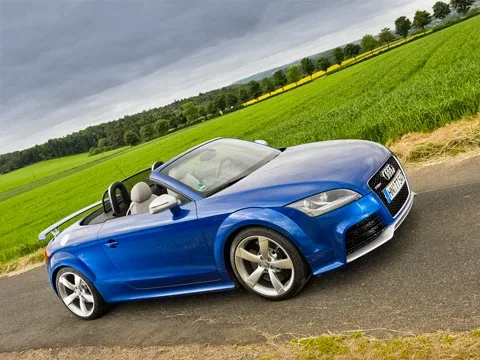
Every opening in the front bumper serves a function. The street-racer wing was tested in a wind tunnel, and if it's not needed, you can order a regular power-operated spoiler like on standard TTs. The wing blades can also be painted in the body color. In this form, the TT looks serious. Matching its technical content.
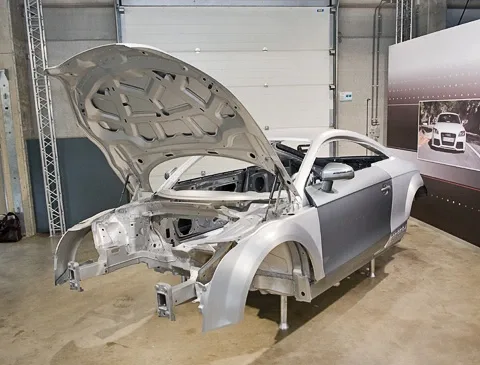
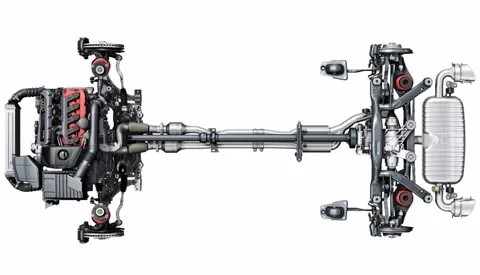
The TT body is two-thirds aluminum—this allowed shedding about a hundred kilograms compared to a fully steel construction. Weight distribution here is decent: the entire front end is made of the "winged metal." And a more proper mass distribution across the axles is ensured by the massive rear differential of the all-wheel-drive transmission with a Haldex clutch. And the TT RS stays within one and a half tons even with the heavy five-cylinder engine (183 kg—30 kg more than the TTS).
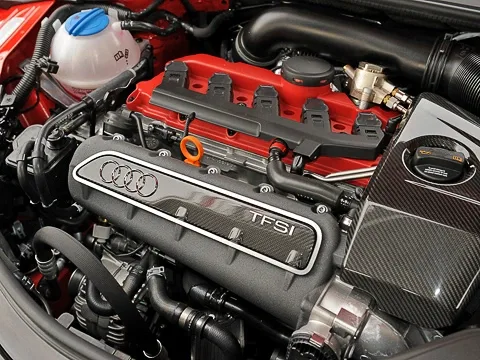
This is not an engine but a real brawler. The engine is based on the block of the 2.5 "five" from the American version of the Volkswagen Jetta sedan, equipped with direct injection and a large turbocharger with peak pressure of 1.2 bar. The result—340 hp and 450 N•m—can make anyone's knees tremble. No joke: 4.6 seconds to 100 km/h (4.7 s for the roadster), and if you remove the electronic limiter, the TT RS will exceed 280 km/h. The characteristics are even better than the 3.0 TFSI engine in the S4! Especially since the supercharged "six" wouldn't fit transversely under the hood of the "T-T.” By the way, why couldn't they just boost the two-liter engine from the TTS instead of creating a new one? "Have you heard the sound of the new engine?"—Audi engineers laugh in response.
Not yet, but I'm already getting comfortable in the cabin. Bucket seats without radical lateral support, not hindering entry and exit (how I'm tired of the Porsche Boxster with optional buckets!). Pedals with quite civil effort, and the gear lever is unexpectedly long-throw. The steering wheel, flattened at the bottom... Popular attributes.
The engine grumbles discontentedly even at idle. And when you press the Sport button (it controls not only the shock absorber stiffness but also the exhaust volume), judging by the sound, it expresses readiness for a good brawl. In its voice—almost atmospheric roar: when shifting, the "five" whistles, not hisses at me like an Impreza. However, responses to accelerator actions lag—turbo lag...
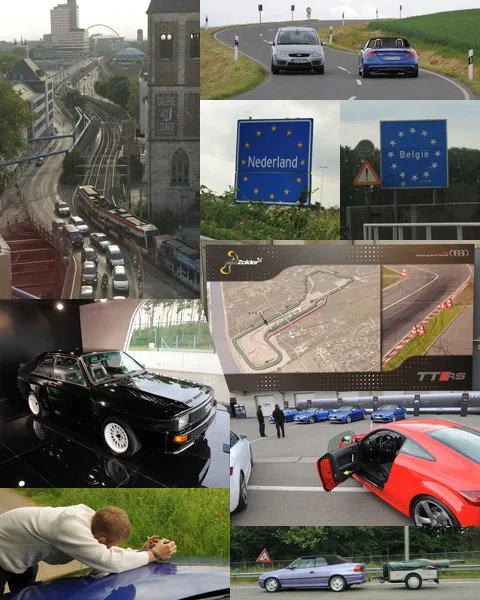
Acceleration. I wouldn't call it fast. Really! Because it's very, very, very fast. I turn onto the autobahn leading from Cologne to the Belgian Zolder track. At the end of the acceleration straight, when I need to merge into traffic, the TT RS is already much faster than that traffic. Did they all shift into reverse? Rather into the left lane, where the "R-S" can take a full breath. Until the unlimited speed zone ends.
At the same time, driving it like a normal person is no harder than in some Golf. You can start without touching the gas pedal, the clutch is light. Just noisy. But have you driven a Porsche? It's much worse there! On European roads, the TT RS doesn't shake your soul out, even when the shock absorbers are set to sport mode. However, recalling how the Audi RS6 played "jackhammer" with me on the Simferopol highway, I suspect things will be different in Russia.
The six-speed gearbox is like a rudiment: the car accelerates well at any speed and from any rpm, although the engine truly comes alive after three thousand. And the shift quality, by the way, turned out to be devilishly good: you can shift very quickly and absolutely without error.
The blast down the autobahn reminds me of Slot Car Racing, where cars with electric motors run on the guides of a plastic track. Steering is simpler than ever: you don't feel any rolls, yaws, or, God forbid, pitching. You just turn the heavy but informative steering wheel and give it gas. But somehow the road quickly ends. R-r-r!—and I've already driven through Germany with Holland. Hello, Belgian Zolder track!
My head in the helmet hits the ceiling... So how does the TT RS behave on the circuit? Just like on a regular road! First, the car is still incredibly fast. And second, it's damn docile. As they say? Slight understeer on entry, then a slide almost neutral. Very safe. And not because the organizers played it safe by making the stability system non-switchable in the test cars for the track. In my Impreza, for example, I always turn off the "collar." But here even the thought of it is perceived as heresy. The electronics work so delicately. The most you can allow is activating sport mode.
On the first lap, I mess up completely. Sometimes I brake too early, sometimes in the next corner—too late and not hard enough. Fortunately, in the TT RS you can make gross errors: the car allows you to correct. And no all-wheel-drive antics: the "T-T” is very smooth, unambiguous, and obedient, and it will only go into a slide on demand, and even then smoothly and carefully. On the second lap, I've more or less found the braking points (the trajectory stopped falling apart into segments) and started enjoying it. As for the brakes, the weak point of the "T-T-Ss”—not a single complaint.
Every detail in the TT RS (be it the sport seat, exhaust sound, or steering effort) is amazing. But you understand that everything is assembled and tuned this way not because it couldn't be otherwise, but to emphasize sportiness. Strength of spirit. A lack of sensations from this car is fundamentally impossible: it's juicy and dense.
At the same time, the spirit living in the car is kind. It will condescend to a hot-headed novice behind the wheel, won't ask for a certificate of completion of super driving courses. All the skill required to drive the TT RS indecently fast is the ability to shift gears in a manual gearbox.
I'm sure on the track an ordinary driver will be faster in an Audi, not a Porsche. Although sitting in the TT RS with a helmet is uncomfortable—the Audi coupe is more suitable for daily driving. The main thing is to drop the idea that you're a real racer. Otherwise, the kind spirit will bring trouble on the wing.
| Model | Audi TT RS Coupe | Audi TT RS Roadster |
|---|---|---|
| Body | ||
| Number of doors/seats | 2/2 | 2/2 |
| Length, mm | 4198 | 4198 |
| Width, mm | 1842 | 1842 |
| Height, mm | 1342 | 1348 |
| Wheelbase, mm | 2468 | 2468 |
| Track front/rear, mm | 1555/1546 | 1555/1546 |
| Curb weight, kg | 1450 | 1510 |
| Gross weight, kg | 1850 | 1830 |
| Trunk volume, l | 290 | 20 |
| Engine | ||
| Type | petrol with direct injection and turbocharging | petrol with direct injection and turbocharging |
| Location | front, transverse | front, transverse |
| Number and arrangement of cylinders | 5, in-line | 5, in-line |
| Number of valves | 20 | 20 |
| Displacement, cm3 | 2480 | 2480 |
| Max power, hp/rpm | 340/5400–6500 | 340/5400–6500 |
| Max torque, N•m/rpm | 450/1600–5300 | 450/1600–5300 |
| Transmission | ||
| Gearbox | manual, six-speed | manual, six-speed |
| Drive | all-wheel | all-wheel |
| Chassis | ||
| Front suspension | independent, spring, McPherson | independent, spring, McPherson |
| Rear suspension | independent, spring, multi-link | independent, spring, multi-link |
| Front brakes | disc, ventilated | disc, ventilated |
| Rear brakes | disc, ventilated | disc, ventilated |
| Performance characteristics | ||
| Maximum speed, km/h | 250 | 250 |
| Acceleration time 0-100 km/h, s | 4.6 | 4.7 |
| Fuel consumption, l/100 km | ||
| — urban cycle | 13.1 | 13.3 |
| — suburban cycle | 6.9 | 7.2 |
| — combined cycle | 9.2 | 9.5 |
| Toxicity standard | Euro-5 | Euro-5 |
| Fuel tank capacity, l | 60 | 60 |
| Fuel | AI-98 | AI-98 |