
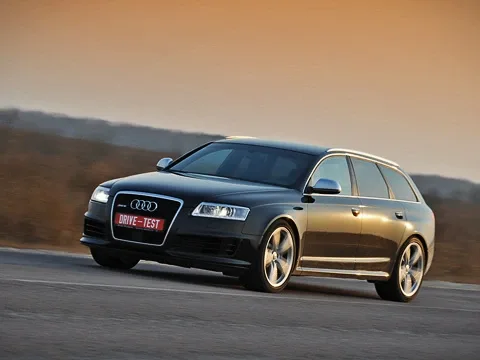
Any car capable of leaving the RS6 behind — whether on a straight or in a corner — I'm ready to call "outstanding," and its driver a complete madman. At the same time, driving the "megavan" fast requires no special talents. That's why the navigation system lacks the item "go to the Nürburgring." There's nothing for this car to do there.
The Audi RS6 is not at all an attempt to embrace the unembraceable, by no means! Yes, the engine here is not inferior in power to a nuclear reactor, but its task is not sport. The car is designed to bring joy not in city bustle or on a race track, but on high-speed country highways.
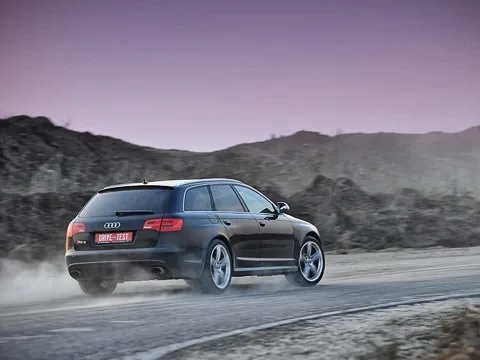
And I really want to say that for such purposes, the S6 version would have been more than enough (and that's the pure truth!). The RS6's power is so absurdly excessive that it turns not into a source of pleasure, but into a tool for gratifying one's own ego. The RS6 owner needs not a racing helmet in the wardrobe, but a crown. At the same time, the car doesn't need to be tamed, domesticated, or studied for a long time: the king of autobahns submits from the first press of the pedal. Acceleration and cornering come easily to it. But the ride truly becomes exciting only at very high speeds, and even then, not at the limit of its capabilities.
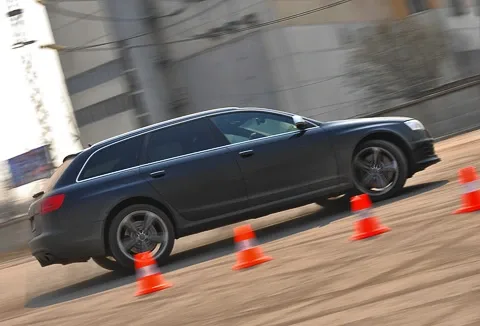
In a critical corner, the body rolls noticeably, and the car begins to drift outward. Even if you manage to rock the car before the entry (and that would require considerable amplitude), the front axle will still break into a slide first. However, on winter surfaces, the picture may change — it's quite possible that drifting the RS6 on snow will turn out to be very exciting.
So the owner would be best off living somewhere in Europe. In our parts, the RS6 lacks not just space, but normal roads. Without suitable highways — quality ones and without speed limits — all that remains is to admire the figures in the technical passport. Yes, it's an express, but without a destination station. And in the city or on the track (which, by the way, are starting to appear here), you'll get little more pleasure from it than from catching crucians in a village pond with a professional spinning rod.
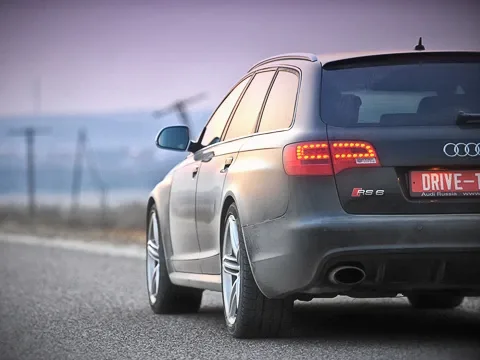
And although the car can even digest 92-octane gasoline and can boast a decent range of 500 kilometers, its passengers will quickly get tired of our roads. So it will become an ideal Gran Turismo for Europe, but for our realities, the Audi Q7 is still more suitable. By the way, its 500-horsepower version will soon be on sale.
Technical specifications
| Model | Audi RS6 |
|---|---|
| Body | |
| Number of doors/seats | 5/5 |
| Length, mm | 4928 |
| Width, mm | 2051 |
| Height, mm | 1460 |
| Curb weight, kg | 2025 |
| Gross weight, kg | 2655 |
| Trunk volume, l | 565–1660 |
| Engine | |
| Type | petrol, with direct injection and turbocharging |
| Location | front, longitudinal |
| Number and arrangement of cylinders | 10, V-shaped |
| Number of valves | 40 |
| Displacement, cm³ | 4991 |
| Max power, hp/rpm | 580/6250–6700 |
| Max torque, N•m/rpm | 650/1500–6250 |
| Transmission | |
| Gearbox | automatic, six-speed |
| Drive | all-wheel drive |
| Chassis | |
| Front suspension | independent, multi-link |
| Rear suspension | independent, multi-link |
| Front brakes | disc, ventilated |
| Rear brakes | disc, ventilated |
| Performance characteristics | |
| Maximum speed, km/h | 250 (280)* |
| Acceleration time from 0 to 100 km/h, s | 4.6 |
| Acceleration time from 0 to 200 km/h, s | 14.9 |
| Fuel consumption, l/100 km | |
| — urban cycle | 20.4 |
| — suburban cycle | 10.3 |
| — combined cycle | 14 |
| Emission standard | Euro-4 |
| Fuel tank capacity, l | 80 |
| Fuel | AI-91–95 |
| * — option | |
Audi RS6 Avant trim levels
Standard equipment
- Front airbags
- Side airbags and inflatable "curtains"
- Dynamic stability control system
- Anti-theft system with immobilizer
- On-board computer
- Multifunctional steering wheel with gear shift paddles
- Light and rain sensor
- Adaptive bi-xenon headlights
- Fog lights
- Seats with leather and Alcantara upholstery, power adjustment and memory function
- Heated front seats
- Carbon interior trim
- Dual-zone climate control
- BOSE audio system with CD changer and 12 speakers
- MMI multimedia system with color display
- Alloy 19-inch wheels
Additional equipment
- Navigation system
- Alloy 20-inch wheels
- Dynamic Ride Control shock absorbers with adjustable characteristics
Price of base trim — 4,743,015 rubles
Price of tested car — 4,937,015 rubles
Price of tested car — 4,937,015 rubles
Technology
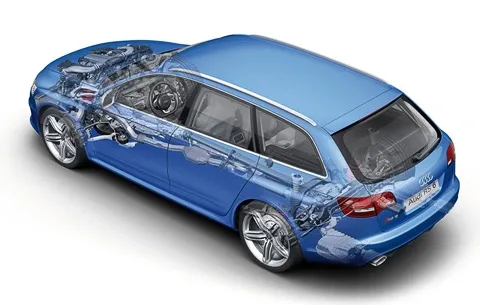
In the Audi RS6, compared to the regular "six", different shock absorbers, springs and anti-roll bars are installed. As an option, Dynamic Ride Control shock absorbers with three operating modes are available.
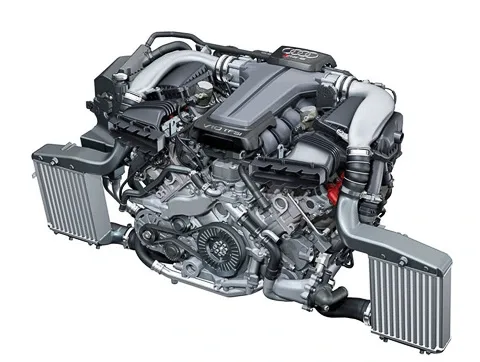
The ten-cylinder engine with an aluminum block and dry sump lubrication system, which was originally installed on the Lamborghini Gallardo, unlike the Audi S6 unit, retained its original displacement of 5 liters. Thanks to two turbochargers, it was possible to achieve high power and enormous torque (650 N•m), available in a wide range from 1500 to 6250 rpm.
History of Audi RS models
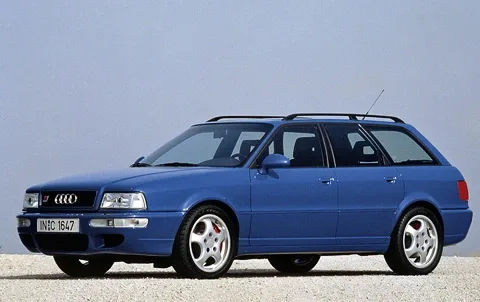
The first RS car (from the German RennSport, i.e. racing sport) in 1994 was the RS2 station wagon, produced at Porsche facilities. Its basis was the Audi 80 station wagon, and under the hood was a five-cylinder turbo engine with a displacement of 2.2 liters and a power of 315 hp. It was 40 mm lower than the regular Audi 80 Avant, equipped with brakes with Porsche inscriptions and side mirrors from model 964. In just over two years, about 2,900 cars were assembled. With a weight of over 1600 kg, the RS2 accelerated to 100 km/h in just 4.8 seconds.
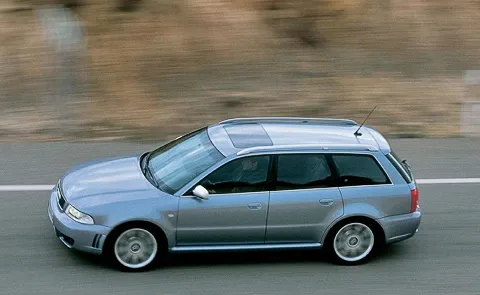
The first generation Audi RS4 (B5) appeared in 1999 and was also produced for only two years, but already at the facilities of quattro GmbH in Neckarsulm. About 6,000 cars were produced. The V6 engine with two turbochargers with a displacement of 2.7 liters was borrowed from the younger S4 model and refined with the participation of Cosworth specialists. As a result, the power was 380 hp, torque — 440 N•m. The car was equipped exclusively with a six-speed manual transmission and accelerated to 100 km/h in 4.9 seconds.
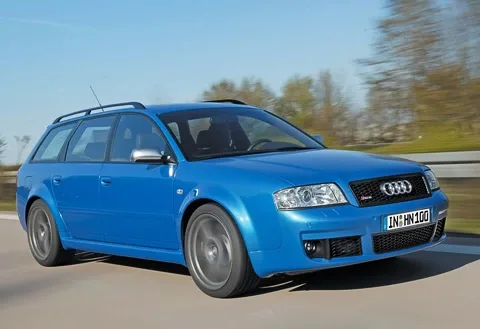
The next in the RS series was the large Audi RS6 (C5), produced from 2002 to 2004. It is based on a V8 engine with a displacement of 4.2 liters, but still with twin turbocharging. The base version developed 450 hp and 560 N•m, and acceleration to 100 km/h took 4.6 seconds. Later, the RS6 Plus modification appeared: the torque remained the same, and the power increased to 480 hp. The "six" became the first RS model offered in both station wagon and sedan body styles. The car also featured active Dynamic Ride Control shock absorbers. Since the car was more than 200 kg heavier than its predecessors of the lower class (curb weight of the RS6 sedan — 1840 kg), a five-speed automatic transmission was offered. About 7 thousand cars were sold.
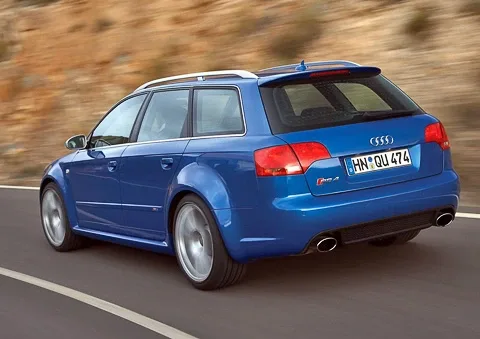
The Audi RS4 (B7), produced from 2006 to 2008, became the first RS model with a naturally aspirated engine. The basis was a V8 with a displacement of 4.2 liters with direct injection FSI, boosted to 420 hp (torque — 430 N•m). What is no less important, the proprietary quattro all-wheel drive system has since become asymmetric: 60 percent of the torque is supplied to the rear wheels of the RS4. The car was produced in three body styles — sedan, station wagon and convertible. About 10 thousand cars were produced.
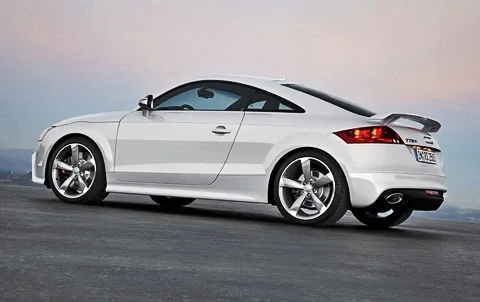
The Audi TT RS is not going to become a thing of the past — on the contrary, this model is just beginning its history. The top version of the TT received the latest five-cylinder engine (the same as the first RS2) with turbocharging. With a displacement of 2.5 liters, the unit produces 340 horsepower and 450 N·m of torque. With a manual transmission, the car reaches the first hundred in 5 seconds, and with the S-tronic robot with two clutches — in 4.8 seconds.
Behind the scenes 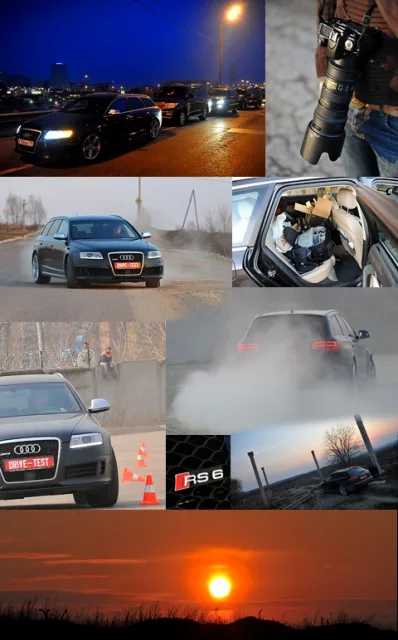
The test RS6 was remembered primarily for participating in a charity visit to an orphanage in Mtsensk, organized by the DRIVE2.RU community. At the same time, all several hundred kilometers on roads of not the best quality the car passed flawlessly.