
Audi Q7 diesel. Elephant-like giant
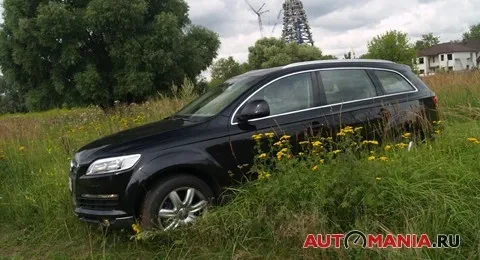
Now we won't touch on VW or Porsche, nor the BMW X5 – the main rival from Germany. Our interest is specifically the Q7.
For the test, we got an Audi Q7 with a 3-liter turbodiesel, which had already won favor on the Allroad. It's a kind of middle ground among the “Audi brothers”: one has a 3.6-liter engine, weak for a car weighing nearly 2.5 tons, another has a voracious 4.2-liter gasoline unit, and the third, the eldest, has a 4.2-liter turbodiesel.
The car we received was without frills – no alcantara, no panoramic roof, no optional 20-inch wheels or other “extras.” As they say, “simple and tasteful.” Straight from the advertising slogan – “Came to take what's mine.” Though personally, I prefer another ad that better captures the essence: “For 20 years we made the Quattro system for our Audis, and now we finally made a car for Quattro.”
Before sharing impressions – both good and, of course, bad – it's worth recalling a bit of history. Two Nobel laureates worked on the design, and it's based on the time-tested VW 72 platform, which already underpinned the Touareg and Cayenne. The number “7” indicates the seven-seat version, and “Q” simply stands for Quattro. Though they could have called it the A8 Allroad, since the A6 Allroad was named after the A6 base.
The car is huge and looks very aggressive. The protruding “ears” of the side mirrors make it look like an elephant. And if an elephant hears well with its ears, the Audi driver, thanks to the mirrors, sees everything around just as well – no problems when changing lanes.
By the way, the Q7 has another advantage in terms of passive safety that even the more expensive and pretentious A8L doesn't have. I'm not talking about adaptive cruise control, which is convenient on the highway (you set the speed – and you can take your feet off the pedals, the radar itself detects obstacles and brakes), nor about adaptive headlights that illuminate corners. The Q7 has a small button on the driver's door that activates the “lane and side assistant” system.
The first part is responsible for monitoring unintentional lane departure and signals it with a vibration of the steering wheel. This is clearly not for Russia. Rather, for disciplined Europeans accustomed to driving strictly in their lane. Our drivers, who like to constantly change lanes, are unlikely to appreciate such a function. The second part monitors the blind spots behind the Q7 and warns of dangerous lane changes with a yellow signal in the side mirrors. The radar detects cars approaching in adjacent lanes and indicates that overtaking is risky at the moment. In short, pressing this button gives you both a nanny and a bodyguard in one. Such care noticeably eases driving.
As for the exterior, the Q7 makes the strongest impression from the front. The low front bumper with an “apron” supporting the fog lights, the predatory squint of the headlights, and the signature vertical Audi radiator grille. The light elements are arranged in three rows, like shark teeth. In this two-story “face,” everything is so well thought out that no one dares to modify it – I've never seen a Q7 with a bull bar.
That the A6 Allroad and Q7 are twin brothers is beyond doubt. If you raise the Allroad's suspension to the “lift” level, it will be hard to tell them apart. The Q7's interior also resembles the A6 – the interior is almost identical (the only difference is the location of the CD changer: in the Q7 it's on the center console, not in the glovebox), so you feel at home and don't need to get used to anything when switching from one Audi model to another. Although, wait. There's one more difference – the pedal handbrake, which is located to the side of the left foot. In other models, the parking brake is electronic, button-operated.
No surprise – after all, the Q7 was created, as I said, for the American market. And there, they're used to this handbrake layout. There's another “US-style” detail in the interior – extremely wide seats with no hint of lateral support. Americans, overfed with hamburgers and cheeseburgers, don't like anything squeezing their sides. But a person of average build will flop around in such a seat like in an ice hole. So the Q7 is a car for solid people with equally solid physiques.
The Q7 handles surprisingly easily and turns around in minimal space. On a straight line – it's just a fairy tale. But in corners, you feel the lack of adjustments in the driver's and passenger's seats (again, compared to the Allroad). There are also issues with the front dimensions – no matter how you adjust. But reversing – no problem. The rearview camera with a color image on the 7-inch screen won't let you hit an obstacle, as it also shows the steering wheel's turning trajectory.
Safety above all – the Q7 upholds this motto with a solid A+. In addition to the aforementioned lane-change assist system, there's a “Distance” function that warns the driver with a buzzer and a message on the screen between the tachometer and speedometer when the distance to the car ahead becomes dangerously small.
In the five-seat version of the Q7, which is exactly what we got for the test, the trunk volume is impressive – 2025 liters. With the rear seats folded, the compartment length reaches 2026 mm. Under the trunk floor, there are two niches with removable plastic containers, convenient for transporting catch or game. You bring it, take it out, wash it – and back on the road…
But under these niches, we found an element unworthy of such a car – a space-saver spare with thin (5-6 cm) rubber instead of a full-size spare. Well, how could they!
The proprietary Audi MMI interface control system with a joystick is fully Russified. It manages the CD, TV, FM radio, phone, air suspension settings, and navigation (also fully in Russian). Unlike in Mercedes and Volvo, you can't watch DVDs.
To the left of the automatic transmission lever (continuously variable transmission) are buttons with clear symbols: Engine start and Engine stop. To open and close the doors and arm the Q7, you don't need to take the chip key out of your pocket. The car recognizes its owner itself. You approach – touch the door, it opens. You walk away – it closes. The trunk lid also works on the “hands-free” principle. You can open it with the remote or a button in the cabin, and close it with a button on the inside of the tailgate. No matter how dirty the road is, your hands stay clean – everything is done without touching the body.
The Car button near the automatic transmission is responsible not only for the suspension, which allows raising the ground clearance to 240 mm, but also for monitoring tire pressure and even their temperature. The system will report a puncture, after which you need to reset the readings (when you change the wheel). Otherwise, the light will constantly blink – the computer will signal a malfunction. The reset procedure is simplified by the fact that prompts appear on the display in Russian.
The navigation system also communicates with you in Russian – a convenient feature with a pleasant female voice that tells you where and when to turn. True, this "blonde" under the hood a couple of times, while showing a right turn on the display, called it left, and also did not always choose the optimal route. It always looks for the shortest path and calculates arrival time, which sounds like a pipe dream for a Moscow driver – because the "lady," unfortunately, cannot detect traffic jams. I think these minor flaws are related to the fact that the navigation is flashed right at the factory in Ingolstadt, and it cannot be adapted to our realities. It tries very hard, it's just that no one taught it to avoid traffic lights or showed it shortcuts through courtyards. But it knows many route options, and if you don't follow its advice and go your own way, it instantly recalculates and adapts to your route, adjusting the arrival time based on average speed. We decided not to test the off-road capabilities of the Q7 – the mere fact that it had rain highway tires Good Year Eagle F1 in size 255/55 ZR18 discouraged any desire to leave the asphalt. Such rubber is made for fast highways, not for mud, potholes, and bumps. We didn't venture into the soggy clay for another reason: the all-wheel drive with the self-locking Torsen differential is primarily aimed at damping skids and confidently holding the car on snow. How it would behave on wet ground – better to find out on a special site and definitely in the company of a tow truck. Now about the engines and their appetites. If you have no trouble finding 98-octane gasoline (and the farther from megacities, the more noticeable this is), and spending 20-23 liters per hundred doesn't bother you, take the Q7 with the 4.2-liter unit. The 3.6-liter engine will give you a solid look on the road but will make you feel embarrassed when overtaking. The optimal option, as our test showed, was the 3.0-liter turbodiesel. In price, it is comparable to the 4.2-liter version, but diesel is cheaper and more accessible away from cities. True, city consumption of 14.6-15.2 liters can hardly be called modest – the Allroad with the same engine fits into 9.6-10.1 liters. So the choice is yours. By the way, in the USA, the main sales market, the Q7 with the 4.2-liter engine is most often bought: there it costs $51,000, while the version with the 3.6-liter unit is $39,000. Diesels are not in demand among Americans and are almost not supplied. In Russia, however, potential buyers may be put off by fuel quality – too much counterfeit diesel. And finally, a couple more touches. If you can't imagine a trip without music, the Q7 will please you. No manual tuning of FM stations will be needed – the car finds all powerful channels in the region by itself. In Moscow, it picked up 31 stations, and outside the city – 12, with some of them disappearing and reappearing depending on the signal. The sound is provided by Bose acoustics, which needs no introduction, and its settings are easy to control with the joystick, even without taking your eyes off the road. Overall, in the Q7 you feel absolutely comfortable and ready for a long journey: the engine runs quietly, the interior is richly finished, and sound insulation is top-notch. It feels like you're sitting in an Allroad or A8, raised half a meter. In the city, your "little elephant" is willingly given way. And thanks to the car's tall "stature" and a 100-liter diesel tank, you can easily cover 1000 km both on the highway and in the city. Go ahead! Technical specifications:
| Dimensions (mm) | 5088 x 2177 x 1737 |
| Weight (kg) | 2295 |
| Curb weight (kg) | 2990 |
| Engine | V6 diesel with Common Rail turbocharging |
| Displacement (cm3) | 2967 |
| Maximum power (hp) | 240 |
| Max. torque (Nm/rpm) | 500/2750 |
| Maximum speed (km/h) | 216 |
| Acceleration 0-100 km/h (s) | 8.5 |
| Tires | 235/60 R18 |
| Fuel consumption, average per 100 km (l) | 10.5-14.6 |
| Fuel tank capacity (l) | 100 |
| Ground clearance (mm) | 180-240 |
| Fording depth (mm) | 535 |
| Price (RUB) | from 2,250,000 to 4,700,000 |
Dmitry Shavyrin
Photo by Sergey Ivanov
Photo by Sergey Ivanov
We thank the company "Audi of Russia" for providing the car for the test.
Source – AUTOMANIA.RU