
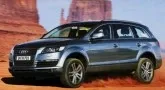
Audi Q7 sales are starting in Russia. This is not just the first SUV in the brand's history, but also the first Audi model that can carry up to seven people.
Let's clarify right away: the third row of seats and two separate "captain's chairs" in the second row are offered for an additional fee. Everything else you could wish for is already included in the standard equipment. True, this statement fully applies to the Audi Q7 4.2 FSI version, which costs from $107,673. The diesel modification with a three-liter turbo engine is more modestly equipped: the base does not include air suspension, leather interior, or a number of other options. But the price is noticeably more attractive — from $76,965. And even if you equip the diesel to the maximum, like the gasoline version, the savings will still be about $10,000.
Despite the difference in power — 233 hp versus 350 — the diesel loses to the gasoline engine in acceleration to 100 km/h by less than two seconds. The secret is in the huge torque, which is available almost from idle. True, the turbo diesel runs quite noisily, although this is noticeable mainly at high revs. The gasoline V8 sounds completely different: even during sharp acceleration, it does not irritate, but pleases with a noble timbre. But you have to pay for pleasure — a week of enjoying the "voice" of the V8 will cost about the same as a couple of opera tickets.
The Q7 has a very low drag coefficient for its class, plus excellent sound insulation. Therefore, even at speeds close to maximum, silence is maintained in the cabin. By the way, the top speed depends on whether air suspension is installed: at high speed it automatically reduces ground clearance, improving aerodynamics. The diesel Q7 with "air suspension" can accelerate to 216 km/h, and without it — to 210. The difference is small, but when pressed to the road, the center of gravity lowers, which has a positive effect on handling.
The air suspension can also increase ground clearance. In the MMI menu, you select Offroad mode — and the ground clearance increases from the standard 180 mm by another 25 mm. In this mode, it is not recommended to drive faster than 100 km/h, but if you exceed it, nothing terrible will happen: the electronics will simply return to standard settings. To overcome high obstacles, such as a curb, there is a Lift mode that raises the car to a maximum of 240 mm. Owners of diesel Q7s with conventional springs are deprived of this option — their ground clearance is always 200 mm.
But the quattro all-wheel drive is standard for all Q7 versions. Torque is distributed by a self-locking Torsen differential, as on the latest Audi RS4. Under normal conditions, 40% of the torque goes to the front axle and 60% to the rear, which is optimal for handling. When slipping, the differential transfers torque to the axle with better traction.
In difficult situations, the driver is helped by modern ESP with an off-road mode, the ASR anti-slip system, and the EDS electronic differential lock with the GMA yaw moment reduction function. Off-road, the electronics help overcome steep descents, maintaining a constant speed and allowing the driver to focus on the steering wheel. If there is a risk of rollover, the RSP system levels the car by braking the wheels.
The Q7 also has interesting electronic assistants: adaptive cruise control ACC and lane change assistant ASA. The latter monitors the areas to the side and rear of the car at a distance of up to 50 meters at speeds above 60 km/h. If the driver turns on the turn signal and a car appears in the blind spot, the system warns with a beep and a light signal in the exterior mirror.
The radar of the adaptive cruise control, hidden under the license plate, "sees" 180 meters ahead. The system maintains a safe distance to the car ahead at speeds from 0 to 200 km/h. ACC for the first time features a collision warning function: if the car in front is too close, the driver receives sound and light signals. If there is no reaction, the electronics performs a short braking to "shake up" the inattentive driver. True, the radar operates at frequencies prohibited in Russia (they are used by the military), so this option cannot be ordered from official dealers. The only way is to bring such a Q7 from abroad.
**Technical characteristics of Audi Q7 4.2 FSI (3.0 TDI)**
Number of seats – 5–7
Curb weight, kg – 2240 (2295)
Gross weight, kg – 2935 (2990)
Dimensions, mm:
- length – 5086
- width – 1983
- height – 1697–1772* (1733)
Wheelbase, mm – 3002
Trunk volume, l – 775/2035
Maximum speed, km/h – 248 (210)
Acceleration time to 100 km/h, s – 7.4 (9.1)
Control fuel consumption, l/100 km:
- city cycle – 19.5 (14.6)
- suburban – 10.2 (8.3)
- combined – 13.6 (10.5)
Fuel tank volume, l – 100
Engine:
- type – gasoline, V8 (turbo diesel, V6)
- displacement, cm3 – 4163 (2967)
- power, hp at rpm – 350 (233)
- torque, Nm at rpm – 440/3500 (500/1750–2750)
Transmission – automatic, 6-speed, quattro all-wheel drive
Tire size – 255/55R18 (235/60R18)
Wheel suspension (front and rear) – independent
Brakes (front and rear) – disc, ventilated
Steering – with adaptive power Servotronic
Price, $ – 107,673 (76,965)
* — For modification with air suspension.
**Advantages and disadvantages**
+ Spacious interior, excellent dynamics, rich equipment.
– The third row of seats is only suitable for passengers up to 160 cm tall.
Audi Q7. Quattro for seven
Audi Q7 sales are starting in Russia. This is not just the first SUV in the brand's history, but also the first Audi model that can carry up to seven people.
Source: 5koleso
Comments
No comments yet. Say the first word.