
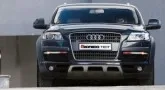
The Audi Q7 has lost $30,000 in price thanks to the arrival of a 3.6-liter gasoline engine — the most modest of all offered for this SUV. A reasonable question arises: can such a "heart" handle a two-ton machine?
Finally, Audi dealers have started accepting orders for the Q7 with the 3.6-liter V6. Usually, the most expensive versions are the first to hit showrooms — this is especially typical for premium brands like Audi, Mercedes-Benz, and BMW. New models, even with hefty prices, sell out instantly. That was the case with the Q7: the advertising campaign and hype swept away the first batch in no time. Then, lucky buyers got versions with the 4.2-liter V8, and a little later, the three-liter diesel arrived.
Now, the most affordable option has appeared — for those brand enthusiasts who approach the purchase with a cool head. These are people who need a spacious, comfortable car with striking looks and a weighty name, and for whom dynamics are not the main thing.
The "six" in the Q7 is a completely new development that is not found in any other model. Perhaps in the future it will be used in other cars, but there is no official confirmation yet. The main trump card of the new model is fuel efficiency. Fuel consumption ranges from 14 to 25 liters per 100 km depending on driving style. In the city, the average figure is 17.6 liters, while the 4.2-liter version consumes 19.5 liters.
The difference in power between the old and new engines is 70 hp (350 vs. 280). Any driver will feel this, although in city traffic jams the advantage of the older brother comes to naught. But on an open road, the younger engine won't let you get bored: acceleration to 100 km/h takes 8.5 seconds, which is only 1.1 seconds slower than the Q7 with the 4.2 FSI. Whether that second is worth $30,000 is a rhetorical question.
The top speed also differs: 244 km/h for the powerful version versus 225 km/h for the weaker one. However, where in Russia can you accelerate to 244 km/h? And if you lower the air suspension, the maximum speed increases by another 5 km/h.
Experts do not expect that the arrival of a cheaper version will radically change the market. Most likely, fully loaded cars will continue to be popular.
Just right
Such results from the 3.6-liter engine were achieved thanks to innovations. A comparison with the 4.2-liter shows that despite the apparent difference in characteristics, the gap is not so large in practice. The torque of 360 Nm in the younger engine is available already at 2500 rpm, while the older one has 440 Nm, but only after 3500 rpm. The maximum power of the 3.6-liter unit is achieved at 6200 rpm versus 6800 rpm for the 4.2-liter. Output and efficiency have also increased thanks to direct FSI injection.
Driving
The steering wheel delights with excellent feedback. The air suspension not only adds 5 km/h to the top speed (up to 230 km/h) but also provides comfort, safety, and, of course, off-road capability.
Interior
Inside, there is a luxurious look complemented by high-quality trim materials.
Comfort
The seats are comfortable, with many adjustments — every passenger will settle in comfortably. The fifth door opens automatically at the touch of a button, simplifying loading and unloading of luggage.
Safety
For premium brands, passenger safety is priority number one.
Price
If you do not take into account the premium for the Audi brand, the price looks quite justified.
| Dimensions, mm | 5086/3002/1983 |
| Engine | gasoline, 3599 cm3, 280 hp/6200 rpm |
| Transmission | automatic, 6-speed, Tiptronic |
| Dynamics 0-100 km/h, s | 8.5 |
| Top speed, km/h | 230 |
| Competitors | Volkswagen Touareg, BMW X5, Mercedes-Benz ML |
Pros and cons
+ Comfortable interior, excellent handling, elastic engine, functional and comfortable air suspension.
– Complex and confusing control system for onboard functions.
Our opinion
Five points