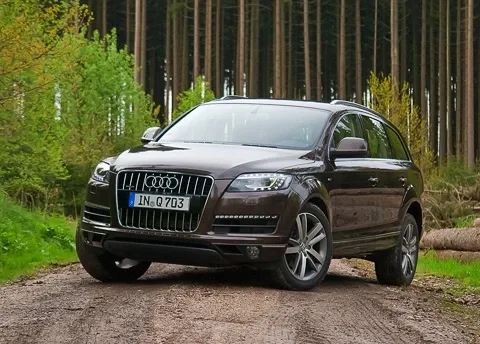
Wrong end. Getting acquainted with the petrol side of the Audi Q7 modernization
Much water has flowed under the bridge since the Audi Q7 crossover joined the high-end automotive society. Four years, to be precise. The 'green' trend has blossomed, and Audi's engine specialists have reliably instilled in buyers a fondness for turbodiesels in the premium segment. As a result, today the Q7 is primarily about the brilliant V6, V8, and V12 engines running on heavy fuel. Gasoline is for enthusiasts. And if that's the case, then a car that doesn't claim to be a driver's car doesn't really need a gasoline V8. It's not some Cayenne, after all. So they replaced both gasoline 'atmospheric' engines — the V8 4.2 and V6 3.6 — with a single supercharged 'six' 3.0 TFSI. I checked in Germany whether the crossover's 333 horsepower are enough.
2,691,686 views
Actually, for the engine with a Roots-type mechanical supercharger, which is already familiar from various Volkswagen Group models — from the Audi A6 and S4 to the hybrid Touareg — the Q7 has another stage of tuning: 272 hp and 400 N•m. But taking such a car for a short test would be strange. Since I was going to study the gasoline, "dark" side of the Q7, it makes sense to take the most powerful version. True, its torque is only a tenth more — 440 N•m. Marketing.
<img here, don't touch>
By the way, unlike the older gasoline modification, which became cheaper after switching from V8 to V6, diesels, on the contrary, have increased in price. So, the 3.0 TDI version went up by 68,400 rubles — now it costs 2,710,000. And the 4.2 TDI rose by 58,200 rubles, to 3,690,000. The top version with the six-liter V12 TDI turbodiesel became more expensive by 69,200 rubles — 5,300,000.
Another new feature is the eight-speed automatic. But don't think that Audi engineers have already started unifying the Q7 with the new Touareg or Cayenne. In Ingolstadt, they still remain loyal to ZF gearboxes. The ZF 8HP eight-speed, like in the Audi A8, has a much wider gear ratio range than the previous six-speed — 7.25:1. I was to assess how the car behaves with this unit on the streets of Stuttgart and the surrounding autobahns. It's just a pity that the route is short — only about 100 km.
<img here, don't touch>
You can distinguish the top gasoline version from the less powerful one by the V6 T badges on the front fenders. Acceleration to 100 km/h, according to the specs, is 6.9 seconds.
After just twenty minutes behind the wheel, you realize: the V6 3.0T engine is more than enough in any situation. Watching how the huge car instantly reacts to the gas pedal, I catch myself thinking: is it really all 2,315 kg here? Subjectively — no more than two tons. On the acceleration lane of the Bavarian E53 highway, it's enough to immediately overtake the main flow. The engine pulls almost to 5,500 rpm, and the acceleration is accompanied by a rich "metallic" roar. At the same time, no traditional supercharger whine — a pleasant bonus.
<img here, don't touch>
In Drive mode, the ZF gearbox immediately tries to shift to the highest gear — it's more economical. But in S, it doesn't go above sixth. Over the entire trip, our average fuel consumption was 12–13 l/100 km. Although we mostly drove on the autobahn at 160–180 km/h, and spent the rest of the time in traffic jams.
The autobahn is the native element of the Audi Q7. The car confidently holds high speeds, and its straight-line stability would be the envy of a locomotive. Heavy steering, silence in the cabin, excellent visibility... The only thing that disrupts the idyll is the absence of family nearby. But in the city, the five-meter giant feels cramped, although the engine has enough elasticity to calmly roll past German houses and restaurants at two thousand rpm. You just gently press the responsive gas pedal — and that's it.
<img here, don't touch>
The Q7's interior is high-quality, expensively finished, and comfortable. The only thing that bothers me is the cheap-looking metallized plastic trim that they haven't given up. But the visibility is excellent, largely thanks to the huge side mirrors.
But no matter how soothing the "Q-seven" is, it couldn't hide the flaws in the automatic's operation. The gearbox is, of course, smart and doesn't get confused in gears. It can instantly jump down four gears and end up exactly where needed. But here's the paradox: during active driving, shifts are fast and imperceptible, but in a calm rhythm, jerks are felt. And this is in both modes — comfort and sport.
<img here, don't touch>
Q7 occupants don't know the concept of lack of space. There's plenty of room both overhead and in the shoulders. And the driver will be pleased with the extending seat cushion.
Will the automatic become silky smooth with the V6 3.0 TDI and V8 4.2 TDI turbodiesels, which have richer low-end torque? We'll look for the answer already in Moscow. Special attention — to the car with the 250-horsepower diesel "six" (550 N•m), which one of Audi's top techies, Christian Brenneisen, called completely new.
However, in terms of ride smoothness and handling, the diesel Q7 with V6 is unlikely to differ much from the gasoline one: the difference in engine mass is only nine kilograms. So the precision of steering responses and moderate body rolls will remain. But if we talk about ride smoothness... honestly, I want a heavier engine.
<img here, don't touch>
Dynamic mode of the air suspension is what you need on the highway. The car lowers, pitching completely disappears, rolls are leveled, and the ride becomes elastic. Fast lane changes are especially indicative — everything is collected and reliable.
Even in Comfort mode (settings, as before, are changed via MMI), the air suspension of the gasoline car, allowing slight rocking on asphalt waves, manages to digest most cracks and potholes. In Automatic, rocking almost disappears, but the micro-profile of the road is transmitted to passengers in more detail. It seems that if you load the front axle with the "eight," there would be fewer vibrations. Alas, the privilege of being heavy remains only with diesels. Admittedly, we hoped that an exception would be made for Russia and the gasoline V8 would be kept. But no! If you really want such an engine, you'll have to look towards the Touareg.
<img here, don't touch>
Demand for the Q7 is stable: even in the crisis year of 2009, 1,968 cars were sold. Here Audi yields only to the BMW X6 (2,232 cars) and BMW X5 (2,023). Dealers are already accepting preliminary orders. Prices are quite reasonable: from 2,680,000 rubles for the 272-horsepower version and from 3,100,000 rubles for the 333-horsepower one. For comparison: the departed 3.6 FSI and 4.2 FSI cost 2,626,900 and 3,596,000 rubles, respectively. I have no doubt that the Q7 awaits a happy old age. And if there were any doubts, they would have dissipated like clouds over Moscow on Victory Day under the pressure of the new "six's" boost. Powerful, torquey, and sweet-voiced. For enthusiasts.
Specifications (table remains as is)
Before us is the updated Audi Q7, and our acquaintance with it began not at a test site, but on German autobahns. I admit, the test organization turned out to be peculiar: along with the crossover, we were also given an Audi TT, and time was strictly limited. The routes were laid exclusively on high-speed highways, which, on one hand, is convenient for assessing traction, and on the other, doesn't allow fully feeling the suspension. But observing local drivers turned out to be instructive: on a highway where signs indicate 120 km/h, no one even thinks of driving at that speed. The left lane is occupied by those going 80 km/h faster, and all this freedom ends only in front of speed cameras, in front of which the flow unanimously slows down. Just like with us.
**Technical content**
The main intrigue is the engines. The gasoline V6 3.0 TFSI with direct injection and a driven supercharger is already the fifth Volkswagen Group model to use this unit. The aluminum "six" with a displacement of 2,995 cubic centimeters, with a 90-degree cylinder angle, weighs 189 kg and is equipped with intake camshaft phasing. The compact Eaton Twin Vortices Series supercharger spins up to 23,000 rpm, and the entire unit with two intercoolers and rotors is placed in the V of the block. With this engine in the 272-horsepower version, the Q7 reaches 100 km/h in 7.9 seconds, and the version boosted to 333 hp does it in 6.9 seconds.
The second-generation diesel three-liter, it would seem, has the same output — 240 hp and 550 Nm, but this is a completely different unit. It became lighter by 20 kg (198 kg), received a lightweight block with optimized cooling and cylinder wall coating that reduces friction. The valvetrain has a modified chain drive, the common rail fuel system has new-generation piezo injectors capable of up to six injections per cycle at a pressure of 2,000 bar, and the turbochargers have variable geometry. The result is impressive: the diesel became 19% more economical (7.4 liters per 100 km in the combined cycle). This is partly due to the start/stop system, which is now standard. In terms of dynamics, the diesel version is not inferior to the younger gasoline one — the same 7.9 seconds to 100 km/h. There is also a Clean diesel version that meets Euro-6 standards, which will be introduced in the EU in 2014. The top V8 TDI with 340 hp and 800 Nm was not ignored either — it received a new injection system and reduced mechanical losses.
The eight-speed ZF 8HP automatic locks the torque converter already in first gear, immediately after launch, which provides excellent control over acceleration. The gearbox has an additional damper to dampen vibrations, and the version for the diesel also has a heat exchanger integrated into the engine cooling system, plus an electric oil pump that maintains pressure during start/stop operation.
**Feelings and numbers**
On the move, the Q7 remains true to itself: it's still a huge and solid car that gives a sense of permissiveness on the highway. The air suspension with double wishbones all around swallows bumps, and the permanent all-wheel drive confidently holds the course. In corners, the body, of course, rolls, but for such a giant, this is expected. The steering is informative enough, although not sharp. The brakes with ventilated discs on all wheels work predictably and tenaciously, which is important with a mass of over two tons.
As for consumption, in the urban cycle, the gasoline version asks for 14.4 liters per 100 km, on the highway — 8.5, and in the combined cycle — 10.7. The diesel in the city fits into 8.6 liters, outside the city — 6.7, and on average — 7.4. The tank in both cases is 100 liters, which with such appetite gives a decent range. The gasoline engine requires AI-98, the diesel — diesel fuel.
As a result, after modernization, the Q7 has become even more cohesive. The supercharged gasoline V6 is a universal fighter, ready to both dash and roll calmly. The diesel, on the other hand, is the choice of a pragmatist who values efficiency and torque. I couldn't fully enjoy all the nuances in a short trip on the autobahns, but even what I saw is enough to understand: this crossover knows how to keep the bar.