
Top and Roots
We have only a few hours and six cars at our disposal. In this short time, we need to thoroughly inspect the vehicles, listen to the technical presentation, and take photos for illustrations, so we immediately declined visiting the Audi museum and the fresh exhibition dedicated to the thirtieth anniversary of quattro all-wheel drive.
We were brought to Ingolstadt for a different reason — the Audi TechDay Drivetrain technical presentation, dedicated to updating the technical content of the Q7 SUV, as well as the TT coupe and roadsters. Let's sort it out in order!
Big but Economical
Among the mass-market brands of the Volkswagen Group, the Audi brand has always stood out. Only this company had its own powertrains that were not installed on VW or SEAT, and its own transmissions — for example, the chain-type CVT or the seven-speed "robot" designed for cars with a longitudinal engine layout. However, nowadays uniqueness is not cheap, so engineers and marketers from Ingolstadt are constantly looking for a golden mean between unifying components with other Volkswagen Group models and maintaining brand individuality for customers.
last year
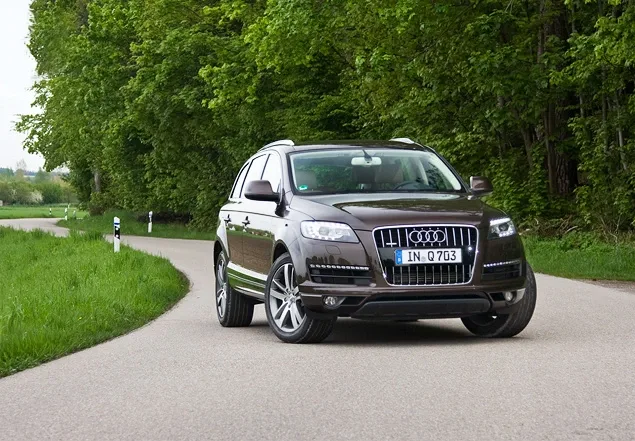
The Audi Q7 SUV, which debuted in 2006, was initially created on the same scheme: based on the extended platform of the VW Touareg / Porsche Cayenne, with almost the same engines. But its all-wheel-drive transmission was of its own design, built around a Torsen differential — this is what gave a bit of Audi's individuality.
However, after the second-generation Touareg and Cayenne appeared, which also got the "Torsen" and an extended wheelbase, the Germans had to think about refreshing the "Q7". Last year, the model received a light exterior facelift, and now, in 2010, it got new engines and an automatic gearbox.
Thanks to the gear ratio spread between the "shortest" and "longest" gears of 7.25:1 (the A8 has 7:1), the heavy Q7 accelerates briskly in lower gears and saves fuel in the top two. Moreover, the new automatic transmission can lock the torque converter almost immediately after launch — this makes the "Q7" respond lively to the throttle, and when stopping, the clutch disengages, disconnecting the engine from the gearbox.
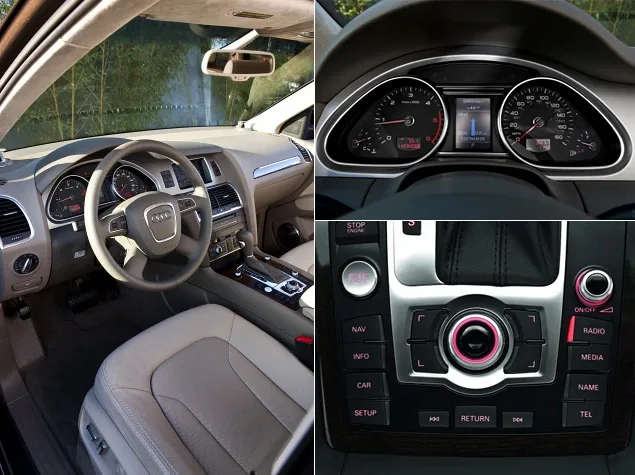
In the version with the three-liter turbodiesel, the Q7 is equipped with a "start-stop" system, for which the automatic transmission had to be supplemented with a compact electric pump that maintains oil pressure in the transmission when the engine is turned off. And the diesel 3.0 TDI itself is also completely new, although it has the same characteristics as its predecessor — 240 horsepower and 550 Nm of torque. The new engine has a lighter block, a different turbocharger, and a common rail fuel injection system, as well as a modernized auxiliary drive scheme that uses two chains instead of four. As a result, this engine is 25 kilograms lighter and 20 percent more economical than the previous version.
From the gasoline range of the updated Audi Q7, the 3.6 V6 and 4.2 V8 engines have disappeared — they were replaced by a three-liter "six" with a supercharger, which will be available in two power variants. The base 272-horsepower engine (400 Nm) will replace the naturally aspirated V6, and the more powerful 333-horsepower unit (440 Nm) will replace the eight-cylinder engine. Supercharged engines, by the way, can be "fed" with 95-octane gasoline, while for naturally aspirated engines it was recommended to use fuel with an octane rating of 98.
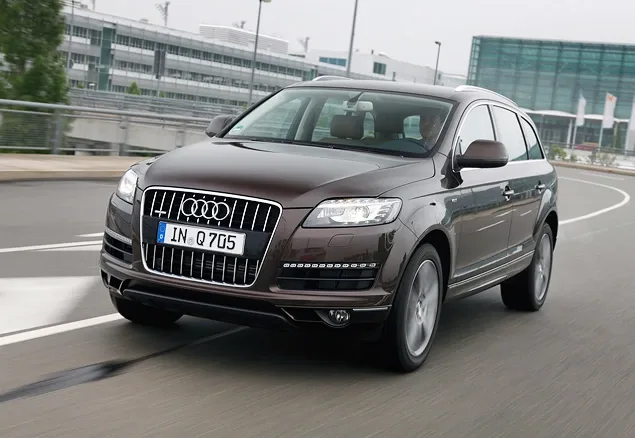
In real life, the dynamics of the Audi Q7 even with the 333-horsepower engine are not too impressive. The sensations are dulled by the car's solid mass and excellent sound insulation, due to which the engine sound penetrates the cabin only at high revs. But the supercharged "Q7" cannot be called sluggish either: after a barely noticeable pause at launch, the SUV enthusiastically takes off and, if desired, can accelerate to 242 kilometers per hour.
The new automatic gearbox is primarily tuned for measured driving. In "Drive" mode, the automatic quickly reaches the top, eighth gear, and the engine revs in the range of 1200–1500 rpm. But if you press the accelerator pedal to the floor, the "automatic" will drop down at once to fourth gear. In addition, at any moment the driver can switch to manual transmission mode by pulling either of the paddle shifters.
In "Sport" mode, the transmission does not go above sixth gear, but during acceleration, gear changes occur with noticeable jerks. Light twitches are also present in the civilian "Drive" mode, and this is strange — on the A8 sedan and the new "Touareg", there were no such complaints about the new transmission.
in late summer — early autumn 2010
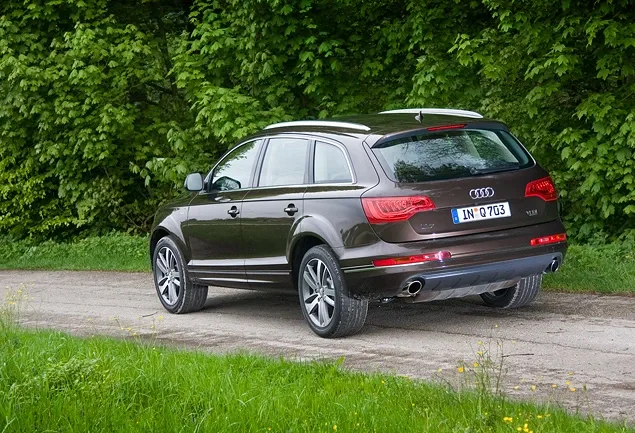
Otherwise, the facelifted "Q7" is no different from its predecessor — it is still a large, comfortable, and rather heavy car that feels surprisingly confident on high-speed German autobahns. The firm suspension, which on uneven roads repeats its profile too meticulously, seems very composed on the highway, not allowing any pitching or trajectory deviations at bridge expansion joints.
It's a pity that we never got to drive the Audi Q7 with the new three-liter turbodiesel and the "base" supercharged "six" — there wasn't enough time. After all, besides the updated SUVs, facelifted Audi TT sport coupes and convertibles were waiting for us in Ingolstadt!
"T-Ts"
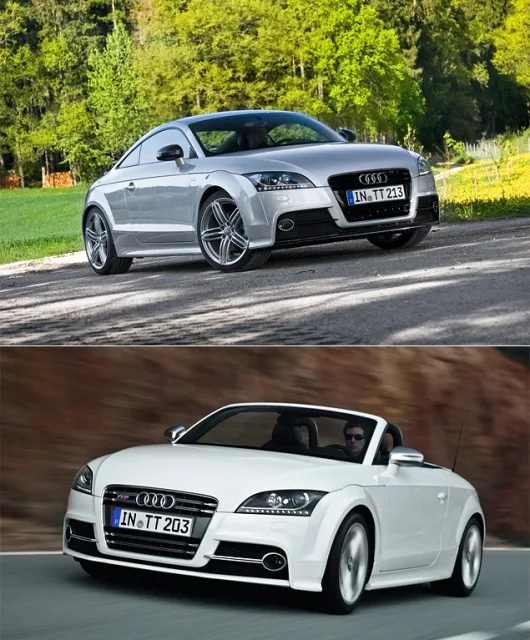
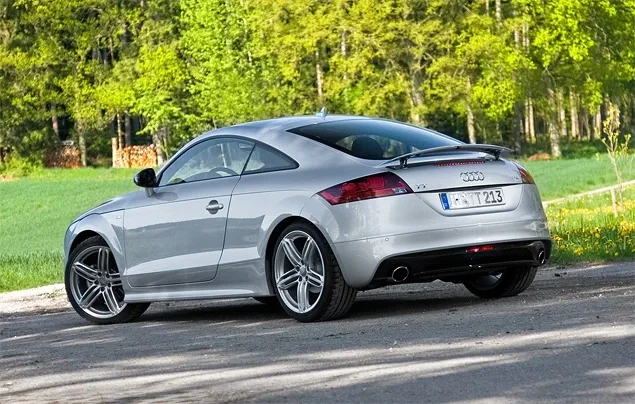
Actually, the facelift of the "T-T" turned out to be rather conditional. In fact, besides the headlights with LED strips for the "parking lights", the Audi TT coupe and roadsters now got the appearance of the modification that previously stood a step higher in the model range. That is, the updated coupe and roadster in base versions now look the same as their predecessors with the S line package — with more expressive front and rear bumper styling, and the updated version of the S line package is an exact copy of the appearance of the pre-facelift "charged" TTS modification.
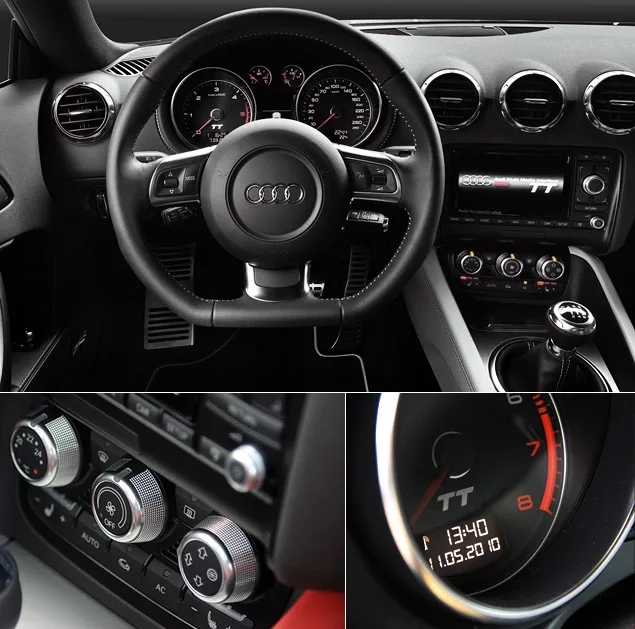
There are even fewer changes in the interior of the updated "T-Ts". The interior was slightly enlivened with chrome knobs on the climate control unit, a black glossy trim on the center console, aluminum inserts on the steering wheel and door panels, and the on-board computer displays had their red backlight changed to white.
The main event for the facelifted Audi TT is the appearance in the engine range of a two-liter turbocharged unit with 211 horsepower (350 Nm). This engine will replace two powertrains at once: the "old" 2.0 TFSI, which developed 200 horsepower, and the naturally aspirated 3.2 "six". The engine itself, however, is not that fresh — it appeared two years ago and is now installed on the larger Audi A5 coupe, as well as the Audi A4 family (including the Allroad version) and Q5 crossovers.
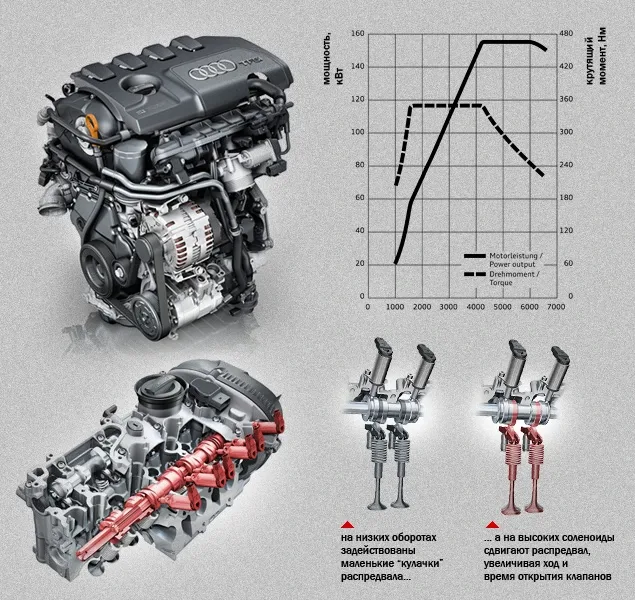
As a result, with the same power of 211 horsepower, the Audi engine has higher torque: 350 Nm versus 280 Nm for the VW Golf GTI engine, and the maximum torque plateau starts at 1600 rpm. Finally, the new engine is more economical than its predecessor (by about 14 percent) and consumes on average about 6.6 liters of fuel (according to the European test cycle).
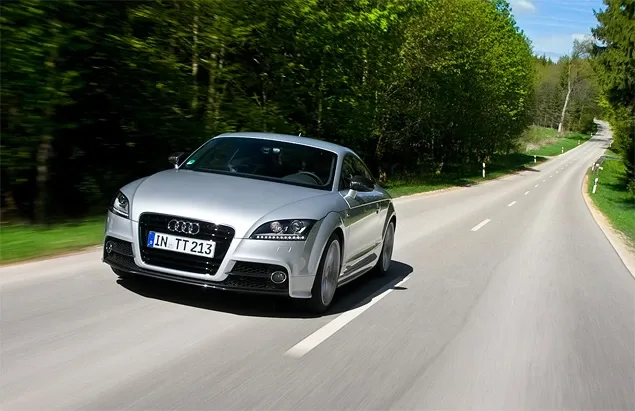
The updated Audi TT with a two-liter turbo engine is noticeably livelier than its predecessor, even when equipped with a manual gearbox. The new engine is significantly more aggressive than the old 2.0 TFSI: the additional 70 Nm of torque is felt immediately — the pull kicks in already at two thousand rpm and confidently pulls up to five to five and a half thousand.
However, the "stick" isn't an ideal match for this engine. On one hand, the gearbox is almost sporty, the gears are well chosen, and the short-throw lever clicks with true pleasure. But the six-speed "robot" DSG does it even better.
In terms of torque reserve, the new engine is almost on par with the boosted TTS version, which produces 272 horsepower — the lag in acceleration to 100 km/h is only 0.4 seconds.
In standard mode, the DSG behaves like a decent "automatic" — shifts are smooth and imperceptible. But in sport mode, the gearbox doesn't let the engine drop out of the working range: when braking before corners, it downshifts on its own with spectacular rev-matching. If we rely on the numbers, the "robot" is noticeably more efficient than traditional manual — those same half a second to 100 km/h are worth a lot.
As before, the Audi TT offers adaptive suspension with magnetorheological dampers. But now the button on the center tunnel (marked with the letter "S" rather than a shock absorber icon) doesn't just "tighten" the chassis — it also changes the settings of the power steering and the electronic throttle pedal, sharpening the car's responses. A kind of simplified Audi Drive Select.
can be extended manually,
by pressing a key next to the gear lever
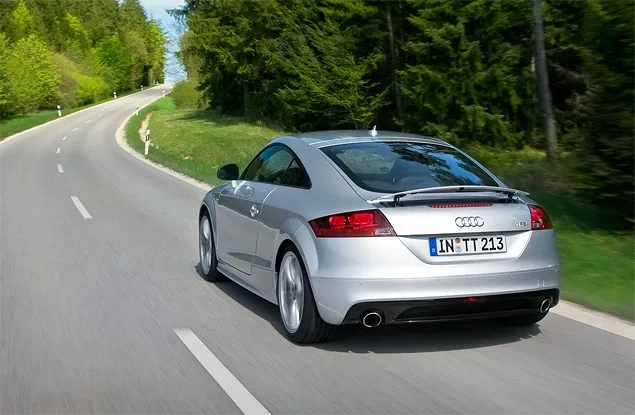
With the "S-mode" engaged, the character of the TT changes — not drastically, but quite noticeably. The steering wheel, which was slightly empty at center, fills with weight (albeit a bit artificial), the suspension better controls body roll, and the throttle response becomes very lively, allowing more precise dosing of torque on the front axle. But even the base TT with the S line package (springs lowered by 10 mm, larger wheels, body kit) is not an extreme sports car. Therefore, a full "fusion" with the car on a winding road doesn't come immediately. After a short drive, it becomes clear: the TT's chassis has a reserve that doesn't reveal itself in five minutes but requires time.
With the TTS version, which has 272 horsepower under the hood, we headed out on the same route — and finding a common language with it turned out to be easier. The suspension is stiffer and more precise, the DSG works faster, the steering is livelier and more informative. All-wheel drive allows you to open the throttle on corner exit much earlier than on the single-axle-drive coupe, and the exhaust "cracks" louder on shifts — on the TTS roadster with the top down, these pops sound especially dramatic.
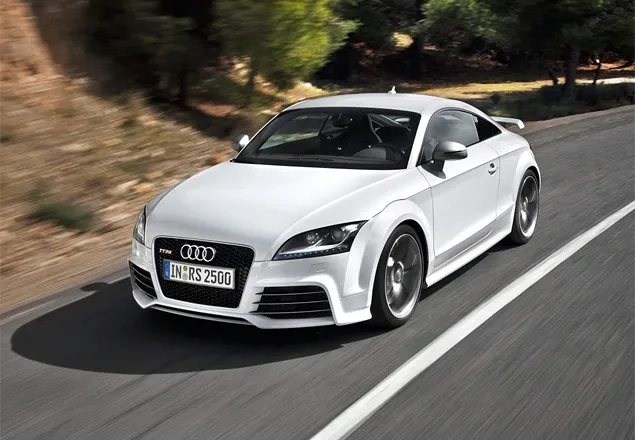
But the regular TT doesn't have to be a sports car — these cars are bought with the eyes. Design is the main thing here, and the well-tuned chassis and powerful engines are just a pleasant bonus to the striking appearance. And it works: according to Audi marketers, the "TT" is the most successful compact sports car in its class. In 2008-2009, the coupes and roadsters from Ingolstadt sold better than BMW and Mercedes-Benz in this niche combined.
In Russia, however, the TT lags behind two-door BMWs. In 2009, sales of the "TT" were almost half as much. The reason is the price: for the most affordable 1-Series they asked about 1.1-1.2 million rubles, while the base TT with the 1.8 engine and manual cost at least 1.5 million. What will happen to prices after the release of the updated family, we'll find out soon — in Russia, the new coupe and roadster will appear closer to the end of summer.
Let's see what happens after the facelift
Technical specifications
| Audi Q7 3.0 TFSI | Audi TT 2.0 TFSI | |
| Length, mm | 5086 | 4187 |
| Width, mm | 1983 | 1842 |
| Height, mm | 1737 | 1352 (coupe) |
| Wheelbase, mm | 3002 | 2468 |
| Weight, kg | - | - |
| Engine displacement, cm3 | 2995 | 1984 |
| Power, hp/rpm | 333/- | 211/4300-6000 |
| Torque, Nm/rpm | 440/2900 - 5300 | 350/1600 - 420 |
| Maximum speed, km/h | 243 | 245 |
| Acceleration from 0 to 100 km/h, s | 6.9 | 6.1 (manual) |