
Adventures of Electronics
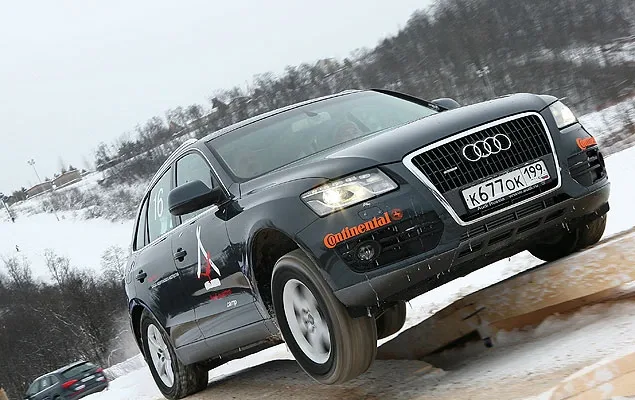
We finally got around to the Audi Q5. In the summer, we couldn't make it to the presentation of this crossover in Valencia, but "Auto.Lenta.Ru" along with other automotive publications was invited to the winter Audi quattro camp, set up on the grounds of the Yakhroma ski resort near Moscow. There, under the guidance of Austrian engineer Alexander Hill, a special test track was built to demonstrate the capabilities of the Q5.
to account for about 20% of the company's
turnover on the Russian market in 2009
Respect
If I were in Audi's management, I would also come up with something unusual to show the new car to Russians. In its proportions, the "Q-five" resembles its older brother — the Audi Q7. On white snow, the crossover seems elongated, slightly "smeared," as if photographed at speed, and quite large. And this is not an optical illusion: the Audi SUV is indeed longer and lower than its classmates. For example, the BMW X3 is 60 millimeters shorter than the Q5, and the Mercedes-Benz GLK is 105 millimeters shorter.
Marketing lessons Audi quattro camp is unique in its kind. The project is not aimed at test engineers evaluating the new model in Russian conditions, but at potential buyers. On two test tracks — an icy one and one simulating light winter off-road — any visitor to the Yakhroma ski resort will be able to test the new crossover for free throughout 2009. In winter, the site operates five days a week, taking two groups of up to 25 people each day. And when the snow melts, Audi quattro camp will not close — a "summer" track will be built here as well.
It's clear that such a project requires substantial investment, but Audi is confident it will pay off. First, the company has high hopes for the new crossover — according to marketers' plans, in 2009 this model will account for about 20 percent of Audi's turnover on the Russian market. Second, in winter, "Quattro camp" can host up to 1,200 people per month. And all of them, as Audi believes, can be considered the target audience for the new crossover. Because in our country, ski resorts are mainly visited by wealthy people. And third, it's practically the most massive test drive in the history of the modern Russian car market. How justified the expectations placed on Audi quattro camp will be is hard to predict now. I, for example, doubt that most visitors to Yakhroma can afford to buy a German crossover that costs 1 million 630 thousand rubles "in the base." Yakhroma is still not Davos or Courchevel. Most likely, during the camp's operation, the Audi Q5 will be tested not only by the wealthy but also by owners of Korean, Chinese, and Russian SUVs. Out of curiosity. But in any case, Audi quattro camp is excellent advertising not only for the new crossover but also for the brand itself. The event is very well organized. And any car enthusiast, after sitting in the driver's seat of the Q5 for 20–30 minutes, will certainly feel increased loyalty to the German new product. |
The wheelbase of the Q5 is also larger than that of competitors. True, in the cabin, it's hard to feel the extra centimeters. The main advantage of the MLP platform on which the crossover is built is the new engine compartment layout, which allowed the front axle to be moved forward and the engine and gearbox to be shifted back — closer to the center of mass. This improved the car's weight distribution and increased the distance between the front and rear wheels.
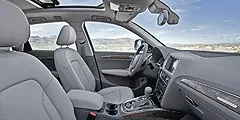
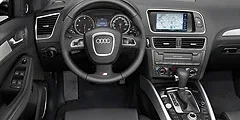
Inside, everything is solid, high-quality, and expensive. Comfortable seats creak hospitably with new leather, and wooden inserts on the front panel, door trim, and transmission tunnel add respectability to the car. The multimedia interface MMI knob, which can control not only the Bang&Olufsen audio system and navigation but also suspension and steering settings, is right at hand — next to the automatic transmission selector.
However, sitting in the driver's seat, you experience a dual feeling. On one hand, next to the massive transmission tunnel, you feel as if in a sports car cockpit. From there, the tachometer and speedometer needles hanging strictly downward on the instrument panel also migrated to the "Q-five." But on the other hand, the high seating position and the massive front panel turned toward the driver remind you that the Q5 is, after all, an SUV. And to resolve this contradiction, you want to quickly get moving and drive at least a few kilometers. Fortunately, that's exactly why we were brought to Audi quattro camp.
Interior
|
Soft off-road park
"Quattro camp" has only two tracks. One is called Ice track, and the second is Soft off-road park. Why "soft" is clear without further explanation. The crossover with four rings on the grille is not designed for serious snow or mud tests, but it has more off-road capability than a "passenger car." The Audi Q5 has 200-millimeter ground clearance, can ford water up to half a meter deep, and climb slopes of up to 60 percent (corresponding to a 30-degree angle).
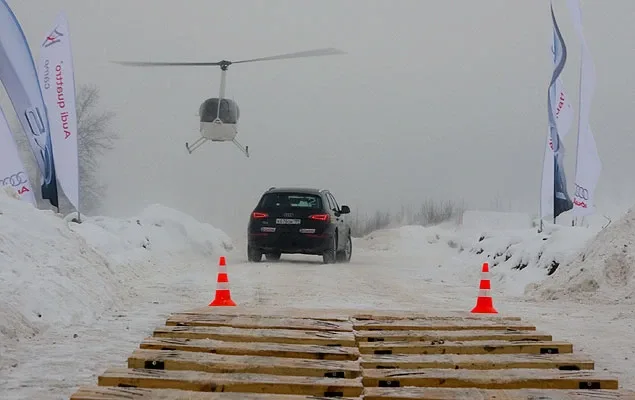
We were able to verify this as soon as we got to the "off-road" site. The first obstacle there was an icy hill with a 50-percent slope (corresponding to a 25-degree angle). At this section, the organizers decided to demonstrate the traction characteristics of the two-liter TFSI at low revs.
Unification
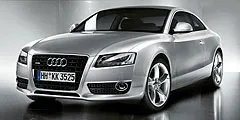
The Q5 crossover is built on the same platform as the A5 coupe and the A4 family. This was made possible for Audi's engineers by the new Modular Longitudinal Platform. However, the "Q-five" currently has only one engine — a two-liter TFSI with turbocharging. But soon, cars with diesel engines of two and three liters will appear in showrooms. |
The engine with 211 horsepower did an excellent job. It reaches its maximum 350 Newton-meters of torque already at one and a half thousand revolutions, and the torque "shelf" remains flat until the tachometer needle reaches 4200 rpm. Thanks to the reserve of traction "at low revs," the Audi Q5 climbs a slippery hill literally "at idle," like an SUV with the "low range" engaged.
Of course, in such a situation, the traction control system actively helps the "Q-five," but its operation can only be guessed at — the moment when the electronic system brakes the wheels that start to slip is hard to notice. The car simply crawls up at a constant speed, despite the bare ice under the wheels.
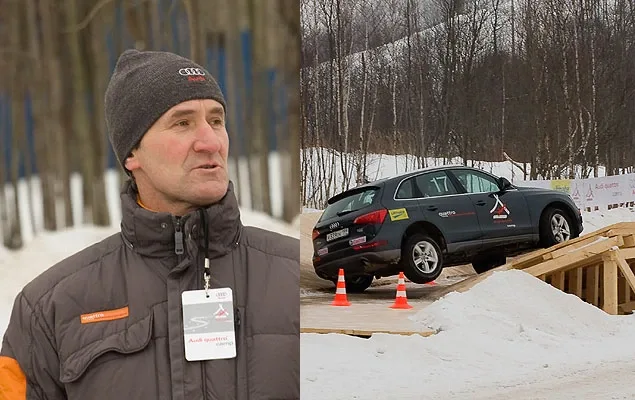
A little later, the effectiveness of the traction control system was demonstrated to us again — on a special track where each wheel could be hung up in turn. For the Audi Q5, moving along such a road does not cause much difficulty. Every time one of the wheels was in the air and began to spin helplessly, the electronics braked it, redirecting torque to the neighboring wheel, and the car continued to move forward.
The combination of two turns with a fifty percent lateral slope following the climb was easy for the Q5. This obstacle, by the way, tests not only the geometric cross-country ability of the car, but also the winter driving skills of the driver, who must remember that such obstacles must be passed with momentum. In this case, centrifugal force and the same traction control system help the car stay on the slope.
The improvised "washboard" made of twenty-inch boards was not an obstacle for the test Audi Q5 either. The crossover softly but elastically swallowed all the artificial bumps, and the suspension and interior did not make a single extraneous knock or creak. This test impressed me even more when I realized that the test car had been subjected to such "abuse" for three weeks — the "quattro camp" opened its doors on January 3.
Ice track
After having plenty of fun on the bumps, we headed to conquer the ice track in the Q5. To be honest, I expected to verify the claimed 7.2 seconds to 100 km/h at the test site and evaluate the work of the sophisticated suspension in corners — multi-link in front, double wishbone in the rear. But the organizers did not call the site Ice track for nothing: almost the entire track, 400-500 meters long, is a skating rink polished to a mirror finish.
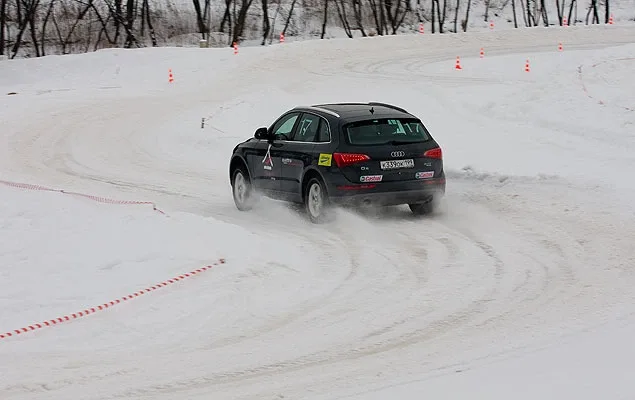
In the end, I was wrong to switch the Audi drive select active chassis selector to Dynamic mode before the start. In this algorithm, the shock absorbers become stiffer, the steering wheel fills with heaviness, and the seven-speed robotic gearbox with two clutches, S tronic, switches to sport mode. But there was no use for it — on the ice track, it is simply impossible to accelerate to "sporty" speeds.
We also failed to test another auxiliary system that works with the electric power steering. The press release states that thanks to an additional gearbox on the steering shaft, ESP can, at a critical moment, send a steering impulse to the front wheels, helping the driver fight understeer or oversteer. But to feel the effect of such intervention, the car must at least somehow react to the steering wheel, and on bare ice such corrections have almost no effect on the trajectory.
I was saved from flying off the track only by the stability control system, which stopped the skidding by cutting fuel supply and braking the wheels. And as soon as the Q5 began an uncontrolled movement towards the next snowdrift, it almost immediately stopped it. Moreover, almost without the driver's participation.
Fantastic
Of course, it is a pity that during this event we did not get to know the sporty character traits of the Q5. But at some point during the test drive, it seemed to me that a test on a high-speed highway or a winding serpentine would only have spoiled that celebration of electronics at which we, without knowing it, found ourselves in the Moscow region's "Yakhroma."
Due to the low speeds, this test drive actually became a triumph of the car's electronic systems over the human central nervous system and vestibular apparatus. The "smart" ESP caught the car when I pressed the gas too hard in a corner, the advanced "hill-assist" lowered me down a steep icy hill, and then, with the help of the traction control system, I climbed it with the same ease. My palms did not even sweat once during the whole day.
So, this is how controllers and printed circuit boards will take care of a person in the near future. And we, having ridden the Audi through a snowy ravine 46 kilometers from Moscow, became only involuntary witnesses of this "electronic miracle." Fantastic!
Alternative
|
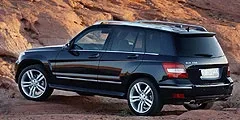
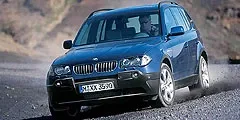
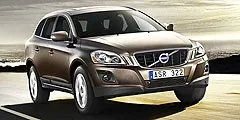
 |
Technical characteristics of Audi Q5 2.0 TFSI
| Length, mm | 4629 |
| Width, mm | 1880 |
| Height, mm | 1653 |
| Wheelbase, mm | 2807 |
| Curb weight, kg | 1740 |
| Engine displacement, cm3 | 1984 |
| Power, hp/rpm | 211/4300-6000 |
| Torque, Nm/rpm | 350/1500-4200 |
| Acceleration time from 0 to 100 km/h, s | 7.2 |
| Maximum speed, km/h | 222 |
| Fuel consumption in combined cycle, l/100 km | 8.5 |