Torsen vs Haldex
The eternal battle of "Torsen" and "Haldex"... How many pages on car forums have been filled with arguments about which all-wheel drive system is more worthy? Who has it better — Audi or BMW, Subaru or Mitsubishi? What is preferable — "Haldex" or "Torsen"?
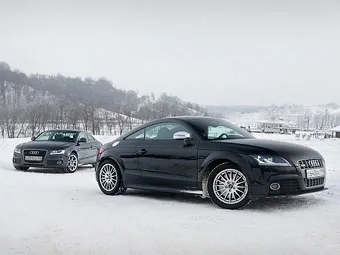
Usually by the fifth to tenth page of discussion, everything came down to figuring out what is "more correct": the good old mechanics or modern electronics. We decided to close this question for ourselves and took two all-wheel-drive coupes from Audi: Audi TTS with electro-hydraulic "Haldex" and Audi A5 3.2 with "Torsen". Both with automatic transmissions: the TTS has a DSG robot, the A5 has a classic hydromechanical "automatic".
while the naturally aspirated Audi A5 has 265 horsepower
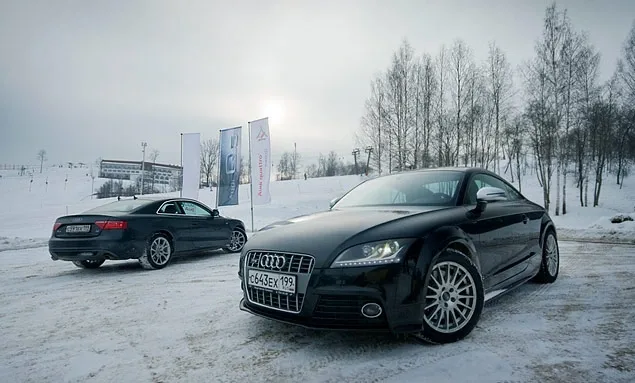
I'll note right away: we didn't have the task of determining which drive is "better". Not at all! We only wanted to understand how differently cars with these transmissions behave and what the driving characteristics are. But before hitting the track, it's worth understanding what exactly distinguishes these systems that are installed on Audis.
Torsen
|
Torsen differential
|
Permanent drive with "Torsen" is a true Audi legend. In 2006, every third car of the brand came off the assembly line with all-wheel drive transmission! But such a differential didn't appear on German cars right away...
The history of all-wheel-drive cars from Ingolstadt dates back to 1981, when the Audi Quattro coupe went into production with permanent drive to all wheels and rigid locks on the center and rear differentials. However, these locks had to be engaged manually, and the transmission itself was created more for off-road use. In essence, it differed little from off-road systems and had nothing to do with sporty driving — on the contrary, with locked differentials, the car refused to turn properly. And many drivers simply forgot to disengage the locks on asphalt, causing them to fail.
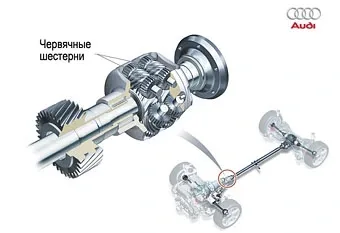
Therefore, within a few years, Audi began installing the Torsen limited-slip differential, invented by the American company Gleason Corp. Its principle is encoded in the name: Torque and Sensing, meaning "sensitive to torque". In other words, Torsen reacts not to the difference in rotational speeds of the axles, like most other transmissions, but to the difference in torque on them. Or, if you will, to the difference in traction between the front and rear wheels with the road.
Another distinctive feature of "Torsen" is that it doesn't try to equalize the wheel speeds during slipping, but simply transfers traction to where traction is better. And it does this without electronics — pure mechanics.
Until 2006, Torsen split torque between axles equally — 50:50 — and could transfer up to 75 percent of the torque to one of them. But because the engines on Audis (referring to previous A4, A6, and A8) were mounted longitudinally and actually hung over the front axle, this formula drew criticism: cars were prone to understeer.
Since 2006, Audi began installing a new version of "Torsen" that distributed torque in a 40:60 ratio favoring the rear wheels. The first to receive it were the updated RS4 and A6, then the A5 coupe and the A4 family. The redistribution range also changed: the front axle could now get a maximum of 65 percent of traction, and the rear axle up to 85 percent.
Besides being fully "mechanical" and inexpensive, Torsen has another important advantage — it works almost instantly, without waiting for wheelspin.
By the way, the Torsen differential is used not only as a center differential but also as a limited-slip differential between wheels — for example, on Alfa Romeo, Toyota (Land Cruiser 200), Subaru Impreza WRX STi, Mazda3 MPS, and "hot" Honda Civic and Accord. The central Torsen is installed on all-wheel-drive Lexuses, Alfa Romeo Brera, and all Audis except A3 and TT.
Haldex
|
Haldex coupling
|
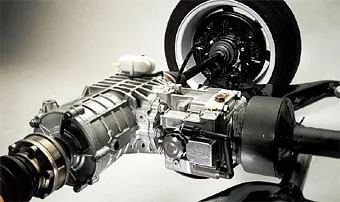
The Haldex transmission came to Audi with the VW Golf IV platform, on which the A3 hatchback was first made, and then the first-generation TT coupe. At the heart of "Haldex" is a multi-plate clutch operating in an oil bath. It locks when there is a difference in the rotational speed of the front and rear wheels.
In normal mode, a car with such a clutch remains front-wheel drive — no more than 10 percent of traction is sent to the rear axle. As soon as the front wheels start to slip, a hydraulic pump (mechanical in early versions) comes into play, increasing pressure in the cylinder, compressing the friction plate pack, and engaging the rear axle.
If in the first generations of the Haldex clutch, electronics only "braked" it by releasing pressure and reducing the degree of locking, now it controls an electric pump that replaced the mechanical one. This means the new clutch can lock not only during wheelspin but also on command from the control unit.
The advantage of this scheme is that electronics can "pre-lock" the clutch in advance — for example, during acceleration or at the slightest slip of one of the wheels (using data from ABS and stability control sensors). It also constantly "plays" with traction on the rear wheels, changing the torque sent to them depending on the situation.
The fourth-generation Haldex clutch is currently installed on Saab (9-3 XWD), Opel (Insignia), Audi A3, TT, VW Tiguan, Skoda Octavia, Superb, and others. Systems of previous generations are found on Volvo, Land Rover (Freelander), Ford (Kuga), and Seat.
Who wins?
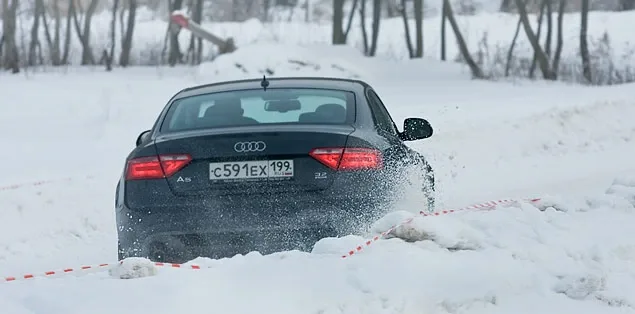
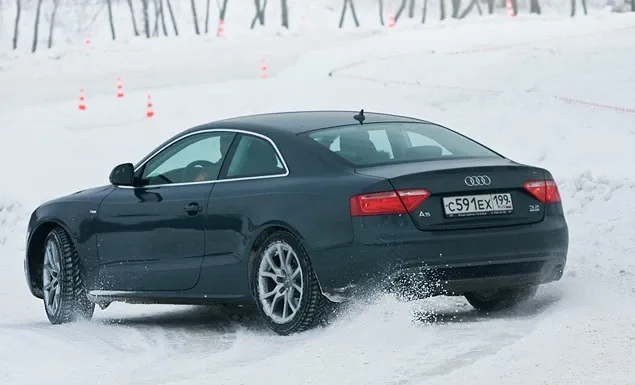
In everyday conditions — say, in the city — you hardly notice the difference between "Haldex" and "Torsen". Both the TTS and A5 confidently accelerate through slush and packed snow. But here's a nuance: the car with the electronic clutch behaves like a front-wheel drive — it accelerates without unnecessary rear-end sway. Meanwhile, the A5 with its rear-wheel-drive character constantly tries to go sideways. Moreover, the stability system allows the rear axle to slide a bit, and the driver has to periodically steer to compensate for these movements.
happily "sweeps its tail"
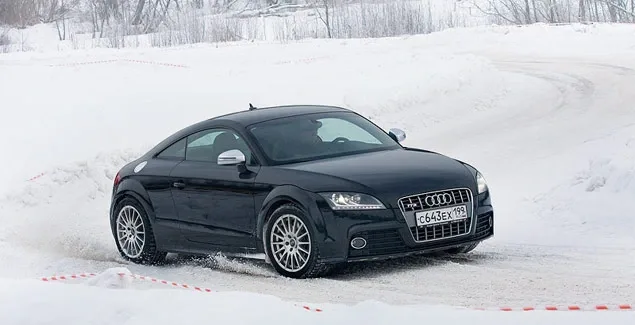
But then we hit a winding winter road — and here the differences in transmission design become much more pronounced. When you try to accelerate out of a corner, the Audi TTS with "Haldex" repeatedly tends to slide its front end outward, not allowing you to "rotate" the rear with throttle. At best, the little coupe goes "sideways" but past the apex, and at worst, it behaves like the most ordinary front-wheel-drive car with pronounced understeer.
Let's try taking the same corner differently... The task is to deliberately break the rear axle of the "TT" into a slide using counter-steering or the "handbrake". As soon as the car responds with an attempt to go into oversteer — we catch the slide with throttle and try to "trace" an arc in a four-wheel drift, holding the drift angle with steering and throttle. Moreover, you need to act decisively with the accelerator: to get the electronics to lock the clutch, you have to feed more throttle to the wheels than they can "digest", provoking wheelspin. If you don't do this, the electronics will start "saving" you, pulling the car out of the slide and transferring traction back to the front axle.
a car with "Haldex" must be "set" sideways in advance
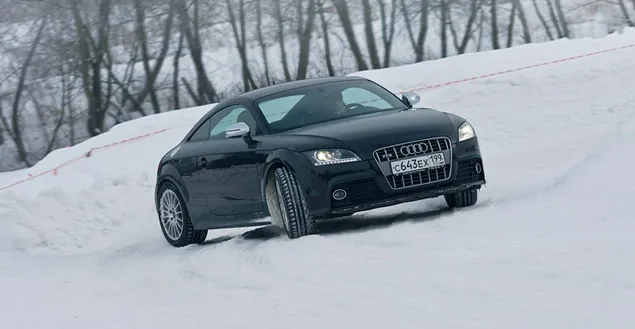
So the TTS driver has to constantly "play" with the right pedal, provoking wheelspin and not allowing the car to become front-wheel drive again.
The Audi A5 with "Torsen" in the same situation behaves differently. Since 60 percent of the torque goes to the rear axle from the start, adding throttle on the corner arc and "rotating" the rear is much easier — just press the accelerator harder. While the front wheels still hold the road, the car will immediately start to slightly sweep its tail. And to take the bend in a "rally" style, you need to ease off the throttle a bit, releasing the pedal, and slightly — not fully — correct the slide with the steering wheel. Real mechanical drive!
also remember about front-wheel drive
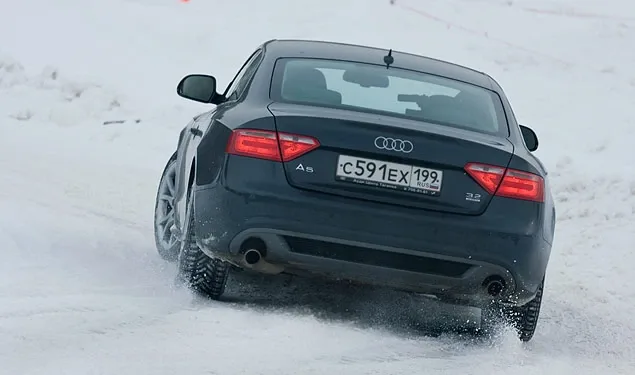
But as soon as the wheels find themselves on packed snow or ice, the A5 with "Torsen" unexpectedly shows the habits of the younger TTS: in response to pressing the throttle, the front wheels lose traction, and the car goes into understeer, flying past the corner. In addition, the "A-Five" is noticeably heavier than the "TT", so all slides are stretched out in time, and it responds to driver inputs not as quickly as one would like.
If the front axle has lost grip and the car stubbornly refuses to turn into the bend, the driver has only one option: almost completely release the throttle, straighten the steering wheel, and wait until the front wheels find traction again. As soon as that happens, the rear axle will slide out a bit further, provoking a slight oversteer, and then you can use the throttle to "rotate" the car into the corner.
and pure “mechanical” drive
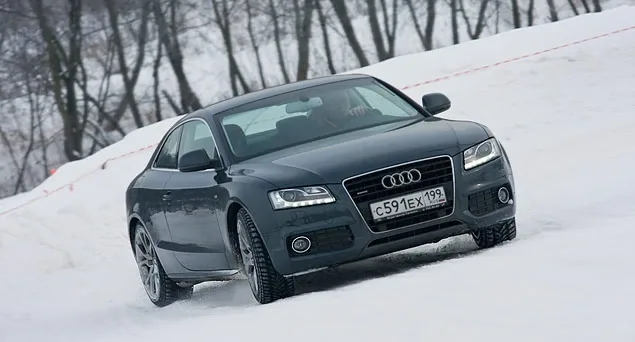
The main thing is that the Audi A5 responds sensitively even to barely noticeable changes in fuel supply, allowing you to control the car almost filigree not so much with the steering wheel as with the gas. The “Haldex” in the TTS behaves completely differently – you don’t have to stand on ceremony with the pedal here: the more traction, the more predictable the car becomes. But at the same time, driving turns into a confrontation between a person and the car’s electronic brain.
Although most drivers will probably find the behavior of a car with a Haldex coupling more understandable and safer than the character of a car with a “Torsen”. This is confirmed by my colleagues who drove both cars on a snowy area. According to them, the TTS, unlike the A5, does not scare with a sudden skid when adding gas, and to cause the rear axle to slide, it was easier for them to pull the handbrake than to decide to press the gas.
more understandable than “Torsen”
But personally, I am closer to the mechanics of the “Torsen” – it has character! It is more alive and involves the driver more deeply in control. Yes, it requires attention to the smallest details of the car’s behavior and more delicate handling of the gas pedal. But for what, if not for character, do we love cars?
yet very interesting character