Audi A4
Engine - 1.8 L TFSI
(2.0 TDI)
Max power -
160 hp/4500-6200 rpm (143 hp/4200 rpm*)
Max torque - 250 Nm/1500-4500 rpm (320 Nm/1750-2500 rpm)
Max speed (km/h) - 225 (215)
Acceleration 0-100 km/h - 8.6 (9.4)
Fuel consumption (l/100 km):
city - 9.9 (7.5)
highway - 5.5 (4.3)
combined - 7.1 (5.5)
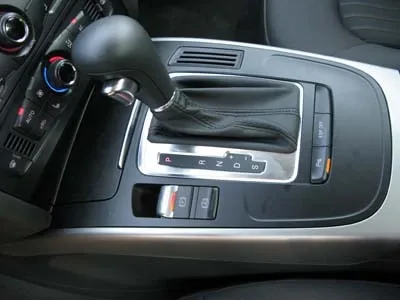
Continuously variable Multitronic with DRP.
Length - 4703 mm
Width - 1826 mm
Height - 1427 mm
Gross weight - 1960 (2010) kg
Tires 225/55R16
ESP, Brake Assistant, servotronic, parktronic, Sideguard, immobilizer, electromechanical parking brake, 8 airbags, Concert audio system, climate control, rain and light sensors, electric seat, fog lights
Price $ 41,540 (332,316 UAH) (1,295,300), price of base configuration with Multitronic 1,150,000 (1,207,000) RUB.
Maintenance cost:
Service interval:
15,000 km
Service 1 15,000 km - 7,150 (6,310) RUB.
Service 2 30,000 km - 9,440 (8,600) RUB.
Service 3 45,000 km - 7,150 (6,310) RUB.
Service 4 60,000 km - 20,400 (18,160) RUB.
Service 5 75,000 km - 7,150 (6,310) RUB.
Service 5 90,000 km - 11,710 (9,620) RUB.
Warranty 2 years without mileage limit
Competitors:
BMW 3
Mercedes C
* Data in parentheses -
for 2.0 TDI
Marat Makhmutov, Deputy Director of the Kazan School of Higher Driving Skills
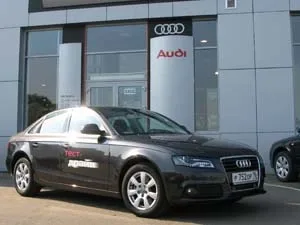
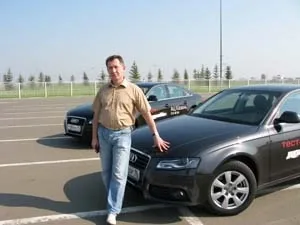
For the first time, I got to drive the AUDI A4 of the new model year during a test drive organized by the official dealer of AUDI cars, the company TransTechService, in early summer of this year, in which our school's staff took a direct part. At that time, the trip in a class D sedan from the renowned German manufacturer was more of an introductory nature, as in a fairly short period of time we needed to test most of the model range: the A6, the Allroad, and the Q7, each better than the other, so everything got mixed up. In general, I didn't catch the nuances of the behavior of the "four" specifically then. What remained in my memory was only the noticeable external difference from the "older brothers" in the form of headlights with LED "eyelashes", which is definitely a characteristic and memorable design detail of the A4, which probably only the laziest didn't mention.
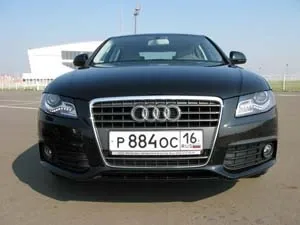
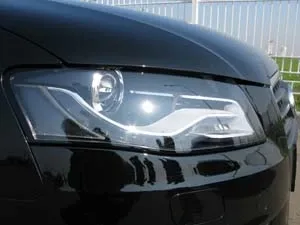
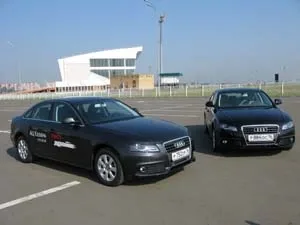
And now I had the opportunity to get more closely acquainted with this car, moreover, it was presented in two versions at once: a gasoline one with a 1.8 L TFSI turbo engine producing 160 hp and a diesel 2.0 TDI with 140 hp. Both variants had the continuously variable Multitronic transmission. The appearance of both "fours" at our "autodrome" looked very impressive: with headlights on, both in the same graphite color, they smoothly and importantly, with equally important drivers behind the wheel (cars contribute to that!), one in the wake of the other, paraded across the asphalt area and stopped next to each other at a slight angle to demonstrate their "aristocratism". Visually, it's noticeable that the new model has become larger and wider than the previous one, and from not too great a distance you could even mistake it for the A6, which is certainly a big plus for the A4.
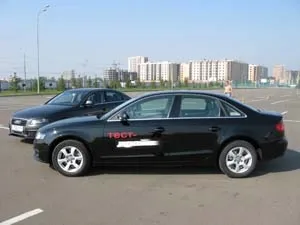
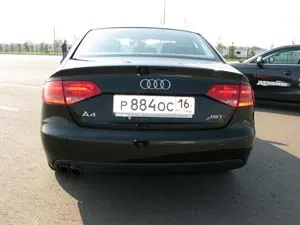
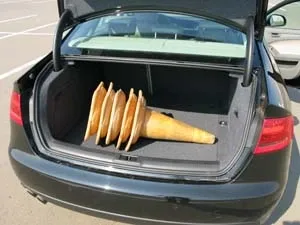
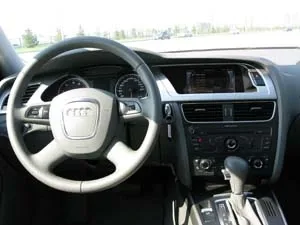
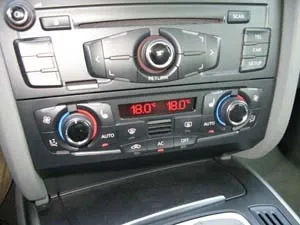
Honestly, the exterior compared to the previous generation has practically not changed for the uninitiated eye, and in my opinion, that's even better, as it won't scare off potential future owners with revolutionary design who want to trade in their old Audi for a new one (remember Chris Bangle's creations when he designed the new BMW 5-series, and how many old BMW enthusiasts turned away from that car). I already wrote about the front headlights, but the shape of the rear ones makes the new "four" seem even wider than it actually is. The gasoline car came in a very rich trim: with all sorts of additional options like a multifunction steering wheel, a color display in the middle of the console showing all information about the climate system settings and built-in radio settings, etc. It's even awkward to mention airbags, electric windows and mirrors, and dual-zone climate control; the class demands it. The diesel one is equipped with fewer "sybaritic" features, but to say it's poor would be a lie; it's just that the gasoline one is more richly equipped. Inside both cars, there are very high-quality plastics and perfect fit and finish of all parts, which is not surprising, after all, it's premium class. I especially liked the plastic covering the upper part of the dashboard: matte black, it's all velvety-soft both in appearance and to the touch. The trunk at 480 liters is of a convenient rectangular shape, everything is at hand and in sight.
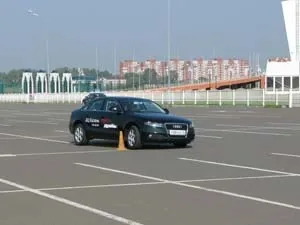
Now it's time to do what was actually required, namely to test the cars in motion, that is, to evaluate the handling, braking, and acceleration dynamics of both. First, I tried the gasoline version: acceleration is powerful, confident, but not crazy. The CVT transmission didn't cause any problems during acceleration, no jerks, no dips, everything is precise and coordinated. For an average driver, the settings of both the engine and the gearbox are almost ideal. But I can't give such high praise for handling: when going through a high-speed slalom, the car started squealing its tires too early, although perhaps it was the tires themselves, because on this test car, the outer tread blocks of the front wheels were almost worn out. The diesel A4, purely subjectively, behaved absolutely similarly to the gasoline one in terms of acceleration dynamics, except that the tachometer readings were in the 2500-3500 rpm range, unlike 4000-5000 on the gasoline version, and the engine sound was bassier.
Having gotten my share of impressions from both cars, I decide to hand over the reins to the school director Shatov O.Yu. Here is his comment from the drive: "The turbodiesel has enviable dynamics, the response to pressing the gas pedal is quite fast, but the Audi reacts with a delay on 'throttle release'. In this regard, the gasoline version seems more adequate. In terms of handling, I didn't see any glorious traditions of DTM series cars. Everything is fine in it: almost neutral understeer doesn't change much with driver actions. The turbodiesel, perhaps, even tends more toward understeer. During an emergency obstacle avoidance maneuver, the gasoline car develops a slide more sharply than the diesel, but I think this is more likely explained by the different tires on the cars. But these are nuances where even a difference in pressure can play a role. However, all this talk about slides is only relevant when the stability control system is disabled, which now disengages in two stages, as was customary on BMWs at one time. In short, it's a normal car with nothing to admire except the rings on the radiator grille, but also no reason for criticism." To what has been said, as it seems to me, additional comments from my side would already be superfluous. The only addition I can make is that at the end of the test drive, I looked at the fuel consumption readings of the on-board computers of both cars; the result was about 13 l/100 km on the 2.0 TDI and a little over 20 l/100 km on the 1.8 TFSI. As they say, "feel the difference," even despite the comparable cost of 1 liter of both fuels. I'll only note that these are fuel consumption figures in almost racing mode of operation. In normal city driving, and even more so on the highway, the final results will, of course, be more modest.
In conclusion of the test drive, I asked myself: "Do I want to own such a car?" No words, the new "four" has succeeded in every way, both externally and internally, but I'm already used to large cars, so as a potential candidate I will primarily consider the A6, or modifications based on it. Especially since I've already had the chance to drive such a car with a 3-liter turbodiesel; that's a hurricane-like yet economical machine.
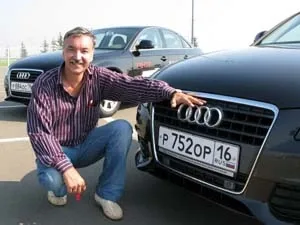
Vadim Sadykov, "Autoclub-Kazan"
Trilogy: "premium class Audi A4". The first component flatters the ego. Mentioning Audi always sparks interest. It's just that the third part of the trilogy – the A4 – slightly spoils the phrase. In the minds of most, true premium starts with the A6. But that, accordingly, is a whole different kind of money. True, the A6 is now on the verge of a generational change, and there are discounts on it in some places, while the A4 is this year's novelty.
Let's approach the choice of a car pragmatically: by comparing prices. Let's take D-class cars and compare them (to avoid a long argument, it's easier for me to agree in advance with Audi fans – they are all worse than the A4). Honda Accord 2.4 with 5-speed automatic, top trim, only 1 million rubles. Toyota Avensis, again in top trim, 2.0 with 4-speed automatic – 891 thousand, 2.4 with 5-speed automatic – 974 thousand. Skoda Superb, it's clear which trim – top, 1.8 turbo with DSG – 990 thousand, 2.0 turbodiesel with DSG – 1040 thousand. Now let me give prices for the A4 in base trim, I'll emphasize again – at the minimum price with a CVT: 1.8 turbo – 1151 thousand, 2.0 turbodiesel – 1207.5 thousand. Now – attention! Additional options (for your money, of course) in the Audi are many: it's an armrest between the front seats, electric mirrors, and electric seat adjustment. A purely German approach, whether it's Opel or Mercedes. What do we get in the end? According to reviews of new A4 buyers, it's quite possible to fit into 1.4 million rubles, and if you don't be greedy – we'll exceed 1.8. Is the A4 better than the same Accord or Avensis by 1.5 times? Everyone answers this question individually. And votes. With their ruble. I'll only note that there is no unambiguous and absolutely "correct" answer to this question. My personal perception: yes, I'm ready to pay more for the A4. But is it that much more? I don't know.
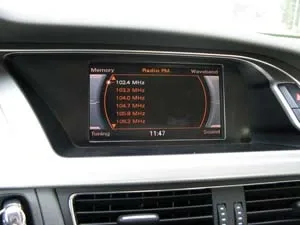
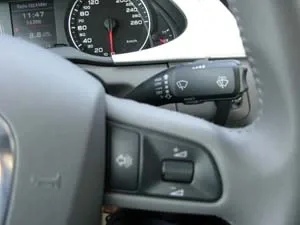
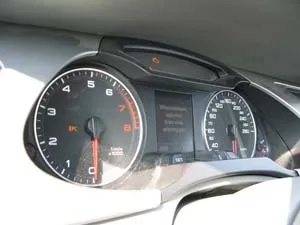
Now about the car's interior. It's clear that the quality of finishing is at a high level – you can't find fault here, for example, even in the base there's a leather steering wheel, quite pleasant to the touch. True, the seating position seemed a bit low to me, which is good for a "racer," but not always pleasant for normal driving. I was very surprised by the mirror in the sun visor on the diesel A4: the mirror design is exactly like the previous Opel Corsa C (the price of a new Corsa was 360 thousand), and there's no backlight!!! On the petrol A4 there is a backlight – again an option?! The armrest (option!) is inconvenient; to rest your elbow on it, you have to unnaturally move your arm back. Climate control, seat heating, radio – in general, the whole multimedia screen complex is very convenient and intuitive. I remember when Alfred and I first sat in the A6 3.0, Andrey Yegoshin (at that time – director of an Audi dealership) quickly (in about 2 minutes) explained the functions to us. Later, without someone else's help, we couldn't turn anything on properly. But on the next trip a few months later, in the A6 3.2 quattro, we figured everything out very quickly ourselves. Convenient. Simple. In the instrument readings, I found two drawbacks. The speedometer calibration (flickering of large and small numbers), and no indication of headlights being on. Hmm. We've already encountered such a trick somewhere, but I don't remember – on which car. By the way, I really liked the operation of the washer jets (they are heated!): two jets, and each has three streams of water. Beautiful and clean. In general, the interior as a whole gets either a 5 or a 4+.
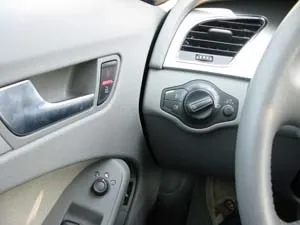
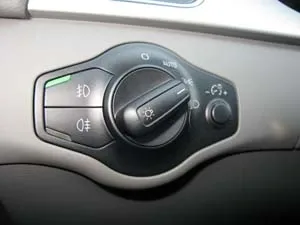
Audi, if you delve into stereotypes, is associated with a powerful and driver-oriented car. We took two cars at once: 1.8 turbo (160 hp) and 2.0 turbodiesel (143 hp). As you can see, there are no power records here; a regular naturally aspirated 2.4 now produces from 170 hp and more. I've heard that the turbodiesel significantly loses to its petrol counterpart in acceleration dynamics. If you look at the characteristics, then acceleration to 100: for the 1.8 – 8.6 s, for the 2.0 diesel – 9.4 s. But the three of us (Alfred, Marat, and I) didn't feel any difference. The only difference is that with a sharp press of the "gas" to the floor, the "petrol" responds a bit more lively. That's all. Attention to those who have heard at least something about the previous 1.8 turbo engine. Now the turbine kicks in at 1500 rpm, providing maximum torque of 250 Nm at 1500-4500 rpm, and after a trip you don't need to let the engine idle – there's a turbo timer. The diesel 2.0 has a maximum torque, of course, much higher – 320 Nm, but the range is smaller – from 1750 to 2500 rpm. The combination of turbo and CVT is simply ideal. Perhaps this is the first CVT that I have no complaints about. And again, this is a good merit of turbocharged engines. What happens to the CVT on a regular "atmospheric" engine? During acceleration, the revs either immediately jump to 6000 (you're guaranteed a loud, dull engine sound for the entire acceleration), or first jump to 4000, and only if you still press the "pedal," they quickly reach 6000. Moreover, acceleration in "manual" mode, on fixed gears, is usually always better than in automatic mode. On the A4, the tachometer needle smoothly goes up during acceleration. Without sharp movements and sound discomfort. Because the maximum torque starts already from 1500 (or from 1750) rpm. Switching to "manual" mode on the A4 doesn't add dynamics. By the way, there are 8 fixed gears here. Manual shifting is a pleasure, allowing you to feel like the master of the situation. But it's unlikely anyone uses it often. Personally, I liked the diesel engine more: both more traction at low revs (see torque figures), and lower fuel consumption. After resetting the average consumption, driving on the highway and in the city, we got: 1.8 petrol – 10.3 l, 2.0 diesel – 7.5 l. By the way, the figures exactly match the technical data for the city.
Now about handling. Oleg Shatov (driving school) casually mentioned that the diesel car handles slightly better than the petrol one. Strange, because the suspension and tire size are the same. Ah, that's the thing! The diesel has Michelin tires, while the petrol car has a rather worn Continental. Passing the "snake" disappointed us: constant tire squeal, impossible to drive above 70 km/h. Already outside the city, on a deserted road, I tried to change lanes sharply – alas, not impressive. True, on our favorite road with a series of turns, the A4 performed well: in smooth turns, there are no complaints about the car. But I decided to conduct another test: a 180-degree turn on a narrow road (for Kazan residents, I'll give the exact address – the descent to Yamasheva Ave from the new bridge, if you go from the neighborhoods towards Kompressorny). That's where I drove my Avensis (pre-restyling, this is important, because the restyling became softer) on the way to the test drive. Naturally, without excessive enthusiasm for records, because meeting wheels with the curb is clearly not in my plans. And I also like the activation of the stability system: the speed should be as safe as possible. The comfortable turning speed is 50 km/h, with some roll. Now I try to take the same turn on the diesel A4. At approximately 45 km/h, tire squeal appeared, the car is carried towards the curb, which forces me to brake with sharp and quick presses on the pedal, plus work the steering wheel well. This test once again confirmed – almost all new products in the D class are becoming more comfortable and softer, and, alas, lose in handling. Such is the general trend.
In conclusion – again about the price. Yes, the A4 is undoubtedly more expensive than the Passat, Avensis, Mondeo, Honda, etc. But isn't there some price inflation here? I don't know.

Alfred Mardanov "Autoclub-Kazan"
In some ways, but in the fact that there is no particular difference between a petrol engine and a diesel in terms of dynamics, I completely agree with Vadim. Only the diesel is a bit noisier, that's the whole difference, if you don't count fuel consumption. Otherwise, the first impression the car made on me was its outstanding grille and its headlights, or rather, the daytime running lights. The unfriendly squint of the eyes looks impressive and reminds me of... a Chinese tape recorder with blinking lights. Well, I don't know, the idea is great, but it's already "tainted" by the Chinese auto industry (this already exists in the FAW Vita), albeit in a much worse execution. Still, when buying an Audi, a person claims some exclusivity and buys not just a car, but something more, a kind of pass to another world. Especially since the A4 contributes to this thanks to the aura it creates around the driver. The interior is without complaints, everything is at a high level. The seat in the petrol version with electric adjustments up to lumbar support adjustment, which will greatly help relieve back fatigue on a long journey. The leather-wrapped steering wheel fits comfortably in the hand. The multifunctional screen doesn't glare, it's neatly nestled under the visor in the center of the panel and is controlled mainly by a rotary knob. I like it when the controls are not buttons, but rotary knobs, it's more familiar to me and more convenient to use on the go. The gear lever is where it should be, right under your hand! I would give a solid five for the convenience and quality of interior materials. (And could it be otherwise?) The appearance has become more dynamic, more expressive, while maintaining conservatism. The signature radiator grille, just as huge and recognizable, clean sides and slightly modified headlights and bumper. Changes seem to be there, but everything is so intelligent and conservative, and at the same time the appearance has become more predatory. The CVT deserves all praise. Very good settings and excellent combination with the engine. I tried switching the CVT to "S" mode, it feels like the car has swallowed a dose of steroids and began to react a bit faster, acceleration became more rapid and reactions faster. Moreover, in this mode, as in manual, the engaged gear is displayed on the screen. Maneuvering in city traffic has become easier, and you even start with a slight wheelspin.
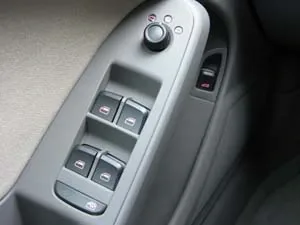
I can imagine what would happen if you pressed the pedal all the way to the floor. Although I did that in track mode, the acceleration seemed drawn-out and, seemingly, slow, until I glanced at the speedometer. My foot involuntarily reached for the brake pedal; 160 km/h is not my driving style! I didn't even notice when I sped up. No wonder the driver of the Corsa in the next lane had slightly wide eyes. No, I liked how the car 'shoots', and I also give a well-deserved five to the CVT-engine combination. Regarding the trim level, it's hard to say much; there were two cars with different equipment, but nevertheless, both are very similar in character and spirit. The petrol version was better equipped, but correspondingly more expensive. The fact that you can configure the trim and set of functions yourself, I consider a huge plus; everyone chooses what they need. I'll also note the excellent brakes; with such a character, it couldn't be otherwise, it's an Audi. As for the steering, there is a barely noticeable delay in response to steering wheel inputs. Apparently, this is because the car is still tuned for more comfortable driving conditions rather than sporty ambitions. This is very noticeable in how the car handles the terrible 'washboard' road on the way to N. Chelny and flies over the bridge joints on the bypass road. Simply magnificent; I'm ready to sacrifice a lot for such behavior! Apparently, age takes its toll; you already want solidity, comfort, and speed qualities, while having just two pedals and the brand itself not being the last on this list.