
How does the Citroen drive? Look into any showroom, take a brochure of any model, and count how many times the word "different" appears there. Then take a ride in the Audi or Honda — and you'll see: they are similar to each other, differences are only in details. But the Citroen is truly different.
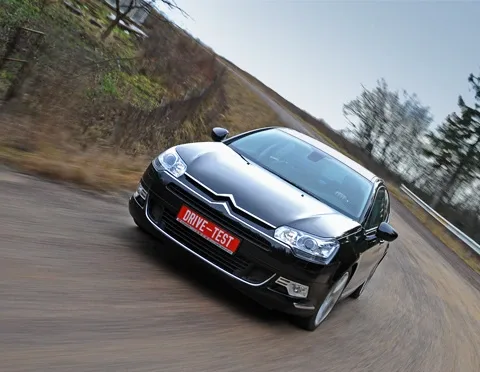
The Citroen's handling is peculiar. In corners, the car is fast, the main thing is to act smoothly.
You get on the highway, press the gas — and it's like flying! The suspension in softness can be compared to a grandmother's sofa, but in a turn, the car becomes more composed and stiffer. Moreover, our example with the V6 is stiffer than its four-cylinder siblings: the Hydractive III+ hydropneumatics received more body position sensors, different settings, and 19-inch wheels. The six-speed "automatic" shifts faster, but the jolts are also more noticeable — although the gearbox is exactly the same as on the two-liter diesel version.
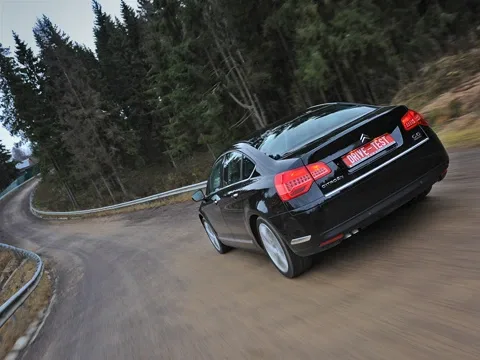
The Citroen C5 handles bumps incredibly softly, but body roll is noticeable: for those who get motion sickness, even Sport mode won't save you.
The main thing in the Citroen is to find a common language with it. No sharpness: pedals — only smoothly, the steering wheel — too. And under no circumstances brake before potholes: then the suspension will go into sport mode for a couple of seconds, and the C5 will pass the bump harshly. But if you make friends, you'll get a lot of driving pleasure. No, you don't have to crawl like a turtle. You can fly at 160, but you need to do it calmly and confidently. And if you try to drive the Citroen like a regular car, the idyll collapses: the large steering wheel and body rolls start to irritate, uncertainty appears, and the rocking gets to you. Sport suspension mode helps, but only slightly. So you need to drive an original car in an original way! Otherwise, you'll just go crazy.
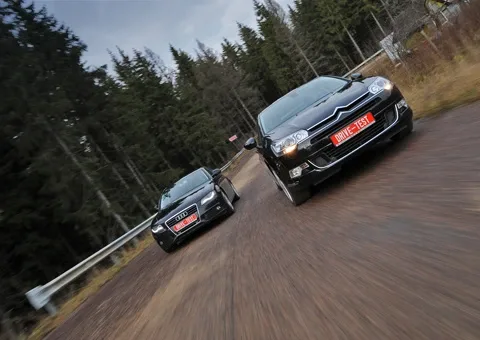
The "four" after the Citroen seems too sharp. The brakes are overly sensitive, the steering wheel and accelerator are sharp. But everything is just as it should be! Moreover, the Audi itself provokes dynamic driving. It doesn't even provoke, but gently nudges. Excellent sound insulation and the CVT hide the real speed, although, as we saw at the beginning, it's there! And you're already speeding, boldly entering corners.
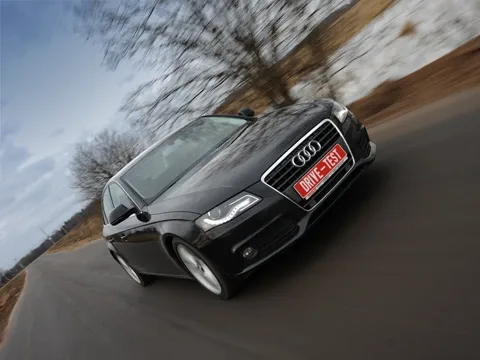
In terms of dynamics, the 160-horsepower A4 is almost as good as its rivals. And what would they do with the 211-horsepower version?
An interesting feature is the Audi drive select system, which changes the gearbox algorithm, throttle response, firmness of the electronically controlled shock absorbers, and steering effort on the fly. Unfortunately, it's just a toy. There are three modes — Comfort, Auto, and Dynamic. And the last one hides the whole trick: the CVT starts simulating an eight-speed automatic, the pedals become more responsive, and the suspension gets denser. All great. But the steering wheel! In Dynamic, it gets heavier, but the effort on it is in no way related to feedback. It's present even where it shouldn't be! And you can't customize the parameters to your liking in our car. Too bad! For that, you need a fourth button — Individual. Our car doesn't have it.
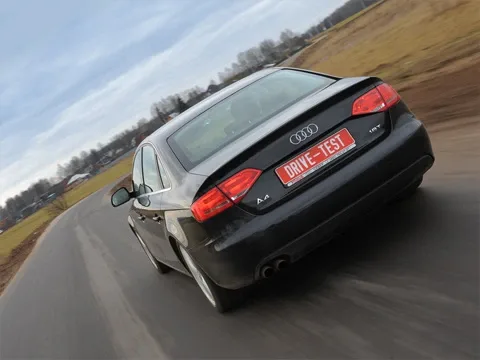
But the chassis is still excellent! Almost perfect front-wheel-drive handling (almost, because the large moment of inertia still makes itself known), and the suspension is the same German classic, like Bach. Not to be confused with a bang-bang — it doesn't make extra noises — it's a bit stiff but energy-intensive. Except that on a broken road, too many vibrations and impacts are transmitted to the A4's steering wheel, but the car holds its course. However, for smooth driving, you also need to concentrate yourself. The Citroen handles measured movement more easily.
And what about Honda? The Accord with the Type-S badge differs from the regular one with wider tires and stiffer shock absorbers, promising the sharpest handling. The promise is fulfilled! The Accord responds to the steering wheel faster than the others, and the suspension transmits all asphalt defects to the driver's seat with a dull thud. Confusing? Not at all! After all, what prevents Honda from being a competitor to Audi?
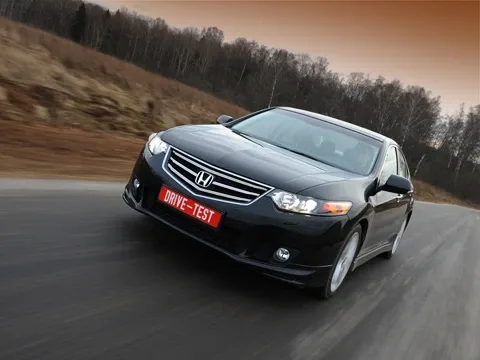
Up to a certain point, the Accord seems very easy to drive, but then it can surprise you unpleasantly.
The steering settings get in the way. Honda presents a surprise — due to the illogically increasing effort, you oversteer, turning the wheel more than necessary. It turns out that's how the power steering works, which cunningly changes the reactive action on the steering wheel depending on the situation. According to the developers' idea, this should help the driver avoid understeer. But such tricks only confuse me! Another annoyance is the stiff suspension (surprisingly!) allows body roll on long waves.
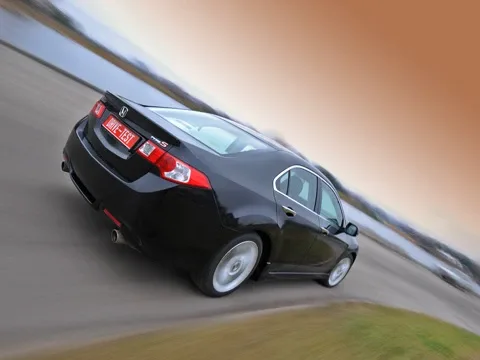
But the Honda holds a straight line no worse than others, and most importantly — if the Citroen encourages active driving, and the Audi imposes a fight with traffic, then with the Honda you can do whatever you want. Steering wheel, pedals, gearbox — everything is so clear that it doesn't require getting used to. Whatever mood you have, the car has the same.
Honda has caught up in many parameters. But in the reckless pursuit of premium, it lost half of its charm. The previous Accord was a fighter — rough but honest. This one is still strong, but already retired. It became more solid and... bland. And if you remember how the Accord's dynamics worsen with the automatic... It's not destined to catch up with Audi, even with the 1.8 T engine.
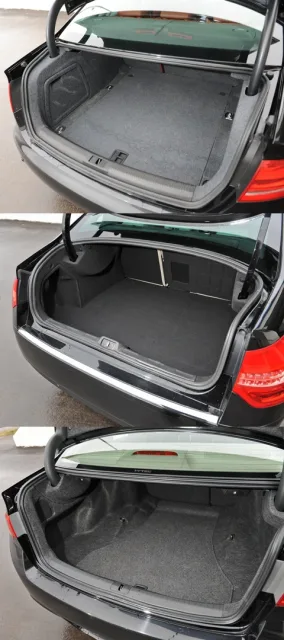
The largest trunk is in the Audi (480 L), followed by the Honda (467 L) and Citroen (439 L). For transporting large items, the Audi is best suited — it has a low loading height and the widest opening. The Citroen is slightly less convenient, and the Honda with its "crooked" trunk is the outsider.
But the Citroen doesn't catch up; it cuts across! Yes, in terms of equipment level, material quality, and ergonomics, it can't reach the Audi. But it looks and drives amazingly! And if all cars start to seem the same — it's ready to dispel that misconception. You don't have to take it in maximum trim: on the contrary, the car with a two-liter diesel and the same six-speed automatic has an even more cohesive (or softer?) character and — for less money. Therefore, the Citroen gets our sympathy award. But — not the main one.
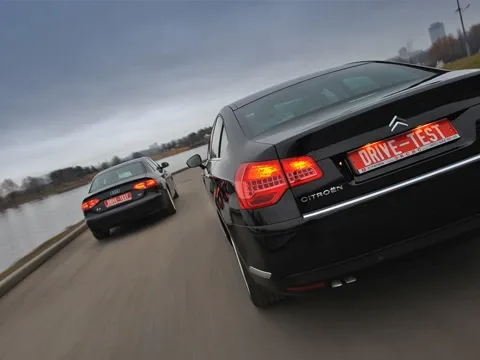
The award, shining with LED eyes, goes to the Audi. No miracles, of course, happened. It's still the most thoughtful, most technological, and most practical car of our trio. And — even if you don't take into account the richest equipment — the most expensive. But, having won the comparative test, it proved that it has the right to do so.
Technical specifications
| Specifications | Audi A4 | Citroen C5 | Honda Accord |
|---|---|---|---|
| Body | |||
| Number of doors/seats | 4/5 | 4/5 | 4/5 |
| Length, mm | 4703 | 4779 | 4726 |
| Width, mm | 1826 | 1860 | 1840 |
| Height, mm | 1427 | 1451 | 1440 |
| Wheelbase, mm | 2808 | 2815 | 2705 |
| Track front/rear, mm | 1564/1551 | 1560/1540 | 1590/1590 |
| Curb weight, kg | 1450 | 1725 | 1518 |
| Gross weight, kg | 2000 | 2230 | 2030 |
| Trunk volume, L | 480 | 439 | 467 |
| Engine | |||
| Type | gasoline, with direct injection and turbocharging | gasoline, with distributed injection | gasoline, with distributed injection |
| Location | front, longitudinal | front, transverse | front, transverse |
| Number and arrangement of cylinders | 4, in-line | 6, V-shaped | 4, in-line |
| Number of valves | 16 | 24 | 16 |
| Displacement, cm3 | 1798 | 2946 | 2354 |
| Max power, hp/rpm | 160 at 4500–6200 | 215 at 6000 | 201 at 7000 |
| Max torque, N•m/rpm | 250 at 1500–4500 | 290 at 3750 | 234 at 4500 |
| Transmission | |||
| Gearbox | chain-type CVT | automatic, 6-speed | manual, 6-speed |
| Drive | front | front | front |
| Chassis | |||
| Front suspension | independent, spring, double-wishbone | independent, hydropneumatic, McPherson | independent, spring, on double wishbones |
| Rear suspension | independent, spring, double-wishbone | independent, hydropneumatic, on trailing arms | independent, spring, multi-link |
| Front brakes | disc, ventilated | disc, ventilated | disc, ventilated |
| Rear brakes | disc | disc | disc |
| Ground clearance, mm | 147 | 110–170 | 150 |
| Performance characteristics | |||
| Maximum speed, km/h | 225 | 224 | 227 |
| Acceleration time 0–100 km/h, s | 8.6 | 9.2 | 7.9 |
| Fuel consumption, L/100 km | |||
| — urban cycle | 9.9 | 15.6 | 12 |
| — suburban cycle | 5.5 | 7.5 | 6.6 |
| — combined cycle | 7.1 | 10.5 | 8.6 |
| Toxicity standard | Euro 4 | Euro 4 | Euro 4 |
| Fuel tank capacity, L | 65 | 71 | 70 |
| Fuel | AI-95 | AI-95 – 98 | AI-95 |
| Equipment | Audi A4 | Citroen C5 | Honda Accord |
|---|---|---|---|
| Front airbags | + | + | + |
| Side airbags and inflatable curtains | + | + | + |
| Knee airbags | + | + | + |
| Electronic stability control | + | + | + |
| Dynamic stabilization system | + | + | + |
| Cruise control | O | + | + |
| Rear parking sensors | + | + | - |
| Front parking sensors | O | + | - |
| Fog lights | + | + | + |
| CD player with MP3 support | + | + | + |
| CD changer | O | + | + |
| Multifunction steering wheel | + | + | + |
| Power-adjustable and heated rearview mirrors | + | + | + |
| Electrochromic rearview mirror | O | + | + |
| Front and rear power windows | + | + | + |
| On-board computer | + | + | + |
| Steering column with tilt and reach adjustment | + | + | + |
| Dual-zone climate control | + | + | + |
| Power-adjustable front seats | O | + | - |
| Heated front seats | + | + | + |
| Ventilated front seats | O | - | - |
| Xenon headlights | - | - | + |
| Bi-xenon headlights | O | + | - |
| Rain and light sensors | + | + | + |
| Tire pressure sensors | - | + | - |
| Space-saver spare wheel | + | + | + |
| Alloy wheels | + | + | + |
| Leather upholstery | O | O | - |
| Leather-wrapped steering wheel and gear knob | + | + | + |
| Driver's seat vibration massage | - | + | - |
| Navigation system | O | O | - |
| Alarm system | + | + | + |
| Electronically controlled shock absorbers | O | - | - |
| Electronically controlled hydropneumatic suspension | - | + | - |
| Metallic paint | O | O | O |
| Base trim price, RUB | 1 151 500 | 1 250 000 | 940 000 |
| Tested car price, RUB | 1 720 246 | 1 383 800 | 950 000 |
Safety
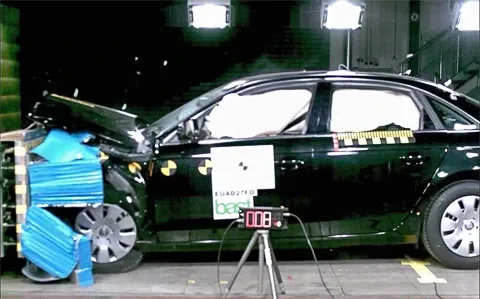
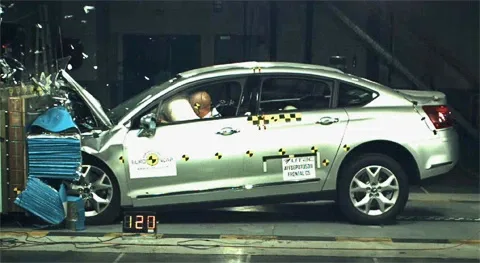
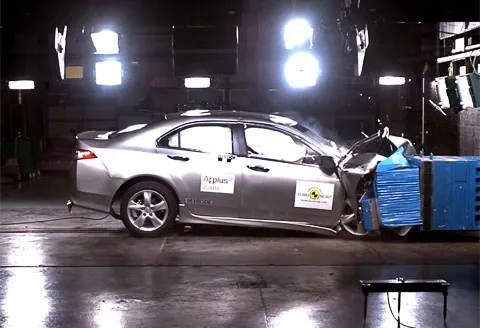
All three cars, regardless of their premium status, showed excellent results in Euro NCAP crash tests, receiving the maximum five stars for adult occupant safety. The Audi A4 scored 34 points, while the Citroen C5 and Honda Accord scored 35 each. Child occupant protection was rated four stars for all: 41 points for the Audi, 38 for the Citroen, and 39 for the Honda. However, the situation with pedestrians is more complicated: the Audi and Citroen received only two out of four stars (14 and 11 points respectively). The Honda is noticeably better here — three stars and 19 points.
Technology
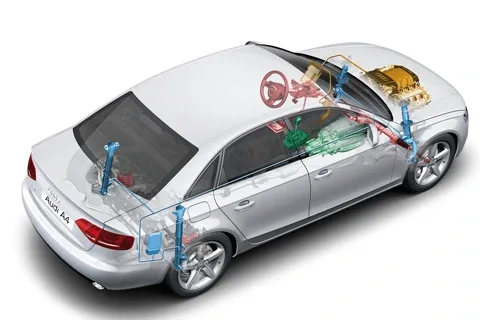
The main feature of the Audi A4 is the drive select system. In the top trim, it allows you to change many parameters on the go: throttle response, stiffness of the electronically controlled shock absorbers, steering effort, and the algorithm of the active steering system with variable ratio. Moreover, each parameter can be adjusted separately. Our car was in a simpler version — without variable-ratio steering and without detailed drive select settings.
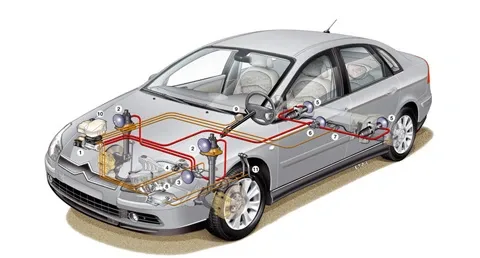
The Hydractive III+ suspension on the second-generation Citroen C5 is fundamentally no different from that of its predecessor. It is one of the few systems in the world that can change ground clearance, stiffness, and damping characteristics. There are still six spheres where nitrogen acts as a spring element. But, unlike early Citroens, such as the XM model, the brakes and power steering are no longer connected to the Hydractive system in a single circuit.
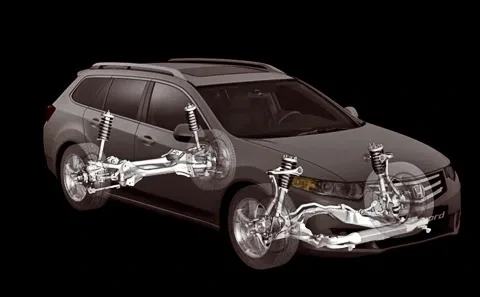
The suspension design of the Honda is the same as that of the previous Accord: double wishbone at the front and multi-link at the rear. Thanks to the extensive use of ultra-high-strength steel, the body weight has hardly increased, while rigidity has grown. Among the Accord's features is steering with a non-linear characteristic and a clever power assist that changes its effectiveness depending on the situation. The idea is that it should hint to the driver which way to turn the wheel in an emergency, but it only confused us.
Behind the scenes
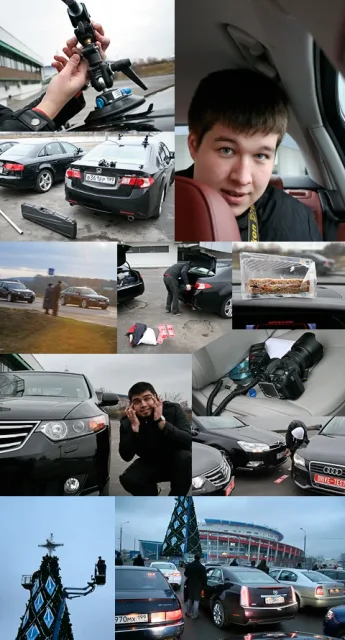
Short daylight hours, roads covered in mud after rain, and three black cars — a real nightmare for a photographer. But we managed to shoot over the weekend, although washing took a considerable amount of time. In addition, at the next DRIVE2.RU meeting, everyone interested could inspect our cars.