
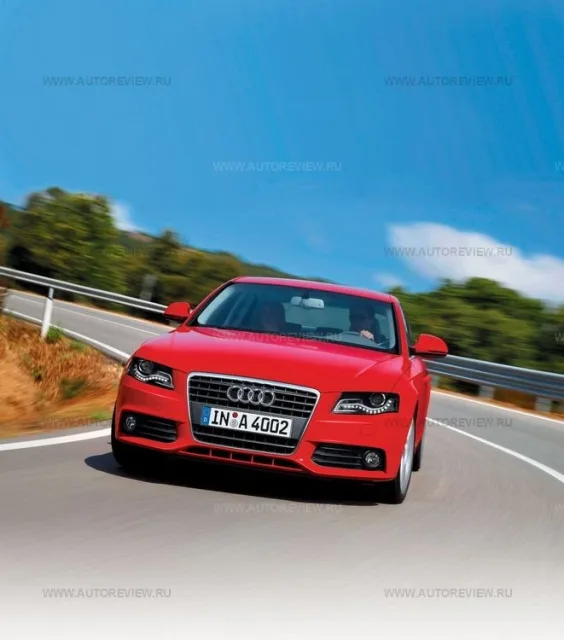
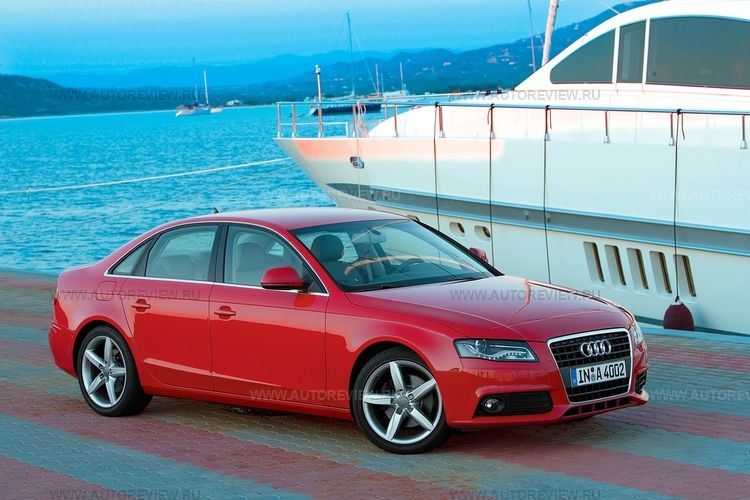
The Fiat Panda squealed its tires desperately, cut apexes, and nearly clipped the barriers, while I raced after it in the new Audi A4 along a winding road on the island of Sardinia, without touching the gas or brake pedals. The radar cruise control managed the throttle and braking, and it did so flawlessly, even despite the abundance of blind corners!
All I had to do was steer — and I recalled Carroll Smith's book "Tune to Win," the bible of all racing car tuners. Apparently, the creators of the new Audi A4 have read it too. They followed Smith's advice — and…
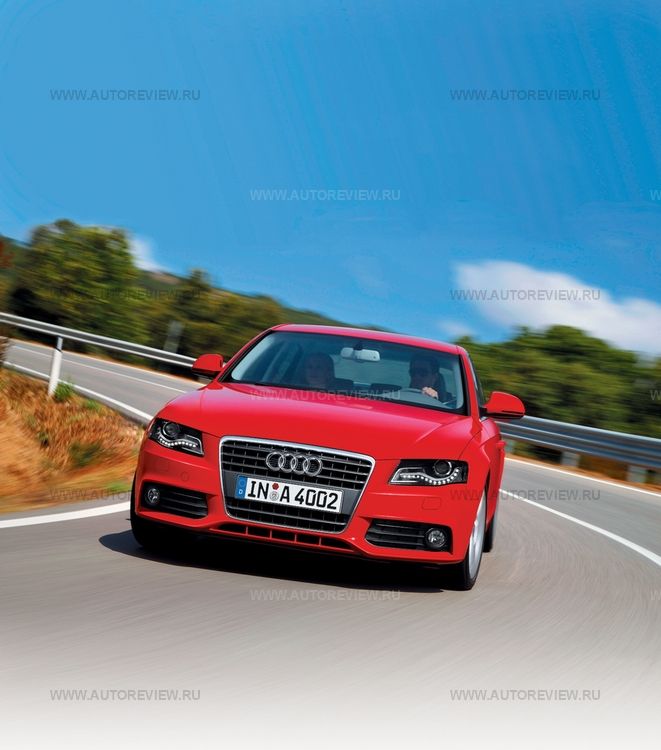
Had the folks at Audi held the presentation somewhere in Bavaria, everything would have been German-style precise, boring, and proper. After all, it's nearly impossible to "heat up" a German, even if he's in a BMW M3 CSL, by hanging right on his bumper. Italians, on the other hand, get fired up instantly: just give them a sparring partner. And so this guy in the Panda was leisurely rolling along on his business until he saw in the mirrors the rapidly approaching Audi.
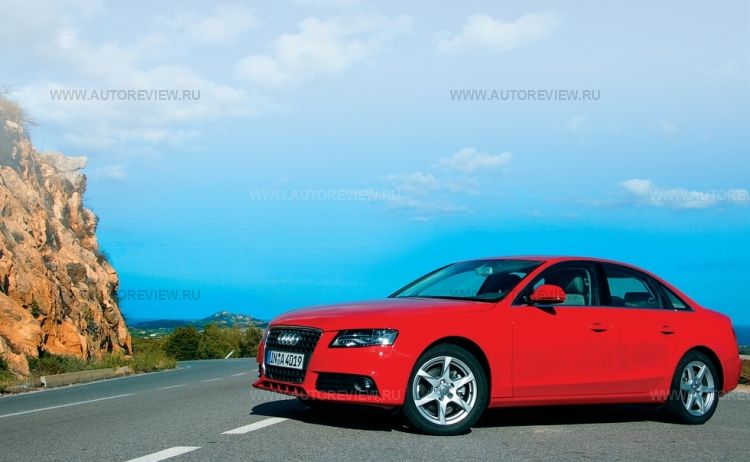
Maybe he mistook the new "four" for the Audi A5 coupe? No wonder — from the front, the A4 and A5 differ only in the shape of the family's brow-like LED daytime running lights. However, their straight line on the "five" resembles the expertly applied makeup of a supermodel, while the curves on the sedan look like bags under the eyes from lack of sleep.
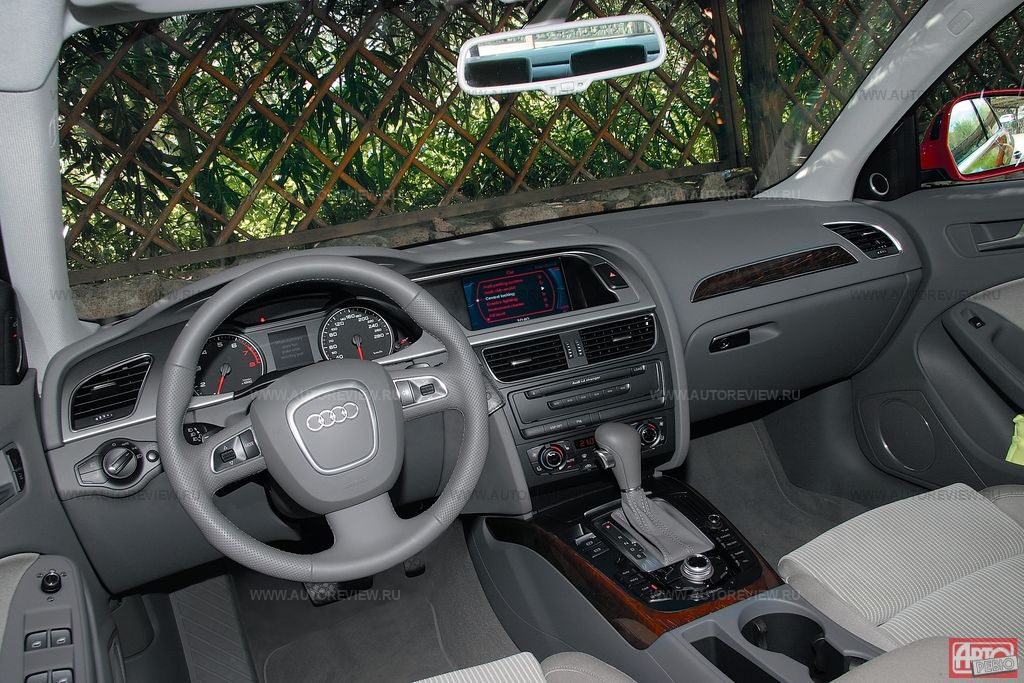 | 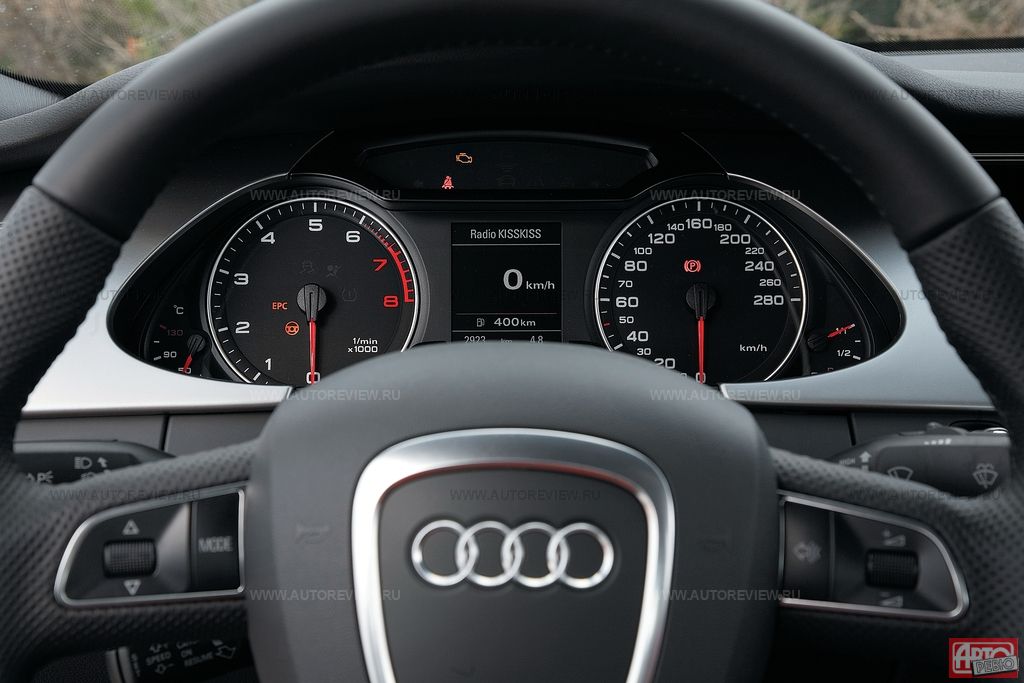 |
| The cockpit interior with the driver-oriented panel is exactly like the Audi A5 coupe | Classic Audi instruments — now in Italian style |
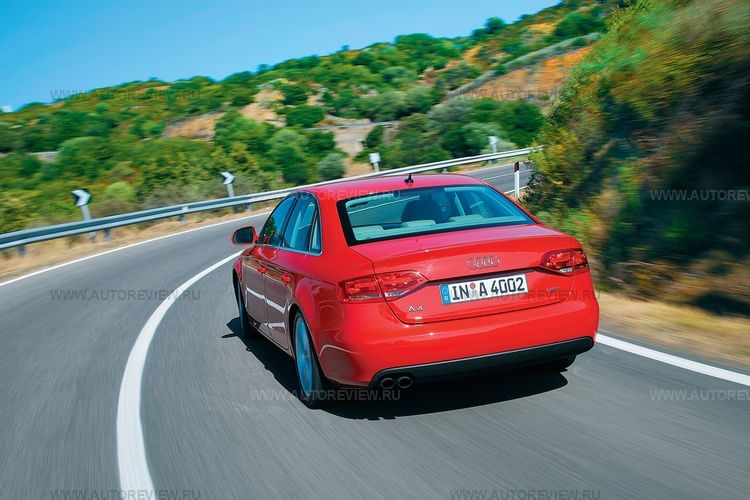
And from the rear, it's impossible to distinguish the A4 from the coupe — the luxurious rear end is identical even in details. But if the A5's profile reminds of the past "southern" works of chief designer Walter de Silva (recall at least the wave-like sides of Seat cars), the A4 sedan is stricter. The traditional Audi circular window opening, high horizontal "windowsill," and muscular side profile, like BMW's. Embodied classic!
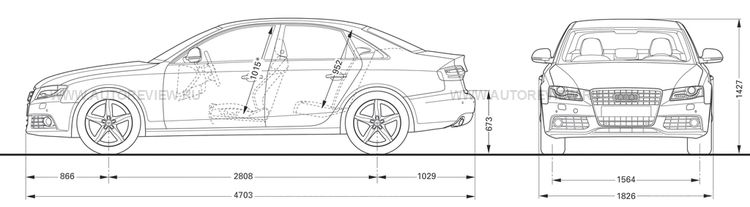
But if the Audi A4 used to look relatively compact, now… The sedan has grown 117 mm in length — the new Mercedes C-Class is shorter by the thickness of a cigarette pack. And in terms of wheelbase, the "four" now surpasses the first-generation Audi A6! Therefore, the volume of the rectangular trunk has increased by 20 liters and reached 480 liters — more than the C-Class and BMW 3 Series.
The interior has also become more spacious, especially in the back. It's a pity that the rear trim of the front seats is still hard, and there's not much headroom: the gap from the top of my head to the ceiling at my height of 176 cm is just a couple of centimeters. However, now a three-zone climate control is available for an extra charge, like in the BMW 3 Series — rear passengers can adjust the temperature themselves.
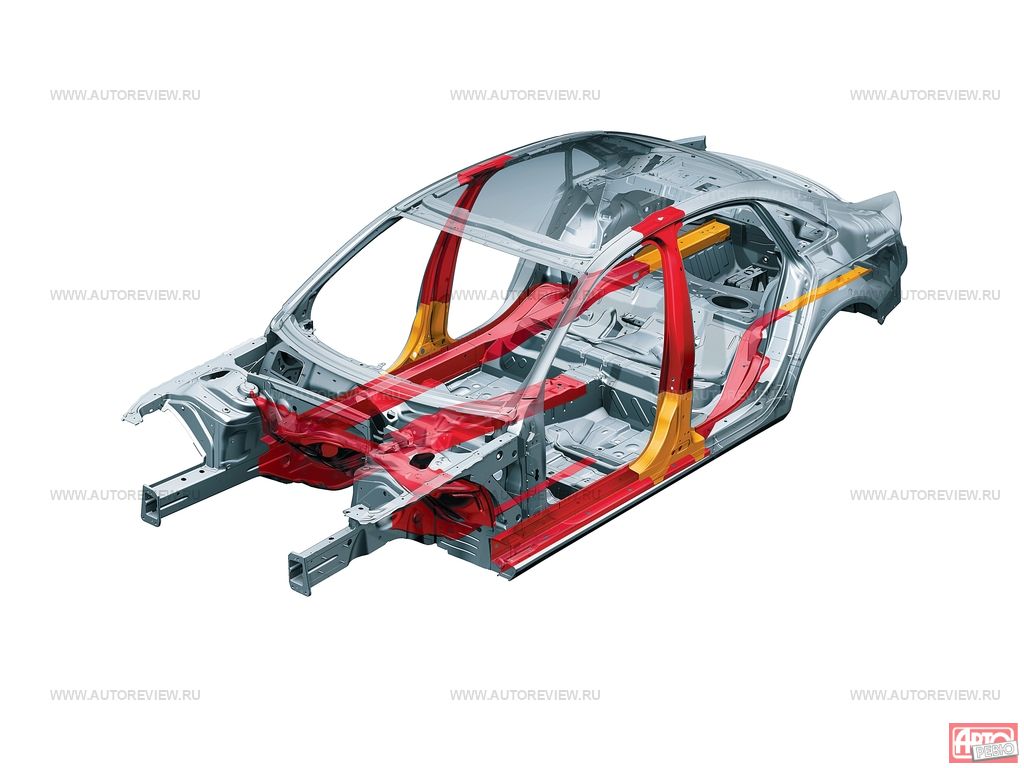 | 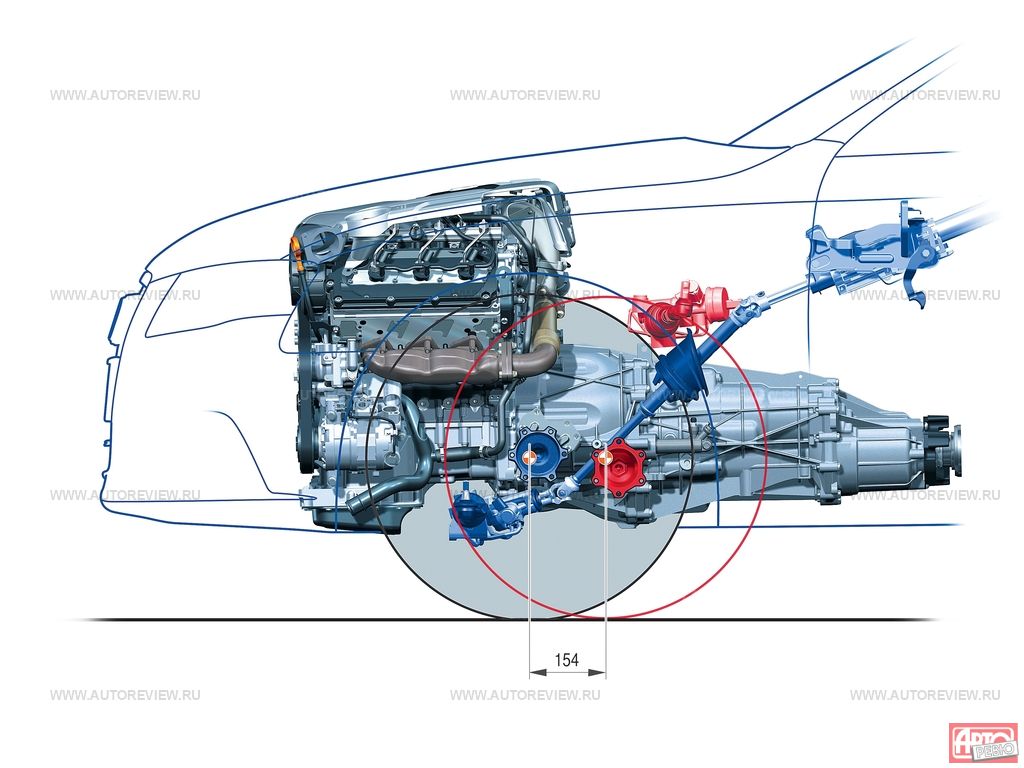 | 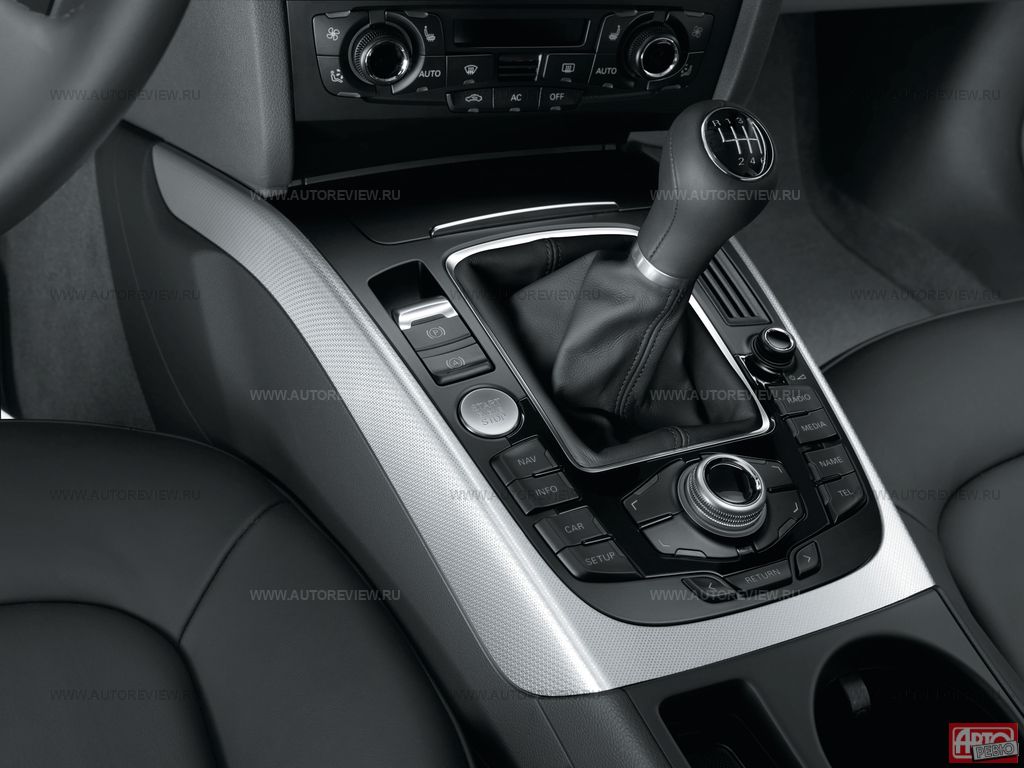 |
| The share of parts stamped using the new hardening technology (metal heated to 950°C is pressed in cooled molds) from ultra-high-strength steel with a yield strength of 1650 MPa (highlighted in red) reaches 12% of the body mass. Another 18% is ordinary ultra-high-strength steel, 32% is high-strength steel. The length of continuous welds that increase rigidity has increased almost fivefold — from 26 to 125 meters (the number of weld points has decreased from 6.5 to 5.5 thousand). Yellow highlights the "weakened" zones of controlled deformation in side and rear impacts | Thanks to the engine shifted back by 154 mm and the battery moved to the trunk, the Audi A4 can now boast an ideal "half" weight distribution. The steering mechanism was lowered and moved forward (blue outline) — to improve feedback | Gears "click" easily, but you can still miss the desired position |
But the Audi "four" is primarily for the driver, isn't it? After all, isn't that what the mini-cockpit with the center console angled toward the driver, like in the Audi A5 coupe, says? Even the chrome-ringed speedometer and tachometer look with fiery needle swords at the zeros strictly downward — in Italian style.
It fires you up!
But the 160-horsepower "turbo-four" under the hood — not so much…
But this is so far the only four-cylinder gasoline engine for the Audi A4: the 200-horsepower 2.0 TFSI version will appear later. So for the first acquaintance, I had to take the simplest A4 1.8 TFSI — front-wheel drive and with a manual gearbox.
The seat is impeccable, with huge adjustment ranges. I sit in a sporty position: cushion as low as possible, backrest vertical, the excellent steering wheel — pushed all the way away. Everything is great, even the difference in height between the gas and brake pedals no longer bothers — it's been reduced by 15 mm. But the long-travel clutch pedal makes you wish a telescopic mechanism were built into your left leg. The gear lever's selectivity is also poor.
The 1.8 TFSI turbo engine pulls evenly from the very bottom to the limit of 7200 rpm, accompanying acceleration with a muted, thoroughbred roar. It's no wonder the Ingolstadt folks introduced an analogue of Honda's i-VTEC system — the Audi Valve Lift mechanism for variable valve timing and lift (see AR No. 20, 2007). But the new "four" is 55 kg heavier than the previous one, and the 160-horsepower engine is clearly "not enough" for mountain roads.
But the brakes are impeccable.
And the chassis?
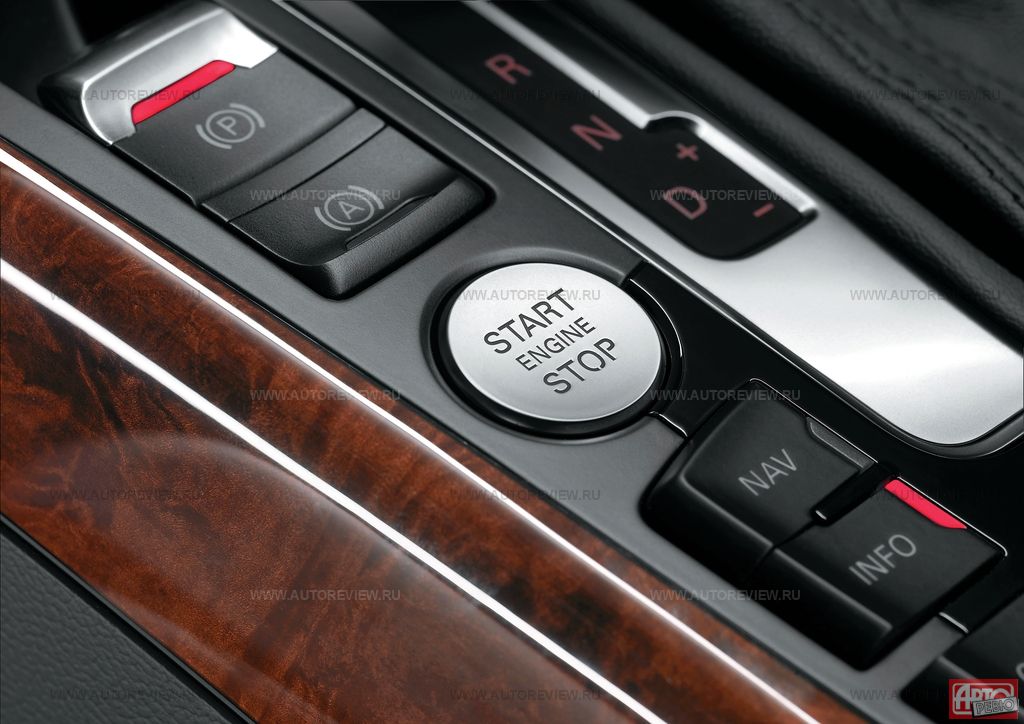 | 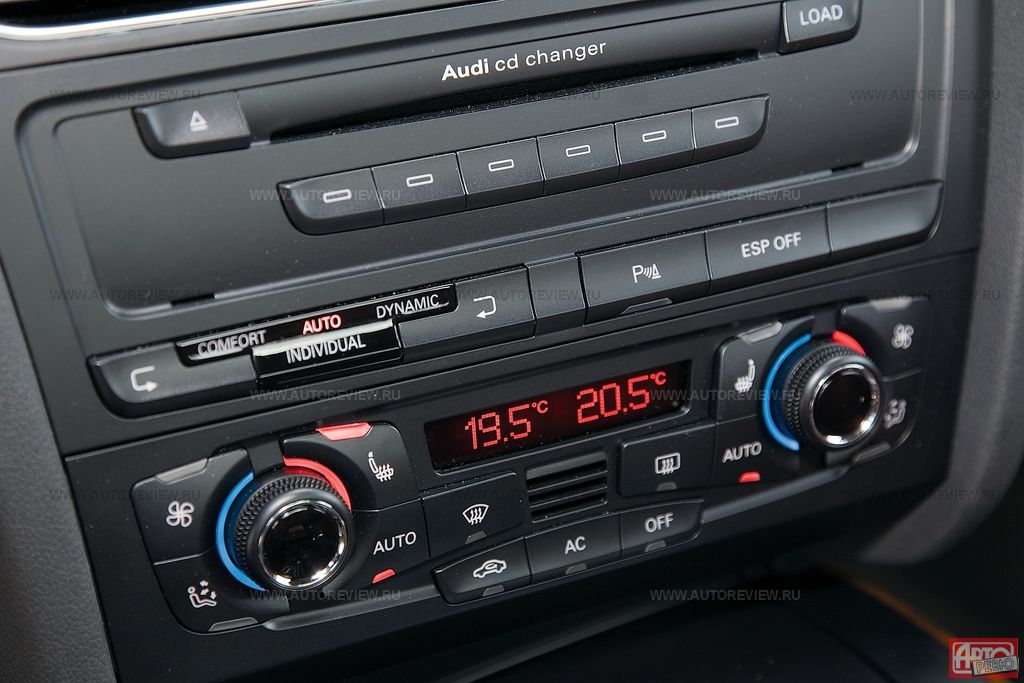 |
| The engine is started by a button or by pressing the key in the slot, and the electromechanical "handbrake" is released with a button | It's easy to figure out the abundance of buttons |
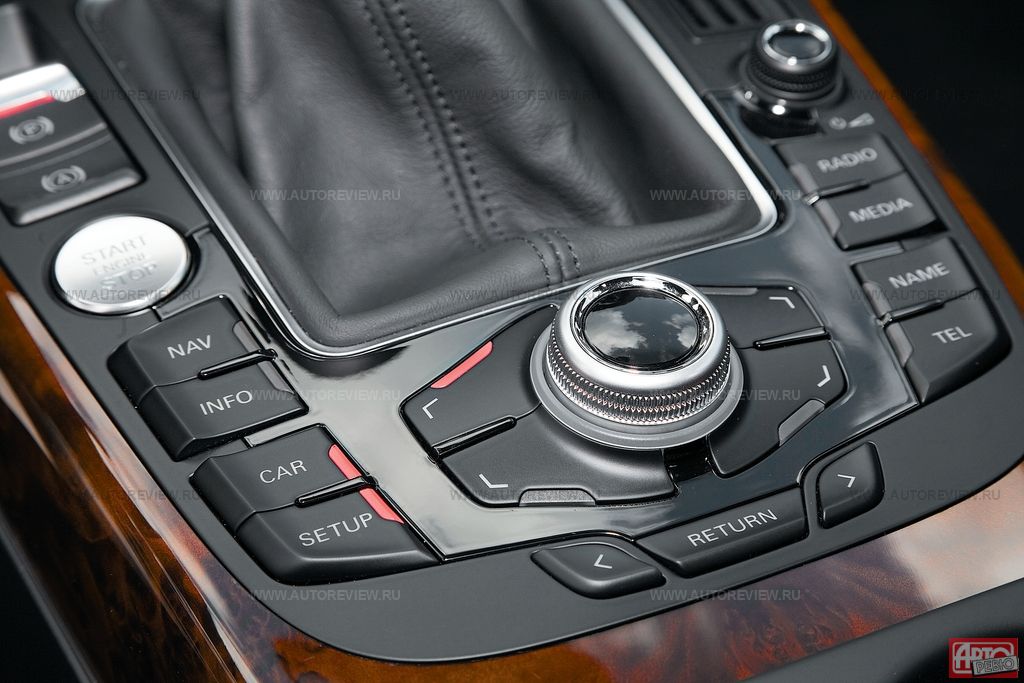 | 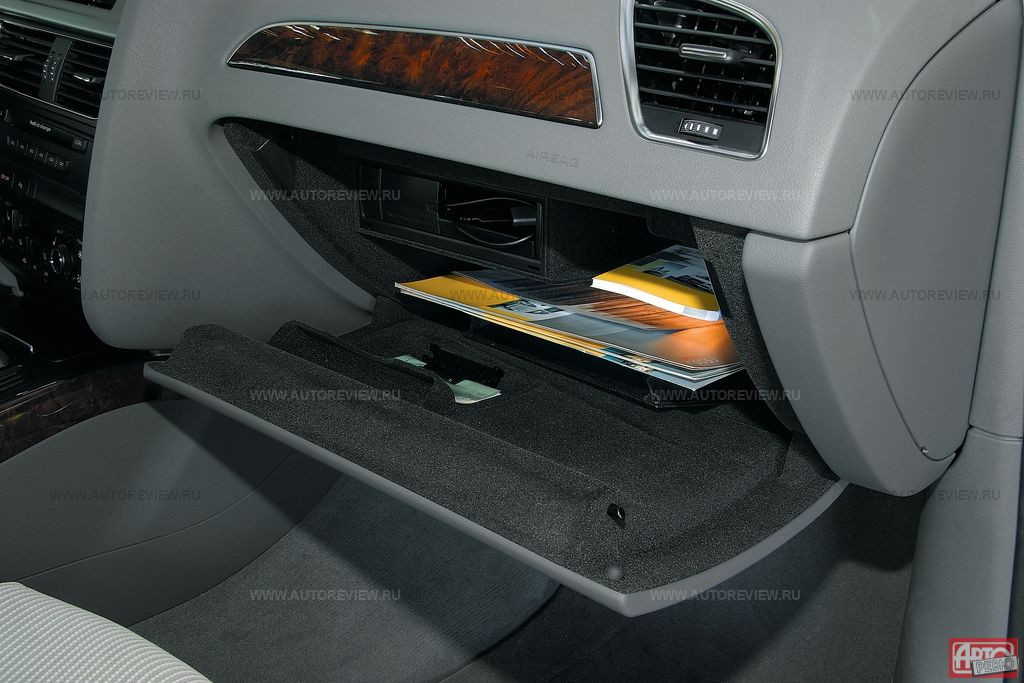 |
| Now the "four" also has the intuitive MMI interface | The glovebox is large, if you don't hide additional equipment in it |
Developing the new platform for the Audi A4/A5 (and the upcoming Q5 crossover) took four years and over a billion euros. What did Audi engineers want to change? First of all, weight distribution. After all, the traditional Audi layout with a longitudinal engine hanging ahead of the front axle is not the best solution for handling. A large moment of inertia around the vertical axis, overloaded driven wheels… Hence the persistent understeer of the "ringed" cars.
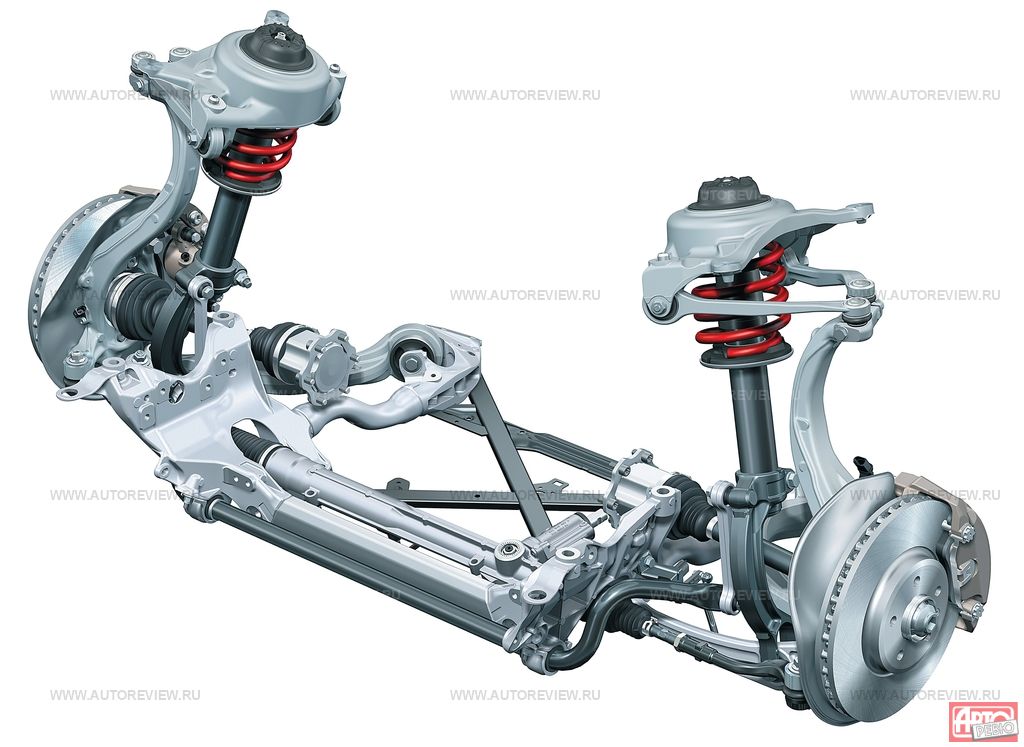 | 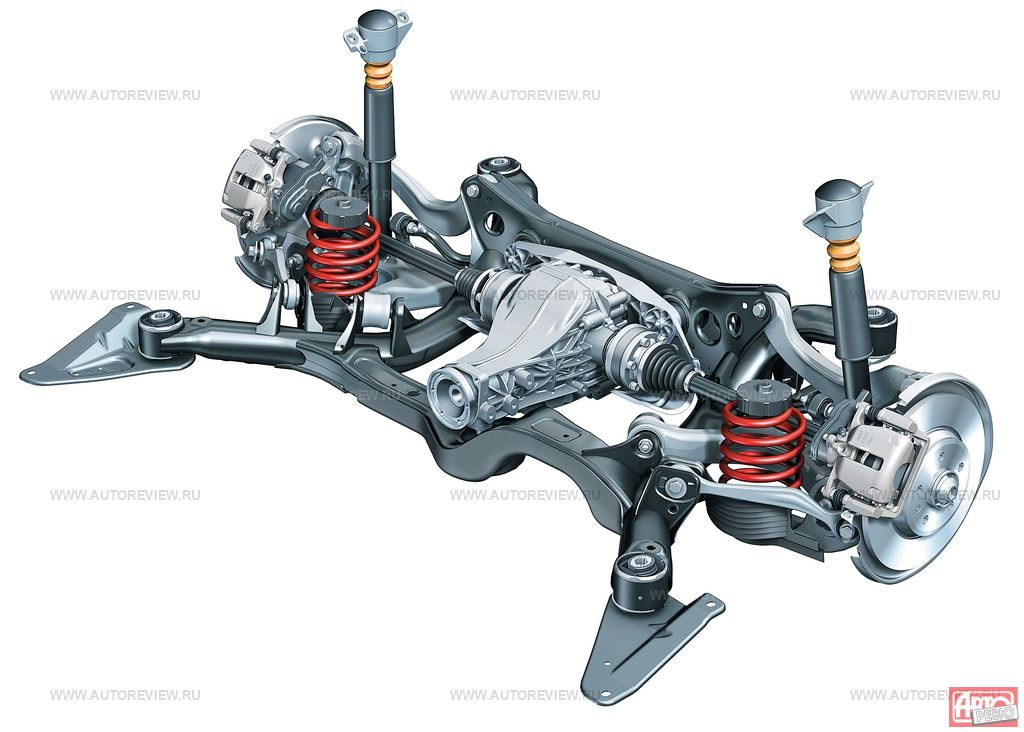 |
| The classic double wishbones remain unchanged, but the suspension travel has been increased by 20 mm, the bushings have become softer in the longitudinal direction and stiffer in the transverse. The strut mounts and upper front suspension arms are now attached to the body via a rigid aluminum "mini-subframe" | |
How to give the Audi a more sporty character? There are many recipes, but in Ingolstadt they used classic ones. The engineers seemed to have picked up Carroll Smith's 1978 book "Tune to Win," opened the chapter on front-engined sedans, and…
"Move the engine back as far as possible," writes Smith. By moving the flywheel with the clutch behind the final drive housing, the engine is shifted back by 154 mm. This technique has been working effectively for five years now on the second-generation Audi A8.
"Put the battery in the trunk," Smith wrote. They put it in the spare wheel well, leaving space on top for a narrow space-saver spare. The result is an ideal, BMW-like, "half" weight distribution across the axles. By the way, BMW has been using this technique since the 70s.
What next? "Lighten and strengthen the body," advises Smith. The steel skeleton of the Audi A4 (without hood, doors, and trunk lid) has become 10% lighter and 5% stiffer than before. "Increase the rigidity of the suspension arm mounting points," is written in "Tune to Win." The upper arms and strut mounts of the front suspension on the A4 are now attached not to the body, but to a rigid aluminum reinforcement. "Remove all compliance from the suspension joints," says the racing bible. They removed it, but selectively — only in the lateral direction.
What's the result?
One turn, second, third... Not bad, but nothing more. The feeling of understeer hasn't gone away: the front-end drift is small, but it's there, and in all phases of the turn. And the moment when sliding begins is hard to feel because of the artificially "overweighted" steering. The suspension is as elastic as a ball — both large potholes and small pits are transmitted roundly. It's quiet inside, with only the annoying hum of tires on rough asphalt standing out.
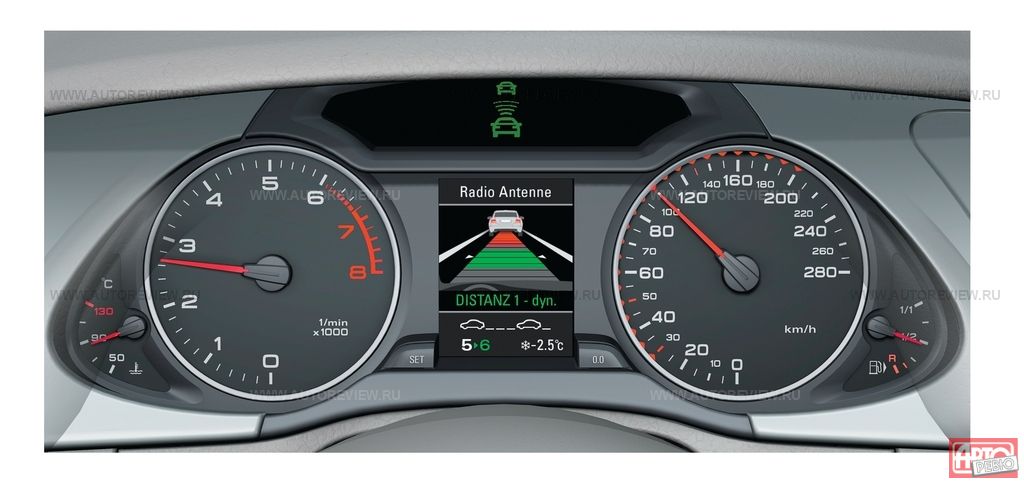 | 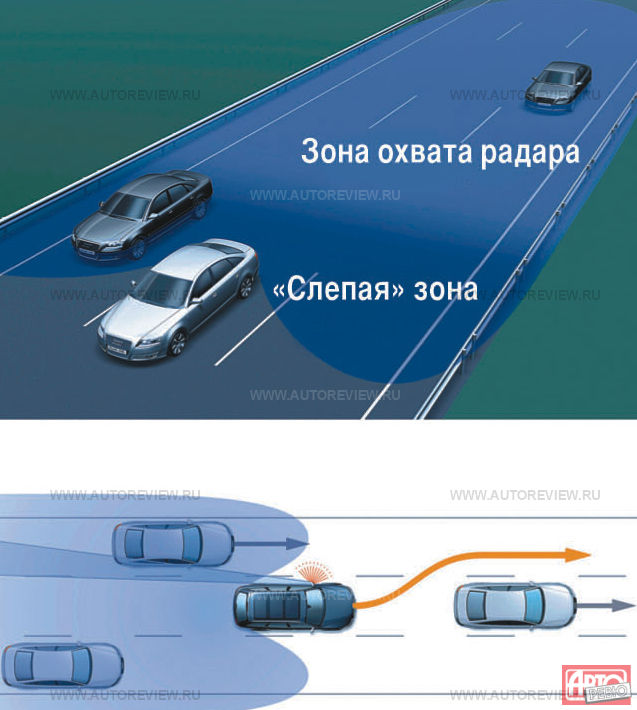 |
| Active cruise control (radar operating frequency 76.5 GHz) maintains a safe distance of up to 180 meters at speeds from 30 to 200 km/h even in closed turns, although the beam coverage angle is only eight degrees | As on more expensive Audis, the "anti-tailgating" Side Assist system informs with flashing orange lights at the mirrors about cars in the "blind" zone — but only if you use the turn signals |
I switched to the same front-wheel-drive "four," but with the chain-driven CVT multitronic. Better! The chassis is naturally the same, but the CVT allows you to manage traction more easily and pleasantly than the "manual" with its long-travel clutch pedal and "sluggish" lever. The CVT, by the way, has been refined with new settings and an expanded power range from 6.25 to 6.73 (the ratio of the lowest gear to the highest). It's simply ideal! The eight quasi-fixed steps here are just for fun.
And why bother with the paddle shifters if there are only 160 horsepower under the hood?
Maybe the powerful Audi A4 3.2 FSI quattro will be different?
Yes!
The synthetic loud roar of the 265-horsepower "six" 3.2 FSI, which gained ten horsepower thanks to the double AVL camshafts, didn't inspire. But the union of the engine with the tiptronic "automatic" is wonderful. The engine picks up powerfully at any rpm, and the gearbox changes gears absolutely imperceptibly thanks to new torsional vibration dampers, mini throttle blips on downshifts, and instant throttle lift on upshifts during acceleration.
And the chassis? It seems the same twists of the mountain serpentine are under the wheels as five minutes ago, but... Where did the heaviness and thoughtfulness go? Where did the understeer disappear, to which I had already managed to adapt? The all-wheel-drive Audi A4 3.2 FSI carves corners willingly, aggressively, and almost "neutral"! Despite the more massive six-cylinder engine.
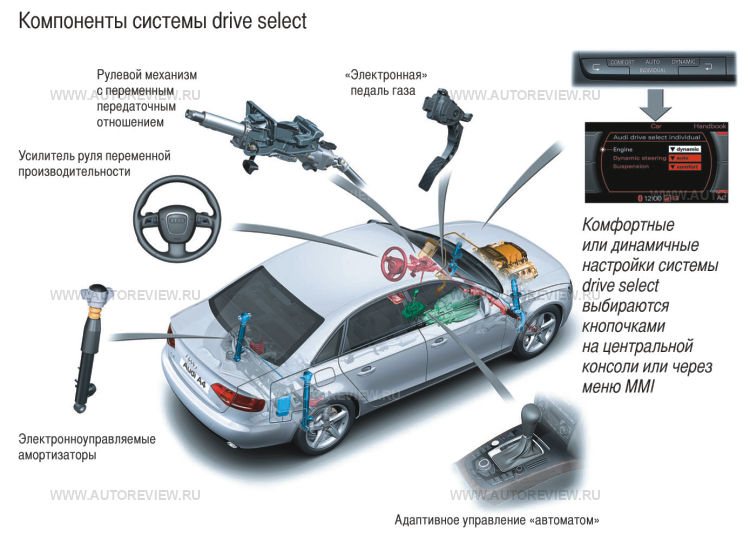
But firstly, the all-wheel drive (as before, with a mechanical Torsen center differential) is now asymmetric — 60% of the torque is delivered to the rear axle by default. And secondly, this car has the new-for-Audi drive select system. Nothing special at first glance: engine control, "automatic," and Sachs variable-damping shock absorbers are tied into one knot. As in the Mercedes Advanced Agility system, a button on the center console can switch "comfort" settings to "dynamic." But Audi allows even more — through the MMI menu, you can choose the operating mode of each component. For example, the "automatic" works better in Dynamic mode, but I didn't like switching the active steering to the "dynamic" algorithm...
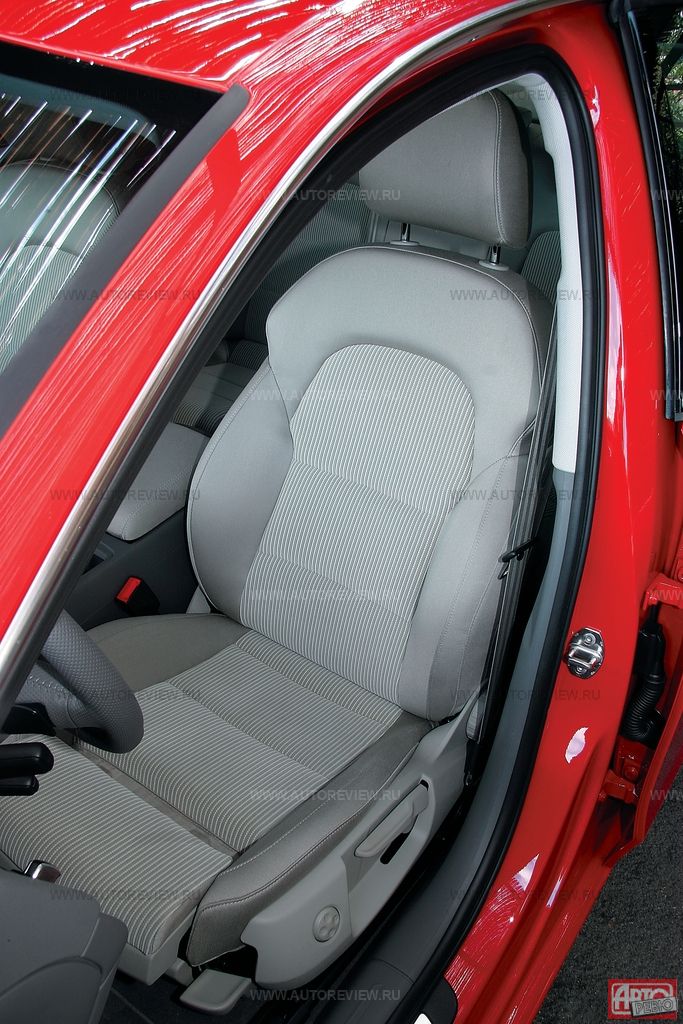 | 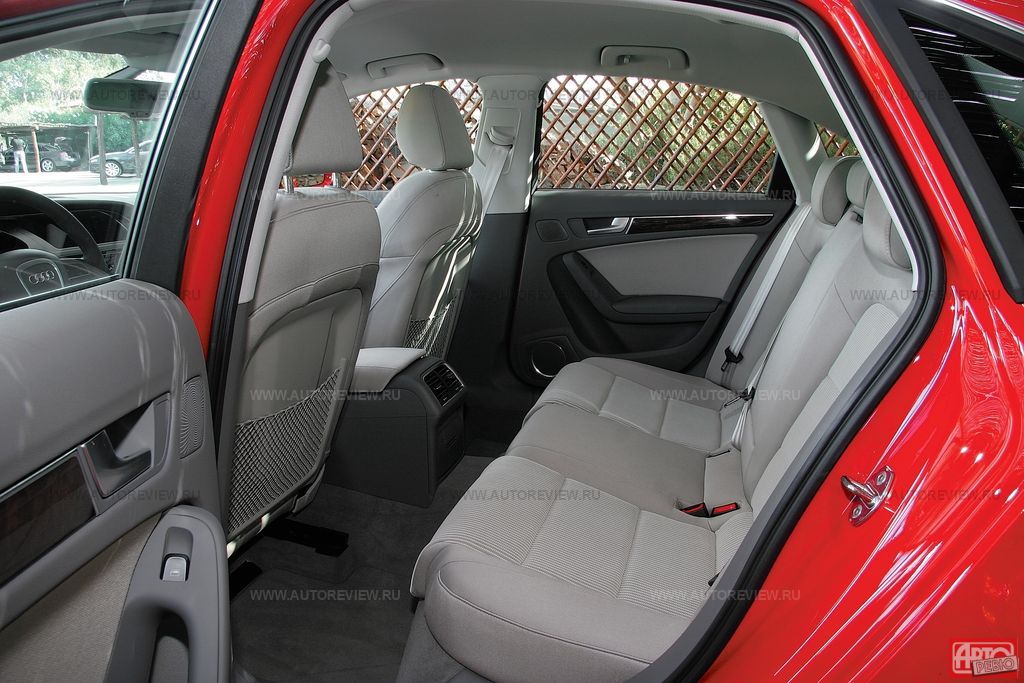 |
| The fabric seats are luxurious — even the cushion length is adjustable. And there are also "buckets" made of perforated leather — with built-in ventilation | The rear has become much more spacious, but headroom is still a bit limited |
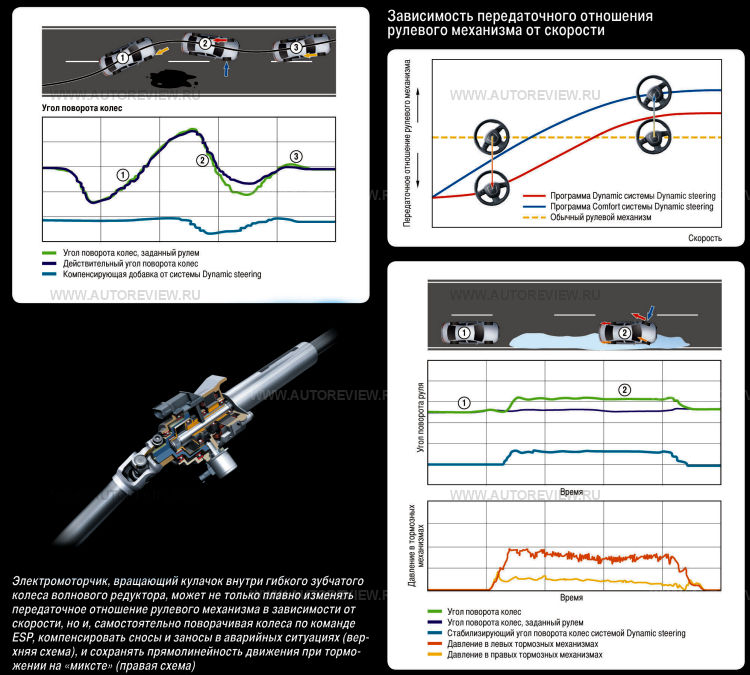
"Active" steering on the Audi A4? Yes, yes, it's true: following BMW, Ingolstadt has also introduced an electronically controlled additional gearbox on the steering shaft! Audi calls this system Dynamic steering, and it technically copies... the Toyota VGRS mechanism with a harmonic drive, which first appeared on the Land Cruiser 100 SUV in 2002. The steering wheel is not directly connected to the drive gear of the steering rack, but rotates it indirectly, through a flexible gear wheel — a "wave generator." The waves are produced by an electric motor that drives an ellipse inside the "generator," smoothly changing the overall steering ratio.
What does this give?
In a regular Audi A4, the steering wheel makes 2.9 turns from lock to lock. And in a car with Dynamic steering — only two turns. But that's if the car is stationary or moving slowly. And as speed increases, the ratio decreases — to four "virtual" turns.
But the main thing is that Dynamic steering can turn the wheels up to 11 degrees without driver input — based on a signal from the ESP stability control system. Therefore, the familiar serpentine bends from the regular car required less effort — the electric motor with the magic gearbox, at the command of ESP, reduced the steering angle of the front wheels by precisely calculated degrees during understeer and corrected hints of oversteer. And it didn't deprive the excellent steering feel!
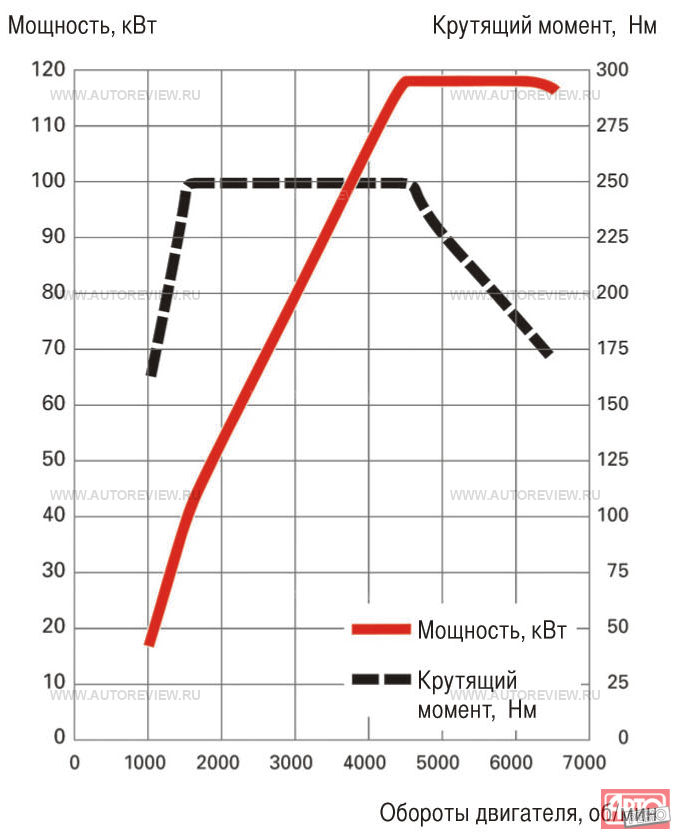 | 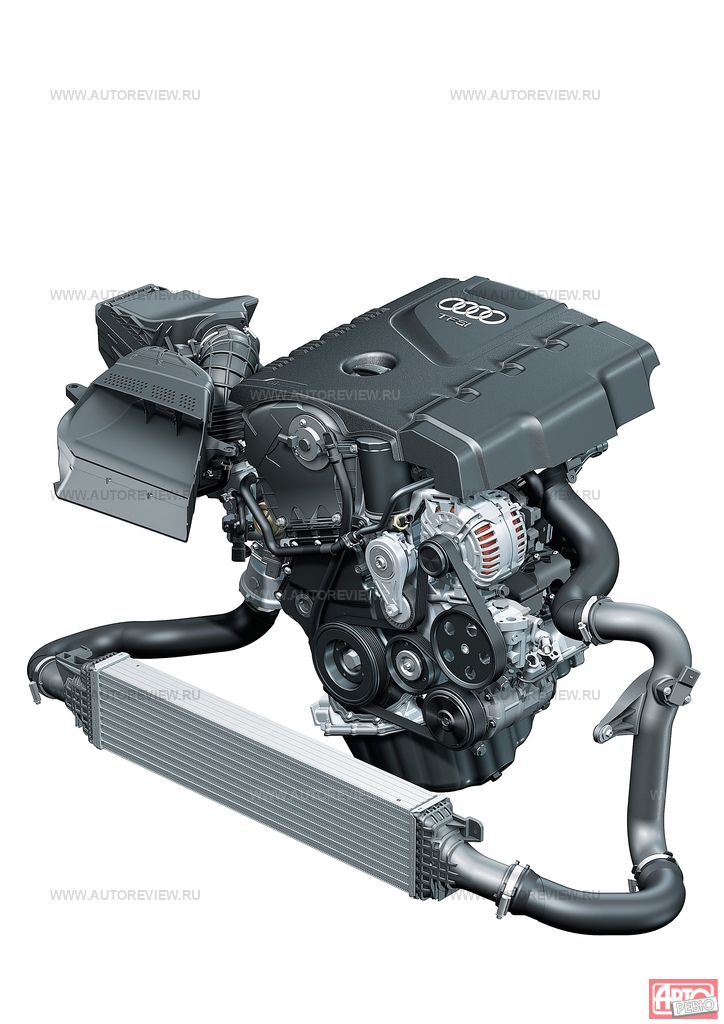 | 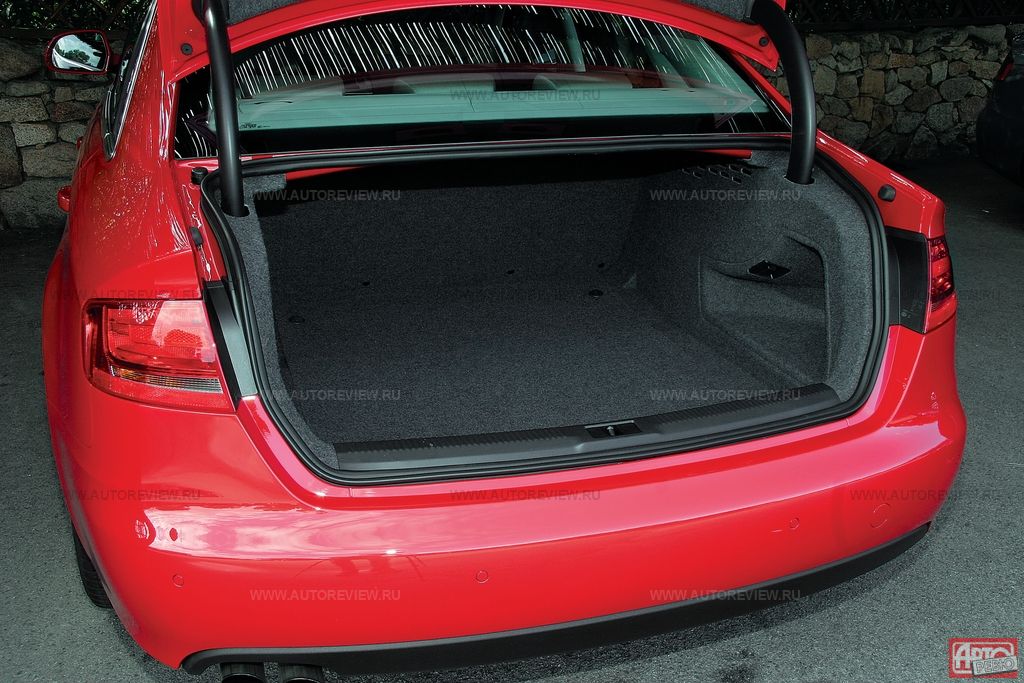 |
| The dual intake camshafts of the Audi Valve Lift system gave the new 1.8 TFSI engine a wide power "plateau" — it's constant from 4500 to 6200 rpm | The trunk is huge, but convenient transformation — only for an extra charge | |
And a couple of emergency braking maneuvers on the proving ground's "mix," when there's asphalt under the right wheels and slippery wet steel tiles under the left, added enthusiasm. In the A4 with "passive" steering, the car spins under the chatter of the ABS, and even with my active correction, it drifts half a meter toward the asphalt. But the car with Dynamic steering deviated only a couple of centimeters, turning no more than a degree, even though I held the wheel perfectly straight.
Well, the final chord was the Audi A4 3.0 TDI quattro. This is the most powerful turbo diesel option — there are also 2.0-liter and 2.7-liter engines. But the 240-horsepower diesel is a beast! The sound is the most correct: quieter than the gasoline V6 3.2, and angrier than the "four" 1.8 TFSI. Five hundred newton-meters promised a heavy clutch pedal, and the reinforced synchronizers of the manual gearbox — stiff shifts. Nothing of the sort! Even the selectivity of the "shifter" is top-notch — not a single miss with gears. In city traffic, no problems — an avalanche of torque is available from 1500 rpm. And in the mountains... With the comfort settings of the drive select system that I liked, the new Audi A4 3.0 TDI quattro is a delightful cocktail of drive and reliability. Like the old Audi S4.
The new S4 will appear only in spring and should be even more sporty and docile thanks to the active rear differential borrowed from Mitsubishi, which was developed over two years jointly with Magna. But we shouldn't expect even the regular new "fours" before spring. And the Avant station wagon, popular in Germany, and the extreme RS4 version (surely with a turbo engine instead of the current naturally aspirated "eight") will be even later.
It's also too early to talk about prices — although in its homeland, the Audi A4 is still more affordable than its competitors. The German price list for the 1.8 TFSI version starts at 25,900 euros, while the BMW 318i starts at 27,300 euros, and the Mercedes C180 Kompressor — even from 30,000 euros. By the way, in terms of global sales, the Audi A4 still lags behind the BMW "three" — 343 thousand cars in 2006 versus 460 thousand for BMW. But the Mercedes C-Class is behind — only 250 thousand, even if you include the CLK coupe. And in Russia, the "four" is on horseback — 2,787 Audis sold in 2006 versus 2,337 BMW "threes" and 1,663 Mercedes (C+CLK).
And if the price ratio holds, Audi's leadership will be strengthened. After all, the new "four" has become larger, more solid, and in powerful versions — even sportier. As Carroll Smith bequeathed in his book "Tune to Win," the title of which in Russian translation might sound like: "Tune to Win."
| Passport data | |||||
| Parameters | Automobile | ||||
| Audi A4 | |||||
| Modification | 1.8 TFSI | 3.2 FSI | 2.0 TDI | 2.7 TDI | 3.0 TDI |
| Body type | 4-door sedan | 4-door sedan | 4-door sedan | 4-door sedan | 4-door sedan |
| Number of seats | 5 | 5 | 5 | 5 | 5 |
| Trunk volume, l | 480/962* | 480/962* | 480/962* | 480/962* | 480/962* |
| Curb weight, kg | 1410 (1445)** | 1580 | 1460 (1495)** | 1595 | 1655 |
| Gross weight, kg | 1960 (1995)** | 2130 | 2010/(2045)** | 2145 | 2205 |
| Engine | petrol, with direct injection and turbocharging | petrol, with direct injection | turbodiesel | turbodiesel | turbodiesel |
| Location | front, longitudinal | front, longitudinal | front, longitudinal | front, longitudinal | front, longitudinal |
| Number and arrangement of cylinders | 4, in-line | 6, V-shaped | 4, in-line | 6, V-shaped | 6, V-shaped |
| Displacement, cm³ | 1798 | 3197 | 1968 | 2698 | 2967 |
| Cylinder bore/piston stroke, mm | 82.5/84.1 | 85.5/92.8 | 81.0/95.5 | 83.0/83.1 | 83.0/91.4 |
| Number of valves | 16 | 24 | 16 | 24 | 24 |
| Compression ratio | 9.6:1 | 12.5:1 | 16.5:1 | 16.8:1 | 16.8:1 |
| Max. power, hp/kW/rpm | 160/118/4500—6200 | 265/195/6500 | 143/105/4200 | 190/140/3500—4400 | 240/176/4000—4400 |
| Max. torque, Nm/rpm | 250/1500—4500 | 330/3000—5000 | 320/1750—2500 | 400/1400—3250 | 500/1500—3000 |
| Gearbox | manual, 6-speed (multitronic)** | manual, 6-speed | manual, 6-speed (multitronic)** | multitronic | manual, 6-speed |
| Drive | front | all-wheel | front | front | all-wheel |
| Front suspension | independent, spring, on double wishbones | independent, spring, on double wishbones | independent, spring, on double wishbones | independent, spring, on double wishbones | independent, spring, on double wishbones |
| Rear suspension | independent, spring, on double wishbones | independent, spring, on double wishbones | independent, spring, on double wishbones | independent, spring, on double wishbones | independent, spring, on double wishbones |
| Front brakes/disc diameter, mm | disc, ventilated/314 | disc, ventilated/320 | disc, ventilated/314 | disc, ventilated/314 | disc, ventilated/320 |
| Rear brakes/disc diameter, mm | disc/300 | disc/300 | disc/300 | disc/300 | disc/300 |
| Tires | 225/55 R16 | 225/55 R16 | 225/55 R16 | 225/55 R16 | 225/55 R16 |
| Maximum speed, km/h | 225 | 250 | 215 | 226 | 250 |
| Acceleration time 0—100 km/h, s | 8.6 | 6.2 | 9.4 | 7.7 | 6.1 |
| Fuel consumption, l/100 km | |||||
| urban cycle | 9.9 | 13.5 | 7.5 | 8.1 | 9.6 |
| extra-urban cycle | 5.5 | 6.7 | 4.3 | 5.7 | 5.4 |
| combined cycle | 7.1 | 9.2 | 5.5 | 6.6 | 6.9 |
| Fuel tank capacity, l | 64 | 64 | 64 | 64 | 64 |
| Fuel | AI-95 | AI-95 | diesel Euro-4 | diesel Euro-4 | diesel Euro-4 |
| * With rear seats folded | |||||
| ** Data in parentheses — for versions with multitronic | |||||
A4: genesis
Igor VLADIMIRSKY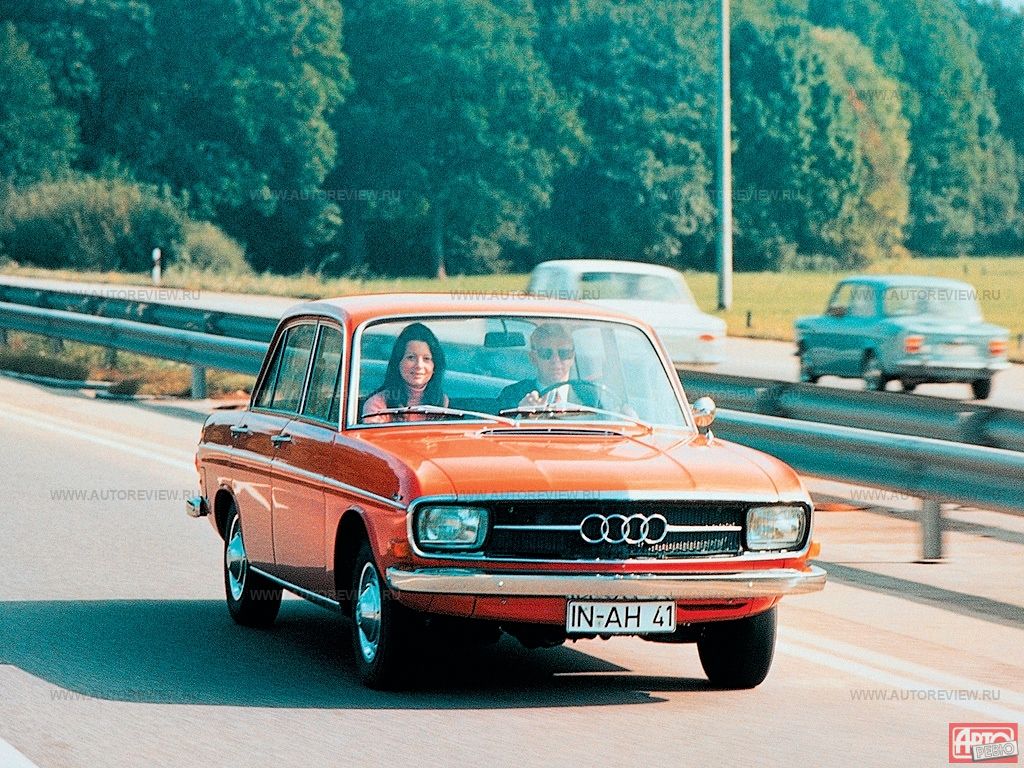 |
| Audi 60 (1968) — the junior representative of the F103 family, from which the modern history of the Audi brand began |
The direct predecessor of the current Audi A4 was the first post-war car of the revived brand: at the Frankfurt Motor Show in 1965, a small Audi sedan was presented — the result of a deep modernization of the front-wheel-drive DKW F102 sedan of 1963 with a new four-stroke engine instead of the ancient two-stroke. The in-line "four" with a displacement of 1.7 liters (72 hp), developed jointly with Daimler-Benz, was distinguished by an unusually high compression ratio for those times — 11.2. Two body types were offered — a two- or four-door sedan.
A year later, more powerful modifications Audi 80 and Super 90 appeared, whose indices indicated engine power. The base model, by analogy, became known as Audi 72. In addition, a luxury trim and a three-door Variant station wagon were added. The last modifications were the Audi 60 (with a 1.5-liter engine) and Audi 75 — their engines operated with a reduced compression ratio of 9.1.
In 1972, they were replaced by the Audi 80 family. The two- or four-door sedans had four-cylinder engines ranging from 1.3 to 1.6 liters and 55—110 hp, front McPherson suspension and rear dependent with a Panhard rod. The drive was still front. The car turned out to be very successful and was even awarded the title of Car of the Year '73. Later, a station wagon appeared, and some body parts of the Audi 80 began to be treated with anti-corrosion coatings at the factory.
The debut of the second-generation Audi 80 took place in September 1978. The station wagon disappeared from the model range, and the famous Giorgetto Giugiaro worked on the design of the sedans. Initially, only petrol in-line "fours" (1.3—1.8 liters, 55—110 hp) were installed on the cars; in 1980, buyers were offered a naturally aspirated diesel (1.6 liters, 54 hp), and a year later a modification with a five-cylinder petrol engine of 1.9 liters (115 hp) appeared. In 1982, the Audi 80 acquired a 2.1 engine (136 hp) and quattro all-wheel drive, borrowed from the coupe of the same name. In 1984, the Audi 80 family underwent a restyling, and all five-cylinder modifications received their own designation Audi 90. At the same time, a self-locking Torsen center differential appeared in the quattro transmission, which could transfer up to 80% of the supplied torque to one of the axles.
The third-generation Audi 80 sedan, with a galvanized steel body, appeared in 1986. Engines — petrol "fours" with a displacement of 1.6—2.0 liters (70—137 hp) and diesels (including turbocharged) with a displacement of 1.6 and 1.9 liters (54—80 hp). The Audi 90 modification, as before, was equipped with in-line "fives" with a displacement of 2.0—2.3 liters and a power of 115—170 hp. The most powerful versions of petrol engines had four valves per cylinder.
In 1991, the Audi 80/90 family underwent a major modernization — the rear suspension changed, the wheelbase increased, and trim levels were revised. In addition, all modifications for Europe now bore the single designation Audi 80, and for the USA — Audi 90. The driver's airbag became standard equipment, the passenger's was installed for an additional cost. The base engine was a 1.6 with 101 hp, and the range was topped by V6 engines of 2.6 and 2.8 liters, which developed 150 hp and 174 hp, respectively. The swirl-chamber turbodiesel 1.9 developed 75 hp, and its counterpart with an undivided combustion chamber — 90 hp. Finally, in 1992, the Audi 80 Avant station wagon appeared.
Well, the first Audi A4 sedan was released at the end of 1994. Along with the "80" index, five-cylinder engines went into history. But even without them, the engine range was wide: petrol in-line "fours" (1.6 and 1.8 liters, 101—170 hp) and V6 (2.4—2.8 liters, 150—193 hp), as well as turbodiesels with a displacement of 1.9 and 2.5 liters and a power from 90 hp to 150 hp. A novelty was the tiptronic automatic transmission with the possibility of manual shifting. The station wagon and all-wheel-drive Audi A4 quattro debuted in 1996.

Four generations of Audi 80 (left) from 1972 to 1991 and three generations of Audi A4 (right) from 1995 to 2004: the whole family assembled
The second-generation Audi A4 of 2000 featured the multitronic continuously variable transmission, and two years later, a 2.0 FSI engine (150 hp) with direct injection. Other engines — petrol with a displacement of 1.6—3.0 liters (102—220 hp) and turbodiesels with a displacement of 1.9 and 2.5 liters (101—180 hp).
At the end of 2004, the design of the Audi A4 was redesigned in the new corporate style of Walter de Silva. Turbo diesels with a volume of 2.7 L and 3.0 L with a common rail injection system appeared, and the range of gasoline engines was headed by the 3.2 FSI V6 with 255 hp.
And finally, this year at the Frankfurt Motor Show, the third-generation Audi A4 made its debut.