
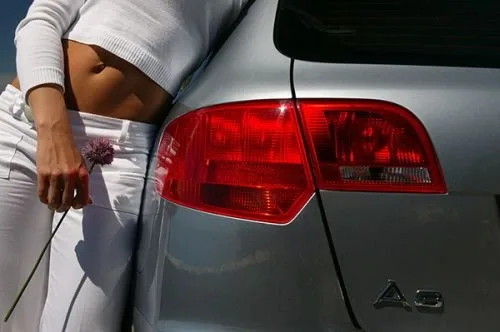
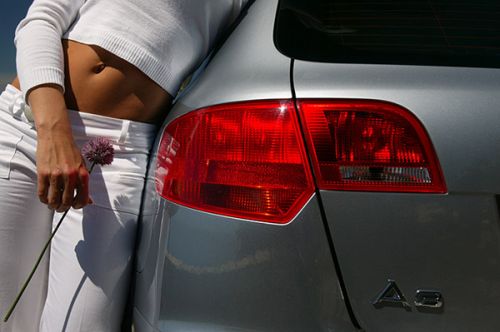
Audi A3 Sportback
© Photo: Audi
When Audi presented the technical specifications and photos of the five-door version of the A3 — Sportback — to the public, journalists were abuzz. The reason is simple: under the hood of this car, a two-hundred-horsepower turbocharged 2.0 TFSI engine was to appear for the first time. However, it is unlikely that even one fundamentally new powertrain could have caused so much talk. The very first contacts with the car showed: we are not just looking at a five-door modification of the "three-door," but a completely different machine — with different proportions, design, and technical content. Even a simple listing of innovations that had not been seen in this class before made it clear that a serious player was entering the market, capable of competing with the few rivals.
After studying the preliminary materials, everyone eagerly awaited the moment when they could get behind the wheel of the new product. And now that moment has come.
Monaco was perfect for testing such a sporty car. The coast here is solid mountains, which man has turned into cities, parks, and winding roads. The surface on these tracks is excellent, the turns take your breath away, the elevation changes are dizzying, but all this splendor is limited by laughable speed limits, and the size of fines instantly wipes the smile off your face...
Contrary to the advice of our superiors ("Take the base version!"), my colleague and I decided that we only live once, and chose a car with a 2.0 TFSI engine and a manual gearbox. Especially since in Russia in this segment, top-end trims usually sell best.
Audi A3 Sportback
© Photo: Audi
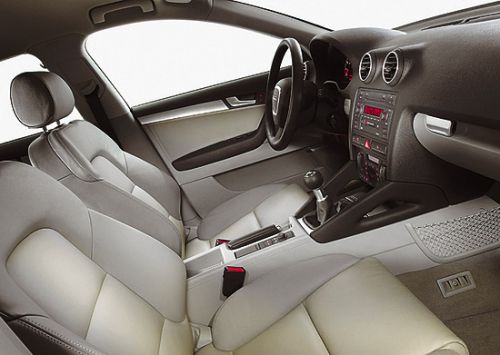
Inside, the car is completely devoid of pomp. The body lines are swift and light. The round climate-control vents, following modern fashion, have become a bright accent of the sporty style. The interior trim materials leave not the slightest hint of economy. The instruments are convenient and optimally positioned, but, oddly enough, they do not make a special impression (it seems Audi has already come up with its "ideal scheme"). On the central console are controls for dual-zone climate, the audio system, and the navigation monitor. The main detail of the interior is the new steering wheel. Its central part repeats the contours of the radiator grille, which is currently the most recognizable element of Audi's corporate style.
The seats are quite firm, hold the body well, and do not let you "nod" in corners. In the second row, you immediately feel those millimeters that were added to the dimensions. Space for passengers has increased in all directions: 40 mm more for legs, 29 mm more in width.
Getting behind the wheel of a premium-class car is already a familiar pleasure: everything necessary is adjusted by electric drives. The started engine shows almost no signs of life. But as soon as you touch the gas pedal, a pleasant unobtrusive hum appears from behind, accompanied by a light whistle of the turbine. The clutch pedal is a bit stiff and has a fairly long travel, which is unusual for "civilian" cars. But the engine picks up from the very bottom, and you just need to get used to it. After adaptation, however, shifting during sharp acceleration is performed much faster.
The gearbox pleases with well-chosen gear ratios — the acceleration gears are quite long. But the main thing worth fighting for in the legal department of Audi AG is the patent for the sound that is made when engaging the next gear "with a flick." Honestly, it deserves it! This signature "clack" resembles the sound of sports car gearboxes, but in a more aristocratic execution.
The first kilometers behind the wheel of an unfamiliar car in an unfamiliar place are usually associated with nervousness. However, encouraged by the curious glances of local residents, you quickly get used to local rules, and after about ten minutes you can easily pass for an avid racer or, at worst, a tourist.
Having somehow figured out the intricacies of city interchanges (honestly, Europeans are too fond of roundabouts), we got out into the mountains. Here it was already possible to properly "warm up" the tires.
Starting from a standstill requires precise work with the gas and clutch pedals. Acceleration deserves a description in sports terms — spurt, jerk.
The Sportback's suspension, despite its almost classic scheme, is clearly tuned sporty. At the front — the usual McPherson, at the rear — a new independent four-link design. The rear is especially interesting: it allowed the car to be significantly lightened. The arms are divided by function. A pair is responsible for lateral acceleration and handling, while the longitudinal ones are for comfort, which in a car of this class should not raise questions.
Tires of impressive size go through turn after turn. How pleasant it is when the road is not a straight arrow, but a set of bends of varying steepness with excellent surface! In such conditions, it is easy to appreciate all the pros and cons of the steering. We have an electric power steering, which "thinks" every time the driver turns the wheel. At parking speeds, the effort is minimal, and on the highway, the steering wheel fills with elastic feedback, allowing you to accurately hold the trajectory.
The brakes deserve special mention. The Sportback is the first in its class with an adaptive braking system. During normal braking, the booster provides excellent pedal responsiveness, working in a 1:5 ratio. But when the system understands that braking is emergency, the effort instantly increases to 1:8.5.
One of the biggest injustices of life: when you are feeling good, time flies unnoticed. And vice versa. In our case, two days (or hours?) flew by like an instant. On the way home, as usual, we did not discuss the prospects of the new product on the Russian market: most likely, they are the rosiest, because the Sportback has a mass of qualities and options that were not previously available in this segment.
2.0 TFSI
This engine for the first time in the world combines the advantages of direct injection FSI and turbocharging.
The 2.0 TFSI is based on the naturally aspirated 2.0 FSI. They have much in common, but in the turbocharged version, a number of parameters were changed to increase reliability in accordance with the increased power.
The cylinder block is cast from especially durable cast iron GG 25, which perfectly withstands high pressure and has good acoustic properties. Two balance shafts, rotating twice as fast as the crankshaft, dampen all inertial forces. The result is complete acoustic comfort and no vibrations.
The intake manifold is made of high-tech plastic. The compression ratio is 10.5:1, which is usually found in naturally aspirated engines.
An interesting comparison: exceeding the 1.8 engine in volume by only 10%, the new engine has 20% more torque — 280 N·m in the range from 1800 to 5000 rpm.
Technical characteristics of Audi A3 Sportback 2.0 TFSI
Curb weight, kg — 1470
Dimensions (length/width/height/wheelbase), mm — 4286/1765/1423/2578
Maximum speed, km/h — 234
Acceleration time to 100 km/h, s — 7.1
Fuel consumption (combined cycle), l/100 km — 8.9
Engine:
- type — inline, 4-cylinder
- displacement, cm3 — 1984
- power, hp at rpm — 200/5100–6000
- torque, N·m at rpm — 280/1800–5000
- fuel system — direct injection FSI with turbocharger and two camshafts (DOHC)
Transmission — all-wheel drive Quattro with manual gearbox
Tire size — 225/45R17
Suspension (front/rear) — McPherson/independent, 4-link
Brakes — with ESP, EBD booster, ABS, and electronic differential lock EDL
- front/rear — disc, ventilated/disc
Steering — with electric power steering and speed-adaptive compensation effect