"Virtue is boring, vice is attractive" — a phrase as old as original sin itself. But this ancient aphorism is deceptive. Sin may allure, but not for long — a passionate affair with a coquette can be a fun adventure, but marrying a frivolous beauty? Heaven forbid. The same goes for cars. Take the new VW Touareg, for instance, about which it's damn hard to write a thrilling, drama-filled article. It doesn't inspire — but I would certainly want one for personal use. Strictly speaking, this is the second generation of the model. What came before, with its flirtatiously lined eyes, was a deep restyling.
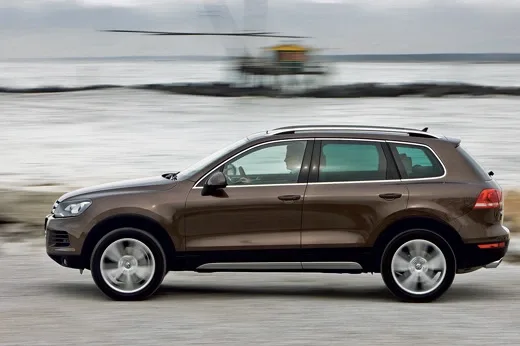
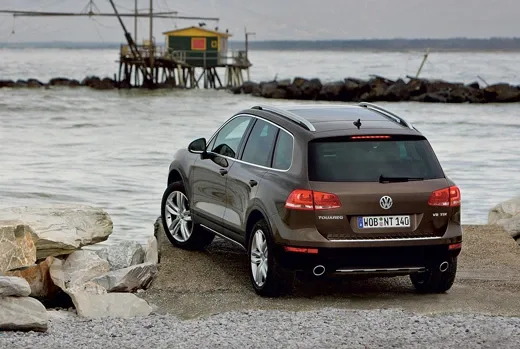
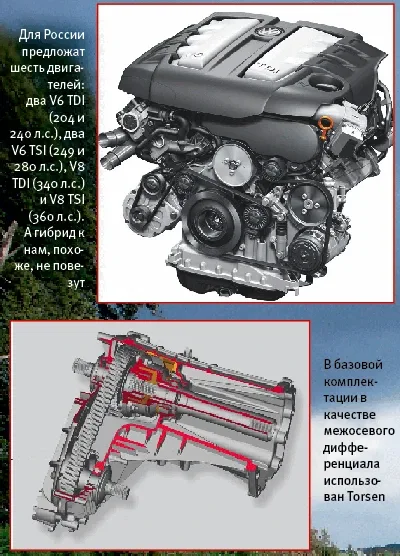
The most important point is the change in concept. Now the low-range gear comes as an option, so in standard trim the Touareg is a crossover with permanent all-wheel drive based on a Torsen differential. This is not a new solution: Mercedes-Benz was the first to offer a low-range gear for an extra charge — for the ML, and, as far as I know, most buyers do just fine without the paid reduction gear.
The Touareg also has a completely updated engine lineup. There is no longer the simplest R5 turbodiesel, nor the flashy V10. The new body has become stiffer. Ride quality is an order of magnitude better, and the interior is so solid that it can be considered a benchmark.
THE SECRET OF WEIGHT LOSS
The joke that the VW Touareg was created by inflating a VW Golf through the exhaust pipe always seemed stupid and crude to me. But now there's a grain of truth in it — on asphalt, the new model behaves completely like a passenger car. Not like a compact hatchback, of course, but like an E-class sedan.
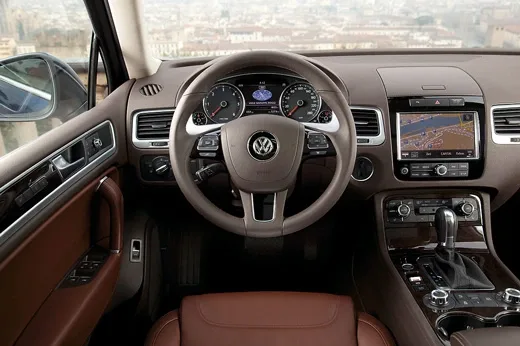
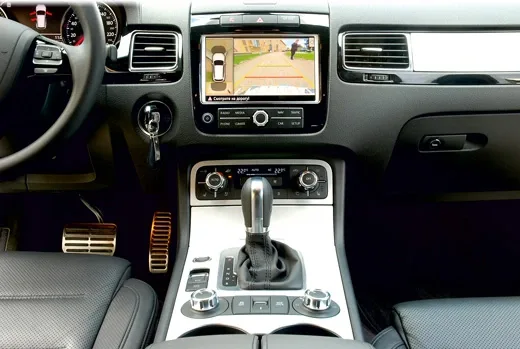
Having lost the low-range gear, the Touareg in base trim became about two hundred kilograms lighter. Partly due to the transmission, partly due to the suspension, and so on. Apparently, this also played a positive role, improving its driving characteristics. Smooth ride, no body roll, no nose dives, no pitching: cruising in such a crossover through the picturesque Italian hills is a pleasure, the more sharp turns, the better. The steering is a bit empty at small steering angles, but that only works in favor of comfort. There is only one universal SUV that could compare with the Touareg on a winding road — the Range Rover Sport. And even among crossovers, few can compete with it: the BMW X5 is not as comfortable due to its overly sharp steering, the Mercedes-Benz ML is not as precise. Maybe the Lexus RX350? Wait, so the new competitors of the Touareg are all from the premium class? It seems so. I must say, this is also supported by the interior trim: the texture of the plastics is pleasant both to the eye and to the touch, the panel fit is impeccable, the leather is high-quality, and the decorative inserts are genuinely wooden. Or, for those who prefer progress, aluminum. But the main thing is that one of the color options for the interior is brown. It looks surprisingly noble. And a bit unusual, adding to the interior what it lacks — a small zest.
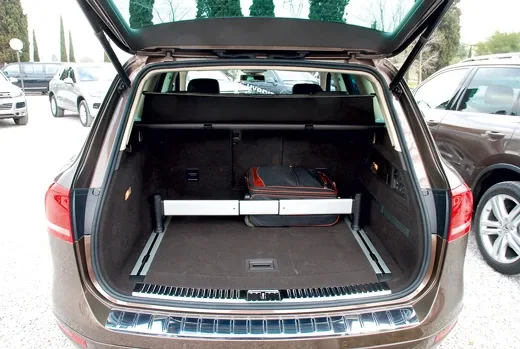
the automated closing of the fifth door – can easily be done without
Ergonomics are top-notch, no complaints. The only objective drawback is the integral speedometer scale: the intervals between marks are at unequal distances. It's a bit distracting at first.
OFF-ROAD FOR AN EXTRA FEE
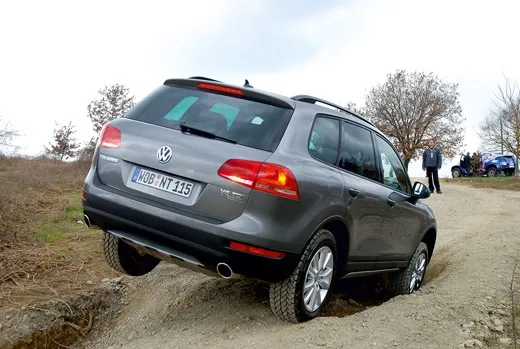
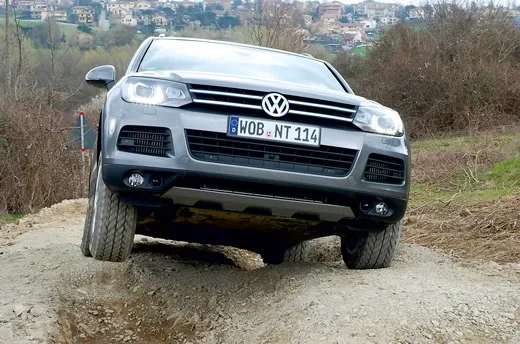
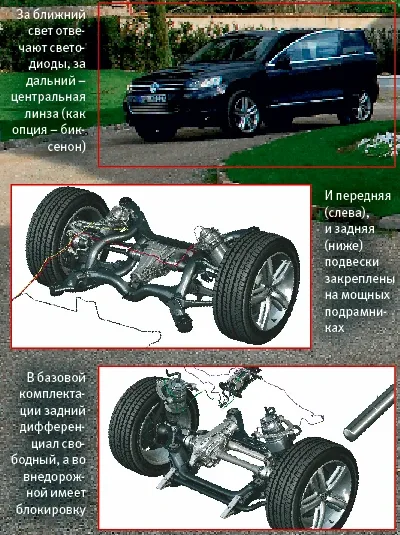
And what about off-road, you ask? Specifically for those who like to get muddy in a car worth over two million, there is the option to pay an extra 1900 euros and get the off-road Terrain-Tech-Paket as an option. It includes a transfer case with a reduction gear (reduction ratio — 2.7), a center differential lockable via an electronically controlled multi-plate clutch, a rigid rear differential lock, an increased ground clearance of 10 mm, and a 100-liter fuel tank instead of 85.
But, alas, this package is only available on the V6 TDI version. Air suspension, however, is available on all versions. But only together with the off-road package does it increase ground clearance to 300 mm, wading depth from 500 to 580 mm, and approach/departure angles to 33 degrees. It was on this — extreme, in the Germans' opinion — version that we drove on a quasi-off-road course set up near a golf club not far from Florence. You probably already understand what kind of off-road that was. The toughest test was the ballet "pas" on "elephant tracks." Nothing new. We knew before that the air suspension in its fully inflated state has no articulation. However, this does not prevent the car from dealing with wheel hanging — mechanical locks plus electronics do their job. Even representatives of VW agreed that the Touareg could have passed this route without the low-range gear. In standard trim, it is equipped with the same arsenal for off-road driving as the Tiguan: it has hill descent and ascent assist, off-road modes for the traction control and anti-lock braking systems. And all this is activated with one turn of a knob. When it appears in Russia, we'll check how it all works on a large crossover.
REMOVE THE TACHOMETER
For now, we only got to try the light versions of the 2010 VW Touareg on the roads. The first was the Touareg Hybrid — a silent monster living its own life. A city route through Florence was specially arranged for it. What can I say: the quietest gasoline turbo engine V6 TSI either stalls or starts, and you only find out about it from the tachometer. But it would be better if this instrument didn't exist at all. When peripheral vision catches a sharp drop of the needle while driving, a slight panic arises on a subconscious level. Here it should be explained that the hybrid drive operates on a parallel scheme — the electric (46 hp) and gasoline (333 hp) engines can work both separately and together. At speeds up to 50 kilometers per hour, the Touareg Hybrid can move only on electric traction, but during a sharp start, the internal combustion engine still kicks in. By the way, the hybrid accelerates decently. But it brakes with quirks — you press the pedal, and it seems to press itself further. The regenerative braking system is likely to blame. Of course, this doesn't affect anything, but the sensations are strange. However, a hybrid is by definition a mysterious thing — to recoup its high cost through fuel savings, you'd have to drive it for a lifetime. And preferably, all the time in heavy traffic jams. It is there that the reduction in fuel consumption and harmful emissions will be noticeable.
THE MAGIC OF THE EIGHT
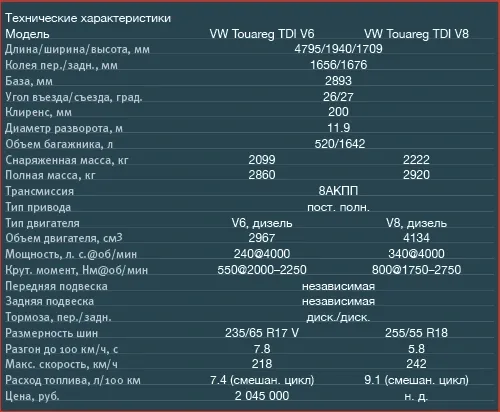
The flagship of the engine lineup is the turbodiesel V8. In the evening, when exchanging impressions, colleagues praised it in unison. "And what," I ask, "did someone lack torque or power on the V6 TDI?" "No," they say, "it was enough. But the sound during acceleration here!" The voice of the "eight" is indeed magical. You know, there are such large gentlemen with a velvety-rolling timbre, whose speech hypnotizes regardless of its meaning. It's a similar story here. However, without a striking dose of charm, this V8 wouldn't manage, because the V6 TDI is hot on its heels. The diesel "six" is the most modest in power, but it's more than enough for dynamic driving. After all, 7.8 seconds to 100 km/h is very good. And 550 Nm of torque is quite a lot. Well, the V8 with its 5.8 seconds to 100 km/h and 800 Nm is already a luxury item. And since I mentioned this fantastic traction, let me note: it's a pity that you can't buy the off-road package as an addition to it...
Both turbodiesels run smoothly, without vibrations or noise. According to the manufacturer, they are very economical — in the city, for example, 8.9 and 11.9 liters per 100 kilometers for the V6 TDI and V8 TDI, respectively. It's clear that these figures are obtained under ideal conditions and in practice usually turn out to be a bit higher, but they are still impressive. Especially when compared with the performance data.
The most affordable version of the new Touareg will now have a gasoline V6 FSI engine. This unit impresses with its silence: at idle, it's inaudible both from inside and even outside. The dynamics are generally good, although subjectively it's slightly weaker than the diesel V6. This is partly true — the diesel pulls more vigorously, but the gasoline "six" reaches 100 km/h in the same 7.8 seconds.
All engines work exclusively in tandem with an 8-speed automatic transmission, but during driving I didn't even notice how it shifts: the gearbox works so smoothly that it resembles a CVT. There is one curious technical detail — the gearbox has a built-in electric pump that forcibly maintains pressure and oil level. This solution wasn't introduced for no reason: the Touareg with the V6 in the base is now equipped with a Start-Stop system. Press the brake, stop — the engine stalls. Take your foot off the pedal, press the gas — it starts. To ensure the gearbox is instantly ready to work at that moment, the electric oil pump is activated during the Stop phase.
HOW TO RAISE THE PRICE
As befits a premium-class car, the Touareg has rich standard equipment. Even in the base — a CD stereo with a six-disc changer and a touchscreen. Even with the junior V6 engines, standard features include dual-zone climate control, a rain sensor, and 17-inch alloy wheels. As for the Hybrid and V8 TDI versions, they offer leather upholstery, push-button engine start, and bi-xenon high beam with automatic adjustment. The latter option is especially helpful on busy highways. Sensors detect an oncoming car, and the electronics adjust the light beam so that, while maintaining maximum illumination, it doesn't blind the oncoming driver. Moreover, as the cars approach, the light beam shifts smoothly. The sensors react not only to the headlights of oncoming cars but also to the brake lights of the vehicle ahead.
The options list also has interesting items. For example, a surround-view system based on video cameras. Or a navigation system with a 60 GB hard drive, which already knows how to speak Russian. And also — a retractable tow bar, four-zone climate control, adaptive cruise control in conjunction with a lane-keeping assist system, and other nice features. I think, by selecting just a minimal set of such additions, you can easily add 10–15 thousand euros to the car's price.
The price for the Russian market has not yet been approved. It is only known that for the new Touareg with the V6 TDI they plan to ask the same as for its predecessor — from 2,045,000 rubles.