And why not? Both are premium, both are fast, both are luxurious. But comparing Porsche and BMW? That's almost sacrilege: Porsche is the pinnacle of the automotive Olympus. And BMW, it turns out, flies lower? No, it doesn't. Why? Because Porsche is the pinnacle... Okay, enough rolling your eyes. We'll compare. We'll even have to get out a micrometer and measure the steepness above sea level.
THEY ARE ALMOST TWINS, BUT BMW IS LONGER
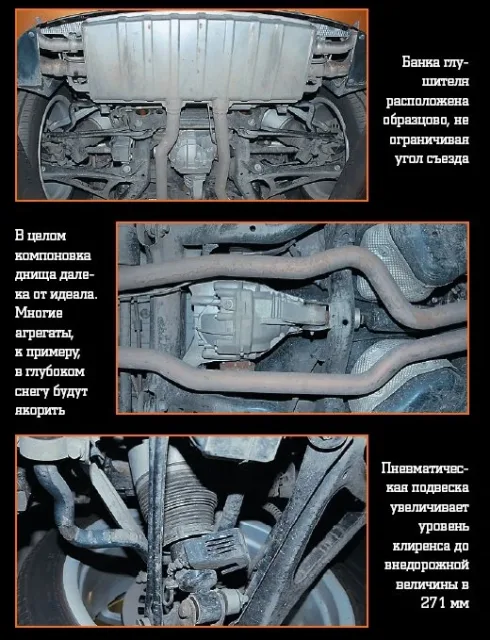
If we approach it purely functionally, pitting the X5 against the Cayenne in a duel is a dubious endeavor. The Porsche has a low-range gear and air suspension that raises ground clearance to 271 mm. But who will take such cars on a logging truck rut? Even if the owner is going hunting, the road to the gamekeeper's hut in the thicket is most likely asphalt. The maximum off-road they'll face in real life is beach sand and a couple of puddles. So comparing their off-road capability from a practical standpoint is pointless. It's purely academic interest. For the premium class, other things matter more: dynamics, comfort, finish quality, handling. And, of course, nuances, nuances, nuances. At such a height, there are no trifles...
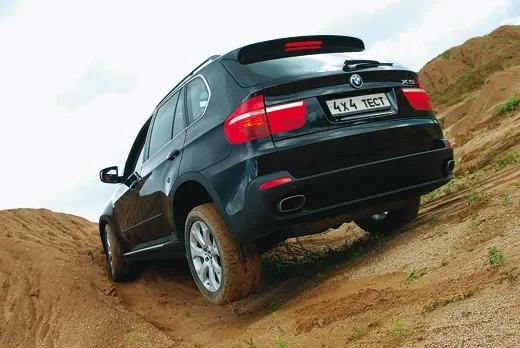
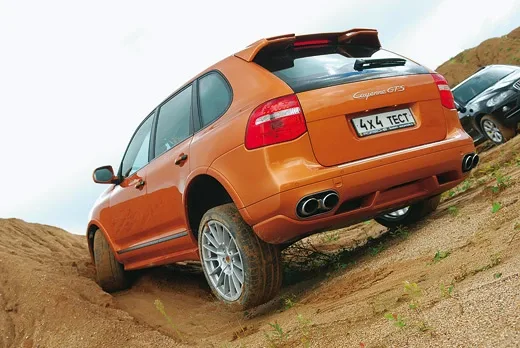
The Bavarian generously gave its rival a head start: its engine is 45 horsepower weaker. And that's in the top version of the X5. As its opponent, we took the mid-range Cayenne with the GTS badge.
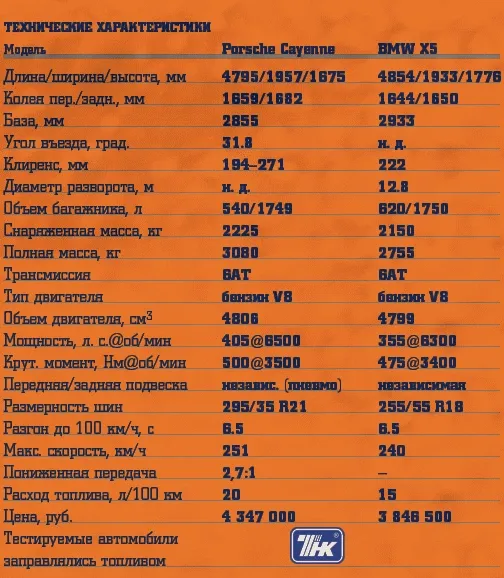
The starting positions of our athletes are laughably close. Each costs about four million rubles. Acceleration to 100 km/h is 6.5 seconds (the Cayenne, though more powerful, is also heavier by about 120 kg). Engines are 4.8-liter, longitudinally mounted. Six-speed automatic transmissions. Just twin brothers! Except that the Cayenne is shorter: total length is less by 74 mm, and wheelbase by 80 mm.
It's worth mentioning that the Cayenne's engine uses the proprietary direct fuel injection technology, and it achieves 405 hp. But the BMW with its 355 hp goes just as fast, and most importantly, consumes much less: 15 liters versus 20 according to our measurements.
THEY ARE ALMOST TWINS, BUT BMW IS LONGER
If we approach it purely functionally, pitting the X5 against the Cayenne in a duel is a dubious endeavor. The Porsche has a low-range gear and air suspension that raises ground clearance to 271 mm. But who will take such cars on a logging truck rut? Even if the owner is going hunting, the road to the gamekeeper's hut in the thicket is most likely asphalt. The maximum off-road they'll face in real life is beach sand and a couple of puddles. So comparing their off-road capability from a practical standpoint is pointless. It's purely academic interest. For the premium class, other things matter more: dynamics, comfort, finish quality, handling. And, of course, nuances, nuances, nuances. At such a height, there are no trifles...
The Bavarian generously gave its rival a head start: its engine is 45 horsepower weaker. And that's in the top version of the X5. As its opponent, we took the mid-range Cayenne with the GTS badge.
The starting positions of our athletes are laughably close. Each costs about four million rubles. Acceleration to 100 km/h is 6.5 seconds (the Cayenne, though more powerful, is also heavier by about 120 kg). Engines are 4.8-liter, longitudinally mounted. Six-speed automatic transmissions. Just twin brothers! Except that the Cayenne is shorter: total length is less by 74 mm, and wheelbase by 80 mm.
It's worth mentioning that the Cayenne's engine uses the proprietary direct fuel injection technology, and it achieves 405 hp. But the BMW with its 355 hp goes just as fast, and most importantly, consumes much less: 15 liters versus 20 according to our measurements.
The suspensions of both cars are packed with electronics. The Cayenne's main tools include roll suppression systems and adjustable shock absorber stiffness. Rolls are suppressed using active stabilizers, which, depending on the steering angle and lateral acceleration, create a force that tends to level the body. Plus a special off-road mode: when the low-range gear is engaged, the stabilizers shift relative to each other and allow increasing the axle articulation angle.
The Bavarian, in turn, is armed with a cornering brake control system, as well as a traction control system (DTC) that allows increased wheel slip when the situation demands it, particularly off-road.
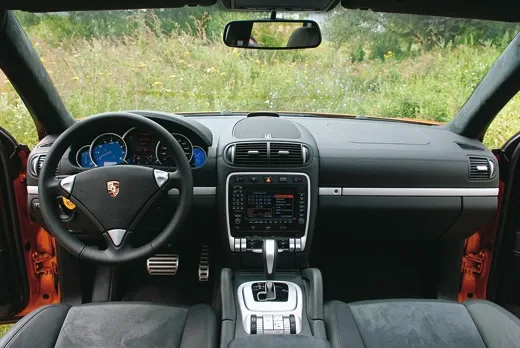
The interior of this car is captive to Porsche passenger car traditions. BMW is also enslaved by corporate style, but it looks much more premium
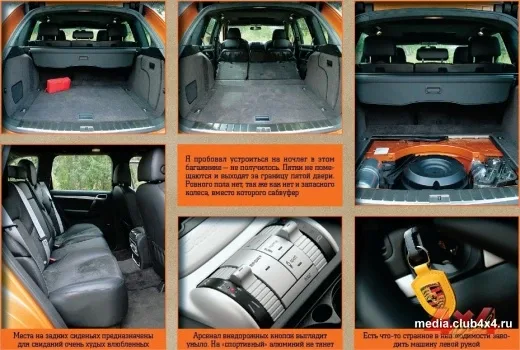
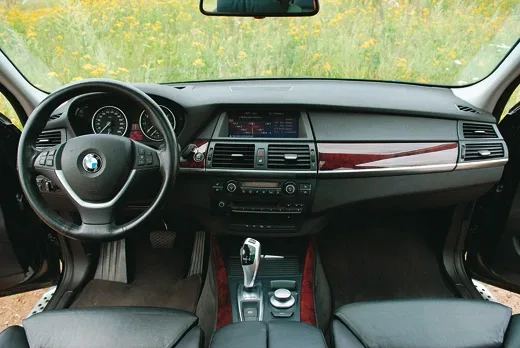
A complex play of planes, asymmetry, and wood inserts: modern art masquerading as antiques
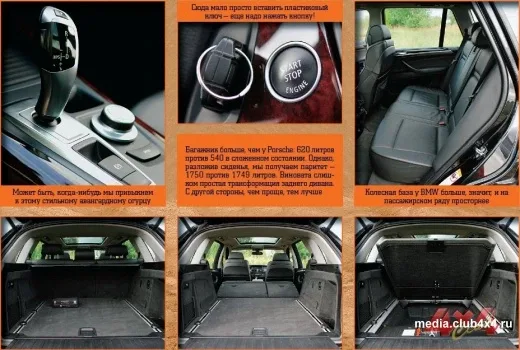
Inside, the cars are finished completely differently. In the X5, the dashboard plastic is very beautiful, expensive, and high-quality. Plus wood inserts. In the Cayenne, there's perfectly crafted, almost hand-stitched leather. Plus aluminum inserts. The dashboard architecture of the X5 is high-tech style, while its rival's is in the spirit of a VW Golf. And so on. Perhaps this is that rare case where a super-modern approach looks more solid than a traditional one. What does the Porsche interior lack? Either solidity or sportiness: it doesn't balance very successfully between these extremes.
True, driving makes its own adjustments. When you switch from the Cayenne to the X5, you'll hear a rattle: it's the Bavarian's interior panels clattering! You might even want to insert earplugs or turn up the music. But let's be honest: such sensations appear only in contrast.
WE DON'T NEED COMPANIONS
So, you won't hear panel squeaks in the Porsche, but at high speed on the highway, aerodynamic noise joins it as an annoying companion. Literally, just accelerate to 150 – and that's it, peace is gone. The BMW doesn't have that. But it does have a limp in directional stability: if on a curve the wheels hit uneven asphalt, this super-crossover noticeably shifts. And on a straight line, similar symptoms. Alas, all its excellent handling, decades-honed suspension tuning culture, and steering are only good for German autobahns. For long hauls on our roads, the Porsche Cayenne is better. Its suspension works more precisely regardless of mode, whether it's "sport" or "comfort." And that's despite the fact that overall the Porsche is stiffer than the BMW!
Writing about city driving is sad. Don't envy those who drive BMW X5 and Porsche Cayenne in Moscow. It's like walking a powerful dog on a short leash in a public park: you're constantly moving in jerks. Passengers are even more miserable: if you don't strap them in tightly, they alternately hit their foreheads and the backs of their heads against the luxurious interiors. Brake to the floor – gas to the floor. And so on constantly. But keep in mind – in the city, the X5 is still a lesser evil than its current rival. It's a bit softer, a bit smoother – as much as such terms apply to such cars at all.
SPECS: PORSCHE CAYENNE
SPECS: BMW X5
WITH SHARK-LIKE PRECISION
Some grunt with pleasure when they get to press the pedal in a sharp turn in a car with a five-liter engine and a price of $150,000. But there's no greater pleasure than driving such a car into a sand quarry. We deliberately use sand in our tests. Victory over mud depends too much on the type of tread or engine power, but on sand everyone is equal, especially on the road tires that most test cars are shod with.
BMW and Porsche met off-road so differently that it's worth writing a doctoral thesis on the peculiarities of their all-wheel drive. The X5 softly, intelligently plows through sandy slopes, only occasionally interfering with the driver with an engine choked by electronics. Torque distribution is quick and precise, almost imperceptible. And this is without any locks; the multi-disc clutch is already "pre-tensioned" at start.
We won't praise the Cayenne GTS; here it works crudely. The car moves in jerks: obeying the traction control system, the pads hit the brake discs hard. With such a "commotion," you expect a feat from the Cayenne, but it climbs through a trivial section as if straining. If not for the low-range gear and air suspension, the Porsche would have disgraced itself.
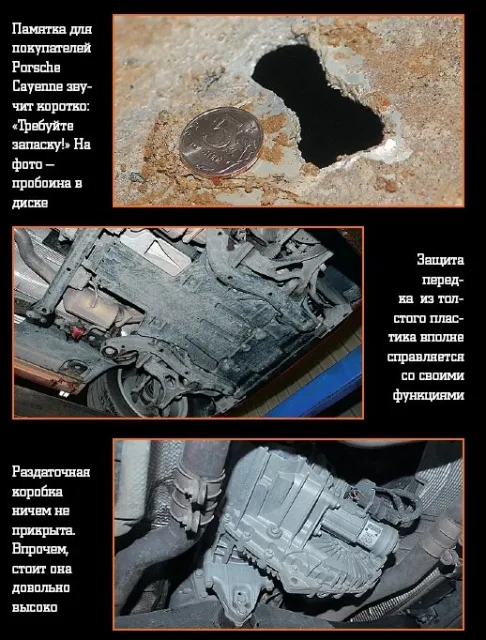
But the BMW... Tear off its front bumper – and it will outperform many off-roaders! Just press the right pedal harder. The Bavarians aren't afraid of mud. And they won't be scared by a punctured tire either. The stiff sidewall allows you to reach a service center 100 km away at speeds no higher than 70 km/h. About the Cayenne, I'm sorry, I can't say that. It doesn't have a stiff sidewall, and instead of a spare tire, in our case, there was a subwoofer. In case of trouble, there's an emergency kit – a can of sealant. We pumped it all through the valve into the punctured tire – it didn't help. We got to the tire shop on the rim, where the stunned master showed us a through puncture five by three centimeters on the inside of the wheel. It was probably a mine.
OFF WITH THE WHEELS AND BUMPER
The Cayenne is a wonderful car. On asphalt, it maneuvers with shark-like precision; it seems just blow on it – and it will obey with diamond precision. The BMW is also excellent, but only on smooth asphalt or on dirt. And the rivals can satisfy a demanding consumer off-road if you take off the 21-inch wheels with low-profile tires from the first, and the front bumper from the second.
So what to choose – Cayenne or X5? I bet on the Porsche: it's excellent on any road. However, its reputation as a celestial being is clearly exaggerated.
Some grunt with pleasure when they get to press the pedal in a sharp turn in a car with a five-liter engine and a price of $150,000. But there's no greater pleasure than driving such a car into a sand quarry. We deliberately use sand in our tests. Victory over mud depends too much on the type of tread or engine power, but on sand everyone is equal, especially on the road tires that most test cars are shod with.
BMW and Porsche met off-road so differently that it's worth writing a doctoral thesis on the peculiarities of their all-wheel drive. The X5 softly, intelligently plows through sandy slopes, only occasionally interfering with the driver with an engine choked by electronics. Torque distribution is quick and precise, almost imperceptible. And this is without any locks; the multi-disc clutch is already "pre-tensioned" at start.
We won't praise the Cayenne GTS; here it works crudely. The car moves in jerks: obeying the traction control system, the pads hit the brake discs hard. With such a "commotion," you expect a feat from the Cayenne, but it climbs through a trivial section as if straining. If not for the low-range gear and air suspension, the Porsche would have disgraced itself.
But the BMW... Tear off its front bumper – and it will outperform many off-roaders! Just press the right pedal harder. The Bavarians aren't afraid of mud. And they won't be scared by a punctured tire either. The stiff sidewall allows you to reach a service center 100 km away at speeds no higher than 70 km/h. About the Cayenne, I'm sorry, I can't say that. It doesn't have a stiff sidewall, and instead of a spare tire, in our case, there was a subwoofer. In case of trouble, there's an emergency kit – a can of sealant. We pumped it all through the valve into the punctured tire – it didn't help. We got to the tire shop on the rim, where the stunned master showed us a through puncture five by three centimeters on the inside of the wheel. It was probably a mine.
OFF WITH THE WHEELS AND BUMPER
The Cayenne is a wonderful car. On asphalt, it maneuvers with shark-like precision; it seems just blow on it – and it will obey with diamond precision. The BMW is also excellent, but only on smooth asphalt or on dirt. And the rivals can satisfy a demanding consumer off-road if you take off the 21-inch wheels with low-profile tires from the first, and the front bumper from the second.
So what to choose – Cayenne or X5? I bet on the Porsche: it's excellent on any road. However, its reputation as a celestial being is clearly exaggerated.