
From Dawn to Dusk
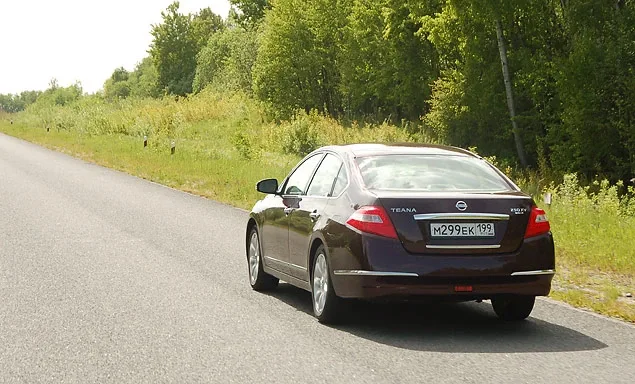
Starting June 1, official sales of the new Nissan Teana will begin in Russia. The Japanese company claims that the car has virtually nothing in common with its predecessor: not only the exterior and interior have changed, but also the platform. However, if you look at the car carefully, it seems that this is just a deep restyling. For example, the wheelbase of the Teana has not changed, the overall dimensions have increased only by a few millimeters, and some body panels (primarily the doors) remain the same.
To get acquainted with this car (whose name translates from one of the languages of the indigenous people of America as "dawn", "beginning" or "beautiful sound of nature"), we went to Kaliningrad, where its Russian presentation took place.
At a Glance
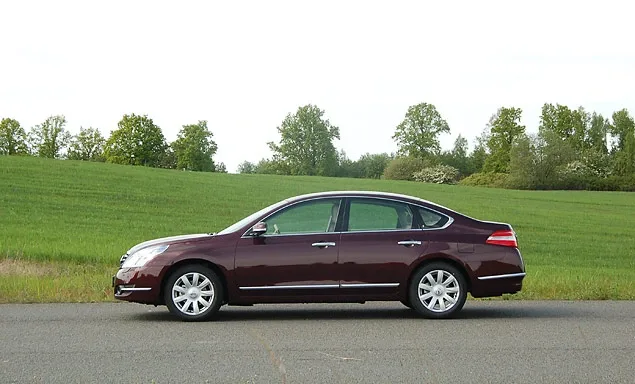
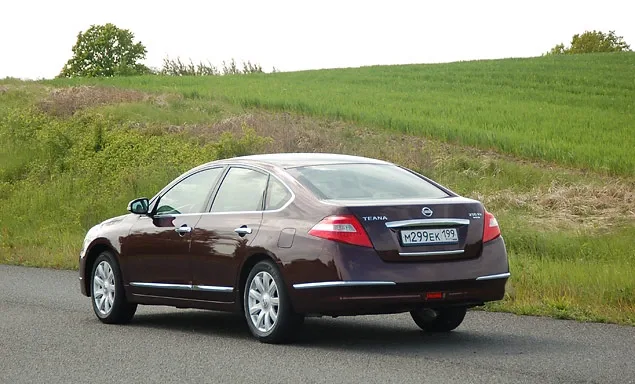
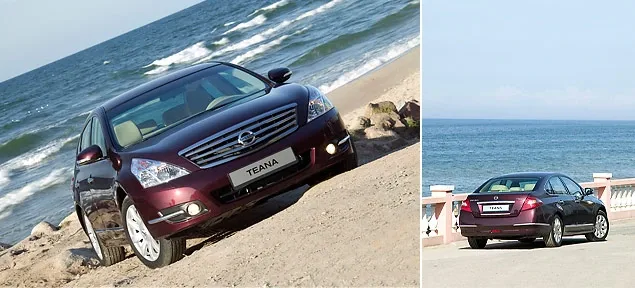
At first glance at the Teana, the conceptual Nissan Intima sedan, presented at the Tokyo Motor Show last year, immediately came to mind. It was an "E" segment car with original rear-hinged doors in the style of the Rolls-Royce Phantom, a "surround view" camera system that helps eliminate "blind" spots, and a front passenger seat that rotates 80 degrees to facilitate access to the cabin. The new Teana "grew" from this prototype, but, of course, it is devoid of the above-mentioned "excesses". The car's design is debatable, but the signature features of the previous Teana are still preserved: huge lighting equipment, many chrome accents on the body, a large "stern"...
 |
Immediately after arriving at Kaliningrad's Khrabrovo airport, we were given a contactless chip key for the car, which, by the way, is already offered as standard for all Teanas. To get into the cabin, you just need to approach the car, grab the handle, press a small button - and the door opens. And to start the engine, you need to press the "Start/Stop" button on the front panel while holding the brake pedal.
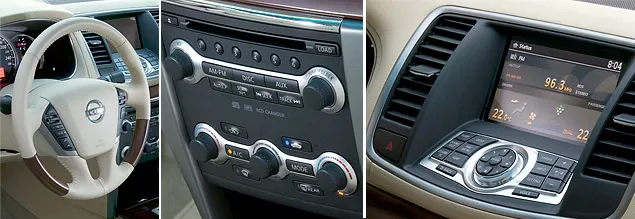
We inspected the Teana's interior already on the way, driving along the most picturesque Kaliningrad roads with their perfectly smooth asphalt. Compared to its predecessor, the Teana's interior has completely changed. A new steering wheel with audio system control buttons appeared (they were not available in any trim before), and the instrument cluster, center console, and navigation and multimedia system screen have changed. But the center tunnel clearly went to the car from the previous Teana.
 |
Inside, it is comfortable and cozy. All Teana trim materials are pleasant to the eye and to the touch, fully corresponding to the status of the car: soft leather and excellent "wood-look" plastic, which at first glance is difficult to distinguish from natural. All buttons on the front panel are exactly where you expect to find them, and they are convenient to use.
Upon arriving at the final point of our route - the Curonian Spit - we discovered that LEDs are hidden on the center console and near the door handles, softly illuminating the interior in the dark. When it is dark around, the interior of the Japanese sedan looks very beautiful and does not look like a black "abyss", however, such a "trick" is no longer new for many other brands.
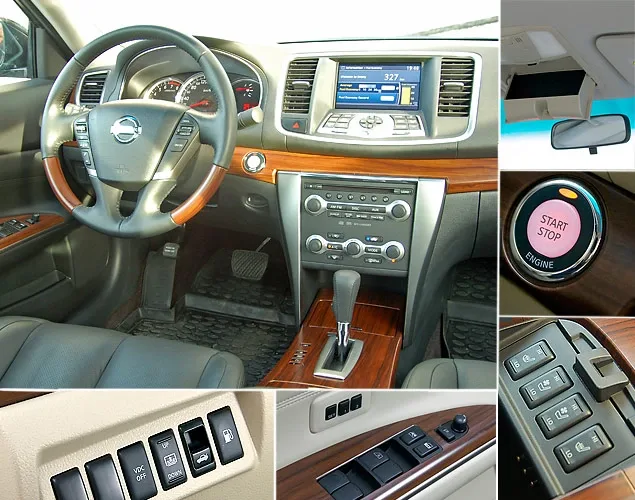 |
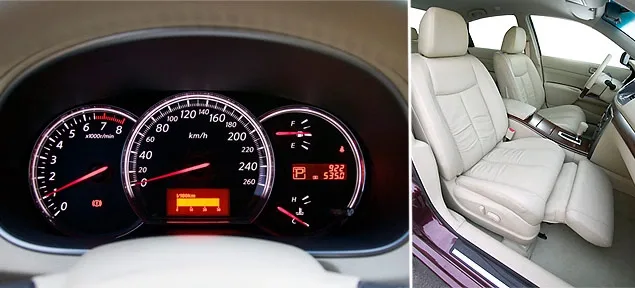
The colleague sitting in the front passenger seat first checked whether the new Teana retained the "ottoman" seat with leg support, which was one of the signature features of its predecessor. This pleasant feature of the car remains, but the massager built into the seat back, which was in the first-generation car, has disappeared. Instead, a ventilation system for all seats in the cabin has appeared. The buttons for turning on seat cooling, as well as heating, are located in the front armrest and are closed with a lid. In our opinion, this is not entirely convenient: it is quite difficult for the driver to open this large compartment while driving, and even more so to find the corresponding switches there.
Sitting on the "ottoman" with the extended leg rest is very comfortable; moreover, the seat back touches the door armrests, forming a fairly wide area on which it is convenient to rest your hand. You can also take a semi-reclining position, and if the road is long, you fall asleep almost instantly - good sound insulation and smooth ride have a very soothing effect.
 |
The next day, when we were driving the Teana to the airport, we managed to ride in the back. There is plenty of space there, as befits a large sedan, for passengers of any height. The central armrest of the rear seat, as on the previous generation Teana, has built-in cup holders, a climate control unit, audio system controls, seat heating and ventilation buttons, and a button for the electric rear window sunshade.
A new feature of the Teana is climate control with an air ionizer designed to combat various microbes and tobacco smoke, as well as a system that automatically activates the recirculation mode when exhaust gases are detected entering the cabin.
Another new feature is the "glass roof", at least that is what the "Nissan people" themselves call it. It is available only for cars in top trim and with the most powerful engine. In fact, the "glass roof" is two large sunroofs in the front and rear of the cabin, with the first one opening, but, alas, not completely, but only halfway. The glass of both sunroofs is tinted and equipped with electrically operated sunshades.
 |
The color screen of the navigation system will now be not just a decoration of the cabin in Russia. When purchasing a car with navigation, a disc with maps of Moscow, St. Petersburg, and their regions will be included, and data updates will be free. The image from the rear view camera is also transmitted to this monitor. The "video parking assistant" shows not only the distance to an obstacle, but also guide lines indicating the width of the car and the expected trajectory of the vehicle.
On the Road
The Teana, which has added only five millimeters in length and 30 millimeters in width, is built on the "D" platform, which is also used by the new Nissan Murano crossover and the American Altima and Maxima.
The sedan received a stiffer body, a modernized rear multi-link suspension, and a newly developed front suspension with new shock absorbers, which, according to Nissan representatives, help improve ride smoothness and reduce body roll in corners.
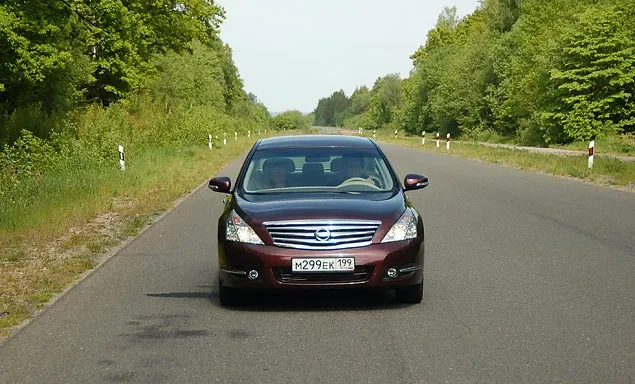 |
As for the excellent ride smoothness, it really seems to be so. The car completely ignores small road irregularities, and the driver notices large ones only by a slight dull "boom" sound somewhere deep in the car. In corners, however, the Teana rolls quite actively.
The Teana in Russia will be offered only with two engines: a 3.5-liter V6 with 249 horsepower and a 182-horsepower 2.5-liter engine, which replaced the 2.3-liter "six" in the lineup. Moreover, if earlier only the most powerful Teana modification was equipped with a CVT, now the adaptive continuously variable transmission Xtronic-CVT will work in conjunction with all engines. There are no other options.
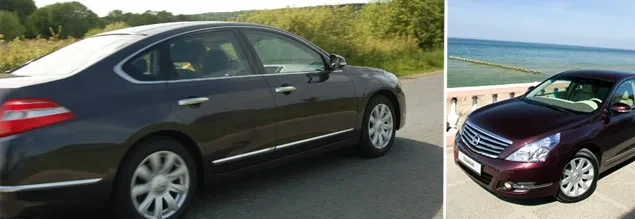 |
The most powerful Teana pleases with a pleasant engine roar, a well-tuned CVT, and decent dynamics. The car instantly responds to pressing the gas pedal, and, according to the Japanese brand, the sedan accelerates from zero to 100 km/h in 7.2 seconds. The top speed is limited to 210 kilometers per hour.
Excellent sound insulation muffles almost all external noises, allowing you to talk in the cabin without raising your voice at speeds up to 140 kilometers per hour, may the traffic police officers forgive us, and the soft suspension masks the feeling of high speed. However, this, in connection with the tightened measures for violating traffic rules, can be fraught.
What the previous Teana did not have, but appeared in the new generation model, is a power steering with variable effort. Therefore, in the city or in the parking lot, you can turn the steering wheel without much effort, and at speed the steering wheel becomes a little heavier.
Overall, driving the Teana is pleasant; minimal vibrations are transmitted to the steering wheel while driving, the car holds the road well, does not require steering corrections, is extremely understandable and predictable, but rolls in corners and slight delays in the car's reaction to turning the steering wheel are disappointing.
 |
The Nissan Teana with the 2.5-liter "six" engine, developed specifically for this model and designed for 92-octane gasoline, no longer impresses with its menacing sound or dynamics. Nevertheless, the power is still sufficient for a 1.5-ton sedan to overtake slow-moving vehicles on the highway and to confidently keep up in city traffic.
Otherwise, the 2.5-liter Teana is no different from its 3.5-liter sibling. The same suspension and steering settings.
Result
As a result, Nissan has produced a comfortable sedan with excellent ride smoothness and sound insulation, sufficiently powerful engines, a well-tuned gearbox, and a convenient interior.
However, to compete on equal terms with other cars in its class, the Teana lacks seemingly minor features such as the ability to close the ventilation vents on the central console, an auto-dimming rearview mirror, a rain sensor, and an automatic mode for all four power windows (it is only available for the driver's side window). Moreover, all the aforementioned shortcomings were present in the previous Teana but have not been addressed.
 |
Our country will be the first market in the world where the new Teana will appear. In Russia, the Nissan Teana will be offered in eight fixed trim levels. The base equipment already includes front and side airbags, an anti-lock braking system, electronic brake-force distribution and brake assist, an alarm, an MP3 audio system with a CD changer, keyless entry, and much more. In general, everything necessary is present. The cost of such a car with a 2.5-liter engine will be 838,500 rubles. The top version will cost 1,233,400 rubles.
By the way, assembly of the Teana at a plant in St. Petersburg is planned to begin next year. Whether prices will change as a result is not yet known.
Specifications
| Nissan Teana 2.5 | Nissan Teana 3.5 | |
| Length, mm | 4850 | 4850 |
| Width, mm | 1795 | 1795 |
| Height, mm | 1475 | 1475 |
| Wheelbase, mm | 2775 | 2775 |
| Ground clearance, mm | 135 | 135 |
| Engine displacement, cm3 | 2496 | 3498 |
| Power, hp/rpm | 182/6000 | 249/6000 |
| Torque, Nm/rpm | 228/4400 | 326/4400 |
| Maximum speed, km/h | 200 | 210 |
| Acceleration from 0 to 100 km/h, s | 9.6 | 7.2 |
| Base price, rub. | 838,500 | 1,108,500 |