
Autopilot
Evening. An empty suburban highway near Moscow. The new Mercedes-Benz E-Class, at a speed "almost enough for license revocation," flies down the road, perfectly holding its line and not bothering passengers with unnecessary noise or vibrations. Inside, it's quiet and comfortable - amber LED light flows from under the wooden trim on the doors and dashboard, the navigation system confidently guides toward the desired destination, and the built-in seat massager diligently works on the driver's back. Perfect - I could just keep driving like this...
Add a couple of interesting turns here, and life would be complete. As if on cue, the adaptive xenon headlights pick out a series of turns ahead - just what's needed! Except the speed before the first bend is clearly more than "prudent." Braking, steering input, to which the headlights respond almost instantly, directing the beam into the turn, and the multicontour seat, inflating the side bolsters, and with a barely audible tire squeal, the car immediately settles into the arc. Super!
We cut through a few more turns at a calmer pace (feeling sorry for the colleagues in the same car, who let out a meaningful "uhh..." in fright at that moment) and then burst back onto the straight highway.
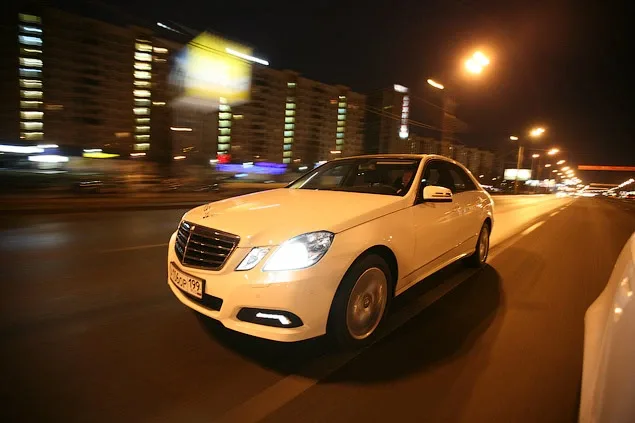
They say first impressions are usually the strongest. Well, the new "E-Class" really handles great! Of course, the respectable business-class sedan hasn't turned into a sports car, but compared to its predecessor, its driving manners have noticeably improved. The old stateliness is gone, responses to the steering wheel are sharper and livelier - it's become genuinely interesting to drive the "E-Class" on a winding road. Thank the engineers? Or the marketers?
Most likely, both should be thanked. The former for implementing all the technical innovations so well, and the latter for coming up with them. And most importantly, even after a short drive in the "E-Class," you want to get back behind the wheel as soon as possible. And it doesn't matter for what - whether it's moving at a snail's pace in traffic or a high-speed sprint on a country highway.
Moreover, the new Mercedes-Benz E-Class is one of the most high-tech cars in its class. Take, for example, the adaptive swiveling bi-xenon headlights (Intelligent Light System). A similar feature was on the previous "E-Class," but on the new car, the headlights not only turn in the direction of the turn but also independently recognize oncoming and following traffic, smoothly adjusting the "range" of the light. Simply put, ILS can switch between low and high beam instead of the driver, without blinding oncoming traffic.
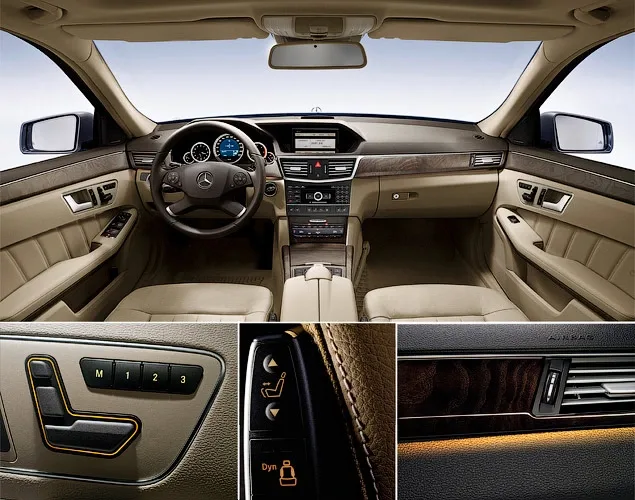
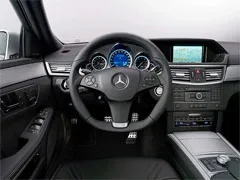
And those active multicontour seats, borrowed from the flagship S-Class - they're simply magnificent! Their shape can be fully adjusted to your body, allowing you to set not only the "clamping" of the side bolsters and lumbar support but also the length of the cushion. So, when you first sit in the new "E-Class," you can spend dozens of minutes on the numerous adjustments for the steering wheel, seats, mirrors, and onboard electronics. The main thing is not to forget to save all these settings into the car's "memory"...
Additionally, the new seats have massage, ventilation, and heating functions, and while driving, they... come alive. As speed increases, the side bolsters inflate, hugging the body more tightly, and in corners, special piezoelectric valves in the air chambers regulate the pressure and volume of air in them, depending on the steering angle, lateral acceleration, and speed.
As for rear passengers, if the driver decides to feel like Schumacher or Loeb, they'll have to make do with just the seat belts or the handle on the door and ceiling. But that's with the "standard" rear row of seats - for the "E-Class," you can now also order a molded-for-two, more comfortable and deeper sofa with a large armrest.
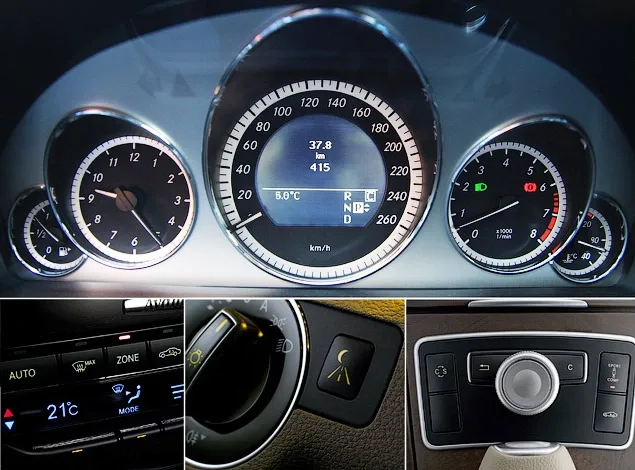
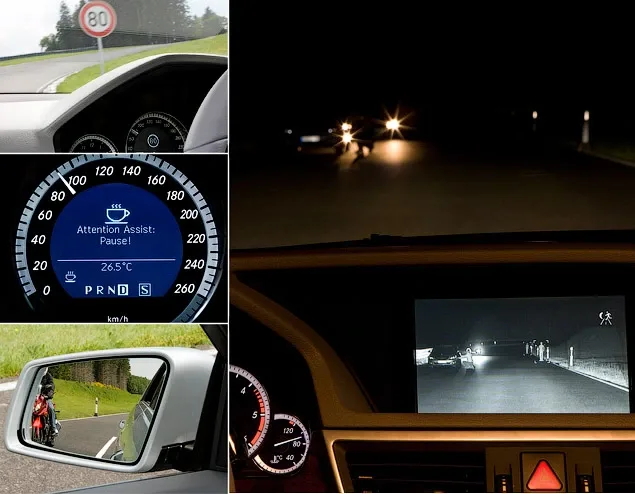
Already approaching the hotel, at the end of the first day of the Russian presentation of the new Mercedes-Benz E-Class, a coffee cup icon appeared on the large display in the instrument cluster. The car once again showed concern for me and suggested I take a break. The Attention Assist system, which is standard on all "E-Class" models, compared data on my driving style at the end and beginning of the trip and decided I had lost concentration. Strange, since I didn't feel any fatigue myself... But I'll have to take the smart electronics at their word - after all, it monitors the driver's behavior across 70 parameters: speed, longitudinal and lateral accelerations, pedal presses, steering angles, deviation from a straight-line trajectory, trip duration, and even wind strength and road surface irregularities.
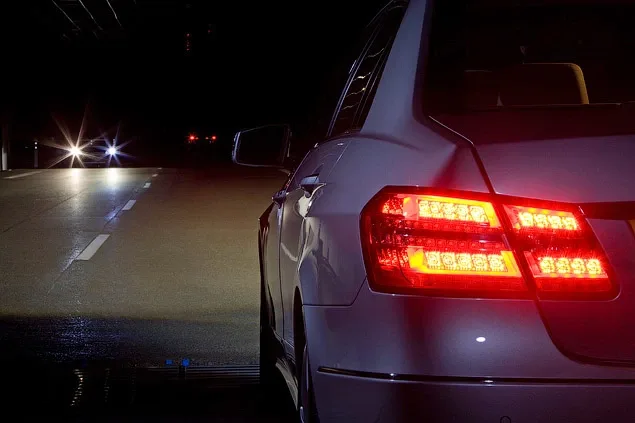
I saw the new E-Class in person only at dusk, so I couldn't immediately examine the car's exterior. From the overall look of the new model, my eyes only caught the LED daytime running lights in place of the usual fog lights and the LED taillights. By the way, depending on the equipment variant, the new "E-Class" can have up to 354 LEDs in total.
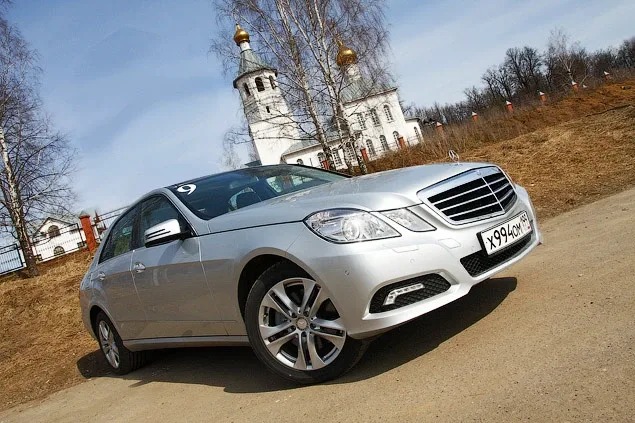
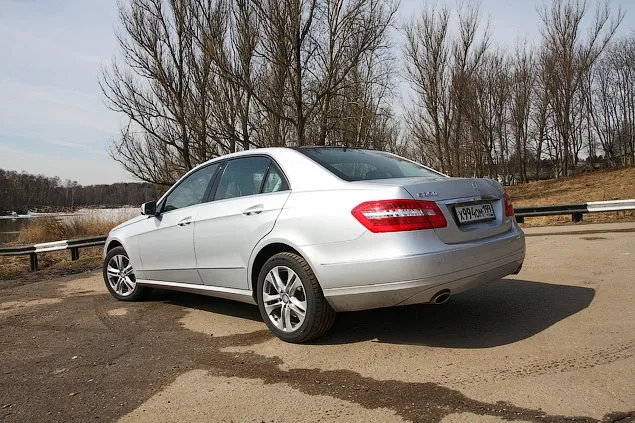
But the next morning, the car appeared in all its glory, and now I can confidently say that in reality, the car looks much nicer than in photos. Yes, its appearance is unusual and even controversial: the rounded forms of its predecessor are a thing of the past, the famous "four eyes" have lost their oval shape, and the body has become angular - in the style of the GLK crossover and C-Class. But if the previous E-Class seemed to me to have gone soft compared to its competitors, the new one is fit and sporty.
The body of the new "E-Class" is completely new. Its torsional rigidity has increased by 30 percent, and the car itself has become 20 millimeters longer, 32 millimeters wider, and 13 millimeters lower than its predecessor. The new sedan has such well-thought-out aerodynamics that even the protruding side mirrors don't affect it: the drag coefficient is 0.25 both with and without mirrors installed.
And the more you learn about this car, the more you're convinced that absolutely everything in it is emphatically functional and made not just for looks. For example, the hood: in the event of a collision with a pedestrian, it "pops up" to soften the impact. But if a minor accident occurs and the hood isn't damaged, it can be easily returned to its original position - as if nothing happened...
I couldn't get acquainted with the new line of gasoline CGI engines with direct fuel injection and turbocharging, which replace the "classic" supercharged Mercedes-Benz engines, during the Russian E-Class presentation - it turns out that production of such power units will only begin in the summer. So for now, sedans with the "old" 3.0-, 3.5-, and 5.5-liter engines in the E 300, E 350, and E 500 modifications will be sold here. Moreover, the first of these was kept specifically for our market, since a similar version was very popular with its predecessor.
All three engines can only work with a seven-speed automatic transmission. Moreover, for versions with six-cylinder engines, the automatic transmission selector is located on the steering column, while for less powerful four-cylinder versions with direct injection, it will be placed in the more familiar location - on the center console. So now you can tell which engine is installed on the new sedan not only by the badge on the trunk lid but also by the position of the gearshift lever.
Speaking of badges. If earlier the numeric index in the model name indicated engine displacement, now it only signifies the power output of a particular modification. For example, the E 200 CGI and E 250 CGI will be equipped with a "turbo-four" with a displacement of 1.8 liters, but with different levels of tuning: in the first case, the engine develops 184 horsepower, and in the second - 204.
The third new engine is a V-shaped "six" 3.5 with direct fuel injection, producing 292 horsepower. However, unlike other "direct injection" engines, it won't be supplied to us. But on four-cylinder versions, Russians will be able to save fuel thanks to a set of measures called BlueEFFICIENCY. Such cars are equipped with special shutters on the radiator fan that remain closed under low engine loads, improving aerodynamics and saving 0.2 liters of fuel per hundred kilometers at a speed of 130 kilometers per hour, a switchable air conditioning compressor, and tires with reduced rolling resistance.
The new E-Class will have three diesel versions in Russia - the E 220 CDI and E 250 CDI (both powered by a 2.1-liter unit producing 170 and 204 horsepower respectively), as well as a 3.5-liter six-cylinder with 231 horsepower. A bit later, all-wheel-drive versions will appear on our market (for the petrol and diesel E 350 and for the "500"), and even the "crazy" AMG sedan with a 6.2-liter V8 engine producing 518 horsepower.
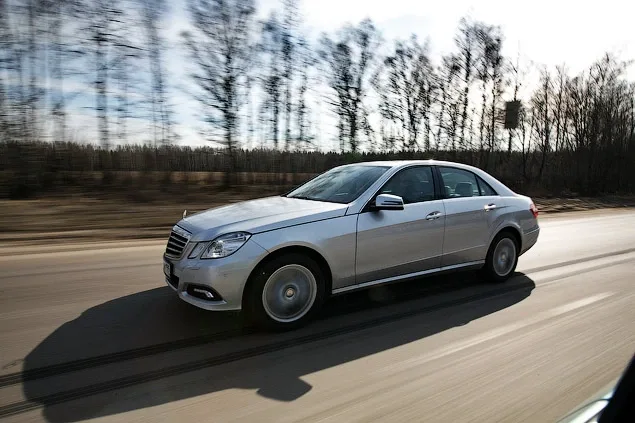
The first car I got to know was the future sales hit - the "E" with a three-liter 231-horsepower engine. On roads battered after winter, the car rode smoothly, barely noticing bumps, but without annoying "nose dives" during braking or "squats" during acceleration. The main credit for this goes to the adaptive dampers already familiar from the C-Class and GLK crossover, which can independently adapt to specific road situations. Moreover, they operate on pure hydromechanics - without electronic assistance. Here, a special bypass valve and a distribution piston moving in a separate oil chamber manage the changes in damping characteristics. When driving on a "moderately beat-up" road, at small damper rod strokes, the piston directs oil into the bypass channel, "loosening" the damper and making the ride softer. And on smooth roads, the suspension "tightens up," reducing body roll and more firmly handling small bumps.
In city traffic, the 7G-Tronic gearbox works well even in "comfort" mode, shifting to higher gears in advance and saving fuel. By the way, at traffic lights and in jams, it can independently shift to "neutral," thereby reducing the load on the engine. But the driver doesn't notice this at all - there are no vibrations or jerks, and as soon as you take your foot off the brake pedal, the gearbox itself engages "Drive" mode.
Once out on the open roads of the countryside, I finally wanted to floor the pedal and do a bit of spirited driving. Despite having the weakest six-cylinder under the hood, the car turned out to be quite peppy - even the 75-kilogram weight increase didn't hinder it. According to the specs, acceleration from zero to 100 km/h takes 7.5 seconds for the new sedan, so you don't feel "inadequate" in such an "E." At least until you switch to the version with the 5.5-liter V8…
What costs how much?
In Russia, prices for the new E-Class will start from 45,900 euros (for the E 300 version) or from 2,065,500 rubles at an exchange rate of 45 rubles per euro. The Mercedes-Benz E 350 and E 500 will cost 50,900 and 68,500 euros respectively. In July, production of cars with CGI engines, all-wheel-drive, and diesel modifications will begin. Prices for these versions are not yet known. Traditionally, Mercedes-Benz will also offer the "E-Class" in a "special series." For example, the E 300 will get parktronic, suspension with increased ground clearance, an anti-theft package, heated front seats, leather interior trim, front seats with "memory," engine protection, and a metallic-painted body, and all this will cost the buyer 51,900 euros or 2,335,500 rubles. |
With such an engine and air suspension, pre-set to "sport" mode, the sensations from the car change radically. During a sharp start from a standstill, passengers' heads are thrown back into the headrests by the acceleration, and the car, growling with its engine, lunges forward sharply, as if trying to prove that the manufacturer's claimed 5.3 seconds to "60 mph" is not a PR stunt. The E 500 is a fast car that can and loves to drive actively. Fast, but not "angry"… And that's probably right - let the passion for maniacally "devouring" asphalt remain with the AMG E-Class, while the "500" remains a comfortable business sedan capable of high-speed "bursts" along country highways…
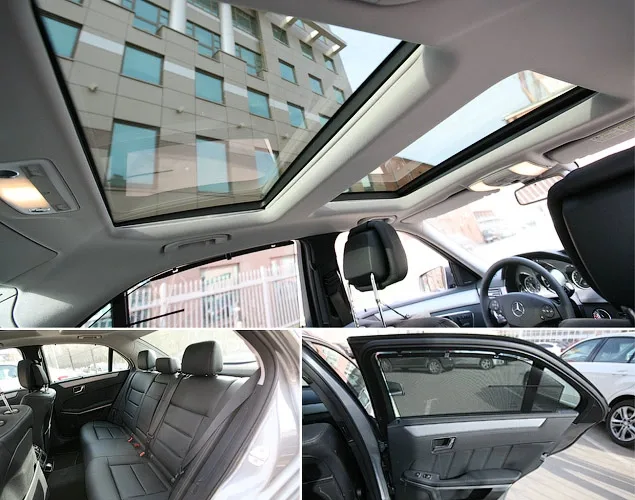
I spent the last hours of the presentation in the spacious back seat, adjusting the climate control to my liking, closing the window shades, and studying press materials, which were especially pleasant to read in the sunlight streaming into the cabin through the glass sunroof (which, by the way, automatically closes in case of rain).
It turns out that the new "E-Class" now almost matches the flagship S-Class in the number of complex electronic systems. For example, the "E" will feature a night vision camera that displays the image on the central console screen. Moreover, for the new sedan, this system has been upgraded: at distances up to 90 meters ahead of the car, it can recognize pedestrians standing on the roadside or crossing the road and draw the driver's attention to them by highlighting their silhouettes with a special frame.
For the new E-Class, you can order a lane departure warning system, a blind spot monitoring system (which should come in handy because the "aerodynamic" rearview mirrors are very small), a traffic sign recognition system, and adaptive cruise control that operates in the speed range from 0 to 200 km/h and can, in an emergency, slow the car down to a complete stop. It's a pity that in Russia all these systems are not yet available: it's all about the radio frequencies on which the active cruise control and its subsystems operate - in our country, they are still closed for civilian use.
But overall, getting acquainted with the new Mercedes-Benz E-Class left the feeling that the future described in science fiction novels is not far off. After all, this car is already almost ready for autonomous movement, without driver involvement.
Judge for yourself: the car can recognize speed limits from roadside signs on its own, control the space around it and the distance to the car ahead, and the navigation system allows the electronics to set the direction of travel. All that remains is to connect all this to the steering, bypassing the driver, and the autopilot is ready. So, perhaps in a couple of decades, the job of an automotive journalist will boil down to describing what material a single button - "Enable Autopilot" - is made of and with what force it is pressed…