
Free choice
More choice - these words began the European presentation of the updated Land Rover Freelander crossover; they were spoken over dinner with LR marketers and engineers in conversations about the restyled "Freel". They also explain the reason for the restyling of the "Freelander" already in the fourth year of its life cycle.
in the appearance of the Freelander 2011 model year
there is no trace left
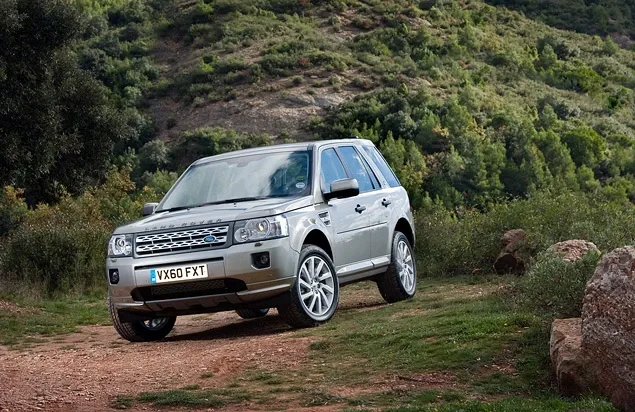
More choice for Russia means expanding the engine lineup with two new turbodiesels, and for Europe - also the appearance of a front-wheel-drive version of the Freelander in the model range. Yes, yes - this is the first front-wheel-drive Land Rover in the history of the British brand.
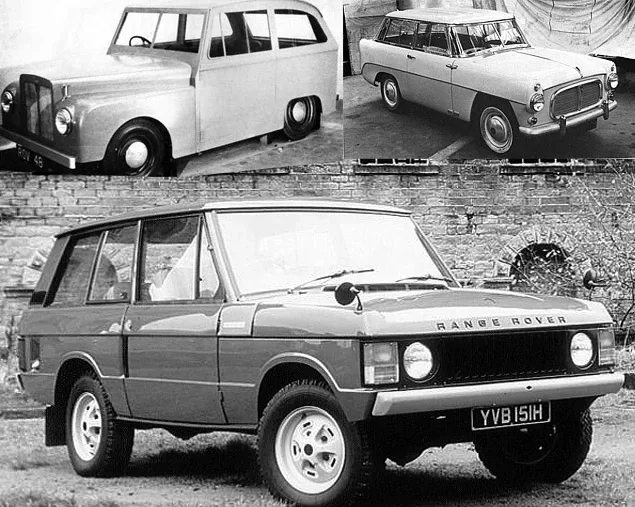
However, Land Rover has already experimented with front-wheel-drive models - for example, the rear-wheel-drive Road Rover prototype marked the beginning of the modern Range Rover family. True, such a car did not go into production: the British decided to make all-wheel drive part of the brand's image and have since produced only real SUVs.
But times change, and with them, consumer preferences change. Now front-wheel-drive modifications occupy almost a quarter of the European crossover market, and their share continues to grow - even Land Rover cannot afford to ignore such a large market segment. Moreover, the Freelander 2WD can be used to test technologies for the new Range Rover Evoque, which is built on the same platform and will appear by the summer of next year.
And from the point of view of European consumers, the front-wheel-drive "Freel" has many advantages: firstly, by abandoning the Haldex coupling in the rear-wheel drive and simplifying the transmission as a whole, such a Freelander weighs 75 kilograms less. This means it is more economical - average fuel consumption in the combined cycle is less than four liters per hundred, more environmentally friendly - carbon dioxide emissions are only 158 grams per kilometer, and allows its owner not only to visit gas stations less often, but also to save on taxes.
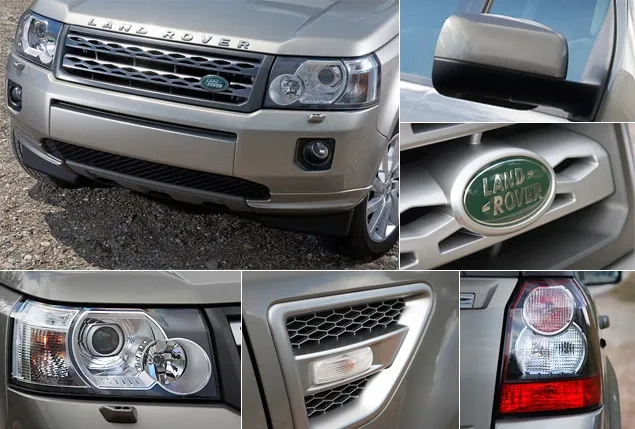
Plus, the internals of the headlights have changed, the rear lights have been slightly updated, and the side mirrors have grown in size by 10 percent and now provide almost exemplary visibility. Moreover, when reverse gear is engaged, the right mirror tilts, showing the rear wheel - this is very convenient when maneuvering in a parking lot or in difficult road conditions.
Another change that is invisible at first glance is the new emblem. More precisely, its new color scheme: the green background has become brighter, and the inscription "Land Rover" is now made in "silver", not "gold", as before.
However, in Russia, the second largest market for LR Freelander in Europe after the UK, the front-wheel-drive version will not be available. However, this is logical - a front-wheel-drive Land Rover with a manual transmission (and an "automatic" for front-wheel drive is not provided in principle) is unlikely to be bought here. But both versions of the new 2.2-liter turbodiesel - with 150 and 190 horsepower - will be brought to Russia. More choice!
There will indeed be plenty to choose from: the 150-horsepower diesel can be equipped with either a manual gearbox or an "automatic", while the 190-horsepower version will be available only with the new-generation Aisin Warner AWF21 automated transmission. Structurally, the gearbox has hardly changed, but there are many minor refinements. A different friction pack with a reduced hydrodynamic resistance coefficient is used here, and the torque converter itself now locks up in a wider range of speeds, which reduces fuel consumption and improves the car's response to the accelerator pedal.
Plus, the calibration of the control electronics has completely changed - gears now shift faster, and at idle in Drive mode, the gearbox tries to reduce the load on the torque converter by using a "pseudo-neutral" mode.
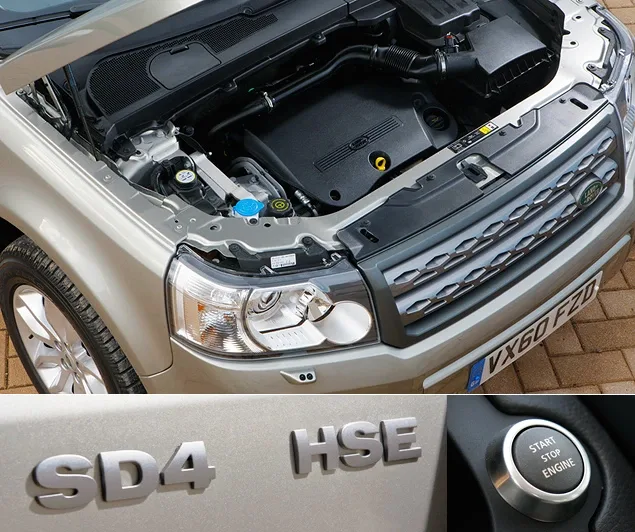
Another task facing the engineers was to reduce parasitic engine losses. New piston rings with reduced friction appeared, modernized main bearings, and braking energy is now not wasted, but is used to recharge the battery. Plus, the new engine has become quieter by two decibels thanks to a new oil pan that reduces vibrations, an additional rubber pad on top of the engine, and a new, stiffer front timing cover.
The "Stop-Start" system, familiar from the pre-restyling "Freel", was slightly modernized and is installed on diesel cars with a manual gearbox. The engine start time has been reduced from 900 milliseconds to 700, and now "Stop-Start" works at temperatures up to 0 degrees Celsius (previously it was deactivated when the temperature dropped below plus 4 degrees).
On the move, the new gearbox is good. Especially in combination with the most powerful turbodiesel - these were the cars available to Russian journalists at the European presentation of the restyled "Freel". The "automatic" is quick, changes gears smoothly, and willingly downshifts even without "kickdown".
The start from a standstill of the 190-horsepower "Freel", however, is not impressive, despite the passport 8.7 seconds in the "acceleration to hundred" column. But on the highway, the new diesel is magnificent! In the speed range from 80 to 130 kilometers per hour, the Freelander accelerates with an ease unexpected for a crossover. Slightly press the accelerator, forcing the gearbox to drop one gear, and enjoy the solid pickup provided by 420 newton-meters of torque. And even at higher speeds within one gear, the car accelerates very willingly.
And with comfort on the highway, everything is very good: the "Freel" holds the straight line perfectly and confidently writes high-speed turns, works out all the joints and cracks in the asphalt collectedly even on 19-inch wheels, and pleases with clear feedback between the steering wheel and the wheels - thanks to the traditional hydraulic power steering with its natural effort on the steering wheel.
Interior
|


Up to 100 kilometers per hour, the LR Freelander's cabin is quiet, and passengers can talk in hushed tones. However, as speed increases, aerodynamic noise becomes noticeably greater: tires start to hum, wind howls around the huge side mirror "ears" - even though they became 10 percent larger during the restyling. The aerodynamics of the "Freelander's" body seem far from ideal - it's no wonder the crossover's top speed is only 190 kilometers per hour.
But on Spanish mountain serpentines, the Freelander feels uncomfortable - it noticeably rolls, leaning onto the outer front wheel, noses down during hard braking, and the "long" steering wheel has to be turned at fairly large angles, requiring hand-over-hand steering. The gearbox in "Drive" sometimes forgets to downshift when exiting a corner, making the engine strain and drone at low revs for a while - for a more aggressive driving rhythm, "Sport" mode is better suited, as the transmission holds gears longer and downshifts faster in response to sharp throttle inputs.
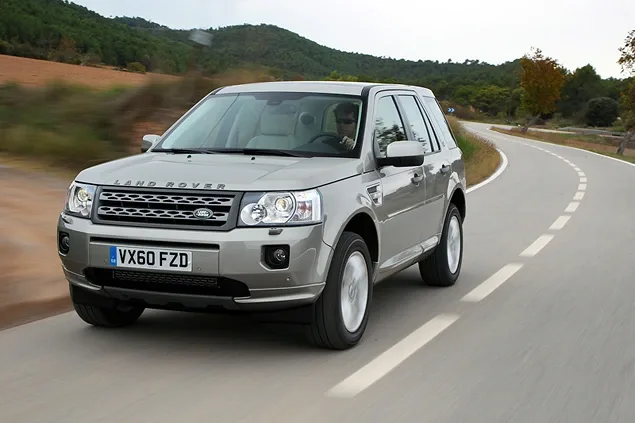
The "Freelander's" element is not asphalt highways, but country roads, dirt tracks, and broken secondary roads. On the dusty gravel road leading to the local Land Rover Experience off-road center, located in the foothills, the Freelander literally flies. It's not afraid of potholes, small washboard waves left by tractors, or large crushed stone on the shoulders - the energy-intensive suspension absorbs all irregularities without bottoming out, firmly and very elastically.
flies, unafraid of potholes or bumps
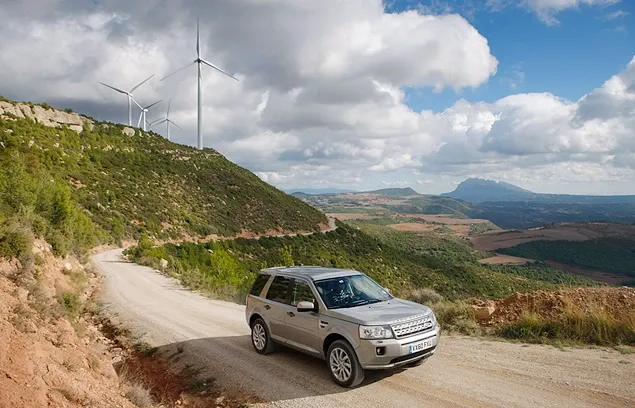
However, the 10-minute dirt road test turned out to be a piece of cake compared to the route prepared for the "Freelander" on the off-road section of the test. Instructors from the local Land Rover school gathered us into columns of 5-6 cars, explained the driving principles, and casually mentioned that the off-road drive would take us about... an hour. An hour! We were expecting at most a 15-minute ride on hard-packed "elephant trails" with a couple of man-made puddles.
Not so! And calling it a "track" doesn't even fit: the hour-long route was laid out along abandoned rocky roads and mountain trails, and sometimes even "by azimuth" - for example, straight down a rocky slope between two sections of a barely visible path. You wouldn't even dare walk there on foot, let alone drive a car. But the "Freelander" just crawled over boulders and sharp rocks behind the instructor's LR Discovery, shod with aggressive off-road tires and with the air suspension raised to maximum height. It crawled without low range or lockers, on road tires, and never once scraped its underbody or bumpers on rocks.
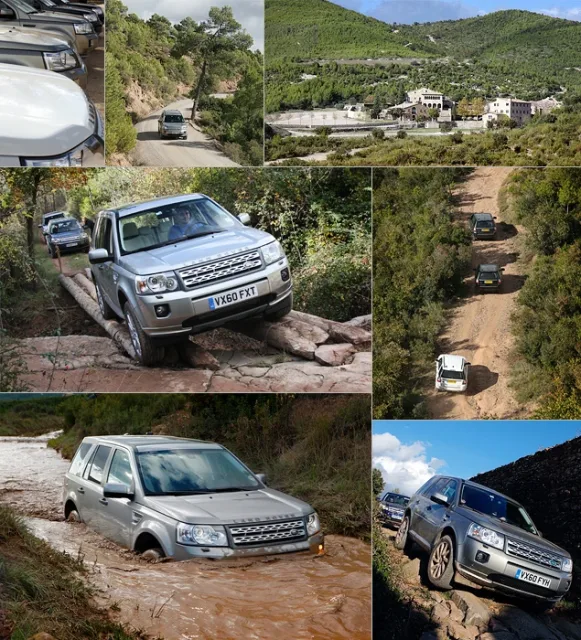
The mountain route included log bridges over ravines, muddy puddles (though with a fairly solid bottom), and rocky ascents and descents. There was even a section with fords - once natural, but clearly improved later. From inside the car, it seems very deep, but in reality, the water barely covers the "Freelander's" sills. However, even truly deep puddles don't scare the crossover - the wading depth is 50 centimeters.
Of course, we assured ourselves, on such off-road terrain, geometric off-road capability plays the main role, and the LR Freelander is very good in that regard: ground clearance of 210 millimeters, approach and departure angles of 31 and 34 degrees respectively - not every SUV can boast such figures. Plus, the signature Land Rover TerrainResponse system, which really helps the driver in difficult conditions: for example, selectively braking wheels on rocky descents or raising the threshold for the traction control system, allowing the wheels to slip slightly when climbing on loose soil.
And the traditional "automatic" on such a route turns out to be much preferable to a "manual". Thanks to the torque converter, it compensates for the lack of torque at low revs, which modern diesels suffer from, and allows crawling at a snail's pace without fear of stalling in the middle of an ascent, or, for example, smoothly pulling away on a smooth stone slab without wheelspin, which could result in uncontrolled sliding of the vehicle.
gave not a single reason to doubt
its off-road capability
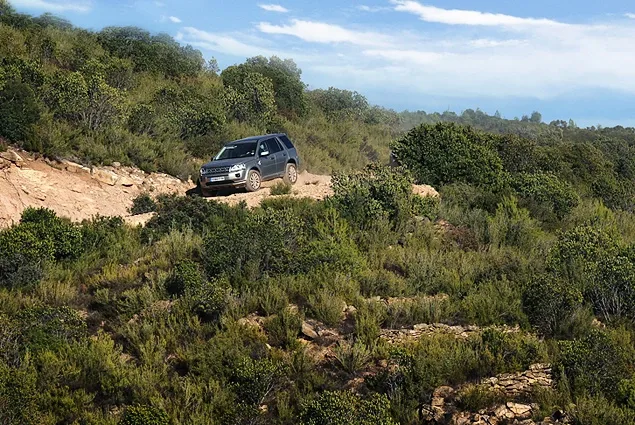
Of course, the right mood during this trip was also created by the instructors themselves, who stood at difficult sections of the route and with serious faces helped drivers overcome the next obstacle and not sit on the underbody on a huge boulder. But at dinner, we learned that even a front-wheel-drive "Freelander" can handle this same route without problems... "How else? It's a Land Rover," the instructors shrugged with a smile in response to our colleagues' bewildered looks.
But this in no way diminishes the merits of the all-wheel-drive Freelander - it only speaks to how good its front-wheel-drive version turned out to be.
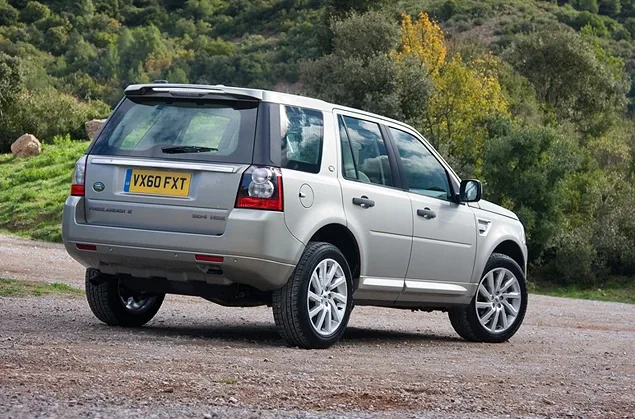
In Russia, orders for the restyled LR Freelander are already being accepted. The base "Freelander" with a 150-horsepower diesel and manual gearbox can be bought for 1.174 million rubles, and this trim includes power accessories and air conditioning. The version with an "automatic" will cost almost 320 thousand more, but it will be much better equipped - climate control, rain and light sensors, all possible power drives, advanced audio, and so on.
For the top 190-horsepower diesel, you'll have to pay from 1.545 to 1.8 million rubles, depending on the trim, which, however, is not that much compared to competitors in the premium segment. And there's also a version with an inline six-cylinder engine, available only in the maximum trim and costing more than two million rubles.
More choices? Unfortunately, that's all for now - at least until Russians figure out the advantages of front-wheel-drive crossovers. Auto.Lenta
Alternatives
|
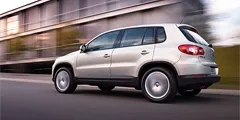
Technical specifications of the Land Rover Freelander
| 2.2 TD4 150 MT | 2.2 TD4 150 AT | 2.2 TD4 190 AT | ||
| Length, mm | 4500 | 4500 | 4500 | |
| Width, mm | 2195 | 2195 | 2195 | |
| Height, mm | 1740 | 1740 | 1740 | |
| Wheelbase, mm | 2660 | 2660 | 2660 | |
| Weight, kg | 1785 | 1805 | 1805 | |
| Engine displacement, cm3 | 2179 | 2179 | 2179 | |
| Power, hp/rpm | 150/4000 | 150/4000 | 190/4000 | |
| Torque, Nm/rpm | 420/1750 | 420/1750 | 420/1750 | |
| Maximum speed, km/h | 181 | 181 | 190 | |
| Acceleration 0-100 km/h, s | 10.9 | 10.5 | 8.6 | |