
Lacquered sneakers
While still little known to the general public, he has nevertheless become a regular at social parties and art performances around the world. Carefully intriguing the public and potential buyers, the British company released details about its new creation - the Range Rover Evoque - in small, measured portions. But this time, the British decided to dump gigabytes of information on the press, inviting journalists to a technical seminar on the "Evoque" at Land Rover's headquarters in Gaydon, where the company's research center and test track are located. It is here that all new "Land Rovers" have been born in recent decades.
The goal the automaker was pursuing was to prove to journalists that the Evoque is by no means a copy of the Land Rover Freelander, but a car that its creators worked on for the last three years - since the concept was shown at the Detroit Auto Show in 2008.
perhaps the most stylish crossover on the market
Meanwhile, by 2017, according to Land Rover marketers, the share of luxury SUVs in the market will grow by another 35 percent (today that's 900 thousand cars sold per year), multi-purpose SUVs - by 25 percent (3 million 250 thousand cars sold per year), and demand for cars intended for an "active lifestyle," which currently sell 7 million 750 thousand units a year, will increase by another quarter in seven years! So the "form factor" of the new model and its market positioning turned out to be obvious - a small "lifestyle" crossover with a premium image. All that remained was to build such a car...
The crossover segment attracts automakers like bees to a barrel of honey. The growth in demand for "pseudo-off-road" vehicles is observed in all world markets, and in Gaydon they understand that walking with a high nose, ignoring the transformation of consumer tastes, is at least stupid. And if in the segment of relatively mass models LR already has one successful model - the Freelander, then in the premium sector, which has recently been growing like yeast, the British brand was represented only by the full-size Range Rover and Range Rover Sport.
The most obvious option is to mount a new body on an existing platform, add a couple of new options, and release it. Most mass-market car manufacturers do just that, changing the configuration of the same "carts," engines, and retuning the suspension. At first glance, the RR Evoque might also seem like just a restyled "Freelander." But only at first...
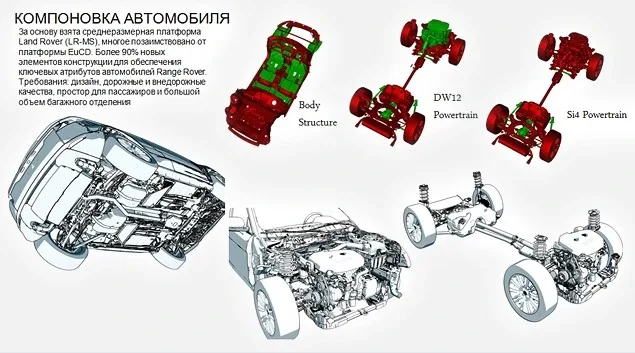
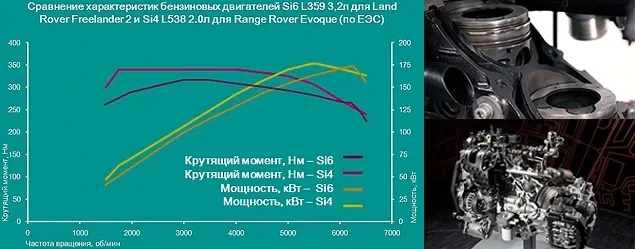
The Evoque is structurally indeed close to the "Fril" - similar MacPherson suspension "all around," an all-wheel drive system with a Haldex coupling, and the same engines - two 2.2-liter turbodiesels with 150 and 190 horsepower respectively, plus a two-liter 240-horsepower gasoline engine unified with the Ford EcoBoost family. But in reality, the "Land Rover people" did a colossal amount of work - they had to radically rethink the design of the platform and body. In fact, this is a completely new car!
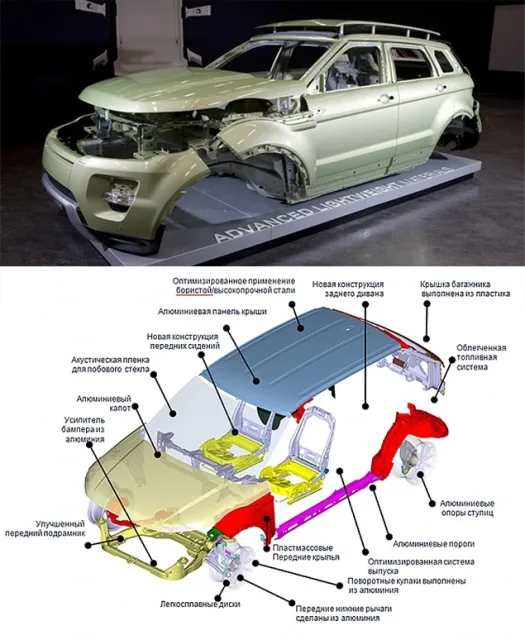
Volumetric laser welding made it possible to make the steel seat frame thinner - the metal thickness ranges from 0.7 to 0.9 millimeters, and the rigidity of the structure is ensured only by the optimal shape of the profile sections - another minus three kilos. Finally, another 6.5 kilograms were saved in the manufacture of the front panel frame from a magnesium alloy.
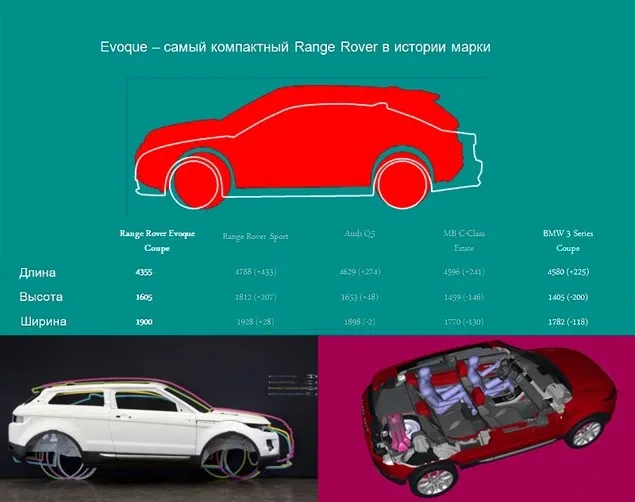
The main problem facing the engineers when developing the Evoque was that the car had to be as similar as possible to the LRX concept, down to the details. And if the engineers had simply mounted the LRX body on a regular Freelander "cart," the car would have turned out either too cramped, or too tall, or too low-slung with a small ground clearance. Therefore, the designers had to rework the entire layout of the car - to ensure decent Land Rover geometric off-road parameters on the one hand, and enough space for four passengers in the cabin, a low center of mass, and acceptable aerodynamics on the other.
The car can ford water up to 500 millimeters deep, and the ground clearance is 212 millimeters, which is 12 millimeters more than the Freelander. In terms of geometric off-road parameters (approach angle - 25 degrees, ramp angle - 22 degrees, departure angle - 33 degrees), the Evoque is inferior to the "Fril," but wins in all indicators against formal competitors - the Audi Q5, BMW X1, and X3.
The front pillars and roof were moved forward by 50 millimeters, which allowed raising the rear pillars by 35 millimeters and keeping the striking sloping roofline without compromising interior space. To maintain off-road capability, the shape of the underbody (the floor thickness was reduced) and the 70-liter fuel tank had to be changed, as well as the exhaust system configuration; the rear suspension geometry was optimized, and the front and rear subframes were modernized. All this, in turn, forced a rethink of the engine compartment design - it was necessary to revise the shape of the bumper reinforcement and suspension strut mounts. They also had to fiddle with the placement of the diesel engine: the engineers moved the cooling fan, the air intake with piping, and optimized the engine mounts.
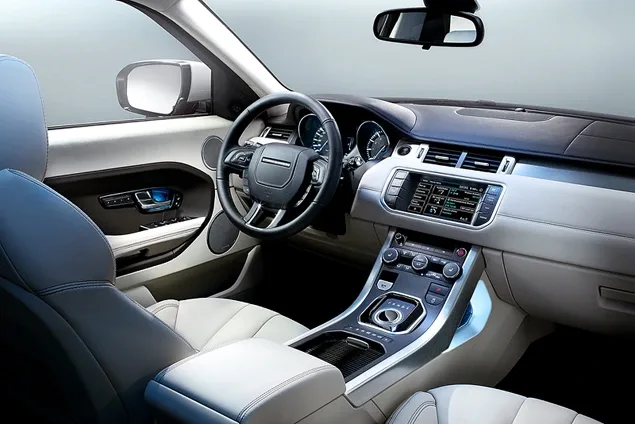
The new multimedia system received a simple and very clear interface with an advanced voice command recognition system - its "lexicon" has become 30 percent richer. The monitor, like on the big "Ranges," is based on Dual View technology, which allows seeing different images on one screen depending on the viewing angle. On request, the car is equipped with the British 16-channel Meridian Surround sound system - 16 channels with 825 watts of power. At the same time, all multimedia electronics operate on the basis of the MOST bus - a high-speed fiber-optic network with a bandwidth of 25.6 megabits.
And this is only a small part of the changes - in total, more than 20 speakers participated in the seminar, each responsible for their own area, from design to the development of Hi-End acoustic systems. And each of them talked about the innovations that were introduced in the company's latest creation. Look at our illustrations; they clearly demonstrate the amount of work done by the "Land Rover people."
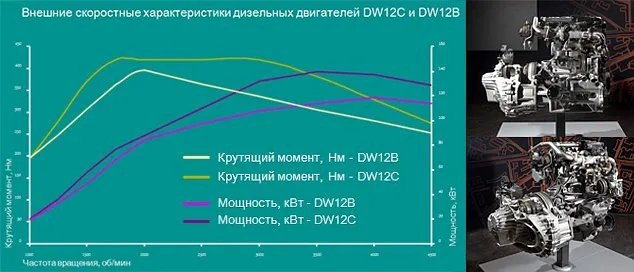
The engine has become quieter - additional sound insulation of the fuel injectors under the decorative cover and double walls at the turbine exhaust pipe have appeared. Despite the fact that the power and torque of the diesel Evoque and Freelander are the same, the "Evoque" engine promises to be slightly more traction-rich "at low speeds" and maintains a flat torque shelf almost up to 3.5 thousand revolutions.
Like most modern automakers, the company actively used a virtual environment to build and refine its crossover, which made it possible to significantly shorten the path from design sketch to real car. In the research center, visitors are proudly shown the "Cave" - that's what they call the 3D visualization room in Gaydon, which allows not only to model a three-dimensional model, but also to work with it, changing certain parameters in real time. The car is drawn here down to every screw and wiring; it can be "immersed" in any environment or setting.
For example, already at the design stage, with the help of the "Cave", you can find out what the visibility on the sides from the driver's seat will be or the geometric cross-country ability of the car. But this is just the tip of the "three-dimensional iceberg": any part can be rotated, removed, rearranged - everything is like in the real world, and this seriously facilitates work in the most hard-to-reach parts of the car. How do you imagine examining the space between the engine shield and the exhaust manifold from all sides live? And here you can climb even inside the combustion chamber. It was in this way that the designers, in particular, optimized the layout of the car. All that is required for work is special stereoscopic glasses with antenna sensors and a special multifunctional joystick.
The aerodynamics of the car were also refined using computers, using the CFD (Computational Fluid Dynamics) method - the so-called computational fluid dynamics, which allows complex calculations of flow processes, forming the geometry of the model and simulating various conditions. The engineers "digitized" the air flow, and then "blew through" and refined the mathematical model of the car on the computer. And to make the calculations as realistic as possible, the engineers used special programs to simulate uneven air flows during tests.
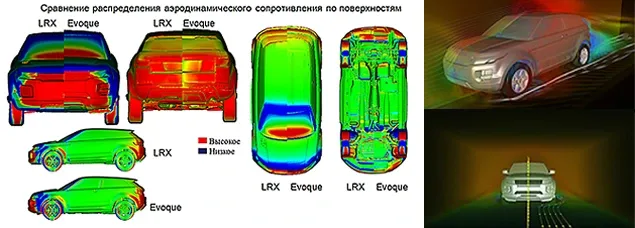
In addition, painstaking work was carried out on the aerodynamics of the elements located under the bottom. The fuel tank received an integrated deflector, fairings were installed near the front wheels, and the location of the middle section of the muffler was changed. To refine the aerodynamics, computational modeling on computers was used - a total of 150 body variants were tested, and three scale models were "blown through" in a real wind tunnel.
But this is all "theory", but what did the "Evoque" turn out to be "in practice"? We will be able to understand all the details of its character only in a few months, when "live" cars appear on sale. However, during the technical presentation, we managed to ride a little on pre-production "Evoques" as passengers along the test track, so we can talk about the first, albeit very fragmentary, impressions right now.
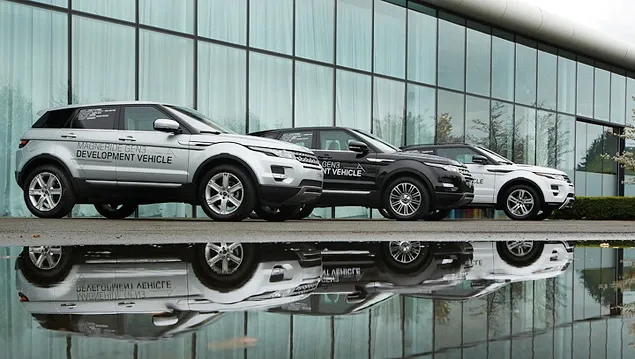
If it weren't for the inscriptions on the outside, the slightly spoiled interior trim, from which bundles of electrical wiring for connecting diagnostic equipment stuck out, the emergency engine and ignition shutdown buttons on the center tunnel, as well as fire extinguishers, it would be hard to guess that these cars were assembled using "bypass technology". Except that on the "coupe" modifications, the heavy doors closed with difficulty - they had to be slammed with force, and on one car, uneven stitching of the leather upholstery on the front panel was noticed.
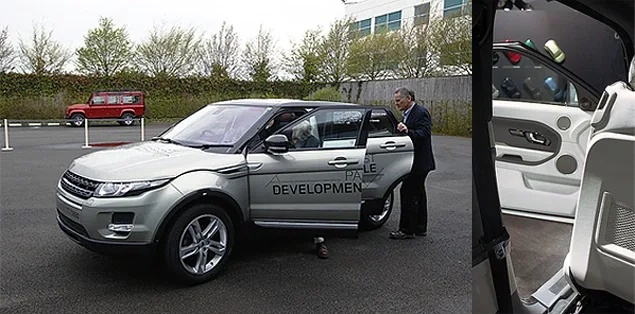
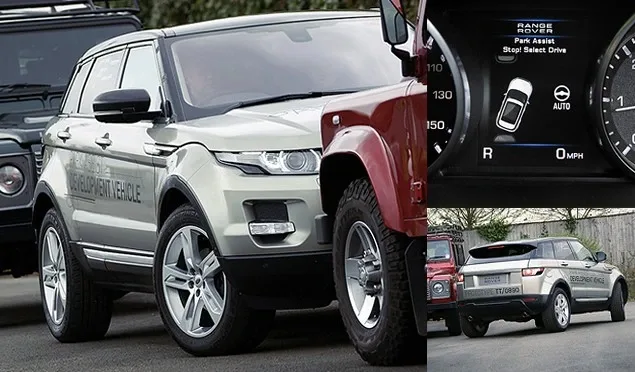
The roads in that part of the test site where we drove resemble our regional highways - with many patches, potholes and completely different quality of the asphalt itself, including a high content of crushed stone. It is hard to imagine better conditions for demonstrating the advantages of the active MagneRide suspension.
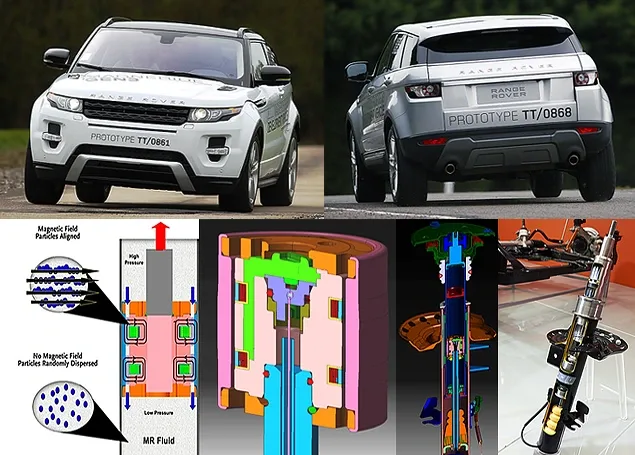
The electronics monitor the position of the car body with a frequency of at least 1000 times per second, and the shock absorbers themselves are able to change their stiffness more than 50 times per second. The system will also work in off-road conditions, changing the level of damping depending on the nature of the irregularities - the electronics automatically determine the transition from one type of off-road to another within a maximum of two seconds.
On the track there were enough bends and turns of various steepness, and the driver was driving by no means at a snail's pace, in places accelerating to 140-150 kilometers per hour. However, the crossover imperturbably softly but confidently "slapped" along the uneven road, did not shake the soul on the washboard and almost "like a passenger car" moderately leaned in corners. At the end of the run, we were waiting for a jump over a small bump-springboard: it shook quite well, but the Evoque landed very tightly without breaking through and drove on. The only remark that arose during the short trip is that the cabin could have been quieter, since we are talking about a "premium" car. On the test prototypes, road noise penetrated into the cabin, but by the time of serial production, the sound insulation will certainly be refined.
And it's a pity that we didn't get to drive off-road - it would be very interesting to find out how this "gentleman" behaves in the mud.
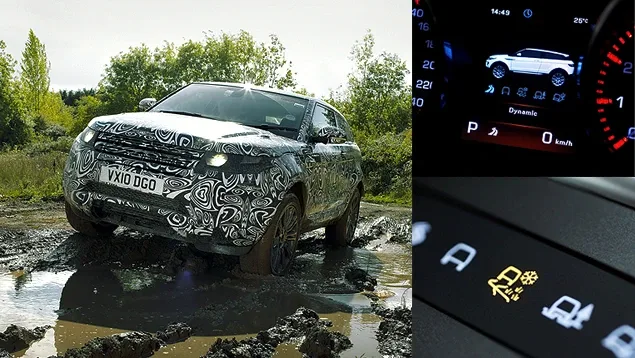
To get an idea of the car, 15 minutes "in the right seat" is, of course, not enough. But our trip to England had a different purpose. The task of the multi-hour presentation was to show that the Evoque is not just a modification of the Freelander. That it truly deserves the right to bear the letters Range Rover stretched across the full width of the front edge of the hood. And with this task, Land Rover's engineers, marketers, and PR specialists did an excellent job. They really created an interesting car that you really want to drive in person.
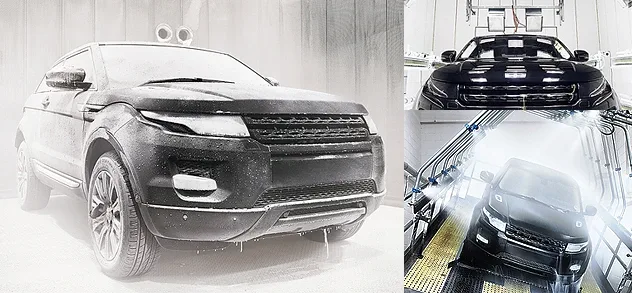
For high-speed tests, the developers went to European autobahns and race tracks (eight thousand kilometers on the Nürburgring and 50 thousand kilometers on the ring in Nardo). Off-road tests were conducted in the UK at army proving grounds used for testing tanks and artillery tractors, as well as at the Eastnor Castle, MIRA, and Gaydon test facilities.
And it's not just us journalists who want it - Land Rover has already received more than three thousand pre-orders for the car, which only a few have seen in person. However, the wait is not long - the cars will appear in Russia this coming autumn. Moreover, at very "tasty" prices. Auto.Lenta
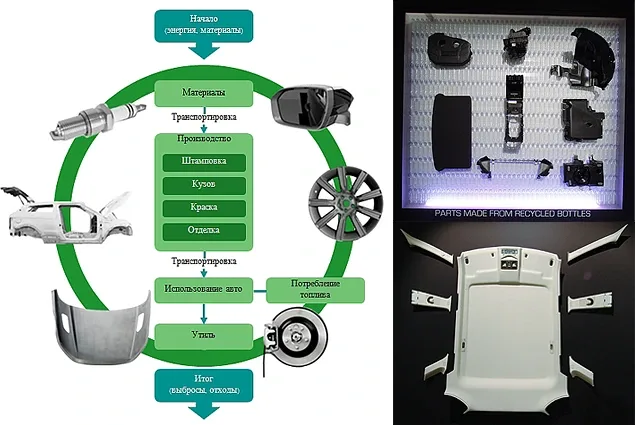
Recycled plastic is also used in the manufacture of wheel arch extensions, the decorative engine cover, the air filter housing, the fan impeller and shroud, air ducts, floor mats, the luggage shelf, and the subwoofer housing. The same applies to aluminum parts, 95 percent of which are obtained through recycling.