Just a Jeep with all four wheels turning. I came up with a slogan for it: Jeep Liberty — freedom from the conventions of the car market.
WANTED ALL MY LIFE
It's hard for us to get used to such a simple approach. Americans find it easier. For them, a car is like a toaster. Bought it, used it, sold it. Don't like it — swapped it. For us, a car is elevated to a cult, which is facilitated by customs duties. That's why we're always dissatisfied: why is the plastic so cheap? Why does the door panel rattle? The cabin is noisy. The suspension bottoms out. And so on. A Russian person can be understood. He dreamed all his life... and now everything should be flawless, and if there's some "cricket," it's not just a mood, but the whole life goes down the drain.
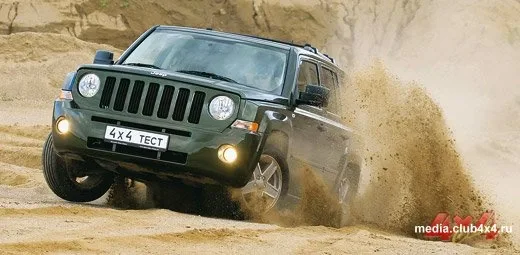
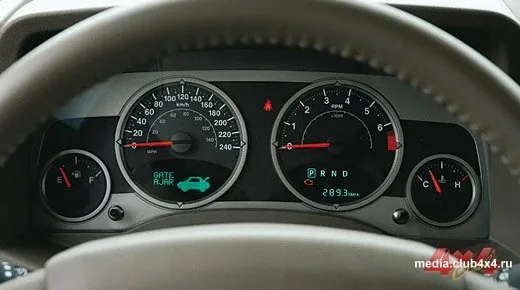
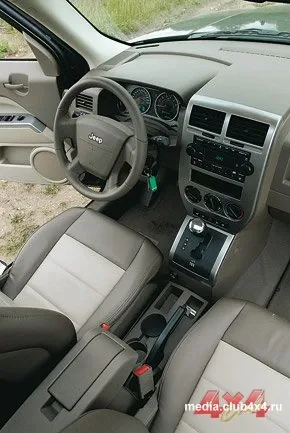
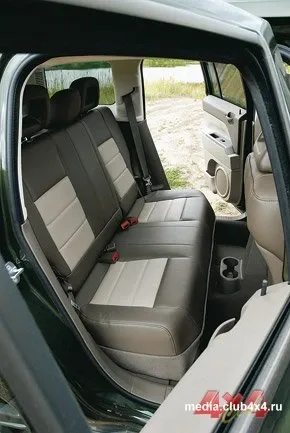
With such an attitude, approaching the Jeep Liberty is pointless. See for yourself. A prospective buyer sits behind the wheel and jumps out a minute later. He was scared by the trim. It reminded him of the VAZ-2108, which he dreamed of getting rid of for 15 years. The price could have reconciled him with such cheap trim materials. No one would have said a word if the new Jeep crossover cost around $18-20 thousand, as in the US. At least a few people in the editorial office were willing, but not for $30 thousand. Too bad. The crossover is unusual. I even know how to make it almost perfect. Camouflage paint, detachable front bumper, aggressive tires. Then, being lightweight and having a modern traction control system, it — within its class — would not disgrace the family honor.
MAYBE DARKER?
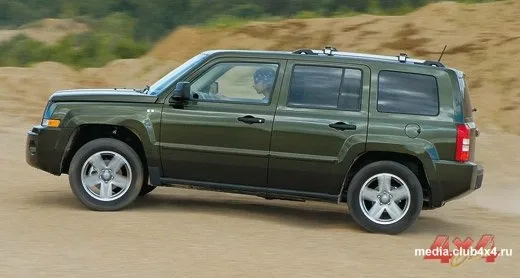
In terms of the powertrain base, the new Liberty is a blood relative of the Compass, but the brothers have different characters. Compared to the Liberty, the Compass is just mush. Many mocked the Compass, predicting buyers only among sexual minorities, but the Liberty has been spared such mockery by designers. For our country, that's already a lot, but they also retuned the suspension. The crossover's behavior is significantly more composed on straights, in corners, and over bumps — in all modes, the car handles better.
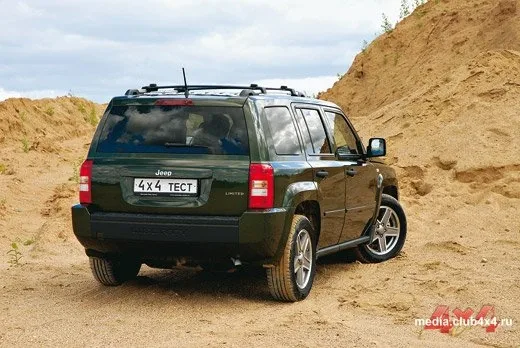
What can its competitors do? The Mitsubishi Outlander XL holds the road much more precisely, and the new Nissan X-Trail is more comfortable on dirt roads and rocks, but it's also more expensive. The Outlander XL costs $40 thousand in base trim, and the X-Trail — $35 thousand. The Liberty doesn't justify its $33 thousand only in terms of interior material quality, but as I said, nothing can be done about that. I even asked DaimlerChrysler's vice president Thomas Hausch whether the company intends to do anything about the trim. Thomas agreed that the materials are... practical and perhaps they should be made darker so they don't look cheap. How quickly these Germans started thinking in Chinese, that is, excuse me, in American. It seems the only move left is to upholster the panel in leather ourselves. But what about the doors and ceiling?
SPECS: JEEP LIBERTY
THINKS FAST
The Liberty arrived at the editorial office in the same trim as the Compass did in its time. They share the same powertrain base. The engine is 2.4 liters. The transmission is a CVT. There's an option to order a two-liter diesel and a manual. The press fleet doesn't have such a car, but while at the Jeep Camp event in France, I managed to try it. The diesel, as expected, picks up more cheerfully from low revs, but it's very noisy, which overall makes the crossover's character too utilitarian.
Perhaps the CVT is optimal for the Liberty. This type of transmission is today called the most promising. An automatic transmission weighs significantly more, is complex and expensive to produce. The so-called robot, or manual with automatic clutch, looks like a half-measure. The CVT also thinks noticeably faster than an "automatic," which is easy to track by the connection between the accelerator pedal and the tachometer (its needle moves almost in sync with the driver's right foot), and works smoother due to the absence of steps (virtual fixed gears are only in manual mode), and has the highest possible efficiency today (transmits torque from the engine to the wheels with minimal losses). And off-road, the CVT helps to dose torque evenly, without jerks or wheelspin.
The problems are mostly psychological. Not everyone can get used to the rather noisy acceleration, especially when the tachometer needle hangs at 6000 rpm, which is normal for a CVT. Not everyone will like the smoothness of operation, subjectively perceived as a lack of power.
ON THEIR OWN
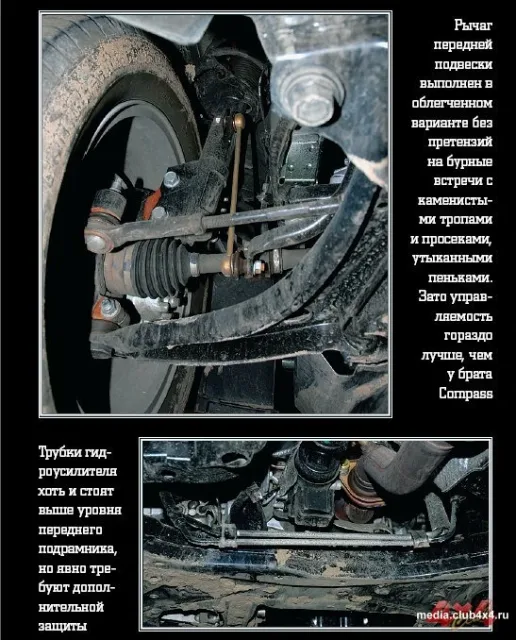
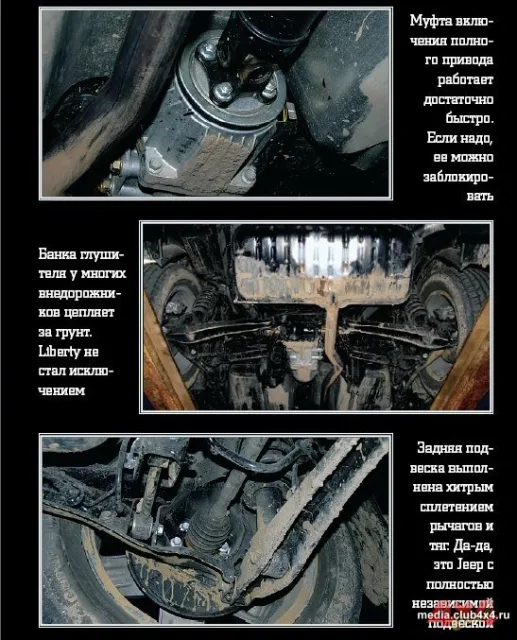
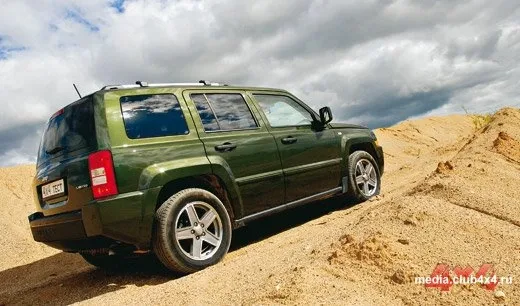
In search of a place for shooting, we drove for hours over sands, dirt roads, and hills. Several times we crossed ambush spots in forest ruts. Off-road, the car behaves decently — of course, for a crossover. The all-wheel-drive coupling works without delays, although it can be completely locked and forgotten. The engine has enough torque since the Liberty isn't burdened with excess weight. But the low and long front bumper and power steering hoses hanging in an unprotected place under the floor prevent relaxation. It seems the manufacturer never thought that anyone would actually drive the Jeep Liberty off the road.
Americans live on their own and for themselves. Perhaps this is unjustified in the long run, but today's tactics are such. Judging by the Jeep Liberty, they don't really care what they say about this crossover in Europe or Russia. They just brought it for sale and clearly don't expect to make a "killing" here. The main consumer of the Liberty lives inside the US.