But after the Great Wall Wingle, the market seemed to be aired out – this is the first Chinese pickup that doesn't resemble a ten-year-old Japanese second-hand. Now it looks like a wombat, or at worst a silly seal, and is nicely finished inside.
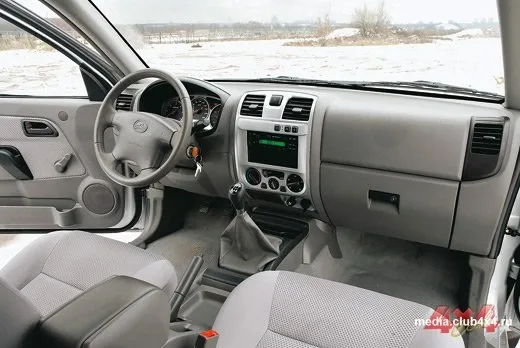
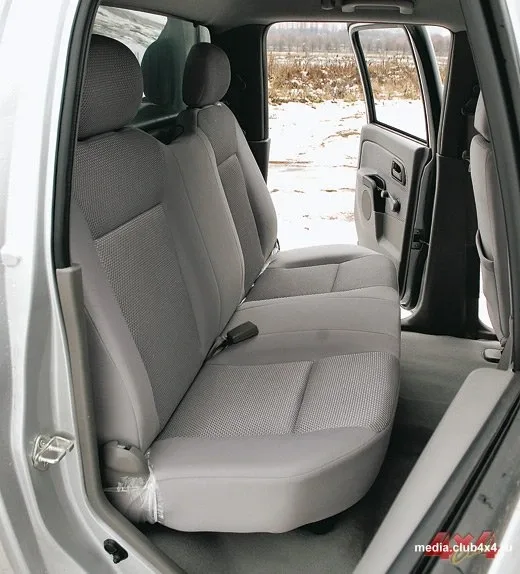
The materials and quality of panel fit are a notch better than those of colleagues from the other side of the Amur. It's only a pity that the build quality didn't affect the ergonomic drawback of Chinese "trucks" – the low seating position. In our case, the seat was slightly raised and steering column tilt adjustment was added, but when you get into the driver's seat, you still feel like you're inside a clothespin, albeit a slightly loosened one.
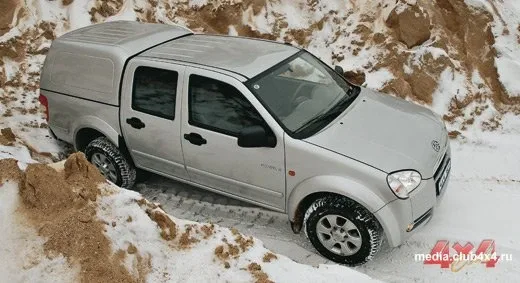
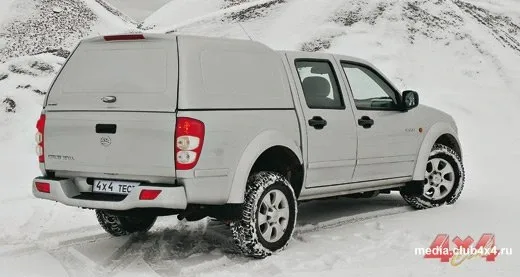
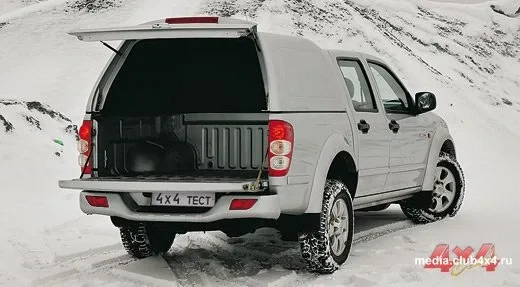
The trim includes a solid hardtop without windows (in Australia it's called a canopy, and in Russia a cover for the cargo bed). Some might be upset by the lack of rear visibility, but I, on the contrary, have always been pleased by the blind rear window. It's not too pleasant to see in the rearview mirror the kindest faces of Russian car owners when you let a frightened pedestrian, worn out by GAZelles, cross the zebra crossing.
"MANUAL WINDOWS" ARE NOT AFRAID OF RAIN
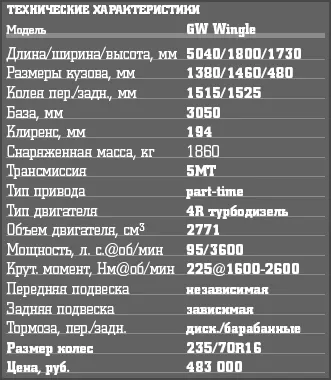
The trim that arrived for our test is priced by the manufacturer at 483,000 rubles ($19,500). This is the most modest version without leather interior, CD player, and power windows. It's a pity we couldn't touch the Chinese leather – it would have been interesting. But the fact that the car turned out to be "on oars," or as they also say, "on a meat grinder," – in general, with manual window regulators – on the contrary, pleased me.
This Chinese electronics is a killer thing. They say they supply the whole world with computers? I've never seen a Chinese PC, but I have a friend who owns a car made in China, and during rain, the speedometer stops showing speed, the fuel gauge stops showing the fuel level, and the parking sensors pretend they don't remember the price of the bumper.
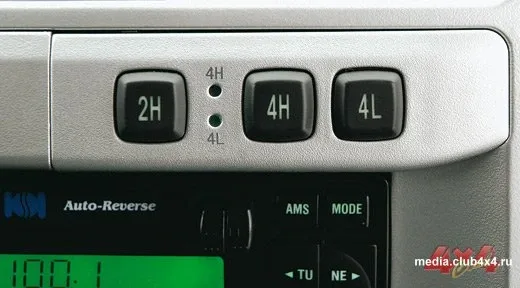
Although the test car had no power windows or parking sensors, the manufacturer couldn't resist electronic control of the transfer case. They probably installed it at the last moment, because the "little box" hangs in the place where you usually sit when climbing over logs and hills.
AT DIFFERENT HEIGHTS, TRYING TO PROTECT...
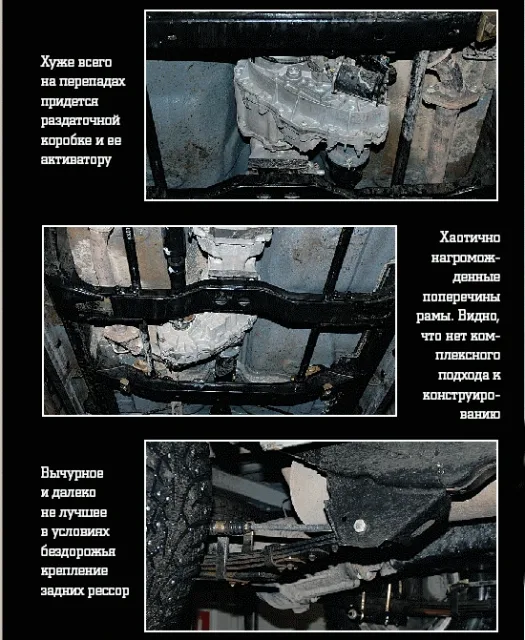
Like any self-respecting diesel SUV, the Wingle starts without throttle blipping both in first and second gear. It drives off-road and climbs hills also without accelerator help. Only the poor geometric off-road capability forces you to keep your foot on the brake, because the pickup's underbody is disfigured by a ridiculous pile of frame crossmembers. They are all at different heights, trying to protect the transmission components, but in reality they just act as anchors. The front bumper also works against off-road driving. It's made as a huge monolithic piece and hangs much lower than would be appropriate. And the ground clearance of the Wingle is less than 200 mm.
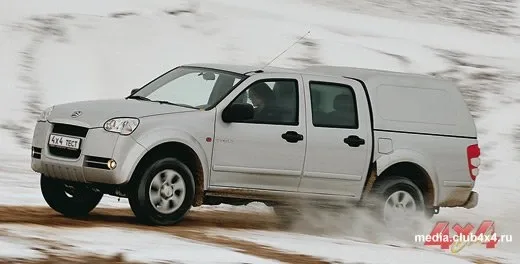
When driving from the field onto the highway, you notice that the diesel doesn't bother the driver with excessive noise, though only compared to other Chinese pickups. The comfortable speed is 100–120 km/h.
You can do 140 if you're not used to driving relaxed, especially since the directional stability allows it.
SPECS: GREAT WALL WINGLE
COMPONENTS FROM JAPAN AND GERMANY
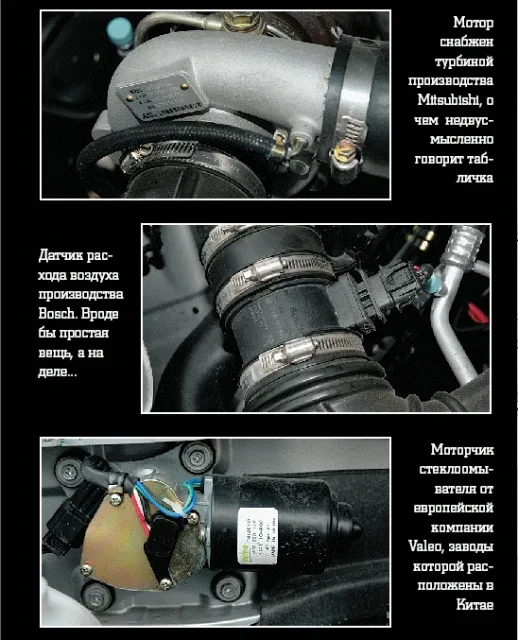
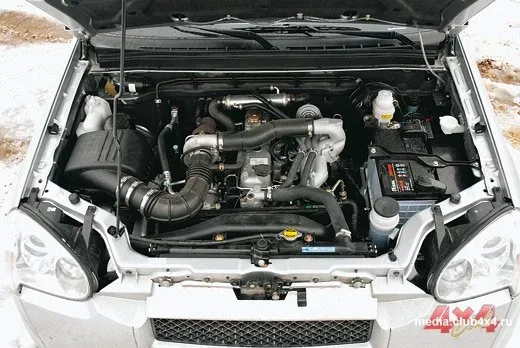
This is already the fourth Chinese SUV with a 2.8-liter diesel that has been tested in our editorial office. Although even dealers don't have exact data on its origin, a visual inspection of the engine and the pilots' internal feelings give a confident answer: the progenitor of the engine, so widely used by Asian friends, was an old Isuzu unit. Only Great Wall equipped it with a common rail system and a turbocharger.

By the way, the turbocharger is Japanese-made, and the turbo valve and air flow sensor are German. They didn't skimp here! Opening the hood, you can find other imported components. The wiper motor is Valeo, the power steering is Bosch. If only it were always like this.
This "Chinese" pleased almost everyone, except for the "aggressive" underbody, the monolithic front bumper, and the car-like seating position. It's well assembled, neatly finished, and well equipped. The incomparably more expensive SsangYong Actyon Sports pickup, for example, has a much worse body rigidity and a smaller engine.
The future buyer should only remember that the maintenance interval up to 50,000 km is 7,000 km, and then the service interval increases to 10,000 km. The driveshaft is replaced every 30,000 km. Tie rods and ball joints – every 22–30,000 km. Wheel bearings, shock absorbers, and gearbox oil – every 15–20 thousand. Checking the body for corrosion – every six months.