
Practice: ticket #92
Answers are checked instantly. The hint — a rules excerpt — is under the question.
-
Question #1 According to the definition of the Traffic Rules, which of these roads can be considered the main road?
Topic: General provisions
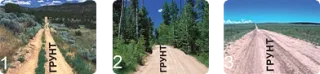
Answer help
main road — a road with a surface relative to an unpaved road or marked by signs 1.22, 1.23.1—1.23.4 and 2.3 The presence of a surface on a secondary road immediately before an intersection does not equate it in importance to the road being crossed; -
Question #2 At the request of a police officer, the driver must stop in compliance with the requirements of these Traffic Rules, and also give the opportunity to check:
Topic: Duties and rights of drivers of mechanical vehicles
Answer help
2.4. At the request of a police officer, the driver must stop in compliance with the requirements of these Rules, as well as:
b) give the opportunity to check the numbers of units and completeness of the vehicle; -
Question #3 This road sign with a plate warns the driver that:
Topic: Road signs (Appendix 1)
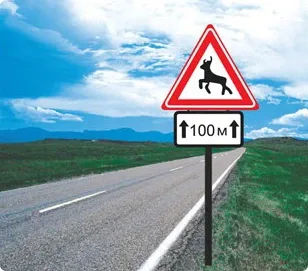
Answer help
1.36. "Wild animals". A road section where wild animals may appear.
7.2.1.—7.2.6. "Area of operation". They indicate: 7.2.1 — the length of the dangerous section marked with warning signs, or the area of operation of prohibition and information-indication signs;
7.2.2 — the area of operation of prohibition signs 3.34—3.37, as well as the length of one or several stopping areas located one after another; 7.2.3 — the end of the area of operation of signs 3.34—3.37;
7.2.4 — that the vehicle is in the area of operation of signs 3.34—3.37; 7.2.5, 7.2.6 — the direction and area of operation of signs 3.34—3.37 in case of prohibition of stopping or parking along one side of a square, building facade, etc. When used together with prohibition signs, the plates reduce the area of operation of the signs. -
Question #4 Do the requirements of these plates differ from each other?
Topic: Road signs (Appendix 1)
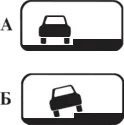
Answer help
7.6.1.—7.6.5. "Method of placing a vehicle for parking". They indicate: 7.6.1 — all vehicles must be parked on the carriageway along the sidewalk,
7.6.2—7.6.5 — the method of placing passenger cars and motorcycles in a parking lot near the sidewalk and with its use. In built-up areas where parking is allowed on the left side of the street, plates 7.6.1—7.6.5 with a mirror image of the symbols may be used. -
Question #5 Is there among these road signs one that would not extend its effect to route vehicles?
Topic: Road signs (Appendix 1)
Answer help
3.1. "Movement prohibited". The movement of all vehicles is prohibited.
3.2. "Several turns". A road section with two or more dangerous turns located one after another: 1.3.1 — with the first turn to the right, 1.3.2 — with the first turn to the left.
3.34. "Stopping prohibited". Stopping and parking of vehicles is prohibited, except for a taxi carrying out boarding or disembarkation of passengers (unloading or loading of cargo).
4.1. "Move straight".
The effect of the signs does not apply:
3.1, 3.2, 3.21—3.24, 3.34 — to vehicles moving on established routes;
3.1, 3.2, 3.35—3.38, as well as sign 3.34 if there is plate 7.18 under it — to drivers with disabilities driving a motorized wheelchair or a car marked with the identification sign
"Disabled";
3.1—3.8, 3.11 — to vehicles serving citizens or belonging to citizens who live or work in this zone, as well as to vehicles serving enterprises located in the marked zone. In such cases, vehicles must enter the marked zone and leave it at the nearest intersection to the destination;
3.3 — to trucks that have an inclined white stripe on the outer side surface or transport groups of people;
3.35—3.38 — to taxis with the taximeter turned on. -
Question #6 In which of the listed cases is it allowed to cross a solid road marking line separating traffic flows of opposite directions?
Topic: Road markings (Appendix 2)
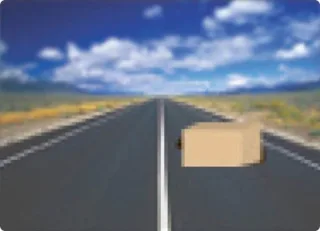
Answer help
1.1. (narrow solid line) — separates traffic flows of opposite directions and marks the boundaries of traffic lanes on roads; marks the boundaries of the carriageway onto which entry is prohibited; marks the boundaries of parking places for vehicles and the edge of the carriageway of roads not classified as motorways by traffic conditions;
Lines 1.1 and 1.3 are prohibited to cross. If line 1.1 marks a parking place or the edge of the carriageway adjacent to the shoulder, this line may be crossed.
As an exception, provided that road safety is ensured, it is allowed to cross line 1.1 to bypass a stationary obstacle whose dimensions do not allow its safe bypass without crossing this line, as well as to overtake single vehicles moving at a speed of less than 30 km/h. -
Question #7 What is the maximum speed allowed for a truck with a permissible maximum mass of no more than 3.5 tons outside populated areas on a road with separate carriageways separated by a dividing strip?
Topic: Speed of movement
Answer help
12.6. Outside built-up areas on all roads and on roads passing through built-up areas marked with sign 5.47, movement is allowed at a speed of:
e) for other vehicles: on a highway marked with road sign 5.1 – no more than 130 km/h, on a highway with separate carriageways, -
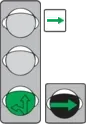
Question #8 Give a full answer: in which directions is movement allowed at this traffic light signal?
Topic: Traffic regulation
Answer help
8.7.3. Traffic light signals have the following meanings:
a) green allows movement;
b) green in the form of an arrow (arrows) on a black background allows movement in the indicated direction (directions). The same meaning has a signal in the form of a green arrow (arrows) in -
Question #9 Under which of the listed conditions is the transportation of organized groups of children by bus or minibus carried out?
Topic: Transportation of passengers
Answer help
21.3. Transportation by bus (minibus) of organized groups of children is carried out provided that mandatory instruction is conducted with children and accompanying persons regarding the rules of safe behavior during movement and actions in the event of emergency situations or a traffic accident. At the same time, in front and behind the bus (minibus), in accordance with the requirements of subparagraph "c" of paragraph 30.3 of these Rules, an identification sign "Children" must be installed.
The driver of a bus (minibus) that transports organized groups of children must have at least 5 years of driving experience and a driver's license of category "D".
21.11. It is prohibited to transport:
d) organized groups of children at night. -
Question #10 Which of the listed actions are prohibited for the driver in accordance with the requirements of the Traffic Rules?
Topic: Warning signals
Answer help
9.8. During the movement of mechanical vehicles in daylight hours, in order to indicate a moving vehicle, low beam headlights must be turned on:
a) in a column;
9.9. Emergency light signaling must be turned on:
b) in case of blinding of the driver by headlights;
12.9. The driver is prohibited from:
d) braking sharply (except when it is impossible to prevent a traffic accident without this). -
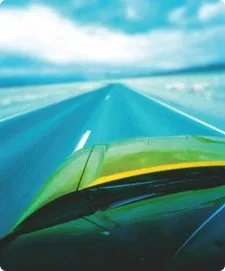
Question #11 On roads where the carriageway is divided into traffic lanes by road marking lines, driving while occupying two lanes simultaneously:
Topic: Position of vehicles on the road
Answer help
11.10. On roads whose carriageway is divided into traffic lanes by road marking lines, it is prohibited to move while occupying two lanes at the same time. It is allowed to run over broken marking lines only during a lane change. -
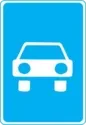
Question #12 At what maximum speed is it allowed for buses (minibuses) transporting organized groups of children to move on road sections marked with this road sign?
Topic: Speed of movement
Answer help
12.6. Outside built-up areas on all roads and on roads passing through built-up areas marked with sign 5.47, movement is allowed at a speed of:
a) buses (minibuses) transporting organized groups of children, passenger cars with a trailer and motorcycles – no more than 80 km/h; -
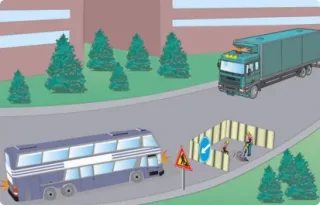
Question #13 What should the bus driver do if there is an obstacle in his lane and a truck road train is moving towards him?
Topic: Distance, interval, oncoming passing
Answer help
13.4. If oncoming passage is difficult, the driver on whose lane there is an obstacle or the dimensions of the vehicle he controls interfere with oncoming traffic,
must yield the right of way. On road sections marked with signs 1.6 "Steep ascent" and 1.7 "Steep descent", in the presence of an obstacle, the driver of the vehicle moving downhill must yield the right of way. -
Question #14 In which of the listed cases is overtaking prohibited on roads with two-way traffic?
Topic: Position of vehicles on the road
Answer help
11.4. On roads with two-way traffic having at least two lanes for movement in one direction, it is prohibited to enter the side of the road intended for oncoming traffic.
11.5. On roads with two or more lanes for movement in one direction, entering the far left lane for movement in the same direction is allowed if the right lanes are occupied, as well as for turning left, making a U-turn, or for stopping or parking on the left side of a road with one-way traffic in built-up areas, if this does not contradict the rules of stopping
(parking).
14.6. Overtaking is prohibited:
e) on roads with two or more lanes for movement in one direction; -
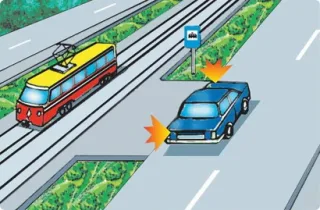
Question #15 Is stopping allowed in this place on the carriageway with one-way traffic?
Topic: Stopping and parking
Answer help
15.3. In built-up areas, stopping and parking of vehicles are allowed on the left side of a road having one lane for movement in each direction (without tram tracks in the middle) and not divided by marking 1.1, as well as on the left side of a road with one-way traffic.
If the road has a boulevard or dividing strip, stopping and parking of vehicles near them is prohibited. -
Question #16 At an intersection of equivalent roads, the driver of a vehicle approaching from the left does not reduce speed. You must:
Topic: Passing intersections
Answer help
16.12. At an intersection of equivalent roads, the driver of a non-rail vehicle must yield to vehicles approaching from the right.
This rule must also be followed by tram drivers among themselves.
At any uncontrolled intersection, a tram, regardless of the direction of its further movement, has priority over non-rail vehicles approaching it on an equivalent road.
9.5. Giving sound signals in built-up areas is prohibited, except when it is impossible to prevent a traffic accident without this. -
Question #17 The driver of a bus, tractor, and truck with a permissible maximum mass of more than 3.5 tons on mountain roads and steep descents must:
Topic: Movement on mountain roads and steep descents

Answer help
28.2. On mountain roads and steep descents, the driver of a truck whose permissible maximum mass exceeds 3.5 t, a tractor, and a bus must:
a) use special mountain brakes if they are installed on the vehicle by the manufacturer; -
Question #18 Which of the listed equipment is used for traffic regulation?
Topic: Traffic regulation
Answer help
8.6. Road equipment is used as an auxiliary means of traffic regulation.
It includes:
d) convex mirrors to expand visibility for drivers of vehicles passing through an intersection or another place with insufficient visibility;
e) devices for forced speed reduction of vehicles;
g) noise strips to increase the attention of road users on dangerous road sections. -
Question #19 In which of the listed cases can fog lights be turned on?
Topic: Use of external lighting devices
Answer help
19.5. Fog lights can be used in conditions of insufficient visibility both separately and with low or high beam headlights, and at night on unlit road sections — only together with low or high beam headlights.
9.8. During the movement of mechanical vehicles in daylight hours, in order to indicate a moving vehicle, low beam headlights must be turned on:
a) in a column;
b) on route vehicles moving on a lane marked with road sign 5.8, towards the general flow of vehicles;
c) on buses (minibuses) transporting organized groups of children;
d) on heavy, large-sized vehicles and vehicles carrying out road transportation of dangerous goods;
e) on the towing vehicle;
f) in tunnels.
In conditions of insufficient visibility on mechanical vehicles, high beam headlights or additionally fog lights can be turned on provided that this does not blind other drivers. -
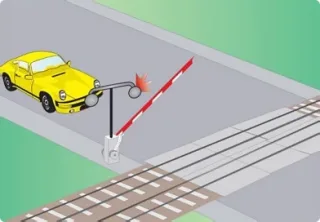
Question #20 What should the driver of a vehicle do if at a railway crossing the prohibiting traffic light signal and sound signal are on, but the barrier has not yet been lowered?
Topic: Movement through railway crossings
Answer help
20.3. To let an approaching train pass and in other cases when movement through a railway crossing is prohibited, the driver must stop before road marking 1.12 (stop line), road sign 2.2, barrier or traffic light so as to see the signals, and if traffic control devices are absent — no closer than 10 m to the nearest rail.
20.5. Movement through the crossing is prohibited if:
b) the barrier is lowered or has begun to lower;
c) a prohibiting traffic light signal or sound signal is on regardless of the presence and position of the barrier;