
Advertising
Practice: ticket #91
Answers are checked instantly. The hint — a rules excerpt — is under the question.
-
Question #1 According to the definition of the Road Traffic Rules, which of these roads can be considered the main one?
Topic: General provisions
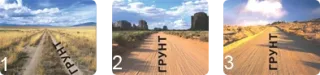
Answer help
main road — a road with a surface relative to an unpaved road or marked with signs 1.22, 1.23.1—1.23.4 and 2.3 The presence of a surface on a secondary road immediately before the intersection does not equate it in importance to the road being crossed; -
Question #2 Is the driver obliged to inform road maintenance organizations or the State Traffic Inspectorate about identified facts of creating obstacles to road traffic?
Topic: Duties and rights of drivers of mechanical vehicles
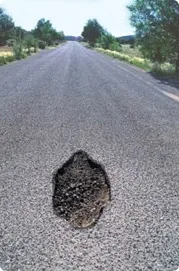
Answer help
2.3. To ensure road safety, the driver is obliged to:
e) report to road maintenance organizations or the State Traffic Inspectorate about identified facts of creating obstacles to road traffic; -
Question #3 What information is contained in this road sign?
Topic: Road signs (Appendix 1)
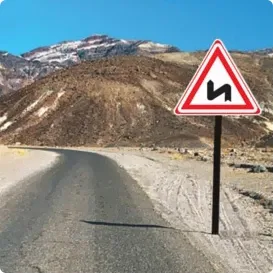
Answer help
1.3.1-1.3.2. "Several turns." A road section with two or more dangerous turns located one after another: 1.3.1 — with the first turn to the right, 1.3.2 — with the first turn to the left. -
Question #4 If this road sign is installed before a section of road, what sign is installed on the opposite side of this section?
Topic: Road signs (Appendix 1)
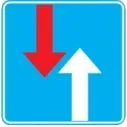
Answer help
2.6. "Advantage over oncoming traffic." A narrow section of road, during movement along which the driver has an advantage over oncoming vehicles. -
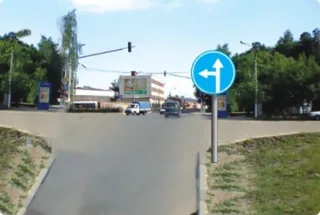
Question #5 Is it allowed to turn right at this intersection?
Topic: Road signs (Appendix 1)
Answer help
4.5. "Move straight or left."
Signs 4.3, 4.5 and 4.6 also allow U-turns of vehicles. The effect of signs 4.1—4.6 does not apply to vehicles moving along established routes.
The effect of signs 4.1—4.6 applies to the intersection of carriageways in front of which they are installed. The effect of sign 4.1, installed at the beginning of the road or after an intersection,
applies to the road section up to the nearest intersection. The sign does not prohibit turning right into courtyards and other territories adjacent to the road. -
Question #6 Are the driver of a moped and his passenger required to wear fastened motorcycle helmets while driving on the road?
Topic: Requirements for drivers of mopeds and bicycles
Answer help
6.1. Riding on the road on mopeds is allowed for persons who have reached 16 years of age, on bicycles — 14 years of age. While moving on the road, the moped driver and the passenger he is carrying must wear fastened motorcycle helmets.
For moped and bicycle drivers, local executive authorities may establish a card in which information about the driver is entered and which moped or bicycle drivers in such a case must have with them. -
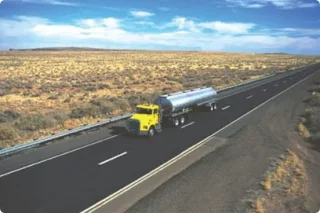
Question #7 This road
Topic: Road markings (Appendix 2)
Answer help
5.5. "Road with one-way traffic." A road or separated carriageway along which vehicle movement across the entire width is carried out in only one direction. -
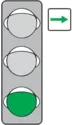
Question #8 Give a full answer: in which directions is movement allowed with this traffic light signal?
Topic: Traffic regulation
Answer help
8.7.3. Traffic light signals have the following meanings:
a) green allows movement;
b) green in the form of an arrow (arrows) on a black background allows movement in the indicated direction (directions). The same meaning has a signal in the form of a green arrow (arrows) in -
Question #9 Is it mandatory to conduct a briefing with children and accompanying persons when transporting organized groups of children by bus (minibus)? Give a full answer.
Topic: Transportation of passengers
Answer help
21.3. Transportation by bus (minibus) of organized groups of children is carried out under the condition of mandatory instruction with children and accompanying persons regarding the rules of safe behavior during movement and actions in the event of emergency situations or a traffic accident. In this case, in front and behind the bus (minibus), in accordance with the requirements of subparagraph "c" of point 30.3 of these Rules, an identification sign "Children" must be installed.
The driver of the bus (minibus) transporting organized groups of children must have at least 5 years of driving experience and a driver's license of category "D". -
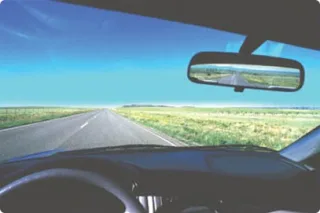
Question #10 Is it allowed for the driver to make a U-turn on this section of the road if, looking in the rearview mirror, he saw that there are no other vehicles behind him?
Topic: Starting movement and changing its direction
Answer help
10.4. Before turning right, left, or making a U-turn, the driver must take in advance the appropriate extreme position on the carriageway intended for movement in this direction, except when turning when entering an intersection where circular traffic is organized, the direction of movement is determined by road signs or road markings, or movement is possible only in one direction established by the configuration of the carriageway, road signs or markings.
A driver making a left turn or U-turn outside an intersection from the corresponding extreme position on the carriageway of this direction must give way to oncoming vehicles, and when performing these maneuvers not from the extreme left position on the carriageway — also to passing vehicles.
If there is a tram track in the middle of the carriageway, the driver of a trackless vehicle making a left turn or U-turn outside an intersection must give way to the tram. -
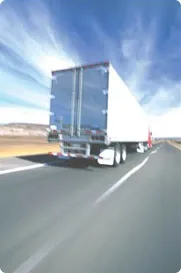
Question #11 The driver of a road train is moving in a straight direction. Did he choose the correct lane for driving?
Topic: Position of vehicles on the road
Answer help
11.2. Trackless vehicles must move as close as possible to the right edge of the carriageway.
11.5. On roads with two or more lanes for movement in one direction, entering the far left lane for movement in the same direction is allowed if the right lanes are occupied, as well as for turning left, making a U-turn, or for stopping or parking on the left side of a road with one-way traffic in built-up areas, if this does not contradict the rules of stopping (parking). -
Question #12 What is the maximum speed allowed for buses (minibuses) transporting organized groups of children on road sections marked with this road sign?
Topic: Speed of movement

Answer help
12.6. Outside built-up areas on all roads and on roads passing through built-up areas marked with sign 5.47, movement is allowed at a speed of:
a) buses (minibuses) transporting organized groups of children, passenger cars with a trailer and motorcycles — no more than 80 km/h; -
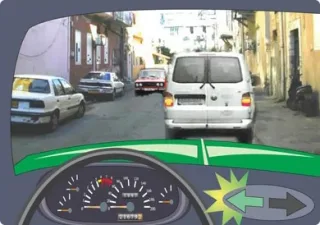
Question #13 The driver of which vehicle must yield the right of way?
Topic: Distance, interval, oncoming passing
Answer help
13.4. If oncoming passing is difficult, the driver on whose lane there is an obstacle or the dimensions of the vehicle he is driving interfere with oncoming traffic,
must give way. On road sections marked with signs 1.6 "Steep ascent" and 1.7 "Steep descent", in the presence of an obstacle, the driver of the vehicle moving downhill must give way. -
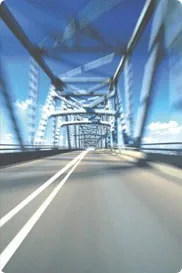
Question #14 Is overtaking a vehicle allowed on this section?
Topic: Overtaking
Answer help
14.6. Overtaking is prohibited:
d) at the end of an ascent, on bridges, overpasses, viaducts, sharp curves, and other road sections with limited visibility or in conditions of insufficient visibility; -
Question #15 What is the maximum speed allowed for a passenger car outside populated areas on a road with separate carriageways separated by a dividing strip?
Topic: Speed of movement
Answer help
12.6. Outside built-up areas on all roads and on roads passing through built-up areas marked with sign 5.47, movement is allowed at a speed of:
e) for other vehicles: on a highway marked with road sign 5.1 – no more than 130 km/h, on a highway with separate carriageways, -
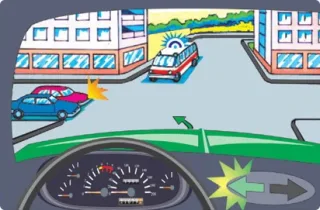
Question #16 The blue car will pass the intersection:
Topic: Passing intersections
Answer help
16.12. At an intersection of equivalent roads, the driver of a non-rail vehicle must yield to vehicles approaching from the right.
This rule must also be followed by tram drivers among themselves.
At any uncontrolled intersection, a tram, regardless of the direction of its further movement, has priority over non-rail vehicles approaching it on an equivalent road.
16.13. Before turning left and making a U-turn, the driver of a non-rail vehicle must yield to a tram traveling in the same direction, as well as to vehicles moving on an equivalent road in the opposite direction straight or to the right.
This rule must also be followed by tram drivers among themselves.
3.2. In the event of approach of a vehicle with a blue flashing beacon and/or special sound signal, drivers of other vehicles that may create an obstacle for its movement must yield the right of way and ensure unobstructed passage of the specified vehicle (and vehicles accompanied by it).
On vehicles moving in an accompanied column, low beam headlights must be turned on.
If on such a vehicle flashing beacons of blue and red or only red are turned on, drivers of other vehicles must stop at the right edge of the carriageway (on the right shoulder). On a road with a dividing strip, this requirement must be fulfilled by drivers of vehicles moving in the same direction. -
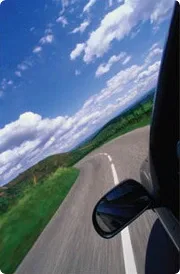
Question #17 The speed on such a turn turned out to be high. What should the driver do to ensure road safety?
Topic: Organization and safety of traffic
-
Question #18 Which of the listed equipment is used for traffic regulation?
Topic: Traffic regulation
Answer help
8.6. Road equipment is used as an auxiliary means of traffic regulation.
It includes:
d) convex mirrors to expand visibility for drivers of vehicles passing through an intersection or another place with insufficient visibility;
e) road marking inserts to improve visual orientation of drivers on the carriageway; -
Question #19 On a road outside a populated area, the maximum speed will be higher:
Topic: Speed of movement
Answer help
12.6. Outside built-up areas on all roads and on roads passing through built-up areas marked with sign 5.47, movement is allowed at a speed of:
e) for other vehicles: on a highway marked with road sign 5.1 – no more than 130 km/h, on a highway with separate carriageways, -
Question #20 Which of the listed actions should the driver approaching a railway crossing perform?
Topic: Overtaking
Answer help
14.6. Overtaking is prohibited:
b) at railway crossings and closer than 100 m before them;
20.2. Approaching a crossing, as well as starting to move after stopping before it, the driver must be guided by the instructions and signals of the crossing attendant, the position of the barrier, light and sound signaling, road signs and road markings, and also make sure that no train (locomotive, railcar) is approaching.